7th ANNUAL Date: 8-9 March 2017 Program Times: 10:30am - 4:00pm - - PowerPoint PPT Presentation

7th annual
SMART_READER_LITE
LIVE PREVIEW

7th ANNUAL Date: 8-9 March 2017 Program Times: 10:30am - 4:00pm - - PowerPoint PPT Presentation

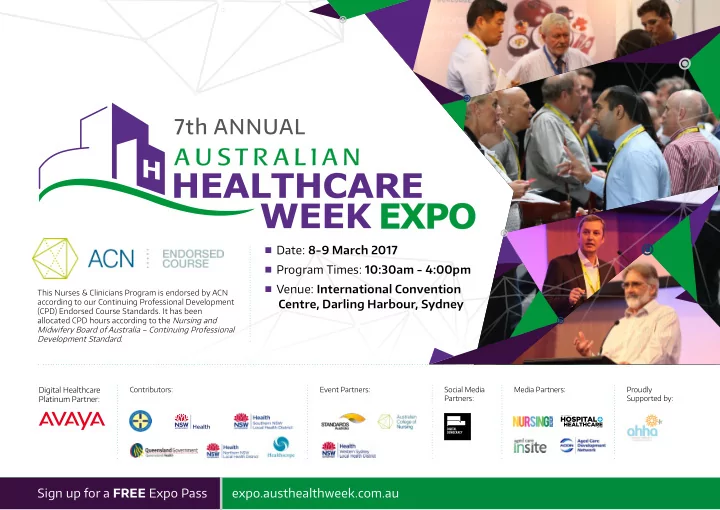
7th ANNUAL Date: 8-9 March 2017 Program Times: 10:30am - 4:00pm Venue: International Convention This Nurses & Clinicians Program is endorsed by ACN Centre, Darling Harbour, Sydney according to our Continuing Professional


slide-1
SLIDE 1

7th ANNUAL

 Date: 8-9 March 2017  Program Times: 10:30am - 4:00pm  Venue: International Convention Centre, Darling Harbour, Sydney

Digital Healthcare Platinum Partner: Social Media Partners: Media Partners: Proudly Supported by: Contributors: Event Partners:

Sign up for a FREE Expo Pass expo.austhealthweek.com.au

This Nurses & Clinicians Program is endorsed by ACN according to our Continuing Professional Development (CPD) Endorsed Course Standards. It has been allocated CPD hours according to the Nursing and Midwifery Board of Australia – Continuing Professional Development Standard.

slide-2
SLIDE 2

Sign up for a FREE Expo Pass expo.austhealthweek.com.au

7th ANNUAL

NURSES & CLINICIANS

 Adjunct Professor Kylie Ward FACN Chief Executive Officer, Australian College

  • f Nursing

 Gary Trytell Deputy CIO, Epworth HealthCare  Louise O’Connor Executive Director, Epworth Eastern  Fiona Hearn Executive General Manager – Care Innovation and Quality, Royal District Nursing Service  Dr Melissa Casey MAPS GAICD Director of Psychology, Monash Health  Angela Ryan FACHI A/Strategy & Design Lead, Office of the CCIO, AAA Interface Project Director, eHealth NSW  Glenn Hokin RN FACN, MAIPM, CPPM MBA, Grad Cert Periop. Nursing, Grad Cert Health Mgt, B.Nurs, Project Manager – Riskman Implementation, Wide Bay HHS, Bundaberg Hospital  Róisín Dunne Director of Strategy, West Moreton Hospital and Health Service  Rob Newell Program lead, MeCare  James Lind Director of Access & Patient Flow, Queensland Health  Adj Assoc Prof Naomi Dobroff RN MPH, MACN, Chief Nursing Information Officer, Monash Health

DISRUPT HEALTHCARE

 Rajesh Vasa Deputy Director, Deakin Software & Technology Innovation Lab, Deakin University  Chris Kommatas Executive Director, LanewayLabs  David Gillatt Professor of Urological Oncology and Robotic Surgery, Director

  • f Medical Services,

Macquarie University Hospital  Nick Abrahams Partner, Norton Rose – Futurist  Mr Paul S D'Urso MBBS PhD FRACS, Neurosurgeon & Executive Chairman, Anatomics  Peter Corke Professor of Robotic Vision, Queensland University of Technology & Director, ARC Centre of Excellence for Robotic Vision  Bruce Coller Chief Information Officer, Sir Moses Montefiore Care  Clara Gaff Executive Director, Melbourne Genomics Health Alliance  Professor John Christodoulou AM MB BS PhD FRACP FFSc (RCPA) FRCPA, Head, Neurodevelopmental Genomics Research Group, Chair of Genomic Medicine, Dept of Paediatrics, University of Melbourne, Murdoch Childrens Research Institute, The Royal Children’s Hospital The healthcare landscape is changing at a rapid pace and we are witnessing unsustainable pressure being placed on an already stretched system and in turn, the workforce. In response to the challenges faced, we are seeing the implementation of various new technologies in an attempt to increase operational efficiency, patient safety and ultimately better care outcomes. This free onsite program has been designed to focus on two aspects of the changing healthcare landscape: Nurses & Clinicians: Explore the challenges faced by nurses and clinicians in the new digital hospital environment, the new technologies that workers on the coalface of healthcare delivery need to be aware of, and the strategies that can be utilised to ensure a smooth transition throughout the design, delivery and operational phases of a digital implementation project. Disrupt Healthcare: Explore the disruptive technologies and medical innovations that are set to revolutionise healthcare delivery in our digitally enabled healthcare system of the future and the new models of care required to respond to the healthcare challenge of 2020 and beyond. Spaces are limited for the on-floor programs, so make sure you reserve your seat when you register for your free expo pass! I look forward to meeting you in March 2017! Doug Power Director Australian Healthcare Week

1 2

ATTEND THIS PROGRAM AND

E A R N C P D H O U R S

Endorsed by the Australian College of Nursing
slide-3
SLIDE 3

Sign up for a FREE Expo Pass expo.austhealthweek.com.au

AGENDA FOR NURSES & CLINICIANS - DAY ONE

10:30 WELCOME ADDRESS FROM THE CHAIR 10:40 Developing and Implementing Nursing Leadership Programs § The role of the nurse leader in today’s health sector § Developing your nursing leaders education program § Combining clinical leadership with business leadership § On-going engagement, reward and career progression strategies Adjunct Professor Kylie Ward FACN Chief Executive Offjcer, Australian College of Nursing 11:20 The Emerging Role of the Chief Nursing Information Offjcer § Understanding the demand for CNIOs in today’s healthcare IT environment § How does the CNIO role difger from other nursing informatics positions? § What are the primary skill sets necessary for this role? § The CNIO role in response to EMR and other technologies that can enhance productivity and improved patient care § Overcoming lack of senior management support on the need for CNIO role – building the business case Adj Assoc Prof Naomi Dobrofg RN MPH, MACN, Chief Nursing Information Offjcer, Monash Health 12:00 Epworth Healthcare – The Patient Centred Culture Journey The Epworth Healthcare vision is - “Consistently delivering excellent patient-centred care with compassion and dignity”. As part of this vision, Epworth have embarked on a major program of work to implement a “Point of Care system” across all hospitals within the Epworth Network. This program is a key component of the ongoing cultural transformation, enabling Epworth to achieve and continue to build on the vision. This session will cover the following key aspects of the program: § The Vision / Epworth Excellence § Point of Care Program Objectives § The Rollout Program – Approach and Structure § Change and Training § Business Benefjts Gary Trytell Deputy CIO, Epworth HealthCare Louise O’Connor Executive Director, Epworth Eastern 12:40 NETWORKING BREAK 14:00 Unleashing the Nascent Potential in Humans to Design and Deliver new Value Transformations in Acute Health Services Culture is ubiquitous and impacts every part of business from strategy to delivery and most certainly innovation and change! What is culture (really) and why does it wield so much power?... remember Peter Druckers famous quote, “Culture eats strategy for breakfast?” § Understanding how humans really change, adapt and innovate in organisations § Adopting a suitable change and design methodology for your transformation efgorts § Why data is “the new oil” – how information is shaping strategy and clarifying drivers for change § Engaging stafg in purpose led design, the proliferations

  • f insights and deciding what to prototype

§ Engaging consumers in co-design; understanding their experiences within the value transformation § Understanding the critical role of data analytics in the measurement of progress and in deciding what designs to invest in at 2 strategic decision points - prototyping and scaling out. Dr Melissa Casey MAPS GAICD Director of Psychology, Monash Health 14:40 How the NSW Electronic Medical Record Supports Nurses’ Real-time Monitoring of Prospective Gaps in Mandatory Risk Assessments eHealth NSW has automated the recording of mandatory risk assessments for adult and paediatric inpatients, including falls, pressure injury and behavioural risks. Compliance is tracked through a dashboard display of real- time completion data at nursing unit and hospital level. § Electronic forms to calculate scores on validated risk assessments; § Automated tasks for completion of forms on admission, transfer and at specifjed intervals; § Automated tasks for patient care and consults based on risk scores calculated; § Dashboard for compliance review and gap identifjcation, linking directly to patient charts with missing assessments; Angela Ryan FACHI A/Strategy & Design Lead, Offjce of the CCIO, AAA Interface Project Director, eHealth NSW 15:20 Capacity at a Glance: Proactive Demand and Capacity Planning for the West Moreton Hospital With a projected 136% population growth at West Moreton Hospital and Health Service (WMHHS) from 2012 to 2036/37 as part of broader strategic programs to manage population boom and consequential impact on the Health Service, the McKesson Demand and Capacity tool has been implemented. While Australians enjoy one of the longest life expectancies in the world, the current model of health service delivery is not focused on improving the long-term health and wellbeing

  • f the population, which has led to increased prevalence
  • f chronic disease and unsustainable growth in fjnancial

investment to manage demand for health care services. WMHHS is not immune to these challenges. The Capacity at a Glance program is designed to provide comprehensive and proactive Demand and Capacity Planning for the hospital and is a process based on: § Understanding patient demand. How many, of what type

  • f patients the hospital is planning to care for, and when?

§ Organising resources (stafg, bed, theatres etc.) to match that demand § Proactively managing and adjusting the plan as required § The program drivers for implementing the program at WMHHS are: § Provide Accountability for demand and capacity management across all areas of the business § Provide Transparency of bed stock to enable efgective demand and capacity management § Provide Predictability in the immediate and long term to support all WMHHS resources being maximised and improve effjciencies in the management of a patient’s journey through West Moreton services. Róisín Dunne Director of Strategy, West Moreton Hospital and Health Service 16:00 END OF DAY 1

slide-4
SLIDE 4

Sign up for a FREE Expo Pass expo.austhealthweek.com.au

§ What needs to be considered form a legal standpoint when implementing an mhealth solution § Ensuing client information security Fiona Hearn Executive General Manager – Care Innovation and Quality, Royal District Nursing Service 14:40 Ensuring Visibility and Capacity Management through the Integration of Efgective Patient Flow Strategies § Providing transparent patient fmow information in real time across your healthcare facility § Improving communication between wards for improved patient care and facility management § Demand management through predictive analytics capability § Ensuring accurate scheduling and patient transfer through access to real time information James Lind Director of Access & Patient Flow, Queensland Health 15:20 CLOSE OF CONFERENCE 10:30 WELCOME FROM THE CHAIR 10:40 Using Data to Standardise High Quality Health Services between like Sized public hospitals § Benchmarking as a way of life § Accessible Datasets to reference § Useful metrics to achieve business/clinical insight § Case Study (this is where we would dig into the data and use the de-identifjed QHealth benchmarking study) Glenn Hokin RN FACN, MAIPM, CPPM MBA, Grad Cert Periop. Nursing, Grad Cert Health Mgt, B.Nurs Project Manager – Riskman Implementation, Wide Bay HHS, Bundaberg Hospital 11:20 Integrating Care: innovations that Support Patients with their Journey through the System Closely aligned with My health, Queensland`s future: Advancing Health 2026 agenda, West Moreton Hospital and Health Service (WMHHS) recognises and values connecting healthcare making the health system work better for consumers, their families and communities by tackling the funding, policy and delivery barriers. This presentation is particularly focused on two innovations that support patients with their journey through the system while also developing and capitalising on evidence and models that work, promoting research and translating it into better practice and care. Health Passport Application – Julian’s Key § Australasian fjrst, the mobile application for consumers needing help to communicate their specifjc care needs to their health care team § Julian’s Key aims to unlock the unknown but ofuen vital information required by health care stafg about patients who have trouble communicating § Julian’s Key makes it easy for patients and their carers to create, update and share their health information and makes it easier for the health care team to access the patient information § Co-designed with patients and their families, the information is patient and/or carer controlled and used to support the provision of care, but not designed to replace the patient’s medical record. It is designed in a clinician-friendly traffjc light format to improve health care stafg access to information about the patient in the absence of clear verbal communication. § The App makes it easy for the patient and or their carer to maintain current information and share their Health Passport with other health care providers such as their GP or community nurse § The App will be available for iOS/Apple and Android phones and tablets Róisín Dunne Director of Strategy, West Moreton Hospital and Health Service Rob Newell. Program lead, MeCare 12:00 Developing a Toolkit to Redesign your Primary Health Facility and Improve Performance Across all Systems § Use of predictive sofuware § Bed confjgurations § Detecting and managing aberrant events § Dashboards development § Governance structures § Special wards eg Medical Assessment Units § Which KPI’s, Does it Work? 12:40 NETWORKING BREAK 14:00 Utilising mHealth and Tablets in the Healthcare Environment to Achieve Improved Patient Care Outcomes § Where do you begin and how do you overcome the many barriers you will face during the deployment phase § Understanding the considerations you need to make when choosing a mHealth device

AGENDA FOR NURSES & CLINICIANS - DAY TWO

slide-5
SLIDE 5

Sign up for a FREE Expo Pass expo.austhealthweek.com.au

10:30 OPENING REMARKS FROM THE CHAIR 10:40 Healthcare 2025: Understanding the Healthcare Technologies and Trends that will Transform Australia’s Healthcare System There are more and more people needing access to healthcare at a time when healthcare facilities are being told to cut costs. This session will explore the digitally enabled healthcare system of the future and the new models of care required to deal with the healthcare challenges of 2025 and beyond. § The healthcare shifu from reactive to preventive § Wellness programs as an integral part of most

  • rganisations

§ Genome medicine – treating illnesses based on your genes to prevent you getting sick in the fjrst place § Consumer driven technology enabled health § The body shop – growing new organs § Digitally enabled coordinated healthcare § Artifjcial intelligence and robots Nick Abrahams Partner, Norton Rose - Futurist 11:20 How the Internet of Things is Transforming Healthcare through Data Capture and Anlytics As the world heads into the age of the Internet of Things, every day devices are reporting data about virtually everything people do. As the internet of things becomes prevalent within the healthcare environment it had become much easier to monitor patients around the clock especially in the age of wearable devices that are designed to automatically measure a wearers vital signs. This session will explore how the IoT is transforming healthcare delivery and discuss how increased access to data will lead to improved health outcomes. § The IoT in healthcare – improved patient care but security remains a concern § Digitizing and streamlining the sharing of health data has the potential for dramatic gains in effjciency and signifjcant cost savings § Managing the risks of the IoT and capturing the benefjts § Flexible patient monitoring § Improved drug management § Challenges to further integration Bruce Coller Chief Information Offjcer, Sir Moses Montefjore Care 12:00 Inside the Future of Robotic Surgery: Understanding the Procedures and Operations that will achievable through Robotic Precision The increasing need for automation in healthcare and growing demand for minimally invasive surgeries are driving the surgical robotic systems and procedures

  • market. In addition, a rise in cases of colorectal cancer,

neurological disorders and gynecological diseases, among

  • thers, will boost the adoption of robotic surgical systems

well adapted for minimally invasive procedures. In this session we will discuss the current use of surgical robotic systems and explore future opportunities for the wider use of robotics in the healthcare environment. § A robot will likely assist in your future surgery! § Understanding current limitations § Based on quality of care – do robots end up paying for themselves? § Future opportunities – will robots ever replace human surgeons? David Gillatt Professor of Urological Oncology and Robotic Surgery, Director of Medical Services, Macquarie University Hospital 12:40 NETWORKING BREAK 14:00 Hospital –Based Accelerator/Incubator Programs: The Successes, Challenges and Current Outputs of Programs like Healthbox and Techstars Health Chris Kommatas Executive Director, LanewayLabs 14:40 Artifjcial Intelligence: A Major catalyst for Change that will Revolutionise Healthcare Delivery and Challenge Ideas on What it Means to be Human A recent analysis of healthcare companies pursuing healthcare applications of AI showed that deals leapt from less than 10 in 2011 to 60 in 2015. “By 2025, AI systems could be involved in everything from population health management, to digital avatars capable

  • f answering specifjc patient queries.” — Harpreet Singh

Buttar, analyst at Frost & Sullivan. With the large amounts of data sourced from Electronic Medical Records, AI systems have the potential to provide clinicians with quality information that can reduce treatment costs, eliminate unnecessary hospital procedures with easier hospital workfmows and provide patient centric treatment plans. This session will explore the current use of AI in healthcare and the potential for improved health outcomes in 2020 and beyond. Rajesh Vasa Deputy Director, Deakin Sofuware & Technology Innovation Lab, Deakin University 15:20 Driving the Integration of Genomics into Clinical Practice

  • n the Melbourne Children’s Campus and Beyond

§ Developing a ‘genomics-literate’ clinical workforce and piloting new models for training medical professionals § New approaches to training will equip clinicians with the necessary skills to integrate genomic technology in to mainstream patient care § Exploring the anticipated challenges to be faced during the training and change management process § Understanding the new operating environment for a genomic literate workforce and the new models of care Clara Gafg Executive Director, Melbourne Genomics Health Alliance 16:00 END OF DAY 1

AGENDA FOR DISRUPT HEALTHCARE - DAY ONE

slide-6
SLIDE 6

Sign up for a FREE Expo Pass expo.austhealthweek.com.au

AGENDA FOR DISRUPT HEALTHCARE - DAY TWO

10:30 WELCOME FROM THE CHAIR 10:40 From Microbots to Medical Tricorders: How do we Overcome the Healthcare Systems Natural Aversion to Change? We are living in an age where disruptive technologies are already in development for many healthcare challenges. A high number of people have access to their genetic data, wearable devices are able to measure vital signs and the precision of surgical robots allow surgeons to carry out intricate and challenging procedures. Exoskeletons allow paralysed people to walk again and AI is improving the approach to accurate medical imaging analysis, yet do we have a healthcare system that is prepared to embrace these disruptive technologies or is it threatened by their increasing level of infmuence and autonomy? This session will explore the steps that need to be taken to embrace disruptive medical technologies in the healthcare environment. Takanori Shibata Ph.D Chief Senior Research Scientist, National Institute of Advanced Industrial Science & Technology Japan 11:20 Preparing Australia for a Genomics Medicine Revolution § A $25 million commitment to support the integration of genomic medicine into healthcare across Australia § Developing a pathway for the seamless integration of genomics into our healthcare system § Exploring the two disease fmagships – rare disease and cancer § Recruiting patients from across the nation who will benefjt from a faster, cheaper and more accurate diagnosis using genomic sequencing § Utilising a patients genomic information to better tailor drug therapy to their individual needs Professor John Christodoulou AM MB BS PhD FRACP FFSc(RCPA) FRCPA, Head, Neurodevelopmental Genomics Research Group, Chair

  • f Genomic Medicine, Dept of Paediatrics, University of

Melbourne, Murdoch Childrens Research Institute, The Royal Children’s Hospital 12:00 How Will Robots Help Run Australia’s Hospitals of the Future? A hospital fully run by robots is of course a long way ofg, but there are many examples of innovative robotics already in use across the healthcare environment. This session will explore the current use of robotics in healthcare and the numerous projects that are taking place to develop the next generation of artifjcially intelligent robots. § Health and safety – disinfectant robots in healthcare § The origami robot – controlled by a technician patching up wounds in the patients stomach § Microbots – delivering medication exactly to where it is needed or repairing damaged cells § Companion robots- treating mental illness, alleviating loneliness and providing assistive care Peter Corke Professor of Robotic Vision, Queensland University of Technology & Director, ARC Centre of Excellence for Robotic Vision 12:40 NETWORKING BREAK 14:00 Community Based Personalised Healthcare § A neurosurgeons bone factory § The fjrst child to benefjt from BioModel Simulation and planning § 3D printing is globally disruptive - 3D printing in a range

  • f materials

§ Understanding community based personalised healthcare § The future Mr Paul S D’Urso MBBS PhD FRACS, Neurosurgeon & Executive Chairman, Anatomics 14:40 Closing Panel Session: Understanding the Innovative Technologies that will enable the Health Consumer of 2020 and Beyond to Control their Own Health The health consumer of 2020 will be better informed about the state of their health, treatment options and will be taking a more preventative approach to increase their control of their own health. We are already wearing FitBit devices that measure quantifjable data, but what does the future hold for wearables and self diagnosis? § Digestible and wearable sensors that can work like a thin e-skin § Radio frequency radio chips that can be implanted under the skin to serve as an identifjcation device § Sensors that measure your vital signs and are able to call an ambulance when you are sufgering a medical emergency § Medical tricorders that can diagnose any disease and give consumers more choice in their own health Takanori Shibata Ph.D Chief Senior Research Scientist, National Institute of Advanced Industrial Science & Technology Japan Rajesh Vasa Deputy Director, Deakin Sofuware & Technology Innovation Lab, Deakin University Chris Kommatas Executive Director, LanewayLabs 15:20 CLOSE OF CONFERENCE