7 Consistency projector Definition (Initial trajectory problem (ITP)) - - PDF document

7 consistency projector
SMART_READER_LITE
LIVE PREVIEW

7 Consistency projector Definition (Initial trajectory problem (ITP)) - - PDF document

Minicourse DAEs, SNU, October 2014: Lecture 3 Version: 17. Oktober 2014 If you have any questions concerning this material (in particular, specific pointers to literature), please dont hesitate to contact me via email:


slide-1
SLIDE 1

Minicourse DAEs, SNU, October 2014: Lecture 3

Version: 17. Oktober 2014

If you have any questions concerning this material (in particular, specific pointers to literature), please don’t hesitate to contact me via email: trenn@mathematik.uni-kl.de

7 Consistency projector

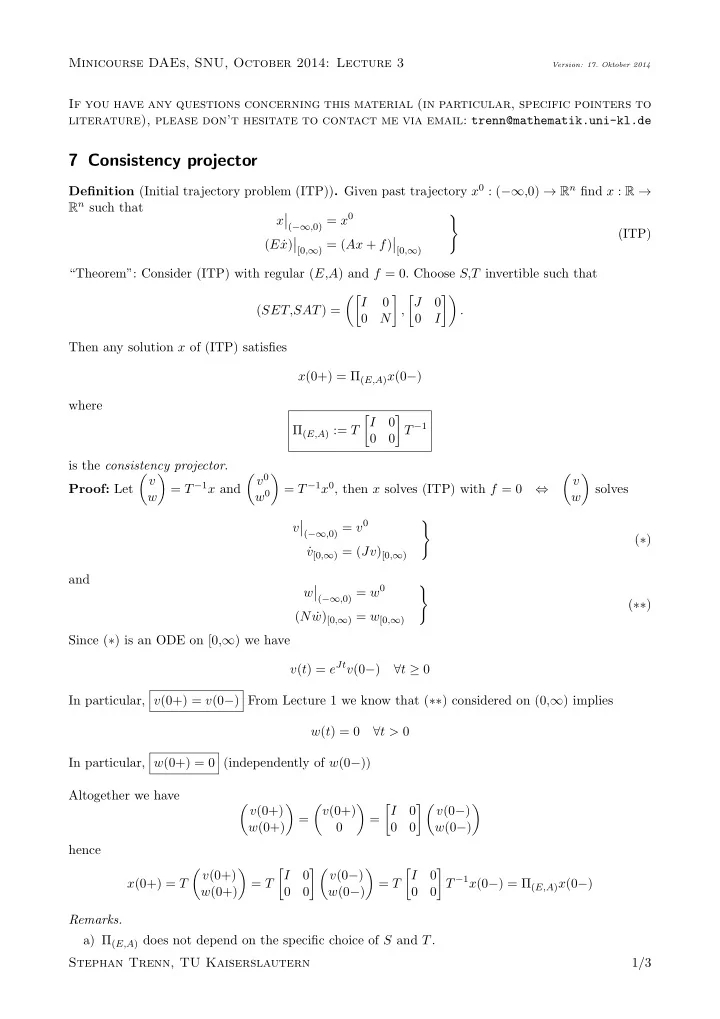
Definition (Initial trajectory problem (ITP)). Given past trajectory x0 : (−∞,0) → Rn find x : R → Rn such that x

  • (−∞,0) = x0

(E ˙ x)

  • [0,∞) = (Ax + f)
  • [0,∞)
  • (ITP)

“Theorem”: Consider (ITP) with regular (E,A) and f = 0. Choose S,T invertible such that (SET,SAT) = I N

  • ,

J I

  • .

Then any solution x of (ITP) satisfies x(0+) = Π(E,A)x(0−) where Π(E,A) := T I

  • T −1

is the consistency projector. Proof: Let v w

  • = T −1x and

v0 w0

  • = T −1x0, then x solves (ITP) with f = 0

⇔ v w

  • solves

v

  • (−∞,0) = v0

˙ v[0,∞) = (Jv)[0,∞)

  • (∗)

and w

  • (−∞,0) = w0

(N ˙ w)[0,∞) = w[0,∞)

  • (∗∗)

Since (∗) is an ODE on [0,∞) we have v(t) = eJtv(0−) ∀t ≥ 0 In particular, v(0+) = v(0−) From Lecture 1 we know that (∗∗) considered on (0,∞) implies w(t) = 0 ∀t > 0 In particular, w(0+) = 0 (independently of w(0−)) Altogether we have v(0+) w(0+)

  • =

v(0+)

  • =

I v(0−) w(0−)

  • hence

x(0+) = T v(0+) w(0+)

  • = T

I v(0−) w(0−)

  • = T

I

  • T −1x(0−) = Π(E,A)x(0−)

Remarks. a) Π(E,A) does not depend on the specific choice of S and T. Stephan Trenn, TU Kaiserslautern 1/3

slide-2
SLIDE 2

Minicourse DAEs, SNU, October 2014: Lecture 3

Version: 17. Oktober 2014

b) At this point we haven’t actually shown that (ITP) has a solution!

  • Theorem. Let (E,A) be regular. In the correct distributional solution space the ITP has a unique

solution for all f. In particular, jumps and Dirac impulses at initial time are uniquely determined. Attention: Choosing the right solution space is crucial and not immediately clear! Here: Solution space = Space of piecewise-smooth distributions DpwC∞

8 Switched DAEs: Definition

Recall example from Lecture 2: u L v i Switch → Different DAE models (=modes) depending on time-varying position of switch Switching signal σ : R → {1, . . . ,N} picks mode number σ(t) at each time t ∈ R: Eσ(t) ˙ x(t) = Aσ(t)x(t) + Bσ(t)u(t) y(t) = Cσ(t)x(t) + Dσ(t)u(t) (swDAE) Each mode might have different consistency spaces ⇒ inconsistent initial values at each switch ⇒ distributional solutions, i.e. x ∈ Dn

pwC∞

  • Corollary. Let

Σ0 :=

  • σ : R → {1, . . . ,N}
  • σ is piecewise constant and σ
  • (−∞,0) is constant
  • .

Consider (swDAE) with regular (Ep,Ap) ∀p ∈ {1, . . . ,N}. Then ∀u ∈ Dn

pwC∞ ∀σ ∈ Σ0 ∃ solution x ∈ DpwC∞

and x(0−) uniquely determines x.

9 Impulse-freeness of switched DAEs

Question: When are all solutions of homogenous (swDAE) Eσ ˙ x = Aσx impulse free? (jumps are OK) Lemma (Sufficient conditions).

  • (Ep,Ap) all have index one (i.e. Np = 0 in QWF)

⇒ (swDAE) impulse free Stephan Trenn, TU Kaiserslautern 2/3

slide-3
SLIDE 3

Minicourse DAEs, SNU, October 2014: Lecture 3

Version: 17. Oktober 2014

  • all consistency spaces of (Ep,Ap) coincide (i.e. Wong limits V∗

p are identical)

⇒ (swDAE) impulse free Proof:

  • Index-1-case: Consider nilpotent DAE-ITP:

(N ˙ w)[0,∞) = w[0,∞) ⇒ 0 = w[0,∞) ⇒ w[0] := w[0,0] = 0 Hence an inconsistent initial value does not induce Dirac-impulse

  • Same consistency space for all modes

⇒ no inconsistent initial values at switch ⇒ no jumps and no Dirac-impulse

  • Theorem. The switched DAE Eσ ˙

x = Aσx is impulse free ∀σ ∈ Σ0 ⇔ Eq(I − Πq)Πp = 0 ∀p,q ∈ {1, . . . ,N} where Πp := Π(Ep,Ap), p ∈ {1, . . . ,N} is the consistency projector. Remarks. a) Index 1 ⇔ Ep(I − Πp) = 0 ∀p b) Consistency spaces equal ⇔ (I − Πq)Πp = 0 ∀p,q

10 Stability of switched DAEs

Examples. a) E1 = 1

  • , A1 =

1 −1 −1

  • E2 =

1 1

  • , A1 =

−1 −1

  • x1

x2 non-switched x1 x2 switched → jumps destabilize b) (E1,A1) as above, E2 = 1

  • , A1 =

−1 −1

  • non-switched behavior exactly the same as above, but switched behavior now stable:

x1 x2 Stephan Trenn, TU Kaiserslautern 3/3