7/27/2018 Introducing a Peptide enhanced bone graft with a unique - - PDF document

7 27 2018
SMART_READER_LITE
LIVE PREVIEW

7/27/2018 Introducing a Peptide enhanced bone graft with a unique - - PDF document

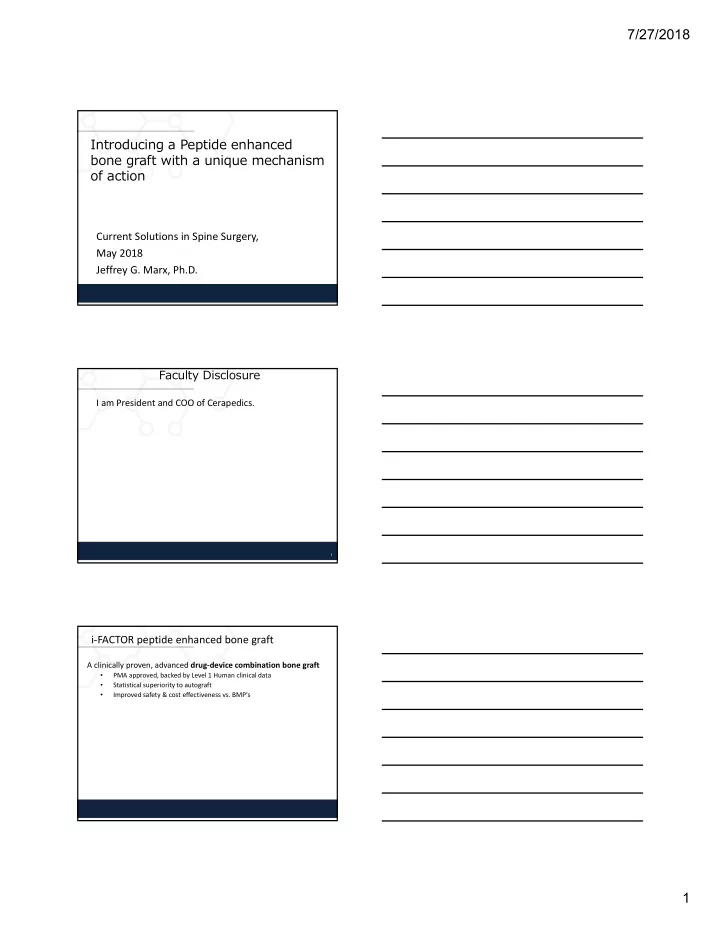
7/27/2018 Introducing a Peptide enhanced bone graft with a unique mechanism of action Current Solutions in Spine Surgery, May 2018 Jeffrey G. Marx, Ph.D. CONFIDENTIAL 0 Faculty Disclosure I am President and COO of Cerapedics. CONFIDENTIAL


slide-1
SLIDE 1

7/27/2018 1

CONFIDENTIAL

Introducing a Peptide enhanced bone graft with a unique mechanism

  • f action

Current Solutions in Spine Surgery, May 2018 Jeffrey G. Marx, Ph.D. CONFIDENTIAL Faculty Disclosure

I am President and COO of Cerapedics.

1

CONFIDENTIAL i-FACTOR peptide enhanced bone graft

A clinically proven, advanced drug-device combination bone graft

  • PMA approved, backed by Level 1 Human clinical data
  • Statistical superiority to autograft
  • Improved safety & cost effectiveness vs. BMP’s
slide-2
SLIDE 2

7/27/2018 2

CONFIDENTIAL

3

Synthetic Collagen Fragment (P-15)

  • Synthetic peptide of a 15 Amino Acid sequence from type 1 Collagen
  • Functional domain of collagen responsible for the attachment of cells

CONFIDENTIAL i-FACTOR™ Peptide Enhanced Bone Graft

Mechanism of Action:

“Attract - Attach - Activate”

ABM Osteogenic Cell P-15

  • Osteogenic cells in the surrounding

tissues have an affinity for and are naturally attracted to P-15

  • Osteogenic cells attached via

cellular surface receptors to the P-15

  • Osteogenic cells are naturally

attachment activated

P-15 has been shown to enhance bone formation by facilitating cellular attraction and attachment which activates natural signaling, creating a micro-environment conducive to new bone formation

CONFIDENTIAL Mechanism of Action

  • i-FACTOR attracts osteogenic

precursor cells by making an abundance of P-15 binding sites available for cellular adhesion

  • Cell binding between P-15

integrins activates natural mechanical and chemical signalling pathways within the cell stimulating the release of specific growth factors, cytokines and Bone Morphogenic Proteins (BMPs)

  • The cascade of events leads to cell

proliferation and natural bone healing ATTRACT ATTACH ACTIVATE

slide-3
SLIDE 3

7/27/2018 3

CONFIDENTIAL

ATTRACT

CONFIDENTIAL

ABM / P-15 ABM Alone

P15 bound to ABM increases the number of bound human fibroblasts and stimulates cellular activation and spreading.

Enhances Cell Attraction & Attachment

Qian JJ., Bhatnager RS., JBMR (1996) 31:545

CONFIDENTIAL

ATTACH

slide-4
SLIDE 4

7/27/2018 4

CONFIDENTIAL Proven to Enhance Cell Proliferation

Lui Q., Lemthongkul W., et. al. Journal of Orthopedic Research (2012) 10:1526

P15 bound to surface increases the number of bound pre-

  • steoblastic cells and stimulates cellular activity

CONFIDENTIAL Cell Attachment & Activation

P15 bound to surface increases the number of bound pre-

  • steoblastic cells and stimulates cellular activation and

spreading

20 40 60 80 100 15 30 60 5000 10000 15000 20000 25000 15 30 60 Number of cell bound Time (min) Time (min)

  • Uncoated surface
  • P15-coated surface

Area (pixels2)

Lui Q. et. al. Journal of Orthopedic Research (2012) 10:1526

* * * * * *

*p<0.05

*p<0.05

CONFIDENTIAL

ACTIVATE

slide-5
SLIDE 5

7/27/2018 5

CONFIDENTIAL Cell Activation: Gene Expression

1 2 3 4 5 1 5 10 Expression of Alkaline Phosphatase mRNA Relative Expression of ALP Time (days) Histochemical Staining for Alkaline Phosphatase

ABM P15/ABM

* * * *p<0.05

  • ABM only
  • P15-coated ABM

P15 bound to ABM stimulates upregulation of Alkaline Phosphatase at the gene expression and protein synthesis levels

Yang XB., Rajendra S. et. al. Tissue Engineering (2004) 10:1148 *p<0.05

CONFIDENTIAL Cell Activation: Gene Expression

1 2 3 1 5 10

P15 bound to ABM stimulates upregulation of BMP-2 at the gene level and

  • nset of calcification

Relative Expression of BMP-2 Time (days) Expression of BMP-2 mRNA Histochemical Staining for Alizarin Red

ABM P15/ABM

* *

*p<0.05

  • ABM only
  • P15-coated ABM

Yang XB., Rajendra S. et. al. Tissue Engineering (2004) 10:1148

*p<0.05

CONFIDENTIAL

  • CE Mark / TGA approved since 2008
  • Putty & Strip form factors
  • No special handling requirements
  • Over 25,000 cases performed
  • Multiple studies / peer-reviewed (PLIF, ALIF)
  • i-FACTOR Putty: U.S. PMA approval Nov’15

i-FACTOR Bone Graft: Clinical Track Record

slide-6
SLIDE 6

7/27/2018 6

CONFIDENTIAL i-FACTOR Cervical Study - FDA IDE Trial

Single-level Anterior Cervical Discectomy & Fusion (ACDF) Allograft ring with anterior plate 319 patients enrolled at 24 clinical sites in US and Canada 1:1 randomization i-FACTOR P-15 Putty versus Autograft Primary: Efficacy (Fusion, NDI, Neurological Outcomes) and Safety (Complications) at 12 months. Non-inferiority statistical plan. Secondary: Pain, Kyphosis, SF-36, Modified Odom’s Criteria 18, 24, 36, 48 and 60 months Procedure Patients Study arms Endpoints Extended study Follow-Up

CONFIDENTIAL Overall Success Outcomes CONFIDENTIAL Overview

  • In Level-I IDE study, i-FACTOR demonstrated superior to autograft

in overall clinical success

  • Accelerates & enhances bone growth
  • Only second PMA approved drug-device combination product in

$2.5B U.S. Spine market, and first & only bone graft approved for U.S. Cervical Spine

  • > 40,000 procedures with multiple Peer-reviewed publications
  • Very positive clinician response and rapid commercial uptake
  • Preparing to initiate IDE trial in TLIF with next-generation version
  • f the product
slide-7
SLIDE 7

7/27/2018 7

CONFIDENTIAL

Thank You!

18

CONFIDENTIAL

  • Increases the number of cells available – Bhatnagar et al, Design of Biomimetic Habitats for Tissue Engineering

with P-15…………., Tissue Engineering, Vol 5, Number 1, 1999

  • Leads to cell differentiation – Qian & Bhatnagar, Enhanced Cell Attachment to anorganic bone……., J of

Biomedical Materials Research, Vol. 31, 1996

  • Produces increases in BMP2 and ALP – Yang, Bhatnagar, et al., Biomimetic Collagen Scaffolds for Human Bone

Cell Growth and Differentiation, Tissue Engineering, Vol. 10, 2004

  • Early bone laid down (& increased ALP, BMP2 and BMP7) – Thorwarth, et al, Bioactivation of anorganic bone

Matrix by P-15 peptide for promotion of early bone formation, Biomaterials, Vol. 26, 2005

  • Enhances cell viability (& increased cells on surface) – Hanks and Atkinson, Comparison of cell viability on aBM

with or without P-15 cell binding peptide, Biomaterials, Vol. 25, 2004

Mechanism of Action Evidence