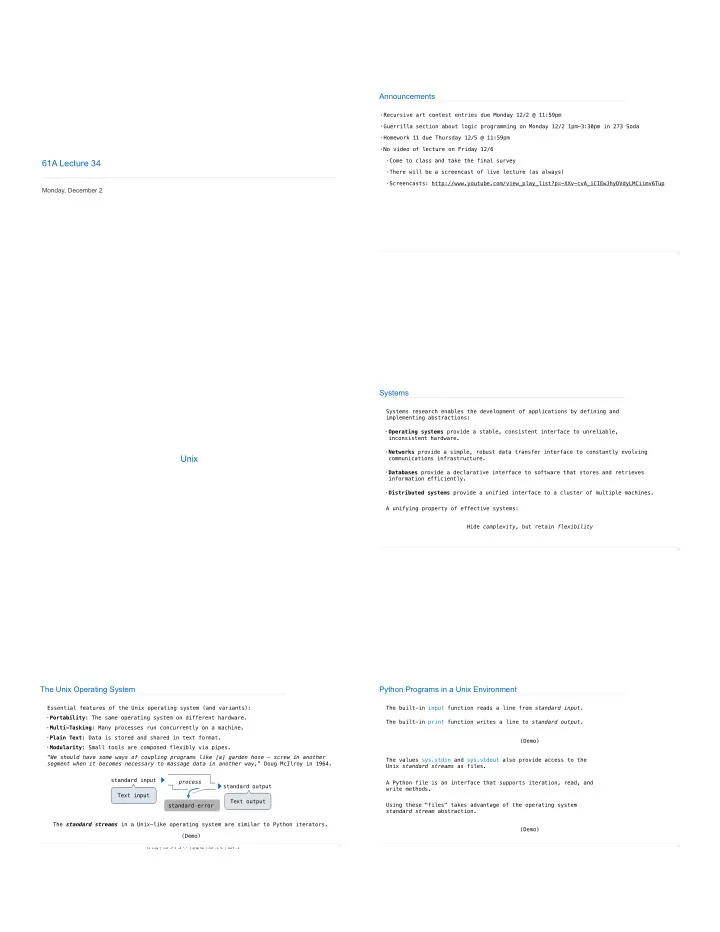
61A Lecture 34 ! There will be a screencast of live lecture (as - - PDF document

61a lecture 34
SMART_READER_LITE
LIVE PREVIEW

61A Lecture 34 ! There will be a screencast of live lecture (as - - PDF document

Announcements Recursive art contest entries due Monday 12/2 @ 11:59pm Guerrilla section about logic programming on Monday 12/2 1pm-3:30pm in 273 Soda Homework 11 due Thursday 12/5 @ 11:59pm No video of lecture on Friday 12/6 ! Come


slide-1
SLIDE 1

61A Lecture 34

Monday, December 2

Announcements

  • Recursive art contest entries due Monday 12/2 @ 11:59pm
  • Guerrilla section about logic programming on Monday 12/2 1pm-3:30pm in 273 Soda
  • Homework 11 due Thursday 12/5 @ 11:59pm
  • No video of lecture on Friday 12/6

!Come to class and take the final survey !There will be a screencast of live lecture (as always) !Screencasts: http://www.youtube.com/view_play_list?p=-XXv-cvA_iCIEwJhyDVdyLMCiimv6Tup

2

Unix

Systems

Systems research enables the development of applications by defining and implementing abstractions:

  • Operating systems provide a stable, consistent interface to unreliable,

inconsistent hardware.

  • Networks provide a simple, robust data transfer interface to constantly evolving

communications infrastructure.

  • Databases provide a declarative interface to software that stores and retrieves

information efficiently.

  • Distributed systems provide a unified interface to a cluster of multiple machines.

A unifying property of effective systems:

4

Hide complexity, but retain flexibility

The Unix Operating System

Essential features of the Unix operating system (and variants):

  • Portability: The same operating system on different hardware.
  • Multi-Tasking: Many processes run concurrently on a machine.
  • Plain Text: Data is stored and shared in text format.
  • Modularity: Small tools are composed flexibly via pipes.

“We should have some ways of coupling programs like [a] garden hose – screw in another segment when it becomes necessary to massage data in another way,” Doug McIlroy in 1964. The standard streams in a Unix-like operating system are similar to Python iterators.

5

standard input standard output process standard error Text input Text output (Demo)

ls *.py | cut -f 1 -d '.' | grep hw | cut -c 3- | sort -n

Python Programs in a Unix Environment

The built-in input function reads a line from standard input. The built-in print function writes a line to standard output. (Demo) The values sys.stdin and sys.stdout also provide access to the Unix standard streams as files. A Python file is an interface that supports iteration, read, and write methods. Using these "files" takes advantage of the operating system standard stream abstraction. (Demo)

6
slide-2
SLIDE 2

MapReduce

Big Data Processing

MapReduce is a framework for batch processing of Big Data.

  • Framework: A system used by programmers to build applications.
  • Batch processing: All the data is available at the outset, and results aren't

used until processing completes.

  • Big Data: Used to describe data sets so large that they can reveal new facts

about the world, usually from statistical analysis. The MapReduce idea:

  • Data sets are too big to be analyzed by one machine.
  • Using multiple machines has the same complications, regardless of the

application.

  • Pure functions enable an abstraction barrier between data processing logic

and coordinating a distributed application. (Demo)

8

MapReduce Evaluation Model

Map phase: Apply a mapper function to inputs, emitting intermediate key-value pairs.

  • The mapper takes an iterator over inputs, such as text lines.
  • The mapper yields zero or more key-value pairs per input.

Reduce phase: For each intermediate key, apply a reducer function to accumulate all values associated with that key.

  • The reducer takes an iterator over key-value pairs.
  • All pairs with a given key are consecutive.
  • The reducer yields 0 or more values, each associated with that intermediate key.

mapper Google MapReduce Is a Big Data framework For batch processing

  • : 2

a: 1 u: 1 e: 3 i: 1 a: 4 e: 1

  • : 1

a: 1

  • : 2

e: 1 i: 1

9

reducer e: 5 reducer a: 6

MapReduce Evaluation Model

mapper Google MapReduce Is a Big Data framework For batch processing

  • : 2

a: 1 u: 1 e: 3 i: 1 a: 4 e: 1

  • : 1

a: 1

  • : 2

e: 1 i: 1 a: 4 a: 1 a: 1 e: 1 e: 3 e: 1 ... i: 2

  • : 5

u: 1 Reduce phase: For each intermediate key, apply a reducer function to accumulate all values associated with that key.

  • The reducer takes an iterator over key-value pairs.
  • All pairs with a given key are consecutive.
  • The reducer yields 0 or more values, each associated with that intermediate key.
10

MapReduce Execution Model

Execution Model

http://research.google.com/archive/mapreduce-osdi04-slides/index-auto-0007.html 12
slide-3
SLIDE 3

Parallel Execution Implementation

http://research.google.com/archive/mapreduce-osdi04-slides/index-auto-0008.html

A "task" is a Unix process running on a machine Map phase Reduce phase Shuffle

13

MapReduce Assumptions

Constraints on the mapper and reducer:

  • The mapper must be equivalent to applying a deterministic pure function

to each input independently.

  • The reducer must be equivalent to applying a deterministic pure function

to the sequence of values for each key. Benefits of functional programming:

  • When a program contains only pure functions, call expressions can be

evaluated in any order, lazily, and in parallel.

  • Referential transparency: a call expression can be replaced by its value

(or vis versa) without changing the program. In MapReduce, these functional programming ideas allow:

  • Consistent results, however computation is partitioned.
  • Re-computation and caching of results, as needed.
14

Map phase Reduce phase Shuffle

MapReduce Applications

Python Example of a MapReduce Application

The mapper and reducer are both self-contained Python programs.

  • Read from standard input and write to standard output!

#!/usr/bin/env python3 import sys from mr import emit for line in sys.stdin: emit_vowels(line) def emit_vowels(line): for vowel in 'aeiou': count = line.count(vowel) if count > 0: emit(vowel, count) Mapper The emit function outputs a key and value as a line of text to standard output Mapper inputs are lines of text provided to standard input Tell Unix: This is Python 3 code

16

Python Example of a MapReduce Application

The mapper and reducer are both self-contained Python programs.

  • Read from standard input and write to standard output!

#!/usr/bin/env python3 import sys from mr import emit, values_by_key Reducer for key, value_iterator in values_by_key(sys.stdin): emit(key, sum(value_iterator)) Takes and returns iterators Input: lines of text representing key-value pairs, grouped by key Output: Iterator over (key, value_iterator) pairs that give all values for each key

17

MapReduce Benefits

slide-4
SLIDE 4

What Does the MapReduce Framework Provide

Fault tolerance: A machine or hard drive might crash.

  • The MapReduce framework automatically re-runs failed tasks.

Speed: Some machine might be slow because it's overloaded.

  • The framework can run multiple copies of a task and keep the result of the one that

finishes first. Network locality: Data transfer is expensive.

  • The framework tries to schedule map tasks on the machines that hold the data to be

processed. Monitoring: Will my job finish before dinner?!?

  • The framework provides a web-based interface describing jobs.

(Demo)

19