61A Lecture 16 Friday, October 11 2 Terminology: Attributes, - - PDF document

61a lecture 16
SMART_READER_LITE
LIVE PREVIEW

61A Lecture 16 Friday, October 11 2 Terminology: Attributes, - - PDF document

Announcements Homework 5 is due Tuesday 10/15 @ 11:59pm Project 3 is due Thursday 10/24 @ 11:59pm Midterm 2 is on Monday 10/28 7pm-9pm 61A Lecture 16 Friday, October 11 2 Terminology: Attributes, Functions, and Methods All objects


slide-1
SLIDE 1

61A Lecture 16

Friday, October 11

Announcements

  • Homework 5 is due Tuesday 10/15 @ 11:59pm
  • Project 3 is due Thursday 10/24 @ 11:59pm
  • Midterm 2 is on Monday 10/28 7pm-9pm
2

Attributes

Class Attributes Functions

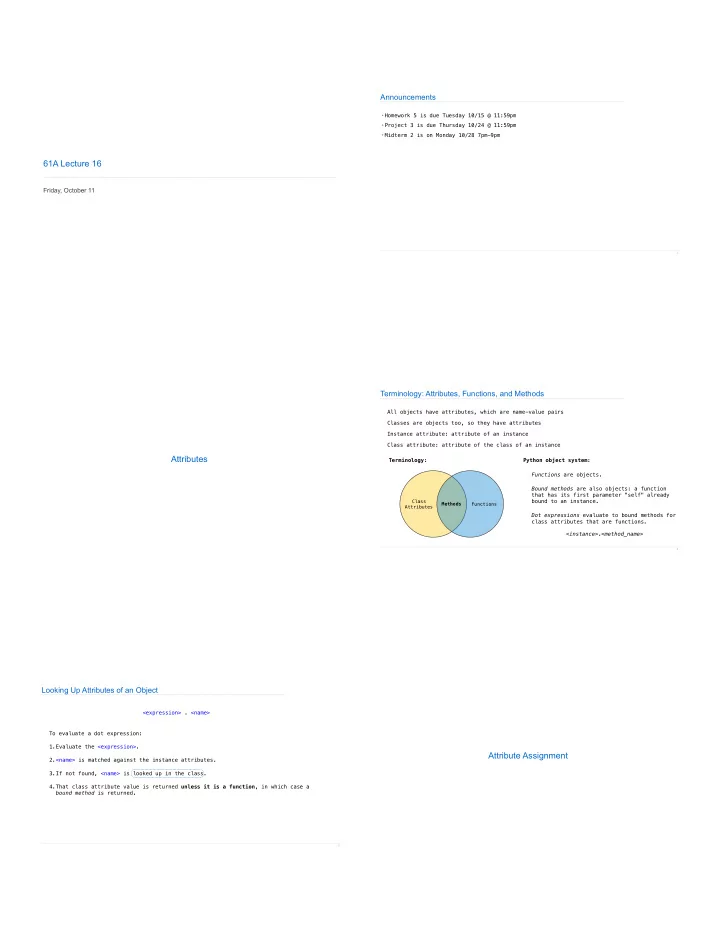
Terminology: Attributes, Functions, and Methods

All objects have attributes, which are name-value pairs Classes are objects too, so they have attributes Instance attribute: attribute of an instance Class attribute: attribute of the class of an instance

Methods

Functions are objects. Bound methods are also objects: a function that has its first parameter "self" already bound to an instance. Dot expressions evaluate to bound methods for class attributes that are functions. Terminology: Python object system:

4

<instance>.<method_name>

Looking Up Attributes of an Object

<expression> . <name> To evaluate a dot expression: 1.Evaluate the <expression>. 2.<name> is matched against the instance attributes. 3.If not found, <name> is looked up in the class. 4.That class attribute value is returned unless it is a function, in which case a bound method is returned.

5

Attribute Assignment

slide-2
SLIDE 2

Assignment to Attributes

Assignment statements with a dot expression on their left-hand side affect attributes for the object of that dot expression

  • If the object is an instance, then assignment sets an instance attribute
  • If the object is a class, then assignment sets a class attribute

tom_account.interest = 0.08 But the name (“interest”) is not looked up Attribute assignment statement adds or modifies the attribute named “interest” of tom_account Instance Attribute Assignment : Account.interest = 0.04 Class Attribute Assignment : This expression evaluates to an

  • bject
7

Attribute Assignment Statements

>>> jim_account = Account('Jim') >>> tom_account = Account('Tom') >>> tom_account.interest 0.02 >>> jim_account.interest 0.02 >>> tom_account.interest 0.02 >>> Account.interest = 0.04 >>> tom_account.interest 0.04 >>> jim_account.interest = 0.08 >>> jim_account.interest 0.08 >>> tom_account.interest 0.04 >>> Account.interest = 0.05 >>> tom_account.interest 0.05 >>> jim_account.interest 0.08 interest: 0.02 (withdraw, deposit, __init__) balance: 0 holder: 'Jim' balance: 0 holder: 'Tom' Account class attributes 0.04 interest: 0.08 0.05

8

Instance attributes of jim_account Instance attributes of tom_account

Inheritance

Inheritance

Inheritance is a method for relating classes together. A common use: Two similar classes differ in their degree of specialization. The specialized class may have the same attributes as the general class, along with some special-case behavior. class <name>(<base class>): <suite> Conceptually, the new subclass "shares" attributes with its base class. The subclass may override certain inherited attributes. Using inheritance, we implement a subclass by specifying its differences from the the base class.

10

Inheritance Example

A CheckingAccount is a specialized type of Account. >>> ch = CheckingAccount('Tom') >>> ch.interest # Lower interest rate for checking accounts 0.01 >>> ch.deposit(20) # Deposits are the same 20 >>> ch.withdraw(5) # Withdrawals incur a $1 fee 14 Most behavior is shared with the base class Account class CheckingAccount(Account): """A bank account that charges for withdrawals.""" withdraw_fee = 1 interest = 0.01 def withdraw(self, amount): return Account.withdraw(self, amount + self.withdraw_fee)

11

Looking Up Attribute Names on Classes

To look up a name in a class.

  • 1. If it names an attribute in the class, return the attribute value.
  • 2. Otherwise, look up the name in the base class, if there is one.

>>> ch = CheckingAccount('Tom') # Calls Account.__init__ >>> ch.interest # Found in CheckingAccount 0.01 >>> ch.deposit(20) # Found in Account 20 >>> ch.withdraw(5) # Found in CheckingAccount 14 Base class attributes aren't copied into subclasses!

12

(Demo)
slide-3
SLIDE 3

Object-Oriented Design

Designing for Inheritance

Don't repeat yourself; use existing implementations. Attributes that have been overridden are still accessible via class objects. Look up attributes on instances whenever possible. class CheckingAccount(Account): """A bank account that charges for withdrawals.""" withdraw_fee = 1 interest = 0.01 def withdraw(self, amount): return Account.withdraw(self, amount + self.withdraw_fee) Attribute look-up

  • n base class

Preferred to CheckingAccount.withdraw_fee to allow for specialized accounts

14

Inheritance and Composition

Object-oriented programming shines when we adopt the metaphor. Inheritance is best for representing is-a relationships. E.g., a checking account is a specific type of account. So, CheckingAccount inherits from Account. Composition is best for representing has-a relationships. E.g., a bank has a collection of bank accounts it manages. So, A bank has a list of accounts as an attribute.

15

(Demo)

Multiple Inheritance

Multiple Inheritance

class SavingsAccount(Account): deposit_fee = 2 def deposit(self, amount): return Account.deposit(self, amount - self.deposit_fee) class AsSeenOnTVAccount(CheckingAccount, SavingsAccount): def __init__(self, account_holder): self.holder = account_holder self.balance = 1 # A free dollar! A class may inherit from multiple base classes in Python. CleverBank marketing executive wants:

  • Low interest rate of 1%
  • A $1 fee for withdrawals
  • A $2 fee for deposits
  • A free dollar when you open your account
17

Multiple Inheritance

A class may inherit from multiple base classes in Python. class AsSeenOnTVAccount(CheckingAccount, SavingsAccount): def __init__(self, account_holder): self.holder = account_holder self.balance = 1 # A free dollar! >>> such_a_deal = AsSeenOnTVAccount("John") >>> such_a_deal.balance 1 >>> such_a_deal.deposit(20) 19 >>> such_a_deal.withdraw(5) 13 Instance attribute SavingsAccount method CheckingAccount method

18
slide-4
SLIDE 4

Resolving Ambiguous Class Attribute Names

Account CheckingAccount SavingsAccount AsSeenOnTVAccount

19

>>> such_a_deal = AsSeenOnTVAccount("John") >>> such_a_deal.balance 1 >>> such_a_deal.deposit(20) 19 >>> such_a_deal.withdraw(5) 13 Instance attribute SavingsAccount method CheckingAccount method

Complicated Inheritance

Biological Inheritance

21

Grandma Grandpa Gramammy Grandaddy Aunt Double Quadruple Mom Dad You Half some_guy Double Half Uncle Half Cousin some_other_guy Double

Moral of the story: Inheritance can be complicated, so don't overuse it!