61A Lecture 13 Guerrilla Section 2 this Saturday 10/5 & Sunday - - PDF document

61a lecture 13
SMART_READER_LITE
LIVE PREVIEW

61A Lecture 13 Guerrilla Section 2 this Saturday 10/5 & Sunday - - PDF document

Announcements Homework 3 deadline extended to Wednesday 10/2 @ 11:59pm. Optional Hog strategy contest due Thursday 10/3 @ 11:59pm. Homework 4 due Tuesday 10/8 @ 11:59pm. Project 2 due Thursday 10/10 @ 11:59pm. 61A Lecture 13


slide-1
SLIDE 1

61A Lecture 13

Wednesday, October 2

Announcements

  • Homework 3 deadline extended to Wednesday 10/2 @ 11:59pm.
  • Optional Hog strategy contest due Thursday 10/3 @ 11:59pm.
  • Homework 4 due Tuesday 10/8 @ 11:59pm.
  • Project 2 due Thursday 10/10 @ 11:59pm.
  • Guerrilla Section 2 this Saturday 10/5 & Sunday 10/6 10am-1pm in Soda.
  • Topics: Data abstraction, sequences, and non-local assignment.
  • Please RSVP on Piazza!
  • Guest lecture on Wednesday 10/9, Peter Norvig on Natural Language Processing in Python.

2

Strings

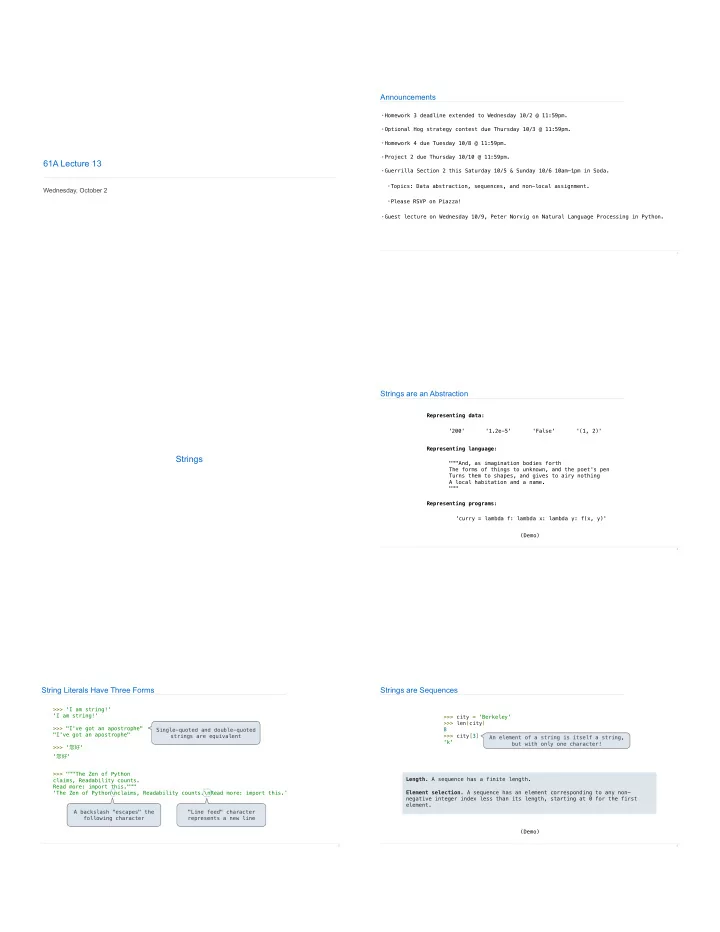
Strings are an Abstraction

Representing data: '200' '1.2e-5' 'False' '(1, 2)' Representing language: """And, as imagination bodies forth The forms of things to unknown, and the poet's pen Turns them to shapes, and gives to airy nothing A local habitation and a name. """ Representing programs: 'curry = lambda f: lambda x: lambda y: f(x, y)' (Demo)

4

String Literals Have Three Forms

>>> 'I am string!' 'I am string!' >>> "I've got an apostrophe" "I've got an apostrophe" >>> '您好' '您好' >>> """The Zen of Python claims, Readability counts. Read more: import this.""" 'The Zen of Python\nclaims, Readability counts.\nRead more: import this.' "Line feed" character represents a new line A backslash "escapes" the following character Single-quoted and double-quoted strings are equivalent

5

Strings are Sequences

>>> city = 'Berkeley' >>> len(city) 8 >>> city[3] 'k'

  • Length. A sequence has a finite length.

Element selection. A sequence has an element corresponding to any non- negative integer index less than its length, starting at 0 for the first element. An element of a string is itself a string, but with only one character!

6

(Demo)

slide-2
SLIDE 2

String Membership Differs from Other Sequence Types

The "in" and "not in" operators match substrings >>> 'here' in "Where's Waldo?" True >>> 234 in (1, 2, 3, 4, 5) False >>> 'Mississippi'.count('i') 4 >>> 'Mississippi'.count('issi') 1 The count method also matches substrings the number of non-overlapping

  • ccurrences of a

substring Why? Working with strings, we usually care about words more than characters

7

Encoding Strings

Representing Strings: the ASCII Standard

American Standard Code for Information Interchange 8 rows: 3 bits 16 columns: 4 bits

  • Layout was chosen to support sorting by character code
  • Rows indexed 2-5 are a useful 6-bit (64 element) subset
  • Control characters were designed for transmission

"Line feed" (\n) "Bell" (\a)

9

(Demo)

Representing Strings: the Unicode Standard

http://ian-albert.com/unicode_chart/unichart-chinese.jpg

  • 109,000 characters
  • 93 scripts (organized)
  • Enumeration of character properties,

such as case

  • Supports bidirectional display order
  • A canonical name for every character

U+0058 LATIN CAPITAL LETTER X U+263a WHITE SMILING FACE U+2639 WHITE FROWNING FACE

'☺' '☹'

10

(Demo)

Representing Strings: UTF-8 Encoding

UTF (UCS (Universal Character Set) Transformation Format) Unicode: Correspondence between characters and integers UTF-8: Correspondence between those integers and bytes A byte is 8 bits and can encode any integer 0-255. Variable-length encoding: integers vary in the number of bytes required to encode them. 00000000 00000001 1 00000011 3 00000010 2 bytes integers In Python: string length is measured in characters, bytes length in bytes.

11

(Demo)

Sequence Processing

slide-3
SLIDE 3

Consider two problems:

  • Sum the even members of the first n Fibonacci numbers.
  • List the letters in the acronym for a name, which includes the first letter of each

capitalized word.

Sequence Processing

0, 1, 1, 2, 3, 5, 8, 13, 21, 34, 55. 1, 2, 3, 4, 5, 6, 7, 8, 9, 10, 11. 0, 2, 8, 34, . enumerate naturals: map fib: filter even: accumulate sum: ., ., ., ., =44

13

Sequence Processing

Consider two problems:

  • Sum the even members of the first n Fibonacci numbers.
  • List the letters in the acronym for a name, which includes the first letter of each

capitalized word.

'University', 'of', 'California', 'Berkeley'

enumerate words: filter capitalized: map first: accumulate tuple:

'University', 'California', 'Berkeley' 'U', 'C', 'B' ( 'U', 'C', 'B' )

14

Mapping a Function over a Sequence

>>> alternates = (-1, 2, -3, 4, -5) >>> tuple(map(abs, alternates)) (1, 2, 3, 4, 5) Apply a function to each element of the sequence The returned value of map is an iterable map object A constructor for the built-in map type The returned value of filter is an iterable filter object

15

(Demo)

Iteration and Accumulation

Iterable Values and Accumulation

Iterable objects give access to their elements in order. Similar to a sequence, but does not always allow element selection or have finite length. Many built-in functions take iterable objects as argument. tuple Return a tuple containing the elements sum Return the sum of the elements min Return the minimum of the elements max Return the maximum of the elements For statements also operate on iterable values.

17

Reducing a Sequence

Reduce is a higher-order generalization of max, min, & sum. >>> from operator import mul >>> from functools import reduce >>> reduce(mul, (1, 2, 3, 4, 5)) 120 Similar to accumulate from Homework 2, but with iterable objects. First argument: A two-argument function Second argument: an iterable object

18

slide-4
SLIDE 4

Generator Expressions

(<map exp> for <name> in <iter exp> if <filter exp>) One large expression that evaluates to an iterable object Short version: (<map exp> for <name> in <iter exp>)

  • Evaluates to an iterable object.
  • <iter exp> is evaluated when the generator expression is evaluated.
  • Remaining expressions are evaluated when elements are accessed.

19

(Demo)