61A Lecture 11 Second withdrawal 50 Different of the same amount - - PDF document

61a lecture 11
SMART_READER_LITE
LIVE PREVIEW

61A Lecture 11 Second withdrawal 50 Different of the same amount - - PDF document

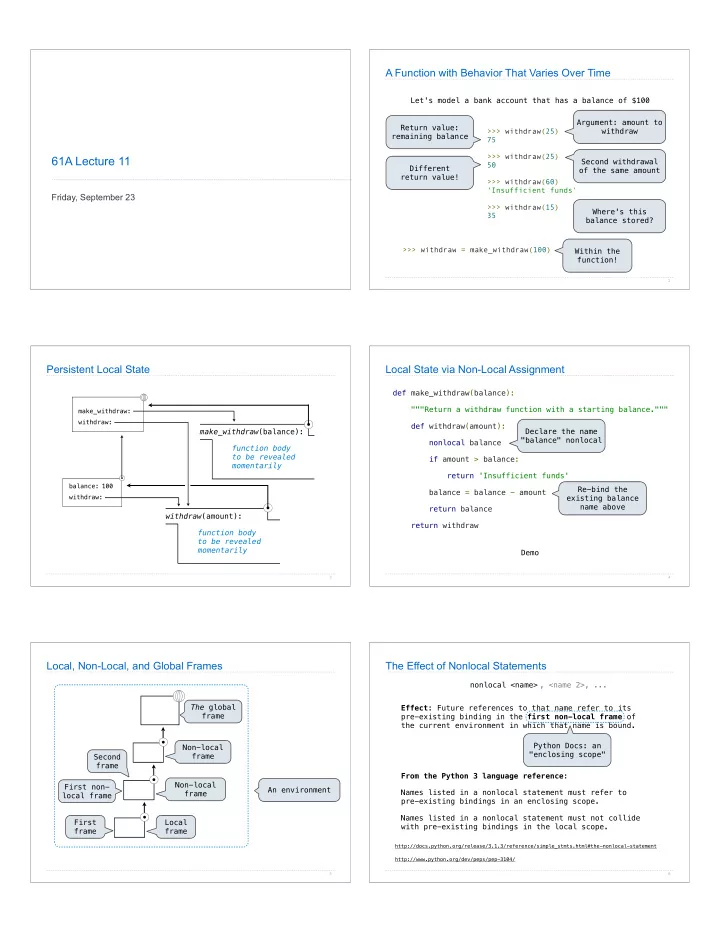
A Function with Behavior That Varies Over Time Let's model a bank account that has a balance of $100 Argument: amount to Return value: >>> withdraw(25) withdraw remaining balance 75 >>> withdraw(25) 61A Lecture 11 Second


slide-1
SLIDE 1

61A Lecture 11

Friday, September 23

A Function with Behavior That Varies Over Time

2

>>> withdraw(25) 75 >>> withdraw(25) 50 >>> withdraw(60) 'Insufficient funds' >>> withdraw(15) 35 >>> withdraw = make_withdraw(100) Let's model a bank account that has a balance of $100 Argument: amount to withdraw Second withdrawal

  • f the same amount

Return value: remaining balance Different return value! Where's this balance stored? Within the function!

Persistent Local State

3

withdraw(amount): function body to be revealed momentarily

balance: 100 withdraw: make_withdraw: withdraw:

make_withdraw(balance): function body to be revealed momentarily

Local State via Non-Local Assignment

4

def make_withdraw(balance): """Return a withdraw function with a starting balance.""" def withdraw(amount): nonlocal balance if amount > balance: return 'Insufficient funds' balance = balance - amount return balance return withdraw Declare the name "balance" nonlocal Re-bind the existing balance name above Demo

Local, Non-Local, and Global Frames

5

Non-local frame The global frame Non-local frame An environment Local frame First frame Second frame First non- local frame

The Effect of Nonlocal Statements

6

http://www.python.org/dev/peps/pep-3104/

From the Python 3 language reference: Names listed in a nonlocal statement must refer to pre-existing bindings in an enclosing scope. Names listed in a nonlocal statement must not collide with pre-existing bindings in the local scope.

http://docs.python.org/release/3.1.3/reference/simple_stmts.html#the-nonlocal-statement

Effect: Future references to that name refer to its pre-existing binding in the first non-local frame of the current environment in which that name is bound. nonlocal <name> , <name 2>, ... Python Docs: an "enclosing scope"

slide-2
SLIDE 2

The Many Meanings of Assignment Statements

7

x = 2 Status Effect

  • No nonlocal statement
  • "x" is not bound locally

Create a new binding from name "x" to object 2 in the first frame of the current environment.

  • No nonlocal statement
  • "x" is bound locally

Re-bind name "x" to object 2 in the first frame of the current env.

  • nonlocal x
  • "x" is bound locally

SyntaxError: name 'x' is parameter and nonlocal

  • nonlocal x
  • "x" is not bound in

a non-local frame SyntaxError: no binding for nonlocal 'x' found

  • nonlocal x
  • "x" is bound in a

non-local frame Re-binds "x" to 2 in the first non-local frame of the current environment in which that name is already bound.

turtle mutant

mutant(y) y, x = y+1, y+2 return ninja(y)/2 ninja(y)

Assignment Review: Teenage Mutant Ninja Turtles

8

def mutant(y): y, x = y+1, y+2 return ninja(y)/2 def ninja(x): return x + 2 def turtle(x): return x * y + 2 y, ninja = 5, turtle mutant(y) y: 5 ninja: turtle: mutant: return x * y + 2 x: 6

32 16

x: 7 6 mutant(y): y, x = y+1, y+2 return ninja(y)/2 ninja(x): return x + 2 turtle(x) return x * y + 2 y: 5

Assignment Review: Teenage Mutant Ninja Turtles

9

def mutant(y): y, x = y+1, y+2 return ninja(y)/2 def ninja(x): return x + 2 def turtle(x): return x * y + 2 y, ninja = 5, turtle mutant(y)

  • Bind mutant, ninja, and turtle to their respective functions
  • Simultaneously: bind y to 5 and ninja to the turtle function
  • Apply the mutant function to 5
  • In the first frame, bind y to 6 and x to 7
  • Look up ninja, which is bound to the turtle function
  • Look up y, which is bound to 6
  • Apply the turtle function to 6
  • Look up x, which is bound to 6

in the local frame

  • Look up y, which is bound to 5

in the global frame

  • Return 32
  • Return half the result: 16

Intrinsic function name

make_withdraw

make_withdraw: withdraw(amount): ... balance:

make_withdraw

withdraw: wd: wd(5) 20

Environment Diagram of Withdraw

10

15 wd = make_withdraw(20) wd(5) 15 nonlocal balance if amount > balance: return 'Insufficient funds' balance = balance - amount return balance amount: 5

withdraw

balance:

Calling a Withdraw Function Twice

11

make_withdraw

make_withdraw: wd = make_withdraw(20) wd(5) wd(3) amount: 5

withdraw

wd(5) 12 nonlocal balance if amount > balance: return 'Insufficient funds' balance = balance - amount return balance amount: 3

withdraw

withdraw(amount): ... balance:

make_withdraw

withdraw: wd: 15 12 balance:

Creating Two Different Withdraw Functions

12

withdraw(amount):

make_withdraw

make_withdraw: balance:

make_withdraw

12 withdraw: wd: wd = make_withdraw(20) wd(5) wd(3) wd2 = make_withdraw(7) wd2(6) make_withdraw(7) def withdraw(amount): ... return withdraw wd2: balance: 7

make_withdraw

withdraw(amount): withdraw:

slide-3
SLIDE 3

Creating Two Different Withdraw Functions

13

withdraw(amount):

make_withdraw

make_withdraw: balance:

make_withdraw

12 withdraw: wd: wd = make_withdraw(20) wd(5) wd(3) wd2 = make_withdraw(7) wd2(6) wd2: withdraw(amount): balance:

make_withdraw

7 withdraw: wd2(6) 1 amount: 6

withdraw

1 nonlocal balance if amount > balance: return 'Insufficient funds' balance = balance - amount return balance balance:

The Benefit of Non-Local Assignment

  • Ability to maintain some state that is local to a function,

but evolves over successive calls to that function.

  • The binding for balance in the first non-local frame of the

environment associated with an instance of withdraw is inaccessible to the rest of the program.

  • An abstraction of a bank account that manages its own

internal state.

14

John's Account $10 Steven's Account $1,000,000

Multiple References to a Single Withdraw Function

15

withdraw(amount):

make_withdraw

make_withdraw: balance:

make_withdraw

withdraw: wd: wd = make_withdraw(12) wd2 = wd wd2(1) wd(1) wd2: amount: 1

withdraw

11 12 wd2(1) nonlocal balance if amount > balance: return 'Insufficient funds' balance = balance - amount return balance 11

Multiple References to a Single Withdraw Function

16

withdraw(amount):

make_withdraw

make_withdraw: balance:

make_withdraw

10 withdraw: wd: wd = make_withdraw(12) wd2 = wd wd2(1) wd(1) wd2: amount: 1

withdraw

amount: 1

withdraw

11 12 wd(1) nonlocal balance if amount > balance: return 'Insufficient funds' balance = balance - amount return balance 10

Sameness and Change

  • So long as we never modify data objects, we can regard a compound
  • bject to be precisely the totality of its pieces.
  • A rational number is determined by its numerator and denominator.
  • This view is no longer valid in the presence of change.
  • Now, a compound data object has an "identity" that is something

more than the pieces of which it is composed.

  • A bank account is still "the same" bank account even if we change

the balance by making a withdrawal.

  • Conversely, we could have two bank accounts that happen to have the

same balance, but are different objects.

17

John's Account $10 Steven's Account $10

Referential Transparency, Lost

  • An expression is referentially transparent if its value does

not change when we substitute one of its subexpression with the value of that subexpression.

18

  • Re-binding operations violate the condition of referential

transparency because they do more than return a value; they change the environment.

  • Two separately defined functions are not the same, because

changes to one may not be reflected in the other. mul(add(2, mul(4, 6)), add(3, 5)) mul(add(2, 24 ), add(3, 5)) mul( 26 , add(3, 5))