
6/30/14 1
MINISTRY OF AGRICULTURE AND WATER RESOURCES OF UZBEKISTAN SCIENTIFIC RESEARCH INSTITUTE OF SELECTION, SEED- GROWING AND AGRO-TECHNOLOGY OF COTTON PLANT CULTIVATION EFFICIENCY OF SELECTING ON THE BASIS OF MOLECULAR MARKERS FOR THE PURPOSE OF G.HIRSUTUM L.COTTON GRADES CREATION KIM ROBERT GRIGOREVICH The academician
- f Russian Academy of Natural sciences
and International Academy of Informatization
Recently more and more attention is given to application of molecular markers in selection processes (marker assisted selection) for increase of selection processes efficiency of necessary genotypes
- f plants. Molecular markers are used widely by selectors of the
USA, the European Union, Australia, Japan, China, Russia and other
- countries. According to - Dubcovsky (2004), the program «MAS
wheat» operating in the USA, in 2004 covered about 430 projects directed on transfer of 43 genes in 75 parental forms of wheat. Therefore introduction of molecular markers in the traditional - scheme of selection demands an implementation of preliminary researches on their efficiency studying at selection and development
- f individual technique for the concrete selection program. On the
basis of this method we defined genotypic stability to natural virulent populations of Verticillium fungi, and also their homogeneity on morpho-biological signs and presence of markers on early maturation.
However, it is necessary to notice that molecular markers should possess certain properties and to meet certain requirements:
- High level of polymorphism;
- Co-dominant character of inheritance;
- Occurrence of optimum level in genome for specific tasks solution;
- Uniform distribution in genome on chromosomes;
- Selectively neutral behaviour;
- Easy estimation of markers parameters;
- Possibility of automation of markers parameters estimation;
- High reproducibility of markers parameters estimation.
Any fragments of DNA used for revealing of polymorphism can serve as molecular markers. In practice the experimenter, as a rule, deals not with a gene-marker, he deals with its phenotypic display – well expressed, discrete, i.e. a qualitative sign. The latter can be considered as the factor of identification of a gene corresponding to it, i.e. as a gene marker, and also the genes linked to it. The reliable marker is a protein sign, as protein is a primary product of a gene (V.G.Konarev, 1974, 1983; A.A.Sozinov, 1982; S.Yunuskhanov, A.Ibragimov, 1988; R.Abidov, 2001).
In this connection the researches on fastening of transgressive forms of plants with a complex of useful signs (earliness, stability to more virulent populations of verticilliose and vascular wilt, productivity, homogeneity, a high output and quality of a fiber, stability to adverse conditions of environment) on the basis of various methods of crossing (repeated, sating, stepped, complex) and selection methods (pedigree, mass, periodic, stabilizing) have been conducted, and also on the basis of molecular markers to define degree of genetic homogeneity on morpho-biological signs at families on earliness and wilt-resistance.
As initial material For experience conducting served the families, lines and complex back-cross hybrids F4, bred in biological nursery (30 families), the 1- st year selection nursery (20 lines) and the 2-nd years selection nursery (13 families). Experimental procedure. Selection of adaptive genotypes was conducted on technology developed by Professor R.Shadmanov in laboratory of applied biochemistry of plants of the Institute of Genetics and Experimental Plant Biology.
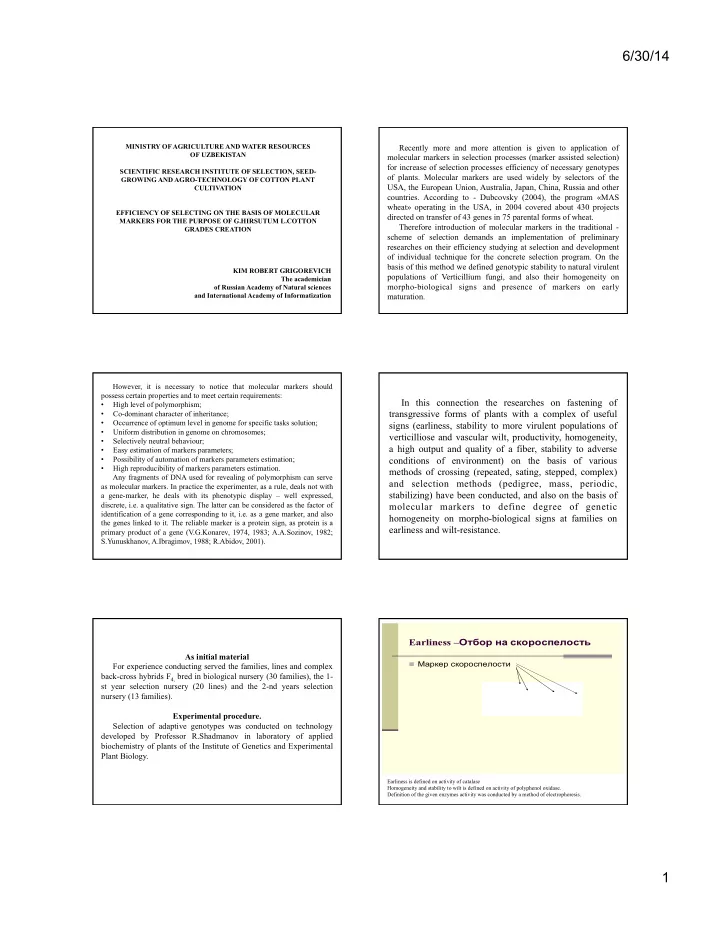
Earliness –Отбор на скороспелость
n Маркер скороспелости
Earliness is defined on activity of catalase Homogeneity and stability to wilt is defined on activity of polyphenol oxidase. Definition of the given enzymes activity was conducted by a method of electrophoresis.