SLIDE 1
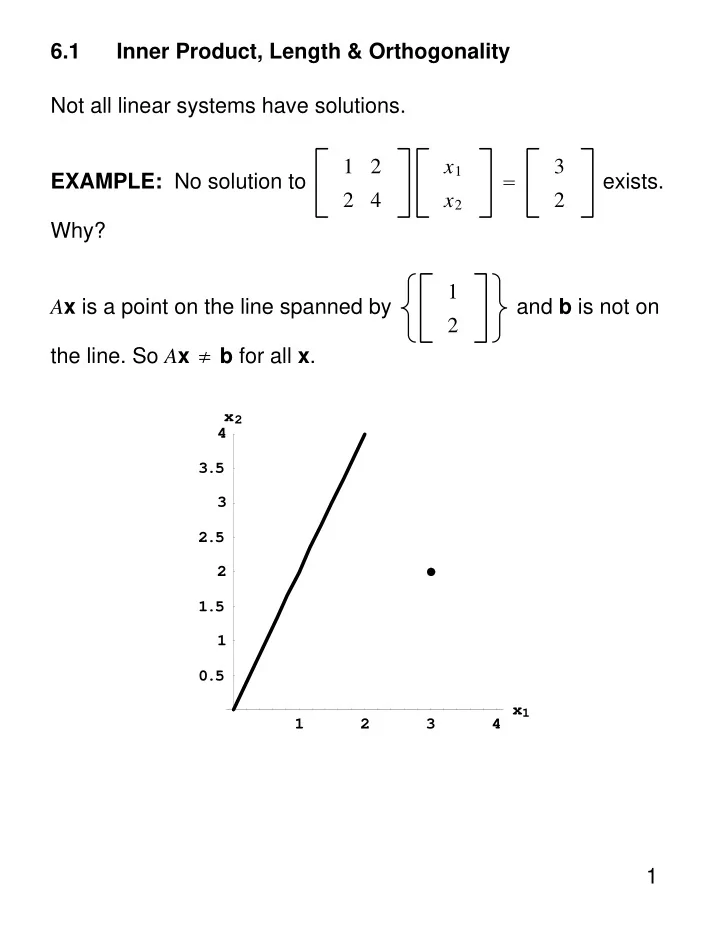
6.1 Inner Product, Length & Orthogonality Not all linear systems have solutions. EXAMPLE: No solution to 1 2 2 4 x1 x2 = 3 2 exists. Why? Ax is a point on the line spanned by 1 2 and b is not on the line. So Ax ≠ b for all x.
1 2 3 4 x1 0.5 1 1.5 2 2.5 3 3.5 4 x2
1
SLIDE 2 Instead find x so that A x lies ”closest” to b.
1 2 3 4 x1 0.5 1 1.5 2 2.5 3 3.5 4 x2
Using information we will learn in this chapter, we will find that x= 1.4 , so that A x =
. Segment joining A x and b is perpendicular (or orthogonal) to the set of solutions to Ax = b. Need to develop fundamental ideas of length, orthogonality and
2
SLIDE 3
The Inner Product Inner product or dot product of u = u1 u2 ⋮ un and v = v1 v2 ⋮ vn : u ⋅ v = uTv = u1 u2 ⋯ un v1 v2 ⋮ vn = u1v1 + u2v2 + ⋯ + unvn Note that v ⋅ u =v1u1 + v2u2 + ⋯ + vnun = u1v1 + u2v2 + ⋯ + unvn = u ⋅ v 3
SLIDE 4 THEOREM 1 Let u,v and w be vectors in Rn, and let c be any scalar. Then
- a. u ⋅ v = v ⋅ u
- b. u + v ⋅ w = u ⋅ w + v ⋅ w
- c. cu ⋅ v =cu ⋅ v= u ⋅ cv
- d. u ⋅ u ≥ 0, and u ⋅ u = 0 if and only if u = 0.
Combining parts b and c, one can show c1u1 + ⋯ + cpup ⋅ w =c1u1 ⋅ w + ⋯ + cpup ⋅ w 4
SLIDE 5
Length of a Vector For v = v1 v2 ⋮ vn , the length or norm of v is the nonnegative scalar ‖v‖ defined by ‖v‖ = v ⋅ v = v1
2 + v2 2 + ⋯ + vn 2
and ‖v‖2 = v ⋅ v. For example, if v = a b , then ‖v‖ = a2 + b2 (distance between 0 and v) Picture: For any scalar c, ‖cv‖ = |c|‖v‖ 5
SLIDE 6
Distance in Rn The distance between u and v in Rn: distu,v = ‖u − v‖. This agrees with the usual formulas for R2 and R3. Let u =u1,u2 and v =v1,v2. Then u − v =u1 − v1,u2 − v2 and distu,v = ‖u − v‖ = ‖u1 − v1,u2 − v2‖ = u1 − v12 + u2 − v22 6
SLIDE 7
Orthogonal Vectors distu,v2 = ‖u − v‖2 = u − v ⋅ u − v = u ⋅ u − v + −v ⋅ u − v = = u ⋅ u − u ⋅ v + −v ⋅ u + v ⋅ v =‖u‖2 + ‖v‖2 − 2u ⋅ v ⇒ distu,v2 = ‖u‖2 + ‖v‖2 − 2u ⋅ v Similarly, distu,−v2 = ‖u‖2 + ‖v‖2 + 2u ⋅ v 7
SLIDE 8
Since distu,−v2 = distu,v2, u ⋅ v = ___. Two vectors u and v are said to be orthogonal (to each other) if u ⋅ v = 0. Also note that if u and v are orthogonal, then ‖u + v‖ = ‖u‖2 + ‖v‖2. THEOREM 2 THE PYTHAGOREAN THEOREM Two vectors u and v are orthogonal if and only if ‖u + v‖ = ‖u‖2 + ‖v‖2. 8
SLIDE 9
Orthogonal Complements If a vector z is orthogonal to every vector in a subspace W of Rn, then z is said to be orthogonal to W. The set of vectors z that are orthogonal to W is called the orthogonal complement of W and is denoted by W⊥ (read as “W perp”). 9
SLIDE 10 Row, Null and Columns Spaces THEOREM 3 Let A be an m × n matrix. Then the orthogonal complement
- f the row space of A is the nullspace of A, and the
- rthogonal complement of the column space of A is the
nullspace of AT: Row A
⊥ =Nul A,
Col A
⊥ =Nul AT.
Why? (See complete proof in the text) Consider Ax = 0: ∗ ∗ ⋯ ∗ ∗ ∗ ⋯ ∗ ⋮ ⋮ ⋱ ⋮ ∗ ∗ ⋯ ∗ ⋆ ⋆ ⋮ ⋆ = ⋮ Note that Ax = r1 ⋅ x r2 ⋅ x ⋮ rm ⋅ x = ⋮ and so x is orthogonal to the row A since x is orthogonal to r1.…,rm. 10
SLIDE 11
EXAMPLE: Let A = 1 0 −1 2 0 2 . Basis for Nul A = 1 , 1 1 and therefore Nul A is a plane in R3. Basis for Row A = 1 −1 and therefore Row A is a line in R3. Basis for Col A = 1 2 and therefore Col A is a line in R2. Basis for Nul AT = −2 1 and therefore Nul AT is a line in R2. 11
SLIDE 12
Subspaces Nul A and Row A
−4 −2
2 4 x1
−4 −2
2 4 x2
Subspaces Nul AT and Col A 12