5/8/2018 Some 1.9 billion data records were lost or stolen during - - PDF document

5 8 2018
SMART_READER_LITE
LIVE PREVIEW

5/8/2018 Some 1.9 billion data records were lost or stolen during - - PDF document

5/8/2018 Cybercrime UNC School of Government STRONG May 11, 2018 Accelerating Speed to Strategic Value Utilizing Quarterly Governance Information Technology Services Technology Challenges Facing Government Security and Data Breaches


slide-1
SLIDE 1

5/8/2018 1

Information Technology Services “Accelerating Speed to Strategic Value Utilizing Quarterly Governance”

STRONG

May 11, 2018

Cybercrime UNC School of Government

M e c k N C . g o v

*

Technology Challenges Facing Government

  • Security and Data Breaches
  • Insufficient staffing / skill-gap
  • Budget constraints
  • Lack of IT governance
  • Competing project priorities
  • Outdated infrastructure
  • Aging software systems
  • Accountability to citizens
  • Slow changes due to bureaucracy
  • Lack of reporting and transparency capabilities

M e c k N C . g o v 3

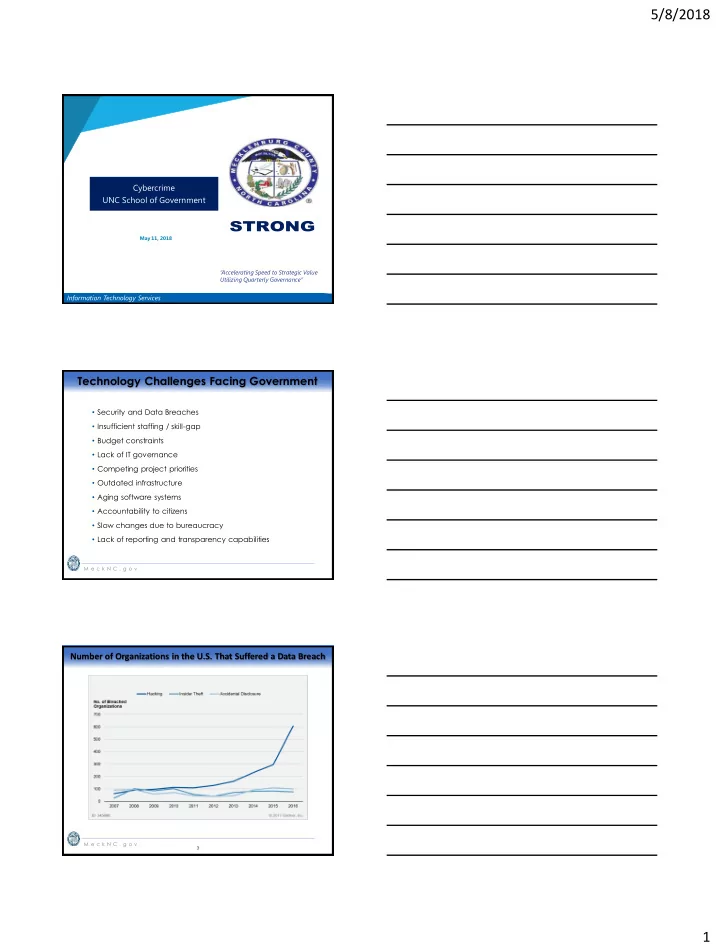
Number of Organizations in the U.S. That Suffered a Data Breach

slide-2
SLIDE 2

5/8/2018 2

M e c k N C . g o v 4 Some 1.9 billion data records were lost or stolen during the first half, compared with 721 million during the previous six months, an increase of 164%. Identity theft accounted for three quarters of data breaches, an increase of 49% compared to the previous six months. M e c k N C . g o v 5

Every 10 seconds, a consumer gets hit with ransomware. (up from every 20 seconds in Q1 2016) Every 40 seconds, a company gets hit with ransomware. (up from every 2 minutes in Q1 2016)

2016 “Year of On-line Extortion” 400% spike in the number of ransomware families from January to September 2016

Growth in Ransomware Variants Since December 2015

M e c k N C . g o v

Other ‘Costs’ of Data Breach

  • Reputation damage / negative publicity
  • Lost / compromised data
  • Lost productivity
  • Potential further affects on clients (e.g.

identify theft)

slide-3
SLIDE 3

5/8/2018 3

M e c k N C . g o v

The Attack: Mecklenburg County

7

M e c k N C . g o v

  • Ransomware attack—December 5, 2017
  • Mecklenburg County network credentials were

compromised by cyber criminal(s) using a social engineering Phishing attack

  • The criminal(s) utilized harvested user sign-on credentials

to gain un-authorized access to Mecklenburg County systems

  • The criminal(s) then planted Ransomware to ‘Freeze’

select systems and then demanded payment to ‘Unfreeze’

  • 48 Servers encrypted—Over 200 systems impacted

8

Mecklenburg County’s Ransomware Attack

M e c k N C . g o v

The Attack: Davidson County

9

slide-4
SLIDE 4

5/8/2018 4

M e c k N C . g o v

The Attack: Catawba County

10

M e c k N C . g o v

The Response: Mecklenburg County

11

M e c k N C . g o v

12

Cyber Incident Response Plan

Information Technology Business Owners Phase 1: Preparation Facilitate, Make Plans & Be Ready Be Ready to implement County response/communications plan —timing is everything Phase 2: Detection Identify & Respond From first alert—follow the plan and communicate Phase 3: Analysis & Validation Investigative Process for Digital Forensics Provide information to support Analysis—help prioritize. Identify manual procedures and controls for business continuity. Phase 4: Containment, Handling & Eradication Utilizing a Controlled, Methodical, Secure Process Clean up and restoring services, procedures to support data integrity and internal controls and customer service Phase 5: Recovery ‘New Normal’ Standard Operating Practices ‘New Normal’ Standard Operating Practices, Training, Build Resilience

slide-5
SLIDE 5

5/8/2018 5

M e c k N C . g o v 13

What preparation did we have? When did we know this was happening? What did we do to contain the damage?

Phase 2: Detection

Shared publicly on Dec. 12th 2017

Preparation & Detection

Phase 1: Preparation M e c k N C . g o v

14

Backups: Server team stood up a new database environment and we restored database backups for various systems which ran overnight Gained additional insights from various sources regarding potential risks / benefits

  • f paying ransom, Engaged Experts (Microsoft, FBI, Fortalice, Others)

Based on risk / benefit analysis and input from numerous discussions with County Executive Leadership, decision was made and communicated that: Mecklenburg County would not pay https://www.nytimes.com/2017/12/06/us/mecklenburg-county-hackers.html

Phase 2: Detection Phase 3: Analysis & Validation

Shared publicly on Dec. 12th 2017

Detection and Analysis

M e c k N C . g o v 15

  • Reset all system accounts and passwords
  • Tightened ‘In-bound’ and ‘Outbound’ Firewall rules
  • Executed Restoration Procedures
  • Finance: Translate what this means for Financial Operations, act

accordingly

  • All: communication

https://www.mecknc.gov/news/Pages/Countywide-system-

  • utage.aspx

Phase 4: Containment, Handling & Eradication

Shared publicly on Dec. 12th 2017

Containment, Handling, and Restoration

slide-6
SLIDE 6

5/8/2018 6

M e c k N C . g o v 16

  • Implemented extended password length
  • Significantly restrict international emails
  • Policy & Perimeter Security changes:
  • External email alerting
  • Non-County web-based email elimination
  • Eliminate email auto-forwarding

Phase 5: Recovery

Identify “New Normal” Security Practices

Microsoft Cloud Microsoft Cloud Vendor Hosted Applications

M e c k N C . g o v

The Response: Davidson County

17

M e c k N C . g o v

The Response: Catawba County

18

slide-7
SLIDE 7

5/8/2018 7

M e c k N C . g o v

The Effect of the Attack on Human Resources and Payroll

19

M e c k N C . g o v

Liability

20

M e c k N C . g o v

Vulnerability and Prevention

  • r

Risk and Risk Management

21

slide-8
SLIDE 8

5/8/2018 8

M e c k N C . g o v

Developing Risk Management Procedures

  • Identify and prioritize risks
  • Perform periodic risk assessments
  • Develop risk mitigation /

contingency plan

  • Implement risk mitigation plan
  • Monitor progress

M e c k N C . g o v

IT Gov

  • vernance St

Structu ture

24

IT Governance Area IT Policy

Password Policy

Email Usage Policy

Computer and Internet Usage Policy/Acceptable Use Policy Access Management

Social Media Policy

Acceptable Use Policy

Remote Access Policy

___________________________

Mobile and Personal Device Policy

Portable Storage Policy IT Operations

Data Management and Retention Policy

Data Back-up Policy

Compliance Policy

slide-9
SLIDE 9

5/8/2018 9

M e c k N C . g o v

Vendor Management

Third-party vendor relationships can create additional risks to your organization. Best practices to manage third-party vendors:

  • Conduct third-party screening, onboarding, and due

diligence during RFP process

  • Establish a tone at the top with management-level
  • versight
  • Ensure appropriate investment and staffing
  • Align vendor IT security plan with organization

M e c k N C . g o v

Security Incidents and Reporting

  • Security incidents can happen at any time – common

examples include: ▪

Information is missing or damaged

Information is disclosed to an unauthorized individual

Equipment is stolen

Your computer is infected with a virus

  • When possible, write down what you are observing and report

as soon as possible

  • Important – do not try to investigate or resolve the incident

yourself – contact your security liaison or IT department as soon as possible

M e c k N C . g o v 27

NETWORK SECURITY APPLICATION SECURITY DATA SECURITY PERIMETER SECURITY MISSION CRITICAL ASSETS ENDPOINT SECURITY

Endpoint Firewall Data Center Firewall Security QA Endpoint Antivirus/IDP Patch Management AUP Enforcement Local Disk Encryption Data Loss Protection/ Prevention Removable Media/Device Control Enterprise Remote Access Multifactor Authentication Data Loss Prevention/ Protection Enterprise Access Edge & WLAN Security Network Access Control Web Content & Application Filtering VoIP Security Code Review Web Application Firewall Multifactor Authentication ID/Access Management Data Classification Rights Management Data Lifecycle Data Encryption IT Security Governance Cyber Threat Intelligence Asset Management Vulnerability Assessment Security Awareness Training Risk Management Security Architecture & Design SIEM Security Policies & Compliance Threat Modeling OWASP Analysis/ Review Backup/ Integrity Security Incident Reporting, Detection & Response Security Dashboards/ KPIs Digital Forensics Escalation Management SOC/NOC Monitoring Asset Management Continuous Monitoring/ Situational Awareness Security Operations Training SSL Inspection Secure Configurations (STIG) TDM SDN/ Automation Edge Firewall/ IDP/IDS SSL Inspection Secure DMZs/ Network Segmentation O365 Email Security – AV/ Malware Real-time Cloud Threat Services Honeypot Data Loss Protection/ Prevention O365 SharePoint DLP O365 Exchange DLP Web Content & Application Filtering Network Segmentation Penetration Testing Security Operations Staffing Vulnerability Reporting and Remediation O365 Exchange DLP

IT Security utilizes a layered model to address security concerns across the enterprise. Due to the highly dynamic nature of information security, specific items on this diagram are frequently updated; however, security initiatives should align with one or more of these layers as an area of focus.

Goal: Reduce an Attacker’s Chance of Success While Increasing an Attacker’s Risk of Detection

IT Services Team

Implement A Layered Security Approach
slide-10
SLIDE 10

5/8/2018 10

M e c k N C . g o v 28