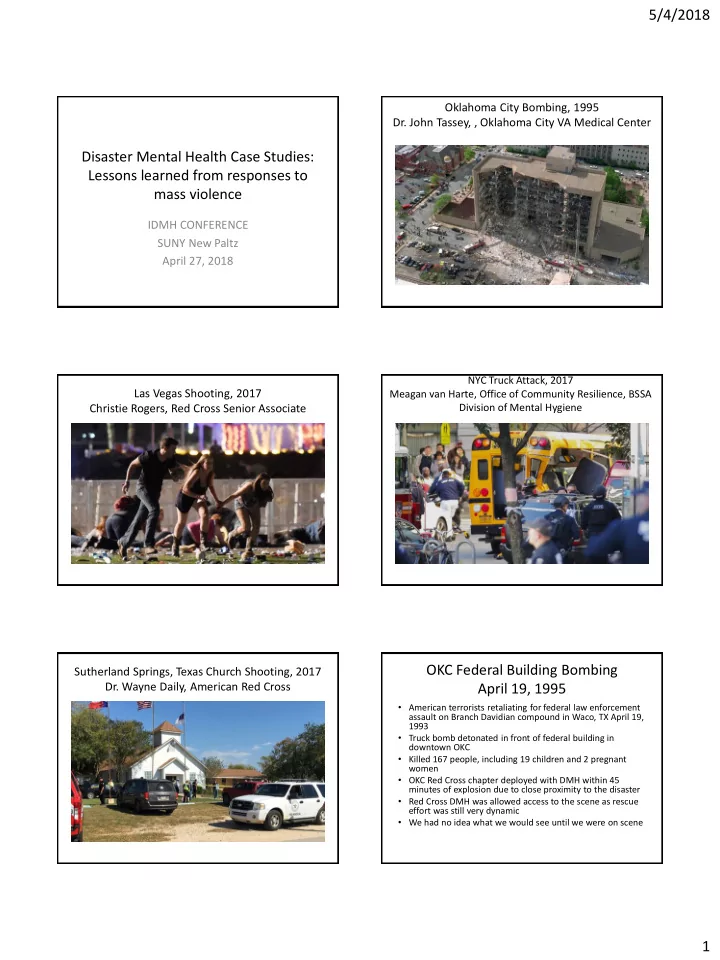
5/4/2018 Oklahoma City Bombing, 1995 Dr. John Tassey, , Oklahoma - - PDF document

5 4 2018
SMART_READER_LITE
LIVE PREVIEW

5/4/2018 Oklahoma City Bombing, 1995 Dr. John Tassey, , Oklahoma - - PDF document

5/4/2018 Oklahoma City Bombing, 1995 Dr. John Tassey, , Oklahoma City VA Medical Center Disaster Mental Health Case Studies: Lessons learned from responses to mass violence IDMH CONFERENCE SUNY New Paltz April 27, 2018 NYC Truck Attack,


slide-1
SLIDE 1

5/4/2018 1 Disaster Mental Health Case Studies: Lessons learned from responses to mass violence

IDMH CONFERENCE SUNY New Paltz April 27, 2018 Oklahoma City Bombing, 1995

  • Dr. John Tassey, , Oklahoma City VA Medical Center

Las Vegas Shooting, 2017 Christie Rogers, Red Cross Senior Associate

NYC Truck Attack, 2017 Meagan van Harte, Office of Community Resilience, BSSA Division of Mental Hygiene

Sutherland Springs, Texas Church Shooting, 2017

  • Dr. Wayne Daily, American Red Cross

OKC Federal Building Bombing April 19, 1995

  • American terrorists retaliating for federal law enforcement

assault on Branch Davidian compound in Waco, TX April 19, 1993

  • Truck bomb detonated in front of federal building in

downtown OKC

  • Killed 167 people, including 19 children and 2 pregnant

women

  • OKC Red Cross chapter deployed with DMH within 45

minutes of explosion due to close proximity to the disaster

  • Red Cross DMH was allowed access to the scene as rescue

effort was still very dynamic

  • We had no idea what we would see until we were on scene
slide-2
SLIDE 2

5/4/2018 2 Cultural/Community Considerations

  • Within hours of the blast Muslim citizens were targeted

by vigilantes

  • DMH providers did not represent diversity of the

casualties or their families

  • Strong faith community (mostly fundamental Christian)

presence at all sites

  • “Oklahoma Standard”

– Volunteer rescuer killed by falling debris within the first 2 hours – Spontaneous volunteers reached 10,000 in first week – Financial and in-kind donations overwhelmed community agencies

Interventions Used and Lessons Learned

  • Mandates to go to “debriefings” work and

become contagious across agencies

  • 7-step CISD model is not procedure of choice

for daily out-processing during ongoing rescue/recovery

  • Civilians impacted by the event should not be

included in a CISD model, EVER!

Self Care

  • Small group support
  • Ongoing relationships that share similar

experiences

  • Find the bigger picture

Las Vegas Shooting: Incident Overview

  • Sunday, October 1, 2017, 10:05-

10:15pm

  • Route 91 Harvest Music Festival, 3 day

festival on the Las Vegas Strip

  • 22,000 people in attendance
  • Over 1,100 rounds of bullets fired into

crowd from 32nd floor of Mandalay Bay hotel

  • Highly premeditated, motive still

unknown

  • 58 dead, 851 injured
  • Highly transient client population

– Concert goers: From nearly every US state and multiple countries – Deceased: From 15 US states and Canada

Las Vegas Shooting: Response Overview

  • Hospitalized Survivors and Families
  • Family Assistance Center
  • Community Vigils and Memorials
  • Police and Fire Departments
  • Long-term Recovery

Las Vegas Shooting: Lessons Learned (and Remembered!)

  • Established, trusting relationships between response
  • rganizations pre-event are invaluable.
  • Importance of speed-to-scale when responding to

mass casualty incidents.

  • Breadth, size and diversity of client population.
  • Communication and service delivery

challenges with highly transient client population.

  • Challenges of responding in a city that

continues to operate as a vacation destination.

slide-3
SLIDE 3

5/4/2018 3 NYC TRUCK ATTACK: Incident Overview

  • At 2:06 p.m. on October 31, 2017, Sayfullo Habibullaevic Saipov rents a

truck from Home Depot in Passaic, NJ

  • At 2:43 p.m. the truck exits the George Washington Bridge, and heads

south to Downtown Manhattan

  • At 3:04 p.m. he drives the truck onto a public walkway and bike path
  • Truck continues for several blocks on pathway hitting pedestrians and

bikers

  • Truck collides with a school bus at Chambers Street halting the vehicle
  • 3:08 p.m. multiple 911 calls come reporting people hurt, school bus crash,

and man with gun. Bystanders call nearby officers and Officer Nash shoots him in stomach

  • Suspect is arrested and undergoes surgery
  • He is charged with murder (8), attempted murder (12), violence and

destruction of motor vehicle (1), and providing and attempting to provide material support to ISIS (1)

Cultural/Community Considerations

  • Attack happened in daylight in a location frequently used

by public

  • It took place on Halloween hours before a very well-

publicized and highly popular Halloween Parade not too far from where truck entered

  • There was both a high school and elementary school at

corner where truck collided with school bus

  • Area previously impacted in 9/11 (re-traumatization risk

high)

Interventions and Lessons Learned

  • Sent in emotional support team to Hudson River Park Trust
  • Provided crisis counseling and PFA for two days after the attack
  • Helped management craft their communication strategies for staff

and others

  • Two weeks later met with supervisors to review stress management

and PFA Lessons Learned

  • Acute phase response critical
  • Risk communication strategies important
  • Psychoeducation material continuously updated

First Baptist Church Sutherland Springs, Texas, November, 2017

slide-4
SLIDE 4

5/4/2018 4

Lessons Learned from Sutherland Springs

  • Demonstrate your willingness to work collaboratively with local

community leaders, service agencies, and other institutions in the disaster response, and pay close attention to local cultural values.

  • It’s essential to have clear authorization to be part of the response. This

means you’ve been invited to participate by emergency management

  • fficials.
  • Even with an official invitation, don’t expect automatic acceptance. Use

local volunteers on your team to help expedite the process of relationship building with the community and with those who need assistance.

  • A key element to your own self-care is the impact of the disaster on

members of your team. Attend to your own stress level, but also to the stress and vicarious trauma experienced by members of your team. Your resilience and their resilience are closely entwined.

Questions Contact Information

  • John R. Tassey, Ph.D., Health Psychology Clinic, Oklahoma City Veterans

Affairs Medical Center John.Tassey@va.gov

  • J. Christie Rodgers, MSW, LICSW, Senior Associate, Disaster Mental

Health, Program Development, American Red Cross christie.rodgers@redcross.org

  • Meagan van Harte, Senior Director, Office of Community Resilience, Office
  • f Community Resilience, BSSA, Division of Mental Hygiene

mvanharte@health.nyc .gov

  • Wayne F. Dailey, PhD, American Red Cross, Yale University School of

Medicine waynefdailey@gmail.com