5/29/2020 Breaking things down In functional (and procedural) - - PDF document

5 29 2020
SMART_READER_LITE
LIVE PREVIEW

5/29/2020 Breaking things down In functional (and procedural) - - PDF document

5/29/2020 Breaking things down In functional (and procedural) programming, break programs down into functions that perform some operation In object-oriented programming, break programs down into CSE341: Programming Languages classes


slide-1
SLIDE 1

5/29/2020 1

CSE341: Programming Languages Lecture 22 OOP vs. Functional Decomposition; Adding Operators & Variants; Double-Dispatch

Brett Wortzman Spring 2020

Breaking things down

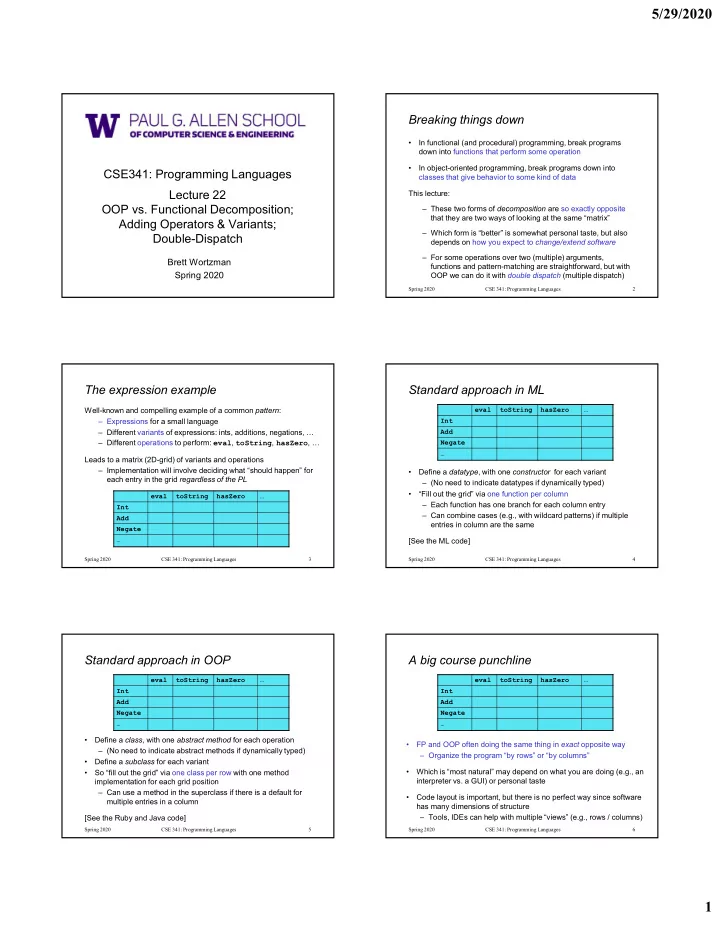
  • In functional (and procedural) programming, break programs

down into functions that perform some operation

  • In object-oriented programming, break programs down into

classes that give behavior to some kind of data This lecture: – These two forms of decomposition are so exactly opposite that they are two ways of looking at the same “matrix” – Which form is “better” is somewhat personal taste, but also depends on how you expect to change/extend software – For some operations over two (multiple) arguments, functions and pattern-matching are straightforward, but with OOP we can do it with double dispatch (multiple dispatch)

Spring 2020 2 CSE 341: Programming Languages

The expression example

Well-known and compelling example of a common pattern: – Expressions for a small language – Different variants of expressions: ints, additions, negations, … – Different operations to perform: eval, toString, hasZero, … Leads to a matrix (2D-grid) of variants and operations – Implementation will involve deciding what “should happen” for each entry in the grid regardless of the PL

Spring 2020 3 CSE 341: Programming Languages

eval toString hasZero … Int Add Negate …

Standard approach in ML

  • Define a datatype, with one constructor for each variant

– (No need to indicate datatypes if dynamically typed)

  • “Fill out the grid” via one function per column

– Each function has one branch for each column entry – Can combine cases (e.g., with wildcard patterns) if multiple entries in column are the same [See the ML code]

Spring 2020 4 CSE 341: Programming Languages

eval toString hasZero … Int Add Negate …

Standard approach in OOP

  • Define a class, with one abstract method for each operation

– (No need to indicate abstract methods if dynamically typed)

  • Define a subclass for each variant
  • So “fill out the grid” via one class per row with one method

implementation for each grid position – Can use a method in the superclass if there is a default for multiple entries in a column [See the Ruby and Java code]

Spring 2020 5 CSE 341: Programming Languages

eval toString hasZero … Int Add Negate …

A big course punchline

  • FP and OOP often doing the same thing in exact opposite way

– Organize the program “by rows” or “by columns”

  • Which is “most natural” may depend on what you are doing (e.g., an

interpreter vs. a GUI) or personal taste

  • Code layout is important, but there is no perfect way since software

has many dimensions of structure – Tools, IDEs can help with multiple “views” (e.g., rows / columns)

Spring 2020 6 CSE 341: Programming Languages

eval toString hasZero … Int Add Negate …

slide-2
SLIDE 2

5/29/2020 2

Extensibility

  • For implementing our grid so far, SML / Racket style usually by

column and Ruby / Java style usually by row

  • But beyond just style, this decision affects what (unexpected?)

software extensions need not change old code

  • Functions [see ML code]:

– Easy to add a new operation, e.g., noNegConstants – Adding a new variant, e.g., Mult requires modifying old functions, but ML type-checker gives a to-do list if original code avoided wildcard patterns

Spring 2020 7 CSE 341: Programming Languages

eval toString hasZero noNegConstants Int Add Negate Mult

  • For implementing our grid so far, SML / Racket style usually by

column and Ruby / Java style usually by row

  • But beyond just style, this decision affects what (unexpected?)

software extensions are easy and/or do not change old code

  • Objects [see Ruby code]:

– Easy to add a new variant, e.g., Mult – Adding a new operation, e.g., noNegConstants requires modifying old classes, but Java type-checker gives a to-do list if original code avoided default methods

Spring 2020 8 CSE 341: Programming Languages

eval toString hasZero noNegConstants Int Add Negate Mult

Extensibility The other way is possible

  • Functions allow new operations and objects allow new variants

without modifying existing code even if they didn’t plan for it – Natural result of the decomposition Optional:

  • Functions can support new variants somewhat awkwardly “if they

plan ahead” – Not explained here: Can use type constructors to make datatypes extensible and have operations take function arguments to give results for the extensions

  • Objects can support new operations somewhat awkwardly “if they

plan ahead” – Not explained here: The popular Visitor Pattern uses the double-dispatch pattern to allow new operations “on the side”

Spring 2020 9 CSE 341: Programming Languages

Thoughts on Extensibility

  • Making software extensible is valuable and hard

– If you know you want new operations, use FP – If you know you want new variants, use OOP – If both? Languages like Scala try; it’s a hard problem – Reality: The future is often hard to predict!

  • Extensibility is a double-edged sword

– Code more reusable without being changed later – But makes original code more difficult to reason about locally

  • r change later (could break extensions)

– Often language mechanisms to make code less extensible (ML modules hide datatypes; Java’s final prevents subclassing/overriding)

Spring 2020 10 CSE 341: Programming Languages

Binary operations

  • Situation is more complicated if an operation is defined over

multiple arguments that can have different variants – Can arise in original program or after extension

  • Function decomposition deals with this much more simply…

Spring 2020 11 CSE 341: Programming Languages

eval toString hasZero … Int Add Negate …

Example

To show the issue: – Include variants String and Rational – (Re)define Add to work on any pair of Int, String, Rational

  • Concatenation if either argument a String, else math

Now just defining the addition operation is a different 2D grid:

Spring 2020 12 CSE 341: Programming Languages

Int String Rational Int String Rational

slide-3
SLIDE 3

5/29/2020 3

ML Approach

Addition is different for most Int, String, Rational combinations – Run-time error for non-value expressions Natural approach: pattern-match on the pair of values – For commutative possibilities, can re-call with (v2,v1)

Spring 2020 13 CSE 341: Programming Languages

fun add_values (v1,v2) = case (v1,v2) of (Int i, Int j) => Int (i+j) | (Int i, String s) => String (Int.toString i ^ s) | (Int i, Rational(j,k)) => Rational (i*k+j,k) | (Rational _, Int _) => add_values (v2,v1) | … (* 5 more cases (3*3 total): see the code *) fun eval e = case e of … | Add(e1,e2) => add_values (eval e1, eval e2)

Example

To show the issue: – Include variants String and Rational – (Re)define Add to work on any pair of Int, String, Rational

  • Concatenation if either argument a String, else math

Now just defining the addition operation is a different 2D grid: Worked just fine with functional decomposition — what about OOP…

Spring 2020 14 CSE 341: Programming Languages

Int String Rational Int String Rational

What about OOP?

Starts promising: – Use OOP to call method add_values to one value with

  • ther value as result

Spring 2020 15 CSE 341: Programming Languages

class Add … def eval e1.eval.add_values e2.eval end end Classes Int, MyString, MyRational then all implement – Each handling 3 of the 9 cases: “add self to argument” class Int … def add_values v … # what goes here? end end

First try

  • This approach is common, but is “not as OOP”

– So do not do it on your homework

  • A “hybrid” style where we used dynamic dispatch on 1 argument

and then switched to Racket-style type tests for other argument – Definitely not “full OOP”

Spring 2020 16 CSE 341: Programming Languages

class Int def add_values v if v.is_a? Int Int.new(v.i + i) elsif v.is_a? MyRational MyRational.new(v.i+v.j*i,v.j) else MyString.new(v.s + i.to_s) end end

Another way…

  • add_values method in Int needs “what kind of thing” v has

– Same problem in MyRational and MyString

  • In OOP, “always” solve this by calling a method on v instead!
  • But now we need to “tell” v “what kind of thing” self is

– We know that! – “Tell” v by calling different methods on v, passing self

  • Use a “programming trick” (?) called double-dispatch…

Spring 2020 17 CSE 341: Programming Languages

Double-dispatch “trick”

  • Int, MyString, and MyRational each define all of addInt,

addString, and addRational – For example, String’s addInt is for concatenating an integer argument to the string in self – 9 total methods, one for each case of addition

  • Add’s eval method calls e1.eval.add_values e2.eval,

which dispatches to add_values in Int, String, or Rational – Int’s add_values: v.addInt self – MyString’s add_values: v.addString self – MyRational’s add_values: v.addRational self So add_values performs “2nd dispatch” to the correct case of 9! [Definitely see the code]

Spring 2020 18 CSE 341: Programming Languages

slide-4
SLIDE 4

5/29/2020 4

Why showing you this

  • Honestly, partly to belittle full commitment to OOP
  • To understand dynamic dispatch via a sophisticated idiom
  • Because required for the homework
  • To contrast with multimethods (optional)

Spring 2020 19 CSE 341: Programming Languages

Works in Java too

  • In a statically typed language, double-dispatch works fine

– Just need all the dispatch methods in the type [See Java code]

Spring 2020 20 CSE 341: Programming Languages

abstract class Value extends Exp { abstract Value add_values(Value other); abstract Value addInt(Int other); abstract Value addString(Strng other); abstract Value addRational(Rational other); } class Int extends Value { … } class Strng extends Value { … } class Rational extends Value { … }

Being Fair

Belittling OOP style for requiring the manual trick of double dispatch is somewhat unfair… What would work better:

  • Int, MyString, and MyRational each define three methods

all named add_values – One add_values takes an Int, one a MyString, one a MyRational – So 9 total methods named add_values – e1.eval.add_values e2.eval picks the right one of the 9 at run-time using the classes of the two arguments

  • Such a semantics is called multimethods or multiple dispatch

Spring 2020 21 CSE 341: Programming Languages

Multimethods

General idea: – Allow multiple methods with same name – Indicate which ones take instances of which classes – Use dynamic dispatch on arguments in addition to receiver to pick which method is called If dynamic dispatch is essence of OOP, this is more OOP – No need for awkward manual multiple-dispatch Downside: Interaction with subclassing can produce situations where there is “no clear winner” for which method to call

Spring 2020 22 CSE 341: Programming Languages

Ruby: Why not?

Multimethods a bad fit (?) for Ruby because:

  • Ruby places no restrictions on what is passed to a method
  • Ruby never allows methods with the same name

– Same name means overriding/replacing

Spring 2020 23 CSE 341: Programming Languages

Java/C#/C++: Why not?

  • Yes, Java/C#/C++ allow multiple methods with the same name
  • No, these language do not have multimethods

– They have static overloading – Uses static types of arguments to choose the method

  • But of course run-time class of receiver [odd hybrid?]

– No help in our example, so still code up double-dispatch manually

  • Actually, C# 4.0 has a way to get effect of multimethods
  • Many other language have multimethods (e.g., Clojure)

– They are not a new idea

Spring 2020 24 CSE 341: Programming Languages