5/1/2009 Do we need biopsy to treat early inoperable lung cancer? - - PDF document

5 1 2009
SMART_READER_LITE
LIVE PREVIEW

5/1/2009 Do we need biopsy to treat early inoperable lung cancer? - - PDF document

5/1/2009 Do we need biopsy to treat early inoperable lung cancer? Frank J. Lagerwaard MD PhD VU University medical center Amsterdam, The Netherlands Perspectives in Lung Cancer, Bruxelles, 2009 VUmc Amsterdam Pathological verification of malignancy


slide-1
SLIDE 1

5/1/2009 1

Do we need biopsy to treat early inoperable lung cancer?

Frank J. Lagerwaard MD PhD VU University medical center Amsterdam, The Netherlands

VUmc Amsterdam Perspectives in Lung Cancer, Bruxelles, 2009

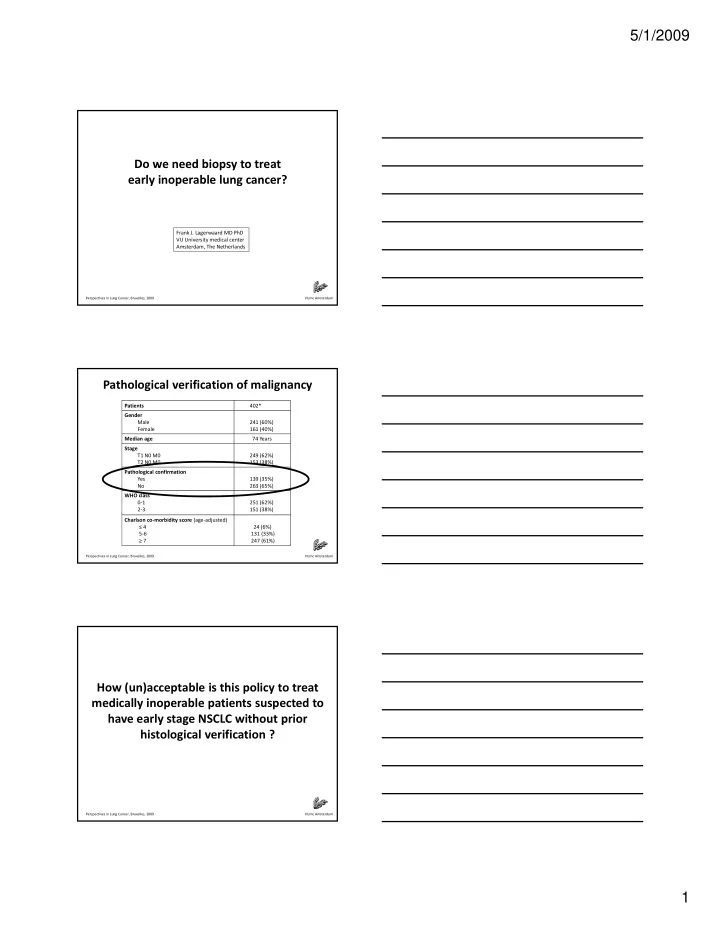
Pathological verification of malignancy

Patients 402* Gender Male Female 241 (60%) 161 (40%) Median age 74 Years Stage T1 N0 M0 T2 N0 M0 249 (62%) 153 (38%)

VUmc Amsterdam Perspectives in Lung Cancer, Bruxelles, 2009

Pathological confirmation Yes No 139 (35%) 263 (65%) WHO class 0‐1 2‐3 251 (62%) 151 (38%) Charlson co‐morbidity score (age‐adjusted) ≤ 4 5‐6 ≥ 7 24 (6%) 131 (33%) 247 (61%)

How (un)acceptable is this policy to treat medically inoperable patients suspected to have early stage NSCLC without prior

VUmc Amsterdam Perspectives in Lung Cancer, Bruxelles, 2009

y g p histological verification ?

slide-2
SLIDE 2

5/1/2009 2

Case study

  • 60 years old female
  • Severe COPD

FEV1 0.92 (38%); DCO 45%

VUmc Amsterdam Perspectives in Lung Cancer, Bruxelles, 2009

  • Diagnosed during routine fu
  • Lesion 21 mm right upper lobe
  • WHO 1; Charlson score 5
  • Smoking history, never quit

How would you estimate the pre‐test probability

  • f malignancy in this patient (without FDG‐PET)?
  • A. <40%

VUmc Amsterdam Perspectives in Lung Cancer, Bruxelles, 2009

  • B. 40-60%
  • C. 60-80%
  • D. >80%

Probability of malignancy of SPN

Swensen et al. 1997 (Mayo); clinical & radiological criteria

Probability of malignancy = ex/ (1+ex) X = -6.8272 + 0.039 * age + 0.792 * smoking 1 339 * i + 1.339 * prior cancer + 0.127 * diameter + 1.041 * spiculation + 0.784 * upper lobe

VUmc Amsterdam Perspectives in Lung Cancer, Bruxelles, 2009

For this patient, the pre-test probability of malignancy based on the Swensen calculation (X = 0.7968) is 69%

slide-3
SLIDE 3

5/1/2009 3

Probability of malignancy of SPN

Gould et al. 2007 (Stanford); clinical & radiological criteria

Probability of malignancy = ex/ (1+ex) X = -8.404 + 0.779 * age/ 10 + 0 112 * diameter N=375 Lesions 7-30 mm P l f li 54% + 0.112 diameter + 2.061 * smoking

  • 0.567 * years quit

VUmc Amsterdam Perspectives in Lung Cancer, Bruxelles, 2009

Prevalence of malignancy 54%

Probability of malignancy SPN (Gould 2007)

Diameter 5mm 10mm 15mm 20mm 25mm 30mm 35mm 40mm 50 years Current smoker Never smoked 13 2 21 3 32 6 45 9 59 15 71 24 81 36 88 49 60 years Current smoker 25 37 50 64 76 84 90 94

VUmc Amsterdam Perspectives in Lung Cancer, Bruxelles, 2009

Never smoked 4 7 11 18 28 41 55 68 70 years Current smoker Never smoked 42 8 56 14 69 22 79 33 87 46 92 60 95 72 97 82 80 years Current smoker Never smoked 61 17 73 26 83 38 89 52 94 65 96 77 98 85 99 91

Probability of malignancy of SPN

Gould et al. 2007 (Stanford); clinical & radiological criteria

Probability of malignancy = ex/ (1+ex) X = -8.404 + 0.779 * age/ 10 + 0 112 * diameter N=375 Lesions 7-30 mm P l f li 54% + 0.112 diameter + 2.061 * smoking

  • 0.567 * years quit

VUmc Amsterdam Perspectives in Lung Cancer, Bruxelles, 2009

Prevalence of malignancy 54% For this patient, the pre-test probability of malignancy based on the Gould calculation (X = 0.683) is 66%

slide-4
SLIDE 4

5/1/2009 4

How would you estimate the pre‐test probability

  • f malignancy in this patient (without FDG‐PET)?
  • A. <40%

VUmc Amsterdam Perspectives in Lung Cancer, Bruxelles, 2009

  • B. 40-60%
  • C. 60-80%
  • D. >80%

Case study

VUmc Amsterdam Perspectives in Lung Cancer, Bruxelles, 2009 18FDG-PET scan showed intense uptake in the lesion in the right upper lobe

No pathological uptake in the mediastinum or elsewhere

Would you perform CT‐guided biopsy in this patient with poor pulmonary function (FEV1 38%, DCO 45%)?

  • A. Yes

VUmc Amsterdam Perspectives in Lung Cancer, Bruxelles, 2009

  • B. No, not in regard of the pulmonary function
  • C. No, the probability of malignancy is high enough to justify treatment
slide-5
SLIDE 5

5/1/2009 5

Transthoracic biopsy

Diagnostic transthoracic biopsy is a minimally invasive procedure, which is accurate and safe…..

VUmc Amsterdam Perspectives in Lung Cancer, Bruxelles, 2009

Transthoracic needle aspiration biopsy for the diagnosis of localised pulmonary lesions: a meta‐analysis [Lacasse et al.]

  • 48 studies included, with 9000 biopsies
  • Sensitivity 88%; Specificity 98%

VUmc Amsterdam Perspectives in Lung Cancer, Bruxelles, 2009

y ; p y

  • Pneumothorax incidence 24.5% (range 3%-42%)
  • Chest tube drainage 6.8% (range 0%-17%)

Biopsy is accurate; the risk of significant toxicity is low, but not to be ignored (higher in COPD, advanced age)

Transthoracic biopsy

VUmc Amsterdam Perspectives in Lung Cancer, Bruxelles, 2009

Ohno et al.; 2003 (N=162 biopsies)

slide-6
SLIDE 6

5/1/2009 6

What does a positive 18FDG‐PET indicate ?

False positive (and negative) findings are not uncommon; e.g. benign tumors, inflammatory disease; eg. lung infections, sarcoidosis, tuberculosis. Sensitivity 18FDG-PET: 98% Specificity 18FDG-PET: 83% [meta-analysis Gould et al. 2001] To answer the above question: assessment of the positive predictive value (PPV)

VUmc Amsterdam Perspectives in Lung Cancer, Bruxelles, 2009

To answer the above question: assessment of the positive predictive value (PPV) PPV = True positive True positive + False positive PPV is reported to be 50-100%, highly dependent on the prevalence of disease, i.e. larger in a high risk population. In meta analyses reported to be 88%-95%

Post‐test probability of malignancy

Integrating clinical, radiological and PET data

Herder et al. 2005; S wensen criteria + 18FDG-PET findings Probability of malignancy = ex/ (1+ex) X = -4.739 +3.691*(S wensen probability) +2.322 (faint PET uptake) or +4.617 (moderate PET uptake) or +4.771 (intense PET uptake)

VUmc Amsterdam Perspectives in Lung Cancer, Bruxelles, 2009

For this patient, the post-PET probability of malignancy based on the Herder calculation is 93%

Would you perform CT‐guided biopsy in this patient with poor pulmonary function (FEV1 38%, DCO 45%)?

  • A. Yes

VUmc Amsterdam Perspectives in Lung Cancer, Bruxelles, 2009

  • B. No, not in regard of the pulmonary function
  • C. No, the probability of malignancy is high enough to justify treatment
slide-7
SLIDE 7

5/1/2009 7

SBRT 3 x 20 Gy/ 1 week

VUmc Amsterdam Perspectives in Lung Cancer, Bruxelles, 2009

Case study

VUmc Amsterdam Perspectives in Lung Cancer, Bruxelles, 2009

1 year fu 2 years fu 2 years fu

Probability of malignancy SPN (Gould 2007)

Diameter 5mm 10mm 15mm 20mm 25mm 30mm 35mm 40mm 50 years Current smoker Never smoked 13 2 21 3 32 6 45 9 59 15 71 24 81 36 88 49 60 years Current smoker Never smoked 25 4 37 7 50 11 64 18 76 28 84 41 90 55 94 68 70 years k

VUmc Amsterdam Perspectives in Lung Cancer, Bruxelles, 2009

Current smoker Never smoked 42 8 56 14 69 22 79 33 87 46 92 60 95 72 97 82 80 years Current smoker Never smoked 61 17 73 26 83 38 89 52 94 65 96 77 98 85 99 91

Age: mean 72 yrs, median 72 yrs, range 47-91 yrs Smoking history: 98% (257/262); 65% current smokers Lesion diameter: mean 26 mm, median 25 mm, range 6-79mm

slide-8
SLIDE 8

5/1/2009 8

Characteristics of SBRT pts without pathology

Pre-test probability (Gould) Post-test probability (Herder)

VUmc Amsterdam Perspectives in Lung Cancer, Bruxelles, 2009

In addition, only 2% of pts had no prior imaging (different from screening studies) In addition, more than 35% of lesions had shown growth on sequential imaging

SBRT results in pts with/without pathology

P=0.82 Comparing 139 pts with and 263 pts without pathology treated with SBRT Overall survival: n.s. (p=0.23)

VUmc Amsterdam Perspectives in Lung Cancer, Bruxelles, 2009

Local control: n.s. (p=0.78) Regional control: n.s. (p=0.84) Distant control: n.s. (p=0.65) Disease-free survival: n.s. (p=0.82)

Serial CT scans 3, 6, 12, 24 mos Additional testing: FDG- PET, transthoracic Low probability (<5%) Intermediate Access clinical Surgical risk New SPN (8-30mm)

  • n CXR or CT scan

yes

Management strategy for SPN pts

ACCP guidelines; Chest 2007

Negative tests transthoracic biopsy, contrast- enhanced CT VATS, frozen section, resection if malignant probability (5%-60%) High probability (>60%) probability of malignancy Surgical risk acceptable?

  • n CXR or CT scan

without benign calcifications Establish diagnosis by

  • biopsy. Consider

XRT or monitor for symptoms and palliation

yes no

VUmc Amsterdam Perspectives in Lung Cancer, Bruxelles, 2009 Positive tests

slide-9
SLIDE 9

5/1/2009 9

Management strategy for SPN pts

Suspect SPN in a patient with a high pre-test probability for malignacy: surgery is recommended Why wouldn’t the same strategy apply to medically inoperable patients

VUmc Amsterdam Perspectives in Lung Cancer, Bruxelles, 2009

y gy pp y y p p with a post-test (18FDG-PET) probability of >80% after all, the complication rate of ‘invasive’ diagnostic procedures (in this patient population) may be larger than that of curative SBRT

Serial CT scans 3, 6, 12, 24 mos Additional testing: FDG- PET, transthoracic Low probability (<5%) Intermediate probability Access clinical probability of New SPN (8-30mm)

  • n CXR or CT scan

Management strategy for SPN pts

Adapted from ACCP guidelines

Negative tests biopsy, contrast- enhanced CT VATS, frozen section, resection if malignant probability (5%-60%) High probability (>60%) probability of malignancy Surgical risk acceptable?

  • n CXR or CT scan

without benign calcifications SBRT

yes no

VUmc Amsterdam Perspectives in Lung Cancer, Bruxelles, 2009 Positive tests

Thank you!

VUmc Amsterdam Perspectives in Lung Cancer, Bruxelles, 2009