4-current density . Lets suppose J is the 4-current density, let - - PowerPoint PPT Presentation

4 current density
SMART_READER_LITE
LIVE PREVIEW

4-current density . Lets suppose J is the 4-current density, let - - PowerPoint PPT Presentation

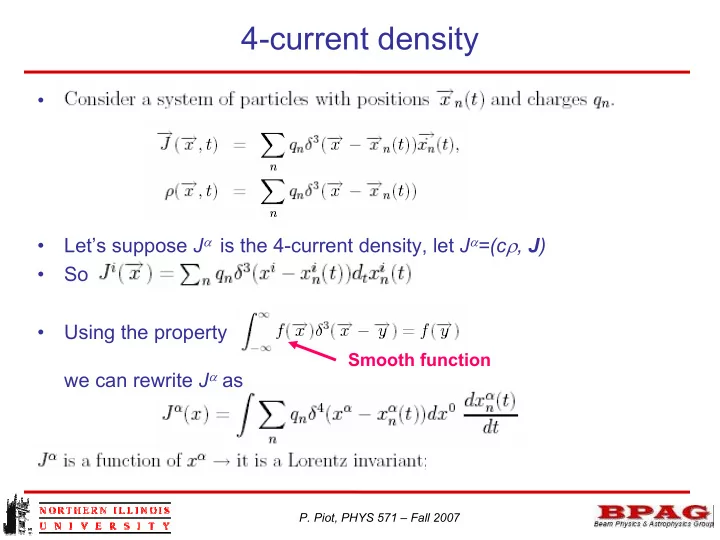
4-current density . Lets suppose J is the 4-current density, let J =(c , J ) So Using the property Smooth function we can rewrite J as P. Piot, PHYS 571 Fall 2007 Charge continuity equation


slide-1
SLIDE 1
  • P. Piot, PHYS 571 – Fall 2007

4-current density

  • ….
  • Let’s suppose Jα is the 4-current density, let Jα=(cρ, J)
  • So
  • Using the property

we can rewrite Jα as

Smooth function

slide-2
SLIDE 2
  • P. Piot, PHYS 571 – Fall 2007

Charge continuity equation

  • Consider the divergence of J
  • So charge continuity can be written as
slide-3
SLIDE 3
  • P. Piot, PHYS 571 – Fall 2007

4-gradient

  • In previous slide we introduce the 4-gradient operator
  • This operator transforms as
  • Note that
  • Can define the covariant form
  • The self-contraction yields the d’Alembertian:
slide-4
SLIDE 4
  • P. Piot, PHYS 571 – Fall 2007

4-potential

  • Define
  • This is precisely the equation we solved to get the field of a moving

charge three lessons ago…

  • In SI unit

In SI unit: φ → cφ

slide-5
SLIDE 5
  • P. Piot, PHYS 571 – Fall 2007

Covariance of Maxwell equations

  • Define the tensor of dimension 2
  • F, is the e.m. field tensor. It is easily found to be
  • In SI units, F is obtained by E → E/c
  • The covariant form is

4 potential 4 potential

slide-6
SLIDE 6
  • P. Piot, PHYS 571 – Fall 2007

Inhomogeneous Maxwell’s eqns

  • Consider
  • Similarly
  • The inhomogeneous Maxwell’s equations can be caster under

the equation

slide-7
SLIDE 7
  • P. Piot, PHYS 571 – Fall 2007

Homogeneous Maxwell’s eqns I

  • Consider the Levi-Civita tensor (rank 4)
  • And consider
slide-8
SLIDE 8
  • P. Piot, PHYS 571 – Fall 2007

Homogeneous Maxwell’s eqns II

  • Consider the Levi-Civita tensor (rank 4)
  • The homogeneous Maxwell’s equations can be caster under

the equation

With the Dual field tensor defined as

slide-9
SLIDE 9
  • P. Piot, PHYS 571 – Fall 2007

Covariant form of Maxwell’s equation

  • To introduce H and D field introduce the rank 2 tensor:
  • Then Maxwell’s equation writes
  • F is a rank 2 tensor that conforms to Lorentz transformation so the

(E,B) field can be computed in an other frame by

  • r, in matrix notation
slide-10
SLIDE 10
  • P. Piot, PHYS 571 – Fall 2007

Covariant form of Maxwell’s equation

  • Example consider the Lorentz boost along z- axis
  • Then from
  • We get the same matrix as [JDJ 11.148]
slide-11
SLIDE 11
  • P. Piot, PHYS 571 – Fall 2007

Invariant of the e.m. field tensor

  • Consider the following invariant quantities
  • Usually one redefine these invariants as
  • Which can be rewritten as

where

  • Finally note the identities
slide-12
SLIDE 12
  • P. Piot, PHYS 571 – Fall 2007

Eigenvalues of the e.m. field tensor

  • The eigenvalues are given by
  • Characteristic polynomial
  • With solutions
slide-13
SLIDE 13
  • P. Piot, PHYS 571 – Fall 2007

Equation of motion

  • The equation of motion (EOM) can be written

where

  • This is equivalent to defining a 4-force:
  • We need to solve EOM once we have specified the external e.m.

tensor (assuming no other fields)