4/3/2014 Function, Literacy, and the Common Core Connecting the - - PDF document

4 3 2014
SMART_READER_LITE
LIVE PREVIEW

4/3/2014 Function, Literacy, and the Common Core Connecting the - - PDF document

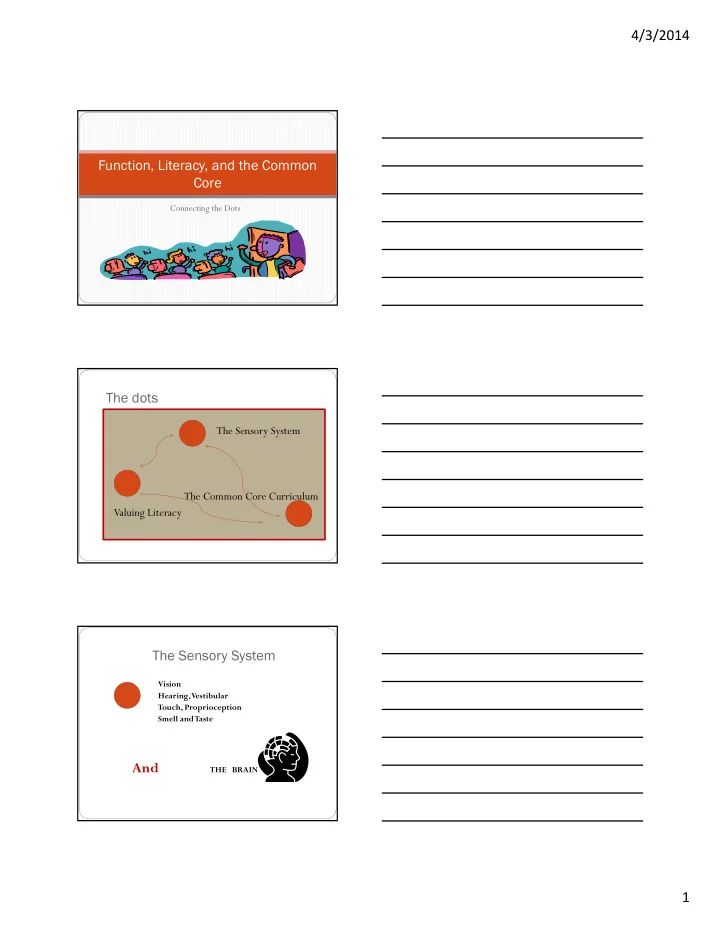
4/3/2014 Function, Literacy, and the Common Core Connecting the Dots The dots The Sensory System The Common Core Curriculum Valuing Literacy The Sensory System Vision Hearing, Vestibular Touch, Proprioception Smell and Taste And THE


slide-1
SLIDE 1

4/3/2014 1

Connecting the Dots

Function, Literacy, and the Common Core The dots

The Sensory System The Common Core Curriculum Valuing Literacy

The Sensory System

Vision Hearing, Vestibular Touch, Proprioception Smell and Taste

And

THE BRAIN

slide-2
SLIDE 2

4/3/2014 2

Factors to consider with the “system”…

 Consider CONNECTIVITY  Its DYNAMIC nature  The place of MEMORY  Information-gathering  Critical thinking and problem solving  FATIGUE – sensory organs, neural system

And the conditions affecting function….

 Poverty  Stress

 Fear (e.g., of failure)  Family dynamics  The Time Factor  Place

 Opportunity  The Physical environment  The organizational nature of movement

Assess the FUNCTIONAL….

 Vision –TVIs usually assess functional as part of their routine

assessment

 Hearing –Teachers of the D/HH sometimes assess this to

better understand what an IEP should contain

 Touch – Functional aspects touched upon by therapists – but

sometimes not noted down to share with others

 Smell/taste – Often connected with the emotional and

associations

 Proprioception – knowing one’s whereabouts in relation to

space

 Vestibular –This sense functions closely with the others…..

slide-3
SLIDE 3

4/3/2014 3

Literacy IS IS functional

 Social Functions (see page 3 of handout)  Never in a vacuum – always has a CONTEXT  May not be what we think of as FORMAL  We think “intellectual” – but need to also think “emotional”,

“personal”

 Literacy as a communication TOOL, not a mysterious

art/science

The Common Core Curriculum

  • The connector:

UNIVERSAL DESIGN FOR LEARNING

Universal Design for Learning

 The principles:

 WHAT  HOW  WHY

 The framework:

 ACCESS

 Ultimate goal:

 LEARNING EXPERIENCE – IMPROVE QUALITY OF LIFE

 Key points:

 Not just knowledge and skill, but PURPOSEFUL  Reduce barriers

slide-4
SLIDE 4

4/3/2014 4

Doing the math…

 A set or sub-set of the CCS curriculum + UDL = ?  Example 1:  Identify characters, settings, and major events in a story

(WHAT) (Print, braille, other)

 Provide access (HOW): (a) Use props, including 3-D ones, to

go with the story; Use braille/large print (b) Repeat, repeat, repeat; (c) PAUSE for feedback from the child

 Engage the child’s brain, memory – and connections to the real

  • world. Motivate the child’s participation (WHY)