
SLIDE 1
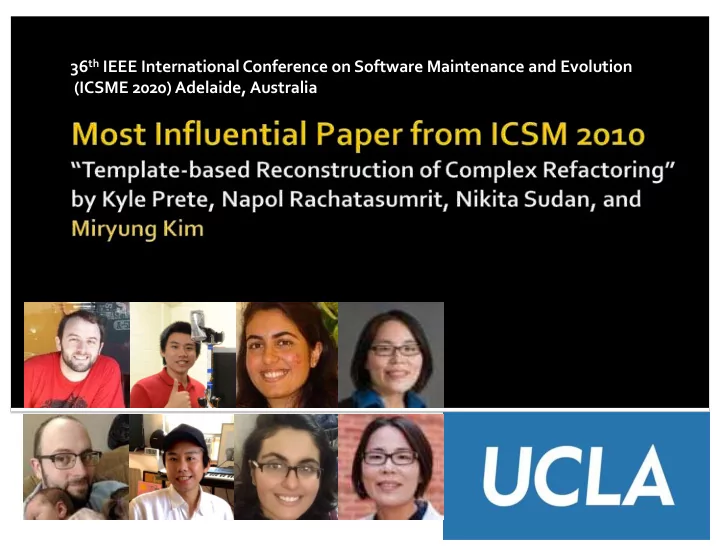
36th IEEE International Conference on Software Maintenance and Evolution (ICSME 2020) Adelaide, Australia
36 th IEEE International Conference on Software Maintenance and - - PowerPoint PPT Presentation
36 th IEEE International Conference on Software Maintenance and Evolution (ICSME 2020) Adelaide, Australia Air Travel Disruption from Earthquake, Port-au-Prince, Haiti Volcanic Eruption, Iceland ICSE 2010, South Africa, Cape Town Deadlines
36th IEEE International Conference on Software Maintenance and Evolution (ICSME 2020) Adelaide, Australia
Earthquake, Port-au-Prince, Haiti Air Travel Disruption from Volcanic Eruption, Iceland ICSE 2010, South Africa, Cape Town
Deadlines sketched on the white board Boxes of papers
A fresh graduate from Vanderbilt U in 2010
A sophomore in Math and ECE in 2010
Do you know how to program? Do you know Java? Could you please read this book and let me know your thoughts?
A fresh graduate from U Maryland in 2010
Analyses of Software Evolution
Automatic Inference of High-Level Change Descriptions
V1 V2
∆
High-level changes are often systematic at a code level
NameService { + public class CmiRegistry extends AbsRegistry implements NameService {
{ .... ...
Changed Code
File Name Status Lines DummyRegistry New 20 lines AbsRegistry New 133 lines JRMPRegistry Modified 123 lines JeremieRegistry Modified 52 lines JacORBCosNaming Modified 133 lines IIOPCosNaming Modified 50 lines CmiRegistry Modified 39 lines NameService Modified 197 lines NameServiceManager Modified 15 lines
Total Change: 9 files, 723 lines
∀m ∀t past_method(m, “setHost”, t) ∧ past_subtype(“Service”, t)
⇒ deleted_calls(m, “SQL.exec”) [except t=“NameSvc” m=”NameSvc.setHost”]
Each rule represents systematic changes by relating groups of change facts. These rules are automatically inferred using inductive logic programming.
CodeQuest: Querying Source Code with DataLog
Elnar Hajiyev1, Mathieu Verbaere1, Oege de Moor1 and Kris de Volder2
1 Programming Tools Group 2 Software Practices Lab
University of Oxford University of British Columbia United Kingdom Vancouver, Canada
elnar.hajiyev@comlab.ox.ac.uk, mathieu.verbaere@comlab.ox.ac.uk, kdvolder@cs.ubc.ca
Navigating and Querying Code Without Getting Lost
Doug Janzen and Kris De Volder
Department of Computer Science University of British Columbia 2366 Main Mall Vancouver BC Canada V6T 1Z4
dsjanzen,kdvolder@cs.ubc.ca
Maintaining software through intentional source-code views
Kim Mens
Département INGI
Louvain-la-Neuve, Belgium
Kim.Mens@info.ucl.ac.be Tom Mens
∗
Programming Technology Lab Vrije Universiteit Brussel Brussels, Belgium
Tom.Mens@vub.ac.be Michel Wermelinger
†
Departamento de Informática Universidade Nova de Lisboa 2829-516 Caparica, Portugal
mw@di.fct.unl.pt
Detecting Merging and Splitting using Origin Analysis
Lijie Zou and Michael W. Godfrey Software Architecture Group (SWAG) School of Computer Science, University of Waterloo lzou, migod @uwaterloo.ca
UMLDiff: An Algorithm for Object-Oriented Design Differencing
Zhenchang Xing and Eleni Stroulia
Computing Science Department University of Alberta Edmonton AB, T6G 2H1, Canada
{xing, stroulia}@cs.ualberta.ca
Automated Detection of Refactorings in Evolving Components
Danny Dig, Can Comertoglu, Darko Marinov, and Ralph Johnson
Department of Computer Science University of Illinois at Urbana-Champaign 201 N. Goodwin Ave. Urbana, IL 61801, USA {dig,comertog,marinov,johnson}@cs.uiuc.edu
Change Distilling: Tree Differencing for Fine- Grained Source Code Change Extraction
Beat Fluri, Student Member, IEEE, Michael Wu ¨rsch, Student Member, IEEE, Martin Pinzger, Member, IEEE, and Harald C. Gall, Member, IEEE
IEEE TRANSACTIONS ON SOFTWARE ENGINEERING,
NOVEMBER 2007 725
SpyWare: A Change-Aware Development Toolset
Romain Robbes
Faculty of Informatics, University of Lugano
Michele Lanza
Faculty of Informatics, University of Lugano
Statistical Relational Structure Learning Inductive Logic Programming Genetic Programming Heuristic Search Infer too many “uninteresting” change rules must encode inductive bias explicitly
“Template-based Reconstruction of Complex Refactoring”
logic rule
program versions
before composite refactorings
LSdiff Predicates Extended Predicates
package type methodbody conditional method field cast trycatch return fieldoftype throws variabledeclation typeintype accesses methodmodifiers fieldmodifiers calls subtype parameter similarbody(σ)* inheritedfield getter setter inheritedmethod addedparameter deletedparameter
difference
added_method(“Foo.summerCharge”, ...) added_method(“Foo.notSummer”, ...) deleted_conditional(“date.before(SUMMER_START). ..) Differences (∆FB)
added_* / deleted_*
New Program
after_*
type(“Bus”,..) method(“Bus.start”,”start”,”Bus”) access(“Key.on”,”Bus.start”) method(“Key.out”,”out”,”Key”)... type(“Foo”,..) method(“Foo.main”,”main”,”Foo”) conditional(“date.before(SUMMER_START)...) methodbody(“Foo.main”, ...)
Old Program
before_*
type(“Foo”,..) method(“Foo.main”,”main”,”Foo”) method (“Foo.notSummer(Date)”, “notSummer”, “Foo”)
A rule’s consequent refers to a target refactoring to be inferred.
(deleted_subtype(t1,t2) ∧(pull_up_field(f,t2,t1) ∨ pull_up_method(m,t2,t1))) ∨(before_subtype(t1,t2) ∧ deleted_type(t1,n,p) ∧(push_down_field(f,t1,t2) ∨ push_down_method(m,t1,t2)) collapse_hierarchy(t1,t2)
Example: collapse hierarchy refactoring—a superclass and its subclass are not very different. Merge them together.
A rule’s consequent refers to a target refactoring to be inferred.
A rule’s antecedent may refer to pre-requisite refactorings.
Example: collapse hierarchy refactoring—a superclass and its subclass are not very different. Merge them together.
(deleted_subtype(t1,t2) ∧(pull_up_field(f,t2,t1) ∨ pull_up_method(m,t2,t1))) ∨(before_subtype(t1,t2) ∧ deleted_type(t1,n,p) ∧(push_down_field(f,t1,t2) ∨ push_down_method(m,t1,t2)) collapse_hierarchy(t1,t2)
before_subtype(“Chart”,”PieChart”) deleted_subtype(“Chart”,”PieChart”) deleted_field(“PieChart.color”, “color”, “PieChart”) added_field(“Chart.color”, “color”, “Chart”) deleted_access(“PieChart.color”, “Chart.draw”) added_access(“Chart.color”, “Chart.draw”)
Fact-base
deleted_field(f1, f, t1) ∧ added_field(f2, f, t2) ∧ deleted_access(f1, m1) ∧ added_access(f2, m1) move_field(f, t1, t2)
Collapse Move Pull Up
before_subtype(“Chart”,”PieChart”) deleted_subtype(“Chart”,”PieChart”) deleted_field(“PieChart.color”, “color”, “PieChart”) added_field(“Chart.color”, “color”, “Chart”) deleted_access(“PieChart.color”, “Chart.draw”) added_access(“Chart.color”, “Chart.draw”)
Fact-base
deleted_field(f1, f, t1) ∧ added_field(f2, f, t2) ∧ deleted_access(f1, m1) ∧ added_access(f2, m1) move_field(f, t1, t2)
Collapse Move Pull Up
before_subtype(“Chart”,”PieChart”) deleted_subtype(“Chart”,”PieChart”) deleted_field(“PieChart.color”, “color”, “PieChart”) added_field(“Chart.color”, “color”, “Chart”) deleted_access(“PieChart.color”, “Chart.draw”) added_access(“Chart.color”, “Chart.draw”)
Fact-base
f1, f, t1, t2, f2, m1, deleted_field(f1, f, t1) ∧ added_field(f2, f, t2) ∧ deleted_access(f1, m1) ∧ added_access(f2, m1)?
Collapse Move Pull Up
before_subtype(“Chart”,”PieChart”) deleted_subtype(“Chart”,”PieChart”) deleted_field(“PieChart.color”, “color”, “PieChart”) added_field(“Chart.color”, “color”, “Chart”) deleted_access(“PieChart.color”, “Chart.draw”) added_access(“Chart.color”, “Chart.draw”) move_field(“color”, “PieChart”, “Chart”)
Fact-base
f=”color”, t1=”PieChart”, t2=”Chart” move_field(“color”, “PieChart”, “Chart”)
Collapse Move Pull Up
before_subtype(“Chart”,”PieChart”) deleted_subtype(“Chart”,”PieChart”) deleted_field(“PieChart.color”, “color”, “PieChart”) added_field(“Chart.color”, “color”, “Chart”) deleted_access(“PieChart.color”, “Chart.draw”) added_access(“Chart.color”, “Chart.draw”) move_field(“color”, “PieChart”, “Chart”)
Fact-base
move_field(f, t1, t2) ∧ before_subtype(t2,t1) pull_up_field(f, t1, t2)
Collapse Move Pull Up
move_field(f, t1, t2) ∧ before_subtype(t2,t1) pull_up_field(f, t1, t2)
before_subtype(“Chart”,”PieChart”) deleted_subtype(“Chart”,”PieChart”) deleted_field(“PieChart.color”, “color”, “PieChart”) added_field(“Chart.color”, “color”, “Chart”) deleted_access(“PieChart.color”, “Chart.draw”) added_access(“Chart.color”, “Chart.draw”) move_field(“color”, “PieChart”, “Chart”)
Fact-base
Collapse Move
Pull Up
before_subtype(“Chart”,”PieChart”) deleted_subtype(“Chart”,”PieChart”) deleted_field(“PieChart.color”, “color”, “PieChart”) added_field(“Chart.color”, “color”, “Chart”) deleted_access(“PieChart.color”, “Chart.draw”) added_access(“Chart.color”, “Chart.draw”) move_field(“color”, “PieChart”, “Chart”)
Fact-base
f, t1, t2, move_field(f, t1, t2) ∧ before_subtype(t2,t1)?
Collapse Move
Pull Up
before_subtype(“Chart”,”PieChart”) deleted_subtype(“Chart”,”PieChart”) deleted_field(“PieChart.color”, “color”, “PieChart”) added_field(“Chart.color”, “color”, “Chart”) deleted_access(“PieChart.color”, “Chart.draw”) added_access(“Chart.color”, “Chart.draw”) move_field(“color”, “PieChart”, “Chart”) pull_up_field(“color”, “PieChart”, “Chart”)
Fact-base
f=”color”, t1=”PieChart”, t2=”Chart” pull_up_field(“color”, “PieChart”, “Chart”)
Collapse Move
Pull Up
before_subtype(“Chart”,”PieChart”) deleted_subtype(“Chart”,”PieChart”) deleted_field(“PieChart.color”, “color”, “PieChart”) added_field(“Chart.color”, “color”, “Chart”) deleted_access(“PieChart.color”, “Chart.draw”) added_access(“Chart.color”, “Chart.draw”) move_field(“color”, “PieChart”, “Chart”) pull_up_field(“color”, “PieChart”, “Chart”)
Fact-base
collapse_hierarchy(“Chart”, “PieChart”)
Collapse Move
Pull Up
before_subtype(“Chart”,”PieChart”) deleted_subtype(“Chart”,”PieChart”) deleted_field(“PieChart.color”, “color”, “PieChart”) added_field(“Chart.color”, “color”, “Chart”) deleted_access(“PieChart.color”, “Chart.draw”) added_access(“Chart.color”, “Chart.draw”) move_field(“color”, “PieChart”, “Chart”) pull_up_field(“color”, “PieChart”, “Chart”) collapse_hierarchy(“Chart”, “PieChart”)
Fact-base
Move
Pull Up Collapse
Types Expected Found Precision Recall False negatives False Positives
1-10 8 19 1 1 11-20 9 20 0.95 1 extract method 21-30 9 12 1 1 31-40 10 13 1 0.9 preserve whole objects 41-50 9 11 1 0.89 replace conditionals with polymorphism 51-60 10 11 1 0.9 replace parameters with explicit methods 61-72 8 14 0.86 0.88 replace type code with state replace magic number with symbolic constants, extract method
Total 63 100 0.97 0.94
Ref-Finder finds refactorings with 97% precision and 94% recall.
Versions # Found Prec. Recall jEdit
3.0-3.0.1 10 0.75 0.78 3.0.1-3.0.2 1 1 1 3.0.2-3.1 214 0.45 1
Columba
300-352 43 0.52 0.9 352-449 209 0.91 1
Carol
62-63 12 1 1 389-421 8 0.63 1 421-422 147 0.64 0.9 429-430 48 0.85 1 430-480 37 0.81 1 480-481 11 0.91 0.9 548-576 20 1 1 576-764 14 0.85 1
Total 774 0.74 0.96
Ref-Finder finds refactorings with 74% precision and 96% recall.
Refactoring Reconstruction Tools for Realistic Refactoring Automated Clone Removal and Code Extraction Studies on Technical Debt, Code Smells, Refactoring Benefits Refactoring Recommendations Multi-Objective Search-based Refactoring Refactoring-Aware Code Review and Merging Accurate Refactoring Reconstruction Refactoring Error Detection Automated Change Documentation Refactoring-Aware Testing and Dynamic Analysis
Refactoring Reconstruction Tools for Realistic Refactoring Automated Clone Removal and Code Extraction Studies on Technical Debt, Code Smells, Refactoring Benefits Refactoring Recommendations Multi-Objective Search-based Refactoring Refactoring-Aware Code Review and Merging Accurate Refactoring Reconstruction Refactoring Error Detection Automated Change Documentation Refactoring-Aware Testing and Dynamic Analysis
How We Refactor, and How We Know It
Emerson Murphy-Hill Portland State University emerson@cs.pdx.edu Chris Parnin Georgia Institute of Technology chris.parnin@gatech.edu Andrew P. Black Portland State University black@cs.pdx.edu
Use, Disuse, and Misuse of Automated Refactorings
Mohsen Vakilian, Nicholas Chen, Stas Negara, Balaji Ambresh Rajkumar, Brian P. Bailey, Ralph E. Johnson University of Illinois at Urbana-Champaign Urbana, IL 61801, USA {mvakili2, nchen, snegara2, rajkuma1, bpbailey, rjohnson}@illinois.edu
A Comparative Study of Manual and Automated Refactorings
Stas Negara, Nicholas Chen, Mohsen Vakilian, Ralph E. Johnson, and Danny Dig
A Field Study of Refactoring Challenges and Benefits
Miryung Kim * miryung@ece.utexas.edu Thomas Zimmermann + tzimmer@microsoft.com Nachiappan Nagappan + nachin@microsoft.com
Reconciling Manual and Automatic Refactoring
Xi Ge Quinton L. DuBose Emerson Murphy-Hill Department of Computer Science, North Carolina State University, Raleigh, NC {xge, qldubose}@ncsu.edu, emerson@csc.ncsu.edu
WitchDoctor: IDE Support for Real-Time Auto-Completion of Refactorings
Stephen R. Foster UC San Diego La Jolla, CA srfoster@cs.ucsd.edu William G. Griswold UC San Diego La Jolla, CA wgg@cs.ucsd.edu Sorin Lerner UC San Diego La Jolla, CA lerner@cs.ucsd.edu
Manual Refactoring Changes with Automated Refactoring Validation
Xi Ge Emerson Murphy-Hill
RefDistiller: A Refactoring Aware Code Review Tool for Inspecting Manual Refactoring Edits
Everton L. G. Alves†‡ Myoungkyu Song† Miryung Kim§
University of Texas at Austin, USA† University of California, Los Angeles, USA§ Federal University of Campina Grande, Brazil‡
{everton, mksong1117}@utexas.edu, miryung@cs.ucla.edu
Refactoring Reconstruction
Tools for Realistic Refactoring Automated Clone Removal and Code Extraction Studies on Technical Debt, Code Smells, Refactoring Benefits Refactoring Recommendations Multi-Objective Search-based Refactoring Refactoring-Aware Code Review Accurate Refactoring Reconstruction Refactoring Error Detection Automated Change Documentation Refactoring-Aware Testing and Dynamic Analysis
RefFinder: An Extensible Framework for Refactoring Reconstruction
Professor Miryung Kim The University of Texas at Austin Type I Proposal (Requested Budget $25,000)
Studies on Refactoring Challenges & Benefits Re-architecting Windows MSR Visit & Collaboration
¡ We integrate RefFinder with FaultTracer
dynamic change impact analysis [ICSM’ 12]
¡ While refactoring edits are only 8% of
changes, 38% of affected tests are relevant to refactoring and a half of failed affected tests include refactoring edits.
From Right to Left Baishakhi Ray (PhD 2013 Assistant Prof @ Columbia) Detecting Recurring Changes and Errors Na Meng (PhD 2014 Assistant Prof @ Virginia Tech) Automating Recurring Changes & Clone Removal Tianyi Zhang (PhD 2019, Postdoc @ Harvard) Leveraging Redundancy for Code Review, Testing, API Usage Mining Muhammad Ali Gulzar (PhD 2020 Assistant Prof @ Virginia Tech) Debugging and Testing for Big Data Analytics Myoungkyu Song (Postdoc 2015 Assistant Prof @ Nebraska, Omaha) Error Detection in Refactoring Edits
ICSM 2009 Edmonton My first PC ICSM 2011 Williamsburg My first OC/ ERA co-chair ICSM 2012 Riva del Garda ICSME 2018 Madrid ICSME 2019 my first PC co-chair / my first SC ICSME 2013 Einhoven
36th IEEE International Conference on Software Maintenance and Evolution (ICSME 2020) Adelaide, Australia