
SLIDE 1
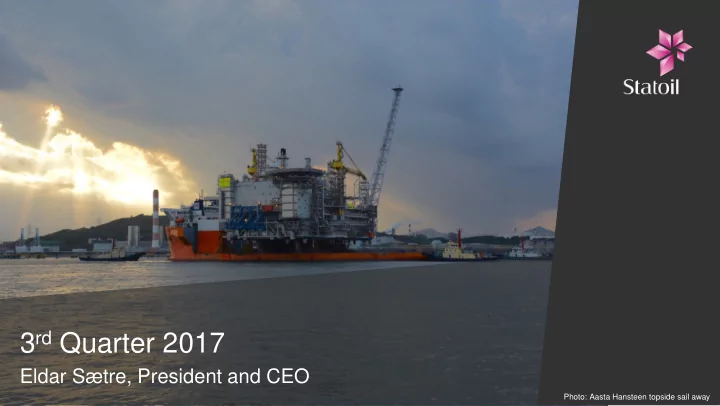
Photo: Aasta Hansteen topside sail away
3 rd Quarter 2017 Eldar Stre, President and CEO Photo: Aasta - - PowerPoint PPT Presentation
3 rd Quarter 2017 Eldar Stre, President and CEO Photo: Aasta Hansteen topside sail away Third quarter 2017 Solid adjusted earnings and underlying cash flow Good operational performance and high production 2017 production
Photo: Aasta Hansteen topside sail away
2
1) Third quarter 2017 is the last quarter in the two year AGM approved scrip program
Serious incidents per million work-hours, 12-month rolling figures 2,2 1,9 1,4 1,1 1,0 0,8 0,6 0,6 0,8 0,7 2008 2009 2010 2011 2012 2013 2014 2015 2016 3Q 2017
3
Net income Reported NOI Adjustments Adjusted earnings Tax on adj. earnings Adjusted earnings after tax
(478) 1,095 1,252 2,346 (1,527) 819 (427) 737 (101) 636 (897) (261)
USD mill
USD mill
1) E&P in respective underlying currency. Adjusted for change in principles for internal allocation of gas transportation costs, which has no NOI effect.
4
USD mill. Pre tax After tax Pre tax After tax Pre tax After tax
3Q’17
3Q’16
E&P Norway
1) OPEX / SG&A in NOK, adjusted for change in principles for internal allocation of gas transportation costs, which has no NOI effect.
E&P International
MMP
5
1 123 1 132 682 913 3Q 2016 3Q 2017
mboe/d
1,805 Liquids Gas 2,045
1) Organic production growth
6
2017 YTD; USD mill
1) Income before tax (8,276) + Non cash adjustments (6,673) Cash flow from
14,9491 Proceeds from sale of assets 403 Net 3,609 Taxes paid (3,304) Cash flows to investments (7,321) Dividends paid (1,118)
7
Organic capex
2017 USD ~10 billion1
Production
2016-2017 2016-2020 ~6% organic production growth ~3% organic CAGR
Maintenance
2017 4Q 2017 30 mboe per day 25 mboe per day
Exploration
2017 USD ~1.3 billion
Efficiency improvements
2017 USD 1 billion
Period Outlook
1) Based on USD/NOK exchange rate of 8.5
8
Photo: Aasta Hansteen topside sail away
adverse changes in tax regimes; the development and use of new technology; geological or technical difficulties; operational problems; operator error; inadequate insurance coverage; the lack of necessary transportation infrastructure when a field is in a remote location and other transportation problems; the actions of competitors; the actions of field partners; the actions of governments (including the Norwegian state as majority shareholder); counterparty defaults; natural disasters and adverse weather conditions, climate change, and other changes to business conditions; an inability to attract and retain personnel; relevant governmental approvals; industrial actions by workers and other factors discussed elsewhere in this report. Additional information, including information on factors that may affect Statoil's business, is contained in Statoil's Annual Report on Form 20-F for the year ended December 31, 2015, filed with the U.S. Securities and Exchange Commission, which can be found on Statoil's website at www.statoil.com. Although we believe that the expectations reflected in the forward-looking statements are reasonable, we cannot assure you that our future results, level of activity, performance or achievements will meet these
completeness of the forward-looking statements. Unless we are required by law to update these statements, we will not necessarily update any of these statements after the date of this report, either to make them conform to actual results or changes in our expectations. This report contains certain forward-looking statements that involve risks and uncertainties. In some cases, we use words such as "ambition", "continue", "could", "estimate", "expect", "focus", "likely", "may", "outlook", "plan", "strategy", "will", "guidance" and similar expressions to identify forward-looking statements. All statements other than statements of historical fact, including, among others, statements regarding plans and expectations with respect to market outlook and future economic projections and assumptions; Statoil’s focus on capital discipline; expected annual organic production through 2017; projections and future impact related to efficiency programmes; capital expenditure and exploration guidance for 2016; production guidance; Statoil’s value over volume strategy; Statoil’s plans with regard to its acquisition of 66% operated interest in the BM-S-8 offshore license in the Santos basin; Statoil’s expected report on helicopter safety on the Norwegian continental shelf; organic capital expenditure for 2016; Statoil’s intention to mature its portfolio; exploration and development activities, plans and expectations, including estimates regarding exploration activity levels; projected unit of production cost; equity production; planned maintenance and the effects thereof; impact of PSA effects; risks related to Statoil’s production guidance; accounting decisions and policy judgments and the impact thereof; expected dividend payments, the scrip dividend programme and the timing thereof; estimated provisions and liabilities; the projected impact or timing of administrative or governmental rules, standards, decisions, standards or laws, including with respect to the deviation notice issued by the Norwegian tax authorities and future impact of legal proceedings are forward-looking
could differ materially from those anticipated in the forward-looking statements for many reasons. These forward-looking statements reflect current views about future events and are, by their nature, subject to significant risks and uncertainties because they relate to events and depend on circumstances that will
materially from those expressed or implied by these forward-looking statements, including levels of industry product supply, demand and pricing; price and availability of alternative fuels; currency exchange rate and interest rate fluctuations; the political and economic policies of Norway and other oil-producing countries; EU developments; general economic conditions; political and social stability and economic growth in relevant areas of the world; global political events and actions, including war, political hostilities and terrorism; economic sanctions, security breaches; changes or uncertainty in or non-compliance with laws and governmental regulations; the timing of bringing new fields on stream; an inability to exploit growth or investment opportunities; material differences from reserves estimates; unsuccessful drilling; an inability to find and develop reserves; ineffectiveness of crisis management systems;
10