3 Short review Lecture no: NARROW-BAND CHANNELS WIDE-BAND - - PowerPoint PPT Presentation

3
SMART_READER_LITE
LIVE PREVIEW

3 Short review Lecture no: NARROW-BAND CHANNELS WIDE-BAND - - PowerPoint PPT Presentation

RADIO SYSTEMS ETI 051 Contents 3 Short review Lecture no: NARROW-BAND CHANNELS WIDE-BAND CHANNELS Radio signals and complex Delay (time) dispersion notation Narrow- versus wide-band Large-scale fading channels


slide-1
SLIDE 1

Ove Edfors, Department of Electrical and Information technology Ove.Edfors@eit.lth.se

RADIO SYSTEMS – ETI 051

Lecture no:

2010-03-23 Ove Edfors - ETI 051 1

3

Narrow- and wideband channels

2010-03-23 Ove Edfors - ETI 051 2

Contents

  • Short review

NARROW-BAND CHANNELS

  • Radio signals and complex

notation

  • Large-scale fading
  • Small-scale fading
  • Combining large- and small-

scale fading

  • Noise- and interference-

limited links WIDE-BAND CHANNELS

  • Delay (time) dispersion
  • Narrow- versus wide-band

channels

  • The WSSUS model

– Wide-sense stationary (US) – Uncorrelated scatterers (US) – Tapped delay line models

  • Condensed parameters

– Some system functions – Window parameters

2010-03-23 Ove Edfors - ETI 051 3

SHORT REVIEW

2010-03-23 Ove Edfors - ETI 051 4

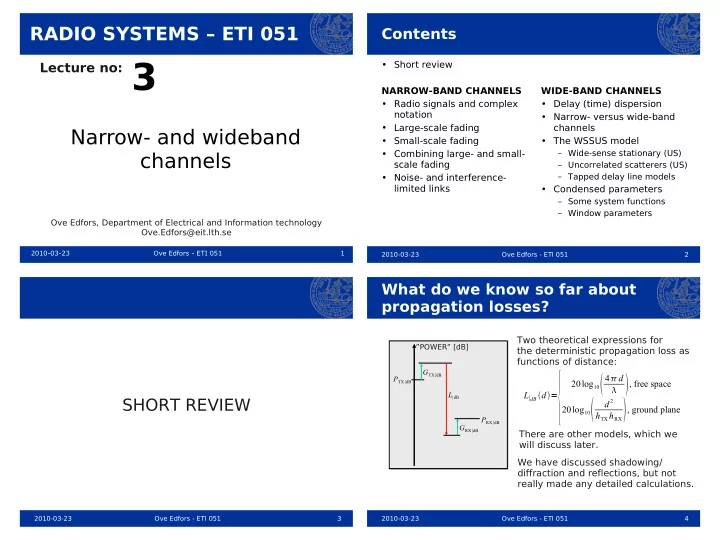
What do we know so far about propagation losses?

”POWER” [dB] PTX∣dB

Two theoretical expressions for the deterministic propagation loss as functions of distance: There are other models, which we will discuss later. We have discussed shadowing/ diffraction and reflections, but not really made any detailed calculations. L∣dB d={ 20log10 4d  , free space 20log10 d

2

hTXhRX, ground plane

GTX∣dB L∣dB GRX∣dB PRX∣dB

slide-2
SLIDE 2

2010-03-23 Ove Edfors - ETI 051 5

Statistical descriptions of the mobile radio channel

”POWER” [dB]

The propagation loss will change due to movements. These changes of the propagation loss will take place in two scales: Large-scale: shadowing, “slow” changes over many wavelengths. Small-scale: interference, “fast” changes on the scale of a wavelength. Now we are going to approach these variations from a statistical point of view.

PTX∣dB GTX∣dB L∣dB GRX∣dB PRX∣dB

2010-03-23 Ove Edfors - ETI 051 6

RADIO SIGNALS AND COMPLEX NOTATION

2010-03-23 Ove Edfors - ETI 051 7

Simple model of a radio signal

  • A transmitted radio signal can be written
  • By letting the transmitted information change the

amplitude, the frequency, or the phase, we get the tree basic types of digital modulation techniques

– ASK (Amplitude Shift Keying) – FSK (Frequency Shift Keying) – PSK (Phase Shift Keying)

( ) ( )

cos 2 s t A ft π φ = +

Amplitude Phase Frequency Constant amplitude

2010-03-23 Ove Edfors - ETI 051 8

The IQ modulator

  • 90
  • c

f

( )

I

s t

( )

Q

s t

( )

cos 2

c

f t π

( )

sin 2

c

f t π − I-channel Q-channel Transmited radio signal Complex envelope Take a step into the complex domain:

2

c

j f t

e

π

Carrier factor (in-phase) (quadrature) ( ) ( ) ( ) ( ) ( )

cos 2 sin 2

I c Q c

s t s t f t s t f t π π = −

 st=sIt j sQt st=Re { ste

j 2 f c t}

slide-3
SLIDE 3

2010-03-23 Ove Edfors - ETI 051 9

Interpreting the complex notation

I Q ( )

I

s t

Complex envelope (phasor) Polar coordinates:

 st=sIt j sQt=Ate

jt

( )

A t

( )

t φ

( )

Q

s t

Transmitted radio signal

By manipulating the amplitude A(t) and the phase Φ(t) of the complex envelope (phasor), we can create any type of modulation/radio signal.

 st

st = Re { ste

j 2 f c t}

= Re {Ate

jte j 2 f c t}

= Re {Ate

j2 f c tt}

= Atcos2 f ctt

2010-03-23 Ove Edfors - ETI 051 10

Example: Amplitude, phase and frequency modulation

4ASK 4PSK 4FSK

( ) ( ) ( )

( )

cos 2

c

s t A t f t t π φ = +

( )

A t

( )

t φ

00 01 11 00 10 00 01 11 00 10 00 01 11 00 10

  • Amplitude carries information
  • Phase constant (arbitrary)
  • Amplitude constant (arbitrary)
  • Phase carries information
  • Amplitude constant (arbitrary)
  • Phase slope (frequency)

carries information Comment:

2010-03-23 Ove Edfors - ETI 051 11

A narrowband system described in complex notation (noise free)

( )

exp 2

c

j f π

( ) ( )

( )

exp t j t α θ

( )

exp 2

c

j f π − Transmitter Receiver Channel Attenuation Phase

( )

x t

( )

y t

( ) ( ) ( ) ( )

( ) ( )

exp A t t j t t α φ θ = +

( ) ( ) ( )

( )

exp x t A t j t φ = In:

( ) ( ) ( )

( )

( ) ( ) ( )

( )

( )

exp exp 2 exp exp 2

c c

y t A t j t j f t t j t j f t φ π α θ π = − Out: It is the behaviour of the channel attenuation and phase we are going to model.

2010-03-23 Ove Edfors - ETI 051 12

LARGE-SCALE FADING

slide-4
SLIDE 4

2010-03-23 Ove Edfors - ETI 051 13

Large-scale fading Basic principle

d Movement Received power Position

A B C C

A B C D

2010-03-23 Ove Edfors - ETI 051 14

If these are considered random and independent, we should get a normal distribution in the dB domain.

Large-scale fading

More than one shadowing object

1

α

2

α

N

α

Signal path in terrain with several diffraction points adding extra attenuation to the pathloss. Total pathloss: Deterministic This is ONE explanation

Ltot=Ld ×1×2×⋯×N Ltot∣dB=Ld ∣dB1∣dB2∣dB⋯N∣dB

2010-03-23 Ove Edfors - ETI 051 15

Large-scale fading Log-normal distribution

Measurements confirm that in many situations, the large-scale fading of the received signal strength has a normal distribution in the dB domain.

”POWER” [dB] PTX∣dB PRX∣dB

Note dB scale dB

Deterministic mean value of path loss, L0

|d B

( )

|dB

pdf L

Standard deviation  F∣dB≈4−10 dB L∣dB

pdf  L∣dB= 1

2 F∣dB

exp− L∣dB−L0∣dB

2

2 F∣dB

2

2010-03-23 Ove Edfors - ETI 051 16

Large-scale fading Fading margin

We know that the path loss will vary around the deterministic value predicted. We need to design our system with a “margin” allowing us to handle higher path losses than the deterministic prediction. This margin is called a fading margin. Increasing the fading margin decreases the probability of outage, which is the probability that our system receive a too low power to operate correctly.

slide-5
SLIDE 5

2010-03-23 Ove Edfors - ETI 051 17

|dB

M

Fading margin Designing the system to handle an M|d

B higher loss than

predicted, lowers the probability of outage.

Large-scale fading Fading margin (cont.)

dB ( )

|dB

pdf L

0|dB

L The upper tail probability of a unit variance, zero-mean, Gaussian (normal) variable: Q y=∫

y ∞

1

2 exp− x

2

2 dx=1 2 erfc y

2

The complementary error-function can be found in e.g. MATLAB

Pout=Pr {L∣dBL0∣dBM ∣dB}=Q M ∣dB  F∣dB

2010-03-23 Ove Edfors - ETI 051 18

The Q(.)-function Upper-tail probabilities

4.265 0.00001 4.107 0.00002 4.013 0.00003 3.944 0.00004 3.891 0.00005 3.846 0.00006 3.808 0.00007 3.775 0.00008 3.746 0.00009 3.719 0.00010 3.540 0.00020 3.432 0.00030 3.353 0.00040 3.291 0.00050 3.239 0.00060 3.195 0.00070 3.156 0.00080 3.121 0.00090 3.090 0.00100 2.878 0.00200 2.748 0.00300 2.652 0.00400 2.576 0.00500 2.512 0.00600 2.457 0.00700 2.409 0.00800 2.366 0.00900 2.326 0.01000 2.054 0.02000 1.881 0.03000 1.751 0.04000 1.645 0.05000 1.555 0.06000 1.476 0.07000 1.405 0.08000 1.341 0.09000 1.282 0.10000 0.842 0.20000 0.524 0.30000 0.253 0.40000 0.000 0.50000

x Q(x) x Q(x) x Q(x)

2010-03-23 Ove Edfors - ETI 051 19

Large-scale fading A numeric example

How many dB fading margin, against σF

|d B = 7 dB log-normal fading, do

we need to obtain an outage probability of 0.5%?

0.5% 0.005 = =

Consulting the Q(.)-function table (or using a numeric software), we get

M∣dB  F∣dB =2.576 ⇒ M∣dB 7 =2.576⇒ M∣dB=18 Pout=Q M∣dB  F∣dB

2010-03-23 Ove Edfors - ETI 051 20

SMALL-SCALE FADING

slide-6
SLIDE 6

2010-03-23 Ove Edfors - ETI 051 21

Small-scale fading

Ilustration shown during Lecture 1

Illustration of interference pattern from above Transmitter Reflector

Movement

Position

A B

A B Received power [log scale]

Many reflectors ... let’s look at a simpler case!

2010-03-23 Ove Edfors - ETI 051 22

Small-scale fading Two waves

Wave 1 + Wave 2 Wave 2 Wave 1

λ

At least in this case, we can see that the interference pattern changes on the wavelength scale.

2010-03-23 Ove Edfors - ETI 051 23

Small-scale fading Many incoming waves

1 1

, r φ

2 2

, r φ

3 3

, r φ

4 4

, r φ

, r φ

( ) ( ) ( ) ( ) ( )

1 1 2 2 3 3 4 4

exp exp exp exp exp r j r j r j r j r j φ φ φ φ φ = + + +

1

r1

2

r

2

3

r

3

4

r

4

r

φ Many incoming waves with independent amplitudes and phases Add them up as phasors

2010-03-23 Ove Edfors - ETI 051 24

Small-scale fading Rayleigh fading

No dominant component (no line-of-sight)

2D Gaussian (zero mean) Tap distribution Amplitude distribution Rayleigh

1 2 3 0.2 0.4 0.6 0.8

r a =

No line-of-sight component TX RX X

( )

Im a

( )

Re a

pdf r= r 

2 exp− r 2

2

2

slide-7
SLIDE 7

2010-03-23 Ove Edfors - ETI 051 25

Small-scale fading Rayleigh fading – Fading margin

min

r

Probability that the amplitude r is below some threshold rm

in :

r

Rayleigh distribution

2

rms

r σ =

Fading margin

pdf r= r 

2 exp− r 2

2

2

M = rrms

2

rmin

2

M∣db=10log10 r rms

2

r min

2 

Pr rr min=∫

r min

pdf rdr=1−exp−rmin

2

r rms

2  2010-03-23 Ove Edfors - ETI 051 26

Small-scale fading A numeric example

How many dB fading margin, against Rayleigh fading, do we need to

  • btain an outage probability of 1%?

1% 0.01 = =

Some manipulation gives

1−0.01=exp−rmin

2

r rms

2 

M∣dB=20 Pr rr min=1−exp−rmin

2

rrms

2 

⇒ln0.99=−rmin

2

rrms

2

⇒ rmin

2

rrms

2 =−ln 0.99=0.01 ⇒ M = rrms 2

rmin

2 =1/0.01=100 2010-03-23 Ove Edfors - ETI 051 27

Small-scale fading Doppler shifts

c θ

Frequency of received signal: where the Doppler shift is

f = f 0 =− f 0 sRX c cos

Receiving antenna moves with speed sR

X at an angle θ relative

to the propagation direction

  • f the incoming wave, which

has frequency f0. [c = speed of light = 3x10⁸ m/s]

The maximal Doppler shift is

max= f 0 sRX c sRX

2010-03-23 Ove Edfors - ETI 051 28

Small-scale fading Doppler spectrum

max

f ν −

max

f ν + f Spectrum of received signal when a f0 Hz signal is transmitted. RX RX movement

Incoming waves from several directions (relative to movement or RX)

All waves of equal strength in this example, for simplicity.

1 1 2 2 3 3 4 4

slide-8
SLIDE 8

2010-03-23 Ove Edfors - ETI 051 29

Small-scale fading Doppler spectrum

Isotropic uncorrelated scattering RX Uniform incoming power distribution (isotropic) Uncorrelated amplitudes and phases Time correlaion

0.5 1 1.5 2

  • 0.5

0.5 1 max t

ν ∆

RX movement

 t =E {ata

*tt}~J0 2maxt 

2010-03-23 Ove Edfors - ETI 051 30

Small-scale fading The Doppler spectrum

max

f ν −

max

f ν + f

( )

D

S f ν −

For the uncorrelated scattering with uniform angular distribution

  • f incoming power (isotropic

scattering), we obtain the Doppler spectrum by Fourier transformation of the time correlation of the signal:

for

max max

ν ν ν − < <

Doppler spectrum at center frequency f0.

This is the ”classical” Doppler spectrum, a.k.a. the Jakes’ doppler spectrum.

S D=∫te

− j 2t d t

~ 1 max

2 − 2 2010-03-23 Ove Edfors - ETI 051 31

r min r min

Small-scale fading Fading dips

Time Received amplitude [dB]

rms

r

|dB

M

The larger the fading margin, the rarer the fading dips, and the shorter they are. Can we quantify these? The length and the frequency

  • f fading dips can be important

for the functionality of a radio system.

2010-03-23 Ove Edfors - ETI 051 32

Small-scale fading Statistics of fading dips

Frequency of the fading dips (normalized dips/second) Length of fading dips (normalized dip-length)

These curves are for Rayleigh fading and isotropic uncorrelated scattering (Jakes’ doppler spectrum).

slide-9
SLIDE 9

2010-03-23 Ove Edfors - ETI 051 33

Small-scale fading Rice fading

A dominant component (line of sight)

2D Gaussian (non-zero mean) Tap distribution A Line-of-sight (LOS) component with amplitude A. Amplitude distribution Rice

r=∣a∣

1 2 3 0.5 1 1.5 2 2.5

k = 30 k = 10 k = 0 TX RX

( )

Im a

( )

Re a

pdf r= r 

2 exp−r 2A 2

2

2 I0

r A 

2 

k= Power in LOS component Power in random components = A

2

2

2

2010-03-23 Ove Edfors - ETI 051 34

COMBINING LARGE- AND SMALL-SCALE FADING

2010-03-23 Ove Edfors - ETI 051 35

Large- and small-scale fading Combining the two

We have seen examples of how we can compute the required fading margins, due to large- and small-scale fading, given certain criteria (e.g. outage probability). If we have both types of fading, how do we combine them into a ”total” fading margin? Alternative 1 is the simple solution, but it will overdimension the system a bit. Alternative 2 is a much more complex

  • peration.

There are basically two options: 2) Derive the pdf (or cdf) of the total fading and calculate a single fading margin for both. 1) Calculate the fading margins separately and add them up.

We will start using Alternative 1

2010-03-23 Ove Edfors - ETI 051 36

NOISE- AND INTERFERENCE- LIMITED LINKS

slide-10
SLIDE 10

2010-03-23 Ove Edfors - ETI 051 37

Noise-limited system

Fading margin and the link budget

”POWER” [dB] PTX∣dB

0|dB

C

0|dB

L

( ) min|

/

dB

C N

|dB

N

|dB

M

Requirement for the receiver to operate properly. We use some propagation model to calculate a deterministic propagation loss.

F a d i n g F a d i n g

Variations in the environment and movements will cause variations in the the propagation loss, which will propagate to the instantaneous received power. To protect the receiver from too low received power, we add a fading margin.

min|dB

C

Noise reference level

2010-03-23 Ove Edfors - ETI 051 38

Interference-limited system Interference fadning margin

( ) min|

/

dB

C I

max

d

Distance

Without taking fading into account RX-A TX-A TX-B Received power [dB]

In interference limited systems, we are preliminary interested in how far from the transmitter we can be, without receiveing too much interference. Depending on the system design and requirements on quality, our receiver can tolerate a certain (C/I)m

in .

Taking fading into account

Assuming fading on the wanted and interfering signal we can calculate a fading margin M|d

B required to fulfill

som criterion on e.g. outage.

( )

| min|

/

dB dB

C I M + C I For independent log-normal fading, we can add the variances

  • f the two fading characteristics and get a “total” lognormal

fading with standard deviation:

2 2 | | | tot dB C dB I dB

σ σ σ = +

2010-03-23 Ove Edfors - ETI 051 39

DELAY (TIME) DISPERSION

2010-03-23 Ove Edfors - ETI 051 40

Delay (time) dispersion A simple case

τ τ

Transmitted impulse Received signal (channel impulse response)

( )

h τ

( ) ( ) ( ) ( )

1 1 2 2 3 3

h a a a τ δ τ τ δ τ τ δ τ τ = − + − + −

1

τ

1

a

2

τ

2

a

3

τ

3

a

slide-11
SLIDE 11

2010-03-23 Ove Edfors - ETI 051 41

Delay (time) dispersion

One reflection/path, many paths

τ ∆ 2 τ ∆ 3 τ ∆ 4 τ ∆

“Impulse response”

Each bin consists

  • f incoming waves

that are too close in time to resolve. What do we mean by “too close in time”?

Delay in excess

  • f direct path

Since each bin consists of contributions from several waves, each bin will fade if we introduce movement.

2010-03-23 Ove Edfors - ETI 051 42

Delay (time) dispersion Bandwidth and time-resolution

τ τ

Band-limiting to B Hz Radio systems are band-limited, which makes our infinitely short impulses become waveforms with a certain width in time.

1 B τ ∆ =

The time-width of the pulses is inversely proportional to the bandwidth.

2010-03-23 Ove Edfors - ETI 051 43

NARROW- VERSUS WIDE-BAND

2010-03-23 Ove Edfors - ETI 051 44

Narrow- versus wide-band Channel impulse response

The same radio propagation environment is experienced differently, depending on the system bandwidth. “High” BW “Medium” BW “Low” BW

( )

h τ

( )

h τ

( )

h τ

τ τ τ

slide-12
SLIDE 12

2010-03-23 Ove Edfors - ETI 051 45

2

B

A wide-band system (bandwidth B2) will however experience both frequency selectivity and delay dispersion.

1

B

A narrow-band system (bandwidth B1) will not experience any significant frequency selectivity or delay dispersion.

Narrow- versus wide-band Channel frequency response

( ) |dB

H f f

Note that narrow- or wide-band depends on the relation between the channel and the system

  • bandwidth. It is not an absolute measure.

2010-03-23 Ove Edfors - ETI 051 46

Narrow- versus wide-band

Let’s not forget the time-dependence!

We need to take absolute time t into consideration, as the channel will change when things move. The channel impulse response becomes:

( )

, h t τ

Measurement in hilly terrain at 900 MHz.

[Liebenow & Kuhlmann 1993] 2010-03-23 Ove Edfors - ETI 051 47

Narrow- versus wide-band Doppler spectrum and delay

Since the channel at each delay τ is the result of different propagation paths, we can have different Doppler spectra for each delay. Measurement in hilly terrain at 900 MHz. This effect is shown by the scattering function:

( )

,

S

P ν τ

(received power as function

  • f doppler shift and delay)

2010-03-23 Ove Edfors - ETI 051 48

Summary

NARROW-BAND CHANNELS

  • Complex notation with amplitude,

phase and complex envelope (phasor).

  • Large-scale fading with log-normal

distribution and calculation of fading margin.

  • Small-scale fading with Rayleig

and Rice distribution, calculation of fading margin.

  • Received signal maximal Doppler

shift, Doppler spectrum and time characteristics.

  • Fading margin in the link-budget
  • f noise limited systems.
  • Fading margin and maximal

distance for interference limited systems. WIDE-BAND CHANNELS

  • Instead of one (time varying)

channel coefficient, we have an entire (time varying) impulse response

  • Channel delay (time) dispersion

and frequency selectivity

  • Doppler spectrum as function of

delay, i.e. the scattering function

There is MUCH MORE to learn about this – which many of you have done in in the Channel Modeling course (ETI 085)!