10 years of observation for greenhouse gases by commercial airliner - - PowerPoint PPT Presentation

10 years of observation for greenhouse gases by
SMART_READER_LITE
LIVE PREVIEW

10 years of observation for greenhouse gases by commercial airliner - - PowerPoint PPT Presentation

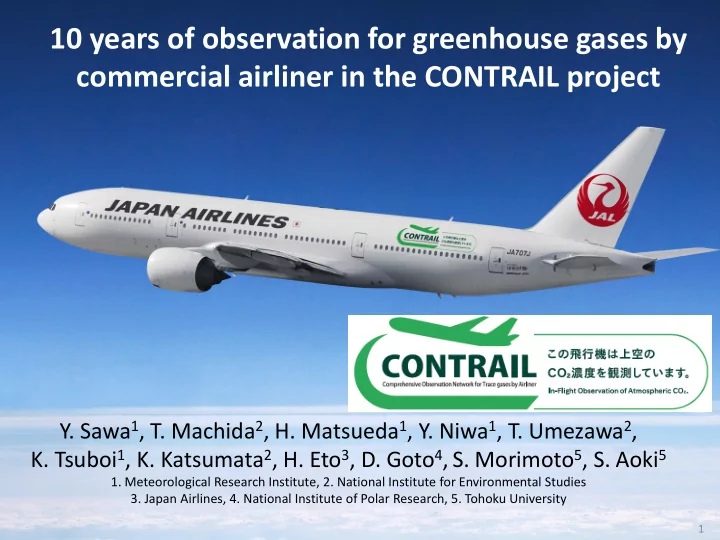
10 years of observation for greenhouse gases by commercial airliner in the CONTRAIL project Y. Sawa 1 , T. Machida 2 , H. Matsueda 1 , Y. Niwa 1 , T. Umezawa 2 , K. Tsuboi 1 , K. Katsumata 2 , H. Eto 3 , D. Goto 4 , S. Morimoto 5 , S. Aoki 5 1.


slide-1
SLIDE 1

10 years of observation for greenhouse gases by commercial airliner in the CONTRAIL project

  • Y. Sawa1, T. Machida2, H. Matsueda1, Y. Niwa1, T. Umezawa2,
  • K. Tsuboi1, K. Katsumata2, H. Eto3, D. Goto4, S. Morimoto5, S. Aoki5
  • 1. Meteorological Research Institute, 2. National Institute for Environmental Studies
  • 3. Japan Airlines, 4. National Institute of Polar Research, 5. Tohoku University

1

slide-2
SLIDE 2
  • 1. What is “CONTRAIL”
  • 2. Equipment
  • ASE, MSE, CME
  • 3. Results: seasonal CO2 distributions
  • 4. Inter-annual variations of CO2
  • 5. Summary
  • Accessibility of the data

2

Outline

slide-3
SLIDE 3
  • 1. What is “CONTRAIL”
  • Comprehensive Observation Network for TRace gases by AirLiner
  • NIES, MRI, JAL, JAMCO, JAL foundation

ASE CME

PI: Dr. Machida (NIES)

3

1. Flask samplings: Australia-Narita since 1993 (from former JAL project), Paris-Haneda since 2012 2. in-situ CO2 observations in wide regions since 2005

slide-4
SLIDE 4

ASE: Flask sampling for several greenhouse gases

  • get 12 air samples during the flight (once/twice a month)
  • mixing ratios of CO2, CH4, N2O, SF6, CO, and H2

– Isotope analysis of CO2, CH4 by NIES or Tohoku Univ. (Umezawa et al., 2012, ACP)

  • Long record more than 20 years between Australia and Japan (Matsueda et al., 2015, GRL)

Aft cargo room of 777-200ER

Machida et al., 2008, JTEC Matsueda et al., 2008, Pap. Meteorol. Geophys.

4

  • Can be installed on only 777-200ER
  • Not used in the regular flights to Europe, nor Australia (May, 2017)
  • 2. Equipment
slide-5
SLIDE 5

In case we can not use 777-200ER…

  • fill the data gap due to changes of aircraft assignment
  • sampled by one of 4 researchers (CDG) or JAL personnel (SYD)
  • use air-outlet nozzle in the cockpit on 777-300s
  • CDG-HND since Apr. 2014, SYD-NRT from Nov. 2015 to Mar. 2017

Manual Sampling Equipment

5

Under special support and permission by JAL, JCAB, …

  • Tough work; 12 samplings during a 12 hours flight, and 3 hours stay in CDG airport
  • My one-day trips to CDG: in Jan., Aug., and Oct. 2017.
slide-6
SLIDE 6

CME: High frequent CO2 observation

  • high resolutions

– 10 sec average during ascending/descending ~ 100 m in vertical – 1 min average during the cruising flight ~ 10 km in horizontal

  • 1-2 month operation (usually on 3 aircraft simultaneously)
  • real time control by aviation information (ARINC)
  • nboard calibrations; high accuracy ±0.2 ppm
  • Several modifications, update/amend FAA/STC (2008, 2011, 2014, 2015, 2017)

Forward cargo room of eight 777-200ERs, two 777-300s

in-situ CO2 measurement

Machida et al., 2008

6

slide-7
SLIDE 7
  • 3. Results: seasonal CO2 distributions
  • with larger amount of CO2

data (8 million data from 14000 flights)

  • wide distributions of CO2 in

the upper troposphere

10 50 100 500 1000 5000 10000 20000 50000 100000 200000 500000

Number of valid CME data Sawa et al., 2012, JGR

7

200000 400000 600000 800000 1000000 1200000 400 800 1200 1600 2000 2400 2005 2006 2007 2008 2009 2010 2011 2012 2013 2014 2015 2016 Number of CO2 data Number of flights

Number of CO2 data Number of flights Year

8km-tropopause

slide-8
SLIDE 8

Equivalent Latitude (deg)

Sawa et al., 2008, JGR

Potential Temperature (K) ∆Θ (K) tropopause

Updated from Sawa et al., 2015, GRL

More tropospheric influences in summer

Potential Temperature (K)

CO2 by CME by ASE & MSE Mar. Aug.

8

  • 3. Distributions in the Upper Troposphere/Lower Stratosphere
slide-9
SLIDE 9

Intensive Biomass Burnings in Indonesia in 2015

  • Oct. 21, 2015

Visible image from Himawari-8 (GMS) Singapore

Luckily, we have many CME flights to SIN both in 2014 and 2015

9

  • 4. Inter-annual variations of CO2
slide-10
SLIDE 10

Vertical profiles of CO2 over Singapore in Sep.-Oct.

10

descending ascending

Smaller vertical gradient in 2014 Higher CO2 at lower altitudes in 2015

larger increases ~ 3 ppm/year

slide-11
SLIDE 11

Can we detect inter-annual variations ?

2014 Number of CME-CO2 data in 2016

8km - tropopause

Example for number of data in 30S-20S from flights between Australia and Japan

Include ASE/MSE flights

Our observation largely depends on aircraft assignment

<-> surface stations, satellites

11

slide-12
SLIDE 12

Check robustness by sub-sampling method

Use all available flights

  • > linear trend,

climatological seasonal changes, anomaly, growth rates

30-20S,

Upper Troposphere between Australia and Japan

Similar growth rates

  • High representativeness in the region
  • may be trustworthy

all flights 30 % selection (20 cases)

Use 30 % of all flights by random selections

  • > linear trend,

climatological seasonal changes, anomaly, growth rates

X 20 cases

Deviations from fitting curve (ppm)

12

slide-13
SLIDE 13

Results over Eurasian continent ?

50-70N,10W-60E

Upper Troposphere(8km-tropopause) between Europe and Japan

Similar linear trend, Seasonal phase, amplitude

  • Based on 10 years observations

all flights 30 % selection (20 cases)

Less reliable for changes in growth rates

Especially after 2014 with less

  • bservations
  • Need more observations
  • for regions with large variabilities

13

slide-14
SLIDE 14

Effect from ENSO in 2015/2016 ?

Large anomalies in 2016 in western Pacific

  • Highest growth rates in these 10 years

Deviations from fitting curve (ppm)

10-20N,

Upper Troposphere, between Australia and Japan

50-70N,

Lower stratosphere (25 K <∆Θ <37.5K) From/to Europe/North America Anomalies in 2016 ?

Large growth rates 2015/2016

Still need to check for data in 2015-2016

  • CME stabilities, Standard gases
  • End effects, Dependencies on flight routes, ∆Θ analysis
  • Sub-sampling limitations with less data period/region

14

Delayed a bit ?

slide-15
SLIDE 15
  • 5. Summary
  • Observations for greenhouse gases by airliner
  • Flask samplings since 1993 over the western Pacific
  • In-situ CO2 observations over the past 10 years since 2005

– More than 8 million CO2 data from about 14000 flights – Spatial distributions and seasonal changes of CO2 in wide regions

  • Large anomalies of CO2 in 2016

– May reflect ENSO in 2015/2016 – Also need to check robustness of the trend analysis for end-effect, instrumentations such as standard gases

15

  • Please visit CONTRAIL WEB (http://www.cger.nies.go.jp/contrail/index.html)
  • Available according to the CONTRAIL data protocol

– Already provided to GOSAT, OCO-2 team, ...

  • Flask CO2 data(~Dec. 2015) are available at WDCGG/ObsPack
  • Just submitted updated CME data(~2010) to ObsPack
  • Plan to open the data at NIES server.
  • Contact PIs for recent data, other flask data, or details

CONTRAIL NIES Accessibility of the data

slide-16
SLIDE 16

Acknowledgements

  • many engineers in the Japan Airlines and JAMCO Tokyo
  • Dr. Katsumata, Ms. Matsuura, and Sandanbata (NIES) for sample analysis
  • Support by Environment Research and Technology Development Fund /

Global Environment Research Account for National Institutes of the Ministry

  • f the Environment in Japan
  • Support for sampling over Siberia by GRENE Arctic Climate Change Research

Project, and Arctic Challenge for Sustainability

16

the CONTRAIL logo on the Boeing 777-200ER (JA705J and JA707J).

slide-17
SLIDE 17

17

slide-18
SLIDE 18
  • Please visit CONTRAIL WEB (http://www.cger.nies.go.jp/contrail/index.html)
  • Available according to the CONTRAIL data protocol
  • Some part of Flask/CME data are available at WDCGG/ObsPack
  • Contact PIs for recent data, other flask data, or details

CONTRAIL data has been used in many works

18

1. GOSAT or other remote sensing validation

  • CO2 by TANSO-SWIR (Araki et al., 2010,

etc.)

  • CH4 by TANSO-SWIR (Inoue et al., 2014)
  • CH4 by TANSO-TIR (Saito et al., 2012)
  • TCCON (Wunch et al., 2010, etc.)
  • AIRS, IASI (Crevoisier et al., 2004; 2010)
  • TES (Kulawik et al., 2010)

2. Flux estimate with CONTRAIL data

  • Impact on India (Niwa et al., 2012)
  • Impact on China (Jiang et al., 2014)

3. Simulated CO2 validation

  • Assimilation system (Engelen et al., 2005)
  • Latitudinal CO2 distribution (Nassar et al.,

2010)

  • South Asia (Patra et al., 2011)
  • Latitudinal gradient (Miyazaki et al, 2009)
  • Time series over western Pacific (Feng et al.,

2011)

  • Multi model comparison (Niwa et al., 2011;

Houweling et al., 2015)

CONTRAIL NIES

4. Collaborative works with other programs

  • IAGOS (Volz-Thomas et al., 2009), CARIBIC

(Schuck et al., 2012), Tohoku Univ. (Ishijima et al., 2010, Umezawa et al., 2012)

Accessibility of the data