3/7/2018 Contemporary Definition Understanding the Standard of Care - - PDF document

3 7 2018
SMART_READER_LITE
LIVE PREVIEW

3/7/2018 Contemporary Definition Understanding the Standard of Care - - PDF document

3/7/2018 Contemporary Definition Understanding the Standard of Care of Sport-Related Concussion (SRC) for Managing Sport-Related Concussions - Including an Update Concussion( commotio Condensed from the 2012 definition cerebri ) a


slide-1
SLIDE 1

3/7/2018 1

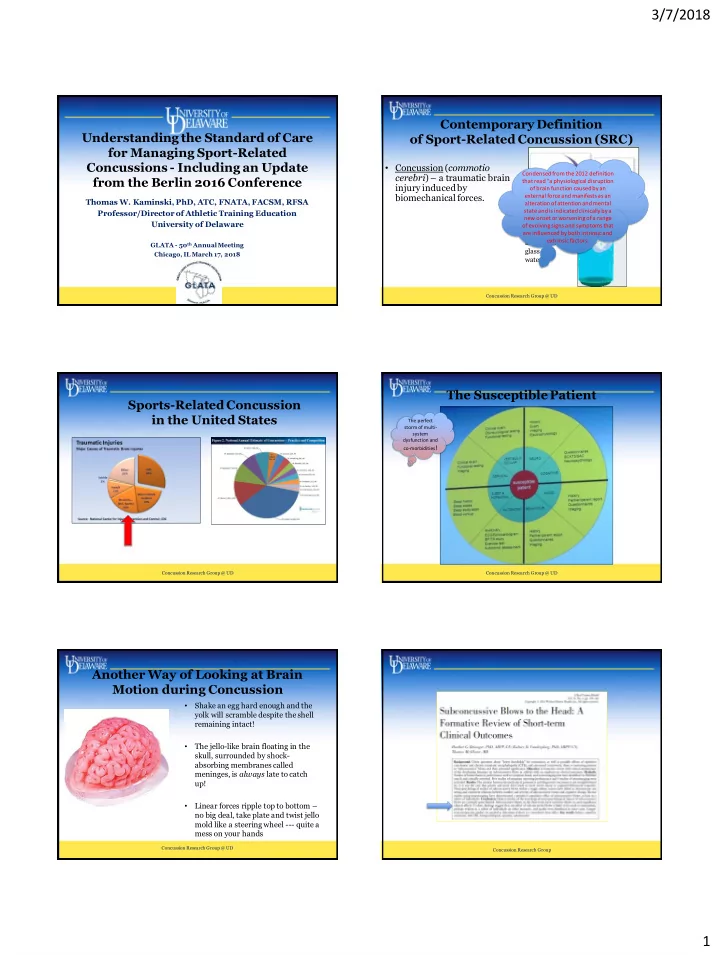
Understanding the Standard of Care for Managing Sport-Related Concussions - Including an Update from the Berlin 2016 Conference

Thomas W. Kaminski, PhD, ATC, FNATA, FACSM, RFSA Professor/Director of Athletic Training Education University of Delaware

GLATA - 50th Annual Meeting Chicago, IL March 17, 2018

Contemporary Definition

  • f Sport-Related Concussion (SRC)
  • Concussion(commotio

cerebri) – a traumatic brain injury induced by biomechanical forces.

Analogous to ice cubes in a glass of water!

Concussion Research Group @ UD

Condensed from the 2012 definition that read “a physiological disruption

  • f brain function caused by an

external force and manifests as an alteration of attention and mental state and is indicated clinically by a new onset or worsening of a range

  • f evolving signs and symptoms that

are influenced by both intrinsic and extrinsic factors.

Sports-Related Concussion in the United States

Concussion Research Group @ UD

The Susceptible Patient

Concussion Research Group @ UD The perfect storm of multi-

system dysfunction and co-morbidities!

Another Way of Looking at Brain Motion during Concussion

  • Shake an egg hard enough and the

yolk will scramble despite the shell remaining intact!

  • The jello-like brain floating in the

skull, surrounded by shock- absorbing membranes called meninges, is always late to catch up!

  • Linear forces ripple top to bottom –

no big deal, take plate and twist jello mold like a steering wheel --- quite a mess on your hands

Concussion Research Group @ UD Concussion Research Group

slide-2
SLIDE 2

3/7/2018 2

Diverse Medical Community Involved with Sport-Related Concussion Management

  • There is much variation in the

knowledge of health care providers managing concussed athletes. Need to make sure the person clearing for return-to-sport is current with knowledge! – Physicians (MD/DO) – Physician Assistants – Nurse Practitioners – Chiropractors – Athletic Trainers – School Nurses – Physical Therapists – Neuropsychologists

  • New and emerging research and

technologies will lead to a continuing evolution of care

Concussion Research Group @ UD

Extent of the Problem

  • Professional/collegiate

athletes get a great deal of attention- but just tip of iceberg!

– ≈1700 NFL players – ≈12,000 Collegiate players (NCAA D-I)

  • Much more common in US

high school than any other level- due to large number of participants – HS Sports Participants

  • Football- 1.14 million
  • Boys Soccer- 384,000
  • Girls Soccer- 345,000
  • Boys Basketball - 545,000
  • Girls Basketball - 444,000

Concussion Research Group @ UD

Not Just a Football (or a “guy”) Problem

Concussion Research Group @ UD

What has happened to make this such a big deal?

  • THE MEDIA!!
  • BETTER

SCIENCE/RESEARCH!

  • High profile cases

– Second-Impact Syndrome (SIS)

  • Death or devastating

brain damage when having a second injury when not healed from the first – Long-term effects

  • Possible long-term

effects - dementia, depression, CTE

Concussion Research Group @ UD

https://www.youtube.com/watch?v=9TrCZcsSyA8 Zac Easter Story (Iowa)

Problems for Athletes- Post-Concussion Syndrome

  • 85-90% of concussed

young athletes will recover within 1 to 2 weeks

  • The remainder may

have symptoms lasting from weeks to months interfering with school and daily life

  • Subtle deficits may

persist a lifetime

Concussion Research Group @ UD

Part I – The Legal Stuff

– Terminology:

  • Liability – legal responsibility!

– Check your job description and duties as either a physical educator or coach (or both)

  • Standard of Care - the legal duty to provide health

care services consistent with what other health care practitioners of the same training, education, and credentialing would provide under the circumstances

Concussion Research Group @ UD

slide-3
SLIDE 3

3/7/2018 3 Strategies for Avoiding Legal Liability

  • Build relationships
  • Insist on a written contract
  • Obtain informed consent
  • Provide physical exams
  • Know the profession and its

standards

  • Document hazards

Concussion Research Group @ UD

Strategies for Avoiding Legal Liability

  • Establish policies
  • Document activities
  • Maintain confidentiality
  • Provide proper instruction
  • Supervise your staff
  • Participate in CE
  • Recognize your qualifications
  • Maintain insurance coverage

Concussion Research Group @ UD

No Need to Worry I’m Well-Versed in Treating Sport-Related Concussion!

  • With more attention in the media on SRC’s the public has become

more educated about the problem (some high-profile athletes involved)

  • ATC’s (and others) have become a popular target of lawsuits alleging

failures to meet the “standard of care”.

  • In cases of unfortunate events the actions (or inactions) of the ATC,

coach, physical educator are likely to be second guessed or blamed.

Concussion Research Group @ UD

Legal Attacks Typically Involve:

  • The evaluation or testing of an athlete (or lack

thereof)

  • Documentation of the injury
  • Communication with the athlete or with a

physician about an athlete

  • Education of the athlete

Concussion Research Group @ UD

Federal Regulations

  • n the Horizon?

Concussion Research Group @ UD

H.R.2062 - Protecting Student Athletes From Concussions Act of 2015 H.R.829 - SAFE PLAY Act H.R.4460 - Youth Sports Concussion Act

State Legislators Want a Piece of the Action Too!

Concussion Research Group @ UD

http://www.ncsl.org/research/health/traumatic-brain-injury-legislation.aspx

slide-4
SLIDE 4

3/7/2018 4

State Concussion Legislation

  • Most state legislation follows these main

components:

– Improve education on concussion and increase awareness – Immediate removal of any athlete suspected of sustaining a concussion (coach, athletic trainer or

  • ther medical personnel)

– Cannot return-to-activity until properly cleared (individuals capable of clearing athletes differ from state to state)

Concussion Research Group @ UD

Will This Legislation Change Things?

  • Policy Evaluation of State Youth Sports

Concussion/Return to Play Legislation

– Cloudburst has been awarded a contract with the Centers for Disease Control and Prevention (CDC), National Center for Injury Prevention and Control (NCIPC) to conduct a policy evaluation of the implementation of state youth sports concussion/return to play laws, to report on and develop materials to disseminate key findings. Cloudburst will assess the implementation of youth sports concussion/return to play legislation from two states with existing legislation. Following completion of the evaluation, a report shall be created and a presentation shall be made to NCIPC that clearly demonstrates findings, promising practices, and unintended consequences of the state legislation implementation efforts.

Concussion Research Group @ UD

http://www.cloudburstgroup.com/

So What’s The Big Deal for ME?

Concussion Research Group @ UD

What Exactly is the Standard of Care?

Concussion Research Group @ UD

What Does the BOC Have to Say About the “Standard of Care”?

Concussion Research Group @ UD Concussion Research Group @ UD

slide-5
SLIDE 5

3/7/2018 5

Berlin 2016 Consensus Statement

Concussion Research Group @ UD

NATA Position Statement

Concussion Research Group @ UD

NCAA Sports Medicine Handbook

Concussion Research Group @ UD

NAIA Athletic Trainers Manual

Concussion Research Group @ UD

National Federation of State High School Associations

Concussion Research Group @ UD

http://www.nfhs.org/resources/ sports-medicine/ NFHS Learning Center: Concussion in Sports – What You Need to Know

What Should YOU be Doing with Regard to SRC Assessment and Evaluation?

Concussion Research Group @ UD

slide-6
SLIDE 6

3/7/2018 6

5th International Consensus Conference on Concussion in Sport – Berlin, Germany 2016

Concussion Research Group

A series of 12 questions and sub-questions were developed and the expert panel members were required to perform a systematic review to answer each question. Following presentation at the Berlin meeting of the systematic review, poster abstracts and audience discussion, the summary Consensus Statement was produced. Further, a series of tools for the management of sport-related concussion was developed, including the Sport Concussion Assessment Tool Fifth edition (SCAT5), the Child SCAT5, and the Concussion Recognition Tool Fifth edition.

A Must Read

Concussion Research Group

11 “R’s” of SRC Management

What is the definition of concussion?

  • What are the critical clinical criteria for an operational

definition of concussion?

  • What do the biomechanics studies tell us about sports

concussion?

Concussion Research Group

Recognize

What are the critical elements of sideline screening that can be used to establish the diagnosis of concussion?

  • Signs from the sidelines (“slow to get up”, blank/vacant

stare, gait ataxia, unresponsiveness)

  • What is the role of technology (eg, impact sensors,

accelerometers, video analysis for observable signs) to assist in sideline diagnosis?

Concussion Research Group

Remove

Recognize

What tests and measures should be added to the SCAT3 and related tests to improve their reliability, sensitivity, and/or specificity in sideline concussion diagnosis?

  • How do we account for cultural factors in these tests?
  • Is there a role for multiple test versions for different time

points?

  • How does Child SCAT3 version differ?

Concussion Research Group

Re-evaluate SCAT5

Maddocks D, Dicker G. An objective measure

  • f recovery from concussion in Australian

rules footballers. Sports Health 1989; 7: 6-7. Concussion Research Group

If you look closely you will see that essentially nothing has really changed in terms of the tests administered for the SCAT, however, they did improve the

  • verall design of the

testing materials and it seems like from first looks that it should be easier to use.

slide-7
SLIDE 7

3/7/2018 7

What domains of clinical function should be assessed post-injury? (eg cognitive, somatic, oculomotor, sleep, postural stability, vestibular, cervical spine)

  • What is the evidence for these approaches?
  • What tools/examination techniques should be used, and when?
  • When is it appropriate to do baseline testing to assist in the

interpretation of post-injury tests?

  • Athletic Trainers need to become proficient at basic vestibular &
  • culomotor screening techniques (NPC, VOMS, Tandem Gait)

Concussion Research Group

Re-evaluate What advanced or novel tests can assist in the evaluation of concussion?

  • What is the role for advanced neuroimaging?
  • What is the role for cerebrospinal fluid and blood

biomarkers?

  • What is the role for genetic or epigenetic testing?

Concussion Research Group

Re-evaluate What is the evidence for and efficacy of specific treatment interventions?

(For eg, active rehabilitation, pharmacological therapy, and rehabilitation techniques for SRC).

  • What is the optimal length of cognitive and physical rest?
  • Symptoms of headache, neck pain, feeling slowed down

are predictive of longer recoveries

  • “Stand Down Time” (i.e. RTP) should be determined by

multimodal clinical assessments

Concussion Research Group

Rehabilitation

Rest Refer

Berlin Group (2016) – Graduated RTP Protocol

What is the time course of physiological recovery after sports concussion?

  • How does it compare to published data on time course of

clinical recovery?

  • Should there be a mandatory minimum stand-down

period post-injury?

  • Is there evidence supporting a change in the duration or

content of the graded return to play?

Concussion Research Group

Recovery

Return-to- Sport What are the key modifiers of concussion outcomes?

  • What factors are associated with a poorer prognosis or

future risk following concussion?

  • How do we best quantify the role of these modifiers?
  • How many concussions are too many?
  • How do sex differences impact concussion management?

Concussion Research Group

Re-evaluate

slide-8
SLIDE 8

3/7/2018 8

What is the difference in concussion management in children as compared to adults?

  • What factors must be considered in ‘return to school’

following concussion and what strategy or accommodations should be followed?

Concussion Research Group

Reconsider

What is the best approach to investigation and treatment of persistent postconcussive symptoms?

  • What are the key domains that need to be evaluated as

part of complete concussion care in the context of prolonged recovery?

  • What skills and expertise are appropriate to assess these

domains?

Concussion Research Group

Re-evaluate What is the current state of the scientific evidence about the prevalence, risk factors, and causation of possible long-term sequelae like CTE and other neurodegenerative diseases, with respect to sports concussion?

  • What are the definition, clinical features, and underlying

pathophysiology (if any) of “subconcussive blows” and how can they be measured and monitored?

  • What have we learned from the retired athlete

population?

Concussion Research Group

Residual Effects and Sequela What strategies can be used to effectively

reduce the risk of concussion in sport?

(For eg, protective equipment, neck strengthening, and policy/rule changes)

Concussion Research Group

Risk Reduction

Clinical Evaluation Tips

  • Take your Time
  • Take them Seriously
  • Make it Personal
  • Make it Technical
  • Take Responsibility

Concussion Research Group @ UD Concussion Research Group @ UD

The Concussion Solution

Prevention

  • Education, Training, Risk

Modification Impact Biomechanics (Impact Sensors) Acute Dx

  • Fluid biomarkers?
  • Neuroimaging?

CONCUSSION

  • Rule Changes
  • Behavior Modification
  • Cervical Muscle

Strengthening

  • Visual Training
  • New Materials & Helmet

Design Changes

Acute Tx

  • Rest vs. Active

Rehab?

  • Pharmacotherapy?
  • Omega 3-FA?
  • Hyperbarics?

Symptoms

Neurocognitive Function

Balance Vision?

slide-9
SLIDE 9

3/7/2018 9

NCAA/DOD CARE Project

Concussion Research Group @ UD

Current enrollment 39,000 + Concussion 3,000+ Care 2.0 begins 2018-19 SY --- stay tuned CARE LONG!

Grand Alliance

Concussion Research Group @ UD Concussion Research Group @ UD

What About Educational Programming

Concussion in Sports - What You Need To Know

Concussion Research Group @ UD

http://www.nfhslearn.com/electiveDetail .aspx?courseID=38000 Concussion in Sports NCAA Sports Science Institute http://www.ncaa.org/health-and- safety/medical-conditions/concussion- sports

CDC: Heads Up: Concussion in High School Sports

http://www.cdc.gov/concus sion/HeadsUp/youth.html

Concussion Research Group @ UD

NATA’s Concussion 101

Concussion Research Group @ UD

slide-10
SLIDE 10

3/7/2018 10

ThinkFirst-SportSmart Concussion Education and Awareness Program

http://parachutecanada.org/

Concussion Research Group @ UD

Nationwide Children’s Hospital: A Coaches Guide to Concussions

Concussion Research Group @ UD

http://www.nationwidechildrens.org/coachs- guide-to-concussions

A YouTube Video Worth Checking Out (Simplifies Sport-Related Concussion)

Concussion Research Group @ UD

http://www.youtube.com/watch? v=zCCD52Pty4A Concussions 101, a Primer for Kids and Parents - Dr. Mike Evans

Suggested Roles and Responsibilities

  • f the School Concussion Management

Team and School Personnel

(High School & Middle School environments)

  • Certified athletic trainer (ATC)
  • Student-athlete
  • Parents and guardians
  • School administrator
  • School medical advisor
  • Licensed health care professional
  • School nurse
  • Director of physical education and/or athletic director (AD)
  • Coach
  • Teacher/school counselor/school psychologist

Concussion Research Group @ UD

http://www.p12.nysed.gov/sss/schoolhealth/schoolhealthservices/Concu ssionManageGuidelines.pdf

Return to Learn Considerations

Concussion Research Group @ UD

Importance of ‘Return-to-Learn’ in Pediatric and Adolescent Concussion Christina L. Master, MD; Gerard A. Gioia, PhD; John J. Leddy, MD; Matthew F. Grady, MD

  • Pediatric Annals
  • September 2012 -

Volume 41 · Issue 9: e180-e185

The concept of “return-to-play” after concussion is familiar to pediatricians who routinely care for injured student-athletes. Premature return-to-play of a student-athlete who is still injured from a concussion may result in more severe and potentially long-lasting deficits. In contrast, “return-to-learn” plans for student-athletes have not received as much attention, perhaps because so much regarding concussion awareness comes from lay reports of professional athletes who play a sport for their livelihood, as compared with pediatric and adolescent- aged athletes for whom school is their primary “work.” Pediatric and adolescent concussions have many unique features requiring special attention from the pediatrician in terms of diagnosis and management. This article addresses the importance of properly timing school re-entry.

  • 1. Prescribe physical and cognitive rest for pediatric and adolescent

concussion.

  • 2. Implement a gradual “return-to-learn” plan for student-athletes after

concussion.

  • 3. Communicate specific school-based accommodations to facilitate a

gradual reintegration to full school activities

One Final Thought – Can We Change Attitudes about Concussions at an Early Age by Utilizing Instruction by Health Educators?

  • Children’s perceptions can be molded during their early years; so

perhaps a good time to introduce concussion awareness instruction in PE and Health classes between 3rd – 5th grade?

  • The concept I propose is a “mini-model” on concussion awareness:

– When to suspect a concussion? – Who do I report it to? – What are the consequences of undiagnosed and untreated concussions?

  • Could this work?

Concussion Research Group @ UD

slide-11
SLIDE 11

3/7/2018 11

You Must Have Some Questions????

Concussion Research Group @ UD

Thank You

Concussion Research Group @ UD