3/5/2020 Mixture of natural streamflow and wastewater for Blanco - - PDF document

3 5 2020
SMART_READER_LITE
LIVE PREVIEW

3/5/2020 Mixture of natural streamflow and wastewater for Blanco - - PDF document

3/5/2020 Mixture of natural streamflow and wastewater for Blanco River General threats to water quality and human Blanco WWTP outfall health from proposed municipal Final Permit request to discharge 1.6 mgd wastewater discharges by the City


slide-1
SLIDE 1

3/5/2020 1

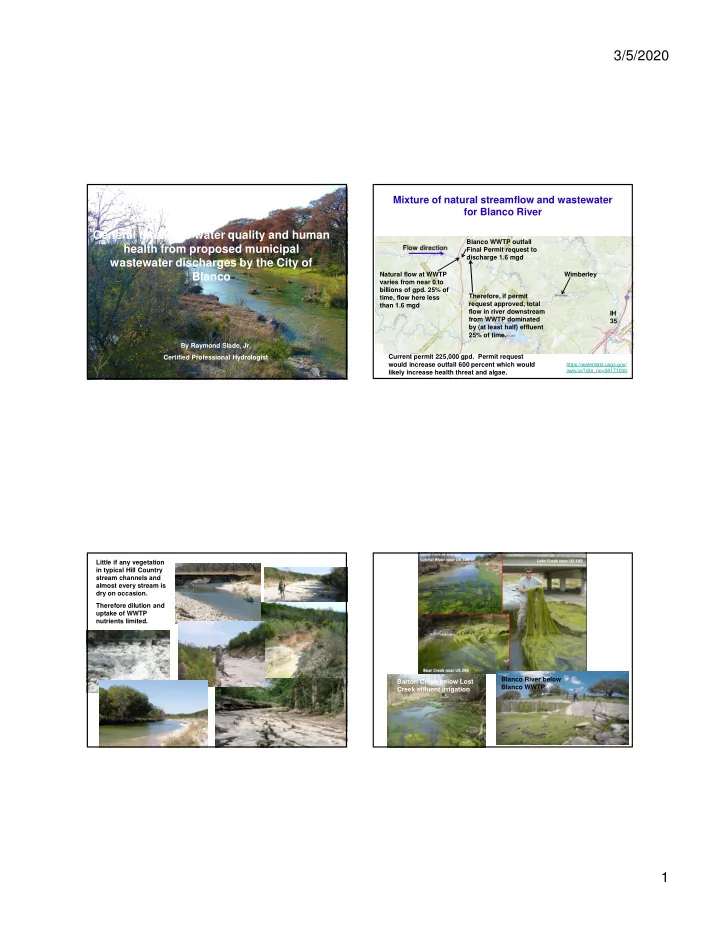
General threats to water quality and human health from proposed municipal wastewater discharges by the City of Blanco

By Raymond Slade, Jr, Certified Professional Hydrologist

Mixture of natural streamflow and wastewater for Blanco River

https://waterdata.usgs.gov/ nwis/uv?site_no=08171000

Natural flow at WWTP varies from near 0 to billions of gpd. 25% of time, flow here less than 1.6 mgd IH 35 Blanco WWTP outfall Final Permit request to discharge 1.6 mgd Therefore, if permit request approved, total flow in river downstream from WWTP dominated by (at least half) effluent 25% of time. Wimberley Current permit 225,000 gpd. Permit request would increase outfall 600 percent which would likely increase health threat and algae. Little if any vegetation in typical Hill Country stream channels and almost every stream is dry on occasion. Therefore dilution and uptake of WWTP nutrients limited. Barton Creek below Lost Creek effluent irrigation Blanco River below Blanco WWTP

slide-2
SLIDE 2

3/5/2020 2

TCEQ sponsors USGS study of water quality for Tx Hill Country streams receiving effluent discharges

  • Study done 12 years ago and 16 streams sampled
  • Total N values for streams with wastewater 5 times greater than

streams without wastewater

  • Total P in streams with wastewater 183 times greater than

streams without wastewater

  • Median total nitrogen value for samples from wastewater

streams 6 times greater than level causing eutrophication

  • Median total phosphorus value for samples from wastewater

streams 48 times greater than level causing eutrophication

https://pubs.usgs.gov/sir/2007/5195/

Major water-quality threats from wastewater discharge due to missing or lax rules

  • 1. Permits do not address many pollutants in wastewater
  • 2. Wastewater quality limits are too lax
  • 3. Permits issued despite evidence that the discharge would threaten

downstream waters

  • 4. Improper water-quality monitoring of wastewater to assure

compliance

  • 5. Lack of monitoring of receiving surfacewater or groundwater for

contamination from wastewater

  • 6. No limit on phosphate levels in non-laundry detergents
  • 7. Lack of effective TCEQ management of wastewater facilities

Compliance and enforcement for municipal wastewater discharge permits within the Texas Hill Country

http://www.hillcountryalliance.org/wp-content/uploads/2018/09/TRDES_TCEQPermitViolations_Slade_2018.pdf

  • The permitted discharge for the 48 facilities totals about 303 million

gallons per day--9 times greater than the mean flow from Barton Springs.

  • 31 of the 48 facilities were non compliant as of September 22, 2018.
  • During the past 3 years, the facilities in New Braunfels, Kyle and

Pflugerville had the most number of effluent violations with 129, 50 and 36 respectively.

  • About 1/3 of the facilities (15 0f 48) had only one on-site inspection during

the past 5 years.

  • During the past 3 years, the 48 facilities had 411 violations, an average of

8.6 violations per facility.

  • Despite 411 violations in the past 3 years, only 38 formal enforcement

actions were issued during the past 5 years.

Blanco WWTP compliance

2018 FY 2019FY Significant noncompliance every quarter. Data not reported

slide-3
SLIDE 3

3/5/2020 3

  • E. Coli. bacteria immediately downstream from

Blanco WWTP outfall

Best fit linear trend indicates 75% increase from 1997-2018

EPA recommended limit for recreational waters (126): 4% illness at this level 10% of samples exceed EPA limit

All water-quality data from TCEQ sampling site 12668

https://www80.tceq.texas.gov/SwqmisWeb/public/crpweb.faces

Year

Total suspended solids during low-flow conditions on the Blanco River immediately downstream from the Blanco WWTP outfall

Best fit linear trend All water-quality data from TCEQ sampling site 12668

https://www80.tceq.texas.gov/SwqmisWeb/public/crpweb.faces

Based on trend line, TSS values have more than tripled since 1997

3

USGS streamflow studies show 9 mgd lost in Blanco R. channel from Chimney Valley Road to San Marcos Within 1/2 mile of river from WWTP to San Marcos are at least 200 water-supply wells including 13 public water-supply wells Public Water Supply Number of wells LSR WSC 1 John Knox Ranch Camp 1 El Rancho CIMA 3 Cedar Oak Mesa WSC 2 Wimberley 4 Granite Creek WSC 2 Wells within 1/2 mile of the Blanco River downstream from WWTP could received effluent from the river.

Blanco

Water wells in upper part of Blanco River area

Wells within 1/2 mile of river shown in green

https://pubs.usgs.gov/of/2002/ofr02-068/

Wells within 1/2 mile of the Blanco River in lower part of Blanco River area

San Marcos Wimberley

https://www2.twdb.texas.gov/apps/waterdataint eractive/GroundwaterDataViewer/?map=desal

slide-4
SLIDE 4

3/5/2020 4

Emerging contaminants

  • Wastewater discharges contain many pharmaceuticals,

personal care products, surfactants, various industrial additives, and numerous organic chemicals identified as Endocrine Disrupting Chemicals (EDCs).

  • U.S. Geological Survey studies downstream from 10

wastewater treatment plants documented 78 EDCs in wastewater discharges, of which 37 are prevalent in most such discharges.

http://digitalcommons.unl.edu/usgsstaffpub/66 https://toxics.usgs.gov/highlights/whatsin.html

Google search of “EDC’s in wastewater” identified 614,000 hits

Large portion of many drugs not metabolized thus are excreted Unused drugs often disposed by flushing

2

Stream or reservoir

Emerging contaminants not removed by conventional WWTP or

  • WTP. However,

technology exists for removal.

slide-5
SLIDE 5

3/5/2020 5

What EDCs Influence?

  • Endocrine Systems Produce:

– hormones – chemicals – messengers

Source: University of Maryland Medical Center

  • Regulates:

– mood – growth & development – tissue function – metabolism – sexual function – reproductive processes Greater concern to fetuses and newborn babies because they are the most vulnerable.

https://www.epa.gov/endocrine-disruption

Emerging contaminants (cont.)

  • Some EDCs detected in wastewater represent estrogenic

pesticides and pharmaceuticals, which operate through estrogen receptors in their target cells--their effects are additive.

  • Therefore, a minimally safe exposure level does not exist because

any dose adds to natural estrogens already present.

  • Wastewater contaminated water supplies will produce continued

exposure and cumulative levels of estrogenic hormonal chemicals in humans.

http://www.awra.org/impact/issues/0705impact.pdf https://www.sciencedirect.com/science/article/pii/S2405665016300361

Links to additional information follow this slide

Questions? Supplemental information that could be used to answer questions

slide-6
SLIDE 6

3/5/2020 6

  • E. Coli bacteria in the Blanco River

immediately upstream from Wimberley

All water-quality data from TCEQ sampling site 12663 Site is about xx miles upstream from mouth of Cypress creek

Xx of yy samples exceed 126 cfu/100 mL—value recommended by EPA as max level for bodily contact water. At this level 4% of people in contact with water became ill.

399 and 126

https://www.epa.gov/sites/prod uction/files/2015- 10/documents/rwqc2012.pdf

EPA recommended limit for recreational waters (126): 4% illness at this level

Trends in total suspended solids in the Blanco River immediately upstream from Wimberley

Best fit linear trend Linear trend documents values to have increased 58% since 2003

https://www80.tceq.texas.gov/SwqmisWeb/public/crpweb.faces

All water-quality data from TCEQ sampling site 12663