
SLIDE 1
3/22/2012 1
Review
- Recursion
- Factorial (Iterative and Recursive versions)
- Call Stack (Last-in, first-out Queue)
- Tracing recursive functions
- Fibonacci Sequence – Recursive Implementation
- Recursive Maze Generation
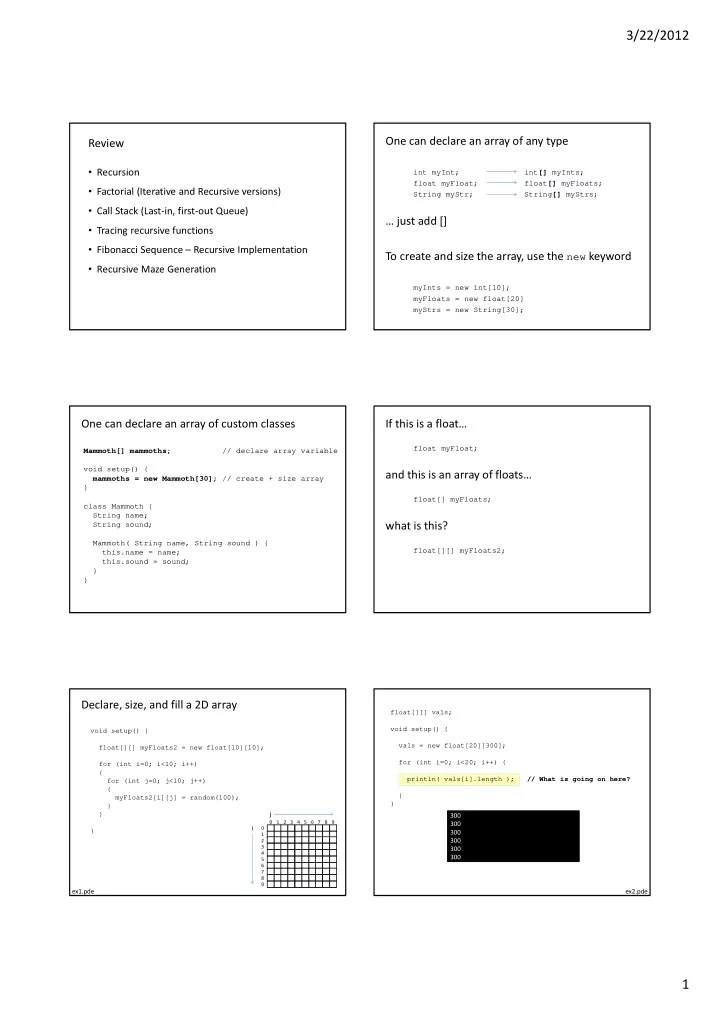
One can declare an array of any type
int myInt; int[] myInts; float myFloat; float[] myFloats; String myStr; String[] myStrs;
… just add [] To create and size the array, use the new keyword
myInts = new int[10]; myFloats = new float[20] myStrs = new String[30];
One can declare an array of custom classes
Mammoth[] mammoths; // declare array variable void setup() { mammoths = new Mammoth[30]; // create + size array } class Mammoth { String name; String sound; Mammoth( String name, String sound ) { this.name = name; this.sound = sound; } }
If this is a float…
float myFloat;
and this is an array of floats…
float[] myFloats;
what is this?
float[][] myFloats2;
void setup() { float[][] myFloats2 = new float[10][10]; for (int i=0; i<10; i++) { for (int j=0; j<10; j++) { myFloats2[i][j] = random(100); } } }
Declare, size, and fill a 2D array
i j
1 2 3 4 5 8 9 6 7 0 1 2 3 4 5 8 9 6 7
ex1.pde float[][] vals; void setup() { vals = new float[20][300]; for (int i=0; i<20; i++) { println( vals[i].length ); // What is going on here? } } ex2.pde 300 300 300 300 300 300