
SLIDE 1
Review and Discussion of FSILG Strategic Plan January 27, 2014
3.1 Capital Needs (Condition) Assessment Proposed Cost Split: 25/ - - PowerPoint PPT Presentation
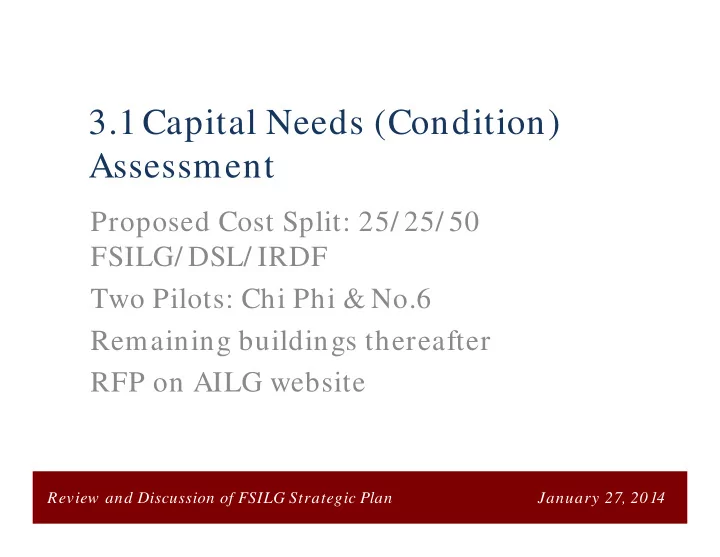
3.1 Capital Needs (Condition) Assessment Proposed Cost Split: 25/ 25/ 50 FSILG/ DSL/ IRDF Two Pilots: Chi Phi & No.6 Remaining buildings thereafter RFP on AILG website Review and Discussion of FSILG Strategic Plan January 27, 2014
Review and Discussion of FSILG Strategic Plan January 27, 2014
Review and Discussion of FSILG Strategic Plan January 27, 2014 Building Structure Building Envelope Plumbing Fire Protection, Sprinklers Fire Alarm Systems Heating, Ventilating, and Air Conditioning Electrical (Tele/Data not in scope) Conveying Equipment (Elevators, Dumbwaiters, and Chutes) Interior Finishes Food Service Equipment Site Improvements and Site Utilities Waste Handling Accessibility concerns
Review and Discussion of FSILG Strategic Plan January 27, 2014
Review and Discussion of FSILG Strategic Plan January 27, 2014
Review and Discussion of FSILG Strategic Plan January 27, 2014
Review and Discussion of FSILG Strategic Plan January 27, 2014
Review and Discussion of FSILG Strategic Plan January 27, 2014
Revitalize our facilities
Initiative # 3.4: Develop tools to educate our m em ber groups about capital planning
Annual Operating Expenses: Taxes, Audit, Insurance, Fees, Utilities, Maintenance, Repair, etc. Capital Component Expenses: Roof, Walls, Floors, Electrical, Plumbing, Heating, Windows, etc. Replacement/Improvement
Total Cost of Operation
lifetime (may be many years hence)
Survey
Capital Planning Questions:
expenses?
Review and Discussion of FSILG Strategic Plan January 27, 2014
Revitalize our facilities
Initiative # 3.4: Develop tools to educate our m em ber groups about capital planning
Component Year When Next Replaced 100 % Component Replacement Cost in Current $ Percent Replaced Each Time Useful Lifetime (years)
Flooring 2018 $78,421 20% 9 Wall Surfaces 2020 $68,075 30% 10 Telecommunications 2020 $57,123 15% 20 Ventilation Systems 2025 $91,728 50% 20 Roofing 2020 $200,666 100% 20
Vanderweil Survey Data OR Your own capital component assessment AILG Capital Planning Tool INPUT
Review and Discussion of FSILG Strategic Plan January 27, 2014
Revitalize our facilities
Initiative # 3.4: Develop tools to educate our m em ber groups about capital planning
AILG Capital Planning Tool OUTPUT
$0 $100,000 $200,000 $300,000 $400,000 $500,000 $600,000 $700,000 $800,000 $900,000 1 10 19 28 37 46 Total One‐Time Capital Expenses Total Capital Equipment Expenses Total Capital Components Expenses
Annual Capital Disbursement
$0 $20,000 $40,000 $60,000 $80,000 $100,000 $120,000 1 10 19 28 37 46 Contingency Reserve Total One‐Time Capital Expense Reserve
50 Year Capital Component Expense Schedule
50 Year Capital Reserve Schedule
Review and Discussion of FSILG Strategic Plan January 27, 2014
Revitalize our facilities
Initiative # 3.4: Develop tools to educate our m em ber groups about capital planning
AILG Capital Planning Tool ANALYSIS
assumptions on expense disbursement schedule and reserve requirements
Based upon Vanderweil survey data for all FSILGs, excluding a major fund‐raising effort, the tool indicates an FSILG should budget an average $80,000 to $100,000 every year to meet future capital component replacement expenses.
AVG INFLATION RATE 2.00% AVG INVESTMENT RETURN ABOVE INFLATION RATE 2.00% CONTINGENCY BURDEN 5.00% DELAY INITIAL CAPITAL COMPONENT NEXT YEAR REPLACED BY YEAR(S) INCREASING CAPITAL COMPONENT USEFUL LIFETIME BY YEAR(S) INCREASING CAPITAL EQUIPMENT USEFUL LIFETIME BY YEAR(S)
Review and Discussion of FSILG Strategic Plan January 27, 2014
Revitalize our facilities
Initiative # 3.5: Address lease challenges in MITIMCo-owned leased housing
Purpose To ensure that all FSILG property leases owned or managed by the MIT Investment Management Co. (MITIMCo) are financially sustainable and appropriate for student housing, so that FSILG corporations have incentives to make future improvements and build capital reserves. Scope Scope ‐ 5 Properties (2 in Cambridge, 3 in Boston) that are owned or partially owned by MIT and leased to MIT FSILGs, where the lessees have responsibility for some or all of the maintenance of the properties*
*Note 2 additional properties also meet this criteria, but are not included in this analysis since they will become the owners of their respective properties at the end of the current lease term in 2020
Review and Discussion of FSILG Strategic Plan January 27, 2014
Revitalize our facilities
Initiative # 3.5: Address lease challenges in MITIMCo-owned leased housing
Key Issues/Challenges for FSILGs in Commercial leases
if/when their leases will be renewed.
responsible for some or all of the maintenance of the properties with no possibility of equity, are not believed to be sustainable.
building maintenance and improvements without equity in the property or long term guarantees of inhabiting the property.
property with their fiduciary duties to the organization – should HCBs be spending money collected from members to improve a building that they don’t own and could be forced to vacate at the end of the lease term (or earlier).
when the expected useful life of improvements is less than the remaining lease term.
that is not owned by the House Corporation.
Review and Discussion of FSILG Strategic Plan January 27, 2014
Revitalize our facilities
Initiative # 3.5: Address lease challenges in MITIMCo-owned leased housing
Progress to Date
corporations was formed
including DSL, MIT President, EVP & Treasurer and a key member of the Corporation (through the DSL Visiting Committee)
together to work towards a resolution for each group
Next Step
Facilitate conversations with Institute leadership and each impacted FSILG to explore alternate lease and/or equity arrangements including but not limited to: property purchase, Green Hall/KAT/PBP model, extending the lease term, modifying lease terms
NOTE: The committee acknowledges that the optimal solution will likely be different for each specific organization
Review and Discussion of FSILG Strategic Plan January 27, 2014
Enhance the reputation of our com m unity
and efficient [… ]
the recruitment program and FSILG membership with MIT’s First-Year Experience
Review and Discussion of FSILG Strategic Plan January 27, 2014
Recruitment take place at the same time as Orientation; freshmen move into their chapter houses right away
Sept 20; pledging numbers drop ~20% from previous year; no fall Sorority Recruitment
moved to early September, after Orientation and classes; IFC rush rules
Review and Discussion of FSILG Strategic Plan January 27, 2014
picture; FSILG Midway during Orientation; rules relaxed; Clearinghouse revived
numbers cross 300
back
Review and Discussion of FSILG Strategic Plan January 27, 2014
Review and Discussion of FSILG Strategic Plan January 27, 2014
Review and Discussion of FSILG Strategic Plan January 27, 2014
Enhance the reputation of our com m unity
Review and Discussion of FSILG Strategic Plan January 27, 2014