
SLIDE 1
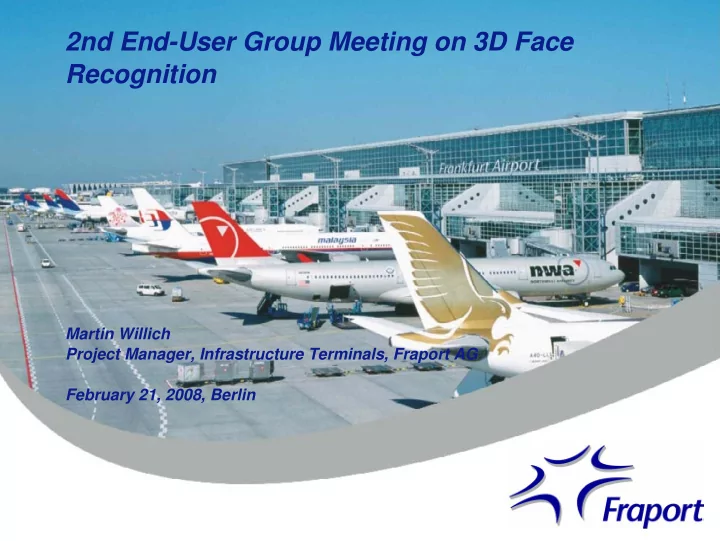
2nd End-User Group Meeting on 3D Face Recognition
Martin Willich Project Manager, Infrastructure Terminals, Fraport AG February 21, 2008, Berlin
2nd End-User Group Meeting on 3D Face Recognition Martin Willich - - PowerPoint PPT Presentation
2nd End-User Group Meeting on 3D Face Recognition Martin Willich Project Manager, Infrastructure Terminals, Fraport AG February 21, 2008, Berlin Page 2 Contents 1. Fraport at a Glance 2. New Challenges ahead 3. Can biometrics be the
Martin Willich Project Manager, Infrastructure Terminals, Fraport AG February 21, 2008, Berlin
2nd End-User Group Meeting on 3D Face Recognition, Berlin SXF, February 2008 Page 2
2nd End-User Group Meeting on 3D Face Recognition, Berlin SXF, February 2008 Page 3
2nd End-User Group Meeting on 3D Face Recognition, Berlin SXF, February 2008 Page 4
Group Revenues by Segments 2006
Aviation Ground Handling External Activities Retail & Properties 701.1 mill. euros 624.1 mill. euros 385.1 mill. euros 433.6 mill. euros
2nd End-User Group Meeting on 3D Face Recognition, Berlin SXF, February 2008 Page 5
*Avarage Data 2005
Fraport at a glance
2nd End-User Group Meeting on 3D Face Recognition, Berlin SXF, February 2008 Page 6
2nd End-User Group Meeting on 3D Face Recognition, Berlin SXF, February 2008 Page 7
2nd End-User Group Meeting on 3D Face Recognition, Berlin SXF, February 2008 Page 8
2nd End-User Group Meeting on 3D Face Recognition, Berlin SXF, February 2008 Page 9
Capacity
demands
Product
estate)
Cost efficiency
automation) Security
worldwide
2nd End-User Group Meeting on 3D Face Recognition, Berlin SXF, February 2008 Page 10
Passenger Screening Carry-on Baggage Checks Baggage Checks (samples) Baggage Reconciliation
Document Checks Passenger Profiling Identity Checks USA (API) 100% Staff Screening Pax Separation In- /Outbound Additional USA/UK Checks 100% Baggage Checks 100% Baggage Reconciliation
1977 – „Landshut“ 1988 – „Lockerbie“ 2001 – „9/11“
Passenger Screening Carry-on baggage checks Document Checks Passenger Profiling Identity Checks USA (API) 100% Staff Screening Pax Separation In- /Outbound Additional USA/UK Checks 100% Baggage Checks 100% Baggage Reconciliation
2006 – „08/10“
Carrying Liquids on Board is prohibited eAPI Passenger Screening Carry-on Baggage Checks Passenger Screening Carry-on Baggage Checks
2nd End-User Group Meeting on 3D Face Recognition, Berlin SXF, February 2008 Page 11
2nd End-User Group Meeting on 3D Face Recognition, Berlin SXF, February 2008 Page 12
1. Use of biometrics within the Passenger Process:
Registration & Seat Allocation Check
Baggage Check Boarding Pass Pax Sreening - Enplaning Aircraft
Biometric Solution
Border Control
Biometric Solution Biometric Solution Biometric Solution
Can biometrics be the answer?
2nd End-User Group Meeting on 3D Face Recognition, Berlin SXF, February 2008 Page 13
for sensitive areas
(in accordance with rules and regulations of Privacy Law)
Can biometrics be the answer?
2nd End-User Group Meeting on 3D Face Recognition, Berlin SXF, February 2008 Page 14
2nd End-User Group Meeting on 3D Face Recognition, Berlin SXF, February 2008 Page 15
Germany to compare different biometric technologies involving facial, iris and fingerprint biometrics.
Interior, Fraport (1000 participants) and Lufthansa (1000 participants).
further decisions of the German government towards the implementation of biometrics in the new passport.
Facial recognition by cognitec Fingerprint recognition by Dermalog and NEC Iris recognition by SD- Industries
Biometric Projects - FRA
2nd End-User Group Meeting on 3D Face Recognition, Berlin SXF, February 2008 Page 16
Source: Federal Office for Information Security, August 2005, Results of BIO P 2 – Project
Biometric Projects - FRA
+ Best Recognition Performance + High level of Security possible + Stable sensors despite contact related application + Little training necessary
+ High level of security possible
(„Myth of fixed limit“)
2nd End-User Group Meeting on 3D Face Recognition, Berlin SXF, February 2008 Page 17
Biometric Projects - FRA
2nd End-User Group Meeting on 3D Face Recognition, Berlin SXF, February 2008 Page 18
– Frankfurt Airport was the first German airport to introduce a biometric iris recognition system for passenger identification as a pilot project. – Using the so-called iris scanning in border controls, we intend to prevent queues at the passport controls and to lower passenger stress levels.
Biometric Projects - FRA
2nd End-User Group Meeting on 3D Face Recognition, Berlin SXF, February 2008 Page 19
The pilot test is expected to give answers to the following questions:
(security aspect)
than the manual check ? (capacity aspect)
automated border control ? (acceptance aspect)
Biometric Projects - FRA
2nd End-User Group Meeting on 3D Face Recognition, Berlin SXF, February 2008 Page 20
BMI/ BGS
border control)
Lufthansa
(frequent flyers)
Fraport
(Enrolment center, border control)
(power, LAN, etc.)
Joint tasks
Project leadership BMI/ BGS
Biometric Projects - FRA
2nd End-User Group Meeting on 3D Face Recognition, Berlin SXF, February 2008 Page 21
23.000 and still rising; Eligibility: All EU-citizens and citizens of Switzerland with machine-readable passports
now entering durable operation. Roll-out in
US NEXUS Air is being considered by the German Ministry of the Interior
Autocontrol unit ABG enrolment center
2nd End-User Group Meeting on 3D Face Recognition, Berlin SXF, February 2008 Page 22
Biometric Projects - FRA
2nd End-User Group Meeting on 3D Face Recognition, Berlin SXF, February 2008 Page 23
Capture data Enter Autocontrol unit Check ID Iris camera inside Autocontrol unit Border Passage Exit Autocontrol unit
Biometric Projects - FRA
2nd End-User Group Meeting on 3D Face Recognition, Berlin SXF, February 2008 Page 24
96% 48% 39% 39% 28% 6% 1%
Speed Data protection Hygiene Security Medically harmless User friendliness
(e.g. less costs) % Interviewee
Source: Passenger survey ABG by Deutsche Lufthansa, July 2004
Biometric Projects - FRA
2nd End-User Group Meeting on 3D Face Recognition, Berlin SXF, February 2008 Page 25
No time savings
8% 15% 44% 33%
Little time savings Enormous time savings Significant time savings % Passenger
Source: Passenger survey ABG by Deutsche Lufthansa, July 2004
Biometric Projects - FRA
2nd End-User Group Meeting on 3D Face Recognition, Berlin SXF, February 2008 Page 26
7% 4% 13% 18% 13% 14% 9% 84% 76% 84% 84% 91% 2% 3% Low Mid Top Total (n = 400) 1 (n = 45) 2 – 5 (n = 184) 6 – 10 (n = 112) 11+ (n = 59) Frequency of usage % Passenger
Source: Passenger survey ABG by Deutsche Lufthansa, July 2004
Biometric Projects - FRA
2nd End-User Group Meeting on 3D Face Recognition, Berlin SXF, February 2008 Page 27
86% 14%
0%
100% Yes No
Yes
Source: Passenger survey ABG by Deutsche Lufthansa, July 2004
No
Biometric Projects - FRA
2nd End-User Group Meeting on 3D Face Recognition, Berlin SXF, February 2008 Page 28
2nd End-User Group Meeting on 3D Face Recognition, Berlin SXF, February 2008 Page 29
Experiences – FRA
Fast ! Biometric systems must accelerate processes. Secure ! Biometric systems must maintain the same level of security as do existing systems, or even higher! Reliable ! Good FAR (False Acceptance Rate) and FRR (False Rejection Rate) Fail-safe High performance Acceptable ! User-friendly, no hygienic problems.
2nd End-User Group Meeting on 3D Face Recognition, Berlin SXF, February 2008 Page 30
fingerprint.
constant light. Outdoor deployment of such systems is therefore problematic.
auditory user guidance can contribute a lot to reduce FRR.
Experiences – FRA
2nd End-User Group Meeting on 3D Face Recognition, Berlin SXF, February 2008 Page 31
entail high unpredicted additional expenses .
Experiences – FRA
2nd End-User Group Meeting on 3D Face Recognition, Berlin SXF, February 2008 Page 32
2nd End-User Group Meeting on 3D Face Recognition, Berlin SXF, February 2008 Page 33
Vision: „Single Technology Infrastructure“ One definite Standard for both passenger processing and staff access Vision: „Off-the Shelf“ Biometric System which can be easily adapted to an existing infrastructure Vision: “One Biometric Media” for all reasons, at all kind of places for secure transactions and authentication
Vision: “Simple “Way to Use” no high effort for user guidance is needed and the performance is independent form user cooperation
Conclusion
2nd End-User Group Meeting on 3D Face Recognition, Berlin SXF, February 2008 Page 34
Integration for the different processing steps and most important establish strong cooperation between the parties involved Vision: Fully integrated and automated „One-stop-check“, without redundant collection and check of identical passenger data!
Registration & Seat Allocation Check
Baggage Check Boarding Pass Pax Sreening - Enplaning Aircraft
Biometric Solution
´Border Control
Biometric Solution Biometric Solution Biometric Solution
Conclusion
2nd End-User Group Meeting on 3D Face Recognition, Berlin SXF, February 2008 Page 35
Charles Darwin
Conclusion
2nd End-User Group Meeting on 3D Face Recognition, Berlin SXF, February 2008 Page 36