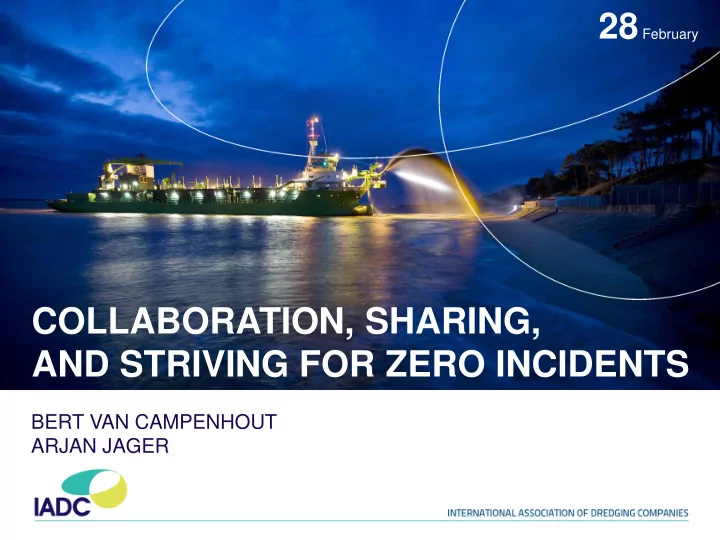
28 February COLLABORATION, SHARING, AND STRIVING FOR ZERO INCIDENTS - - PowerPoint PPT Presentation

28 february collaboration sharing and striving for zero
SMART_READER_LITE
LIVE PREVIEW

28 February COLLABORATION, SHARING, AND STRIVING FOR ZERO INCIDENTS - - PowerPoint PPT Presentation

28 February COLLABORATION, SHARING, AND STRIVING FOR ZERO INCIDENTS BERT VAN CAMPENHOUT ARJAN JAGER CONTENTS Introduction speakers Safety in mooring IADC Safety Committee UXO IADC Health and Safety Charter


slide-1
SLIDE 1

28 February COLLABORATION, SHARING, AND STRIVING FOR ZERO INCIDENTS

BERT VAN CAMPENHOUT ARJAN JAGER

slide-2
SLIDE 2

CONTENTS

  • Introduction speakers
  • IADC Safety Committee
  • IADC Health and Safety Charter
  • Driving safety
  • H2S in dredging
  • Safety in mooring
  • UXO
  • Sharing knowledge
  • Working alone together
  • Questions and answers
slide-3
SLIDE 3

INTRODUCTION SPEAKERS

  • Bert Van Campenhout – DEME
  • Prevention Officer
  • Experience: Civil Engineering, Marine Construction, Dredging
  • Arjan Jager – Van Oord
  • QHSE coordinator
  • Experience: Dredging and Marine
slide-4
SLIDE 4

IADC SAFETY COMMITTEE MEMBERS

In November 2013, a group of QHSE experts from IADC member companies were nominated and the IADC Safety Committee was established.

  • Mr. Christophe Leroy – Jan De Nul
  • Mrs. Ilse Quirynen – DEME
  • Mr. Jan-Willem Ottevanger – Royal Boskalis Westminster N.V
  • Mr. Ton van de Minkelis – Van Oord
  • Mr. René Kolman – IADC (Secretary General)
slide-5
SLIDE 5

IADC HEALTH AND SAFETY CHARTER

slide-6
SLIDE 6
slide-7
SLIDE 7
slide-8
SLIDE 8

DRIVING SAFETY

  • Nowadays the approach of dredging companies has shifted to:
  • Being proactive
  • Incorporate safety within the tender and in the operations
  • No blame culture
  • Stop Work Authority
  • Behavioural programmes
slide-9
SLIDE 9
slide-10
SLIDE 10

SUEZ, AN EXAMPLE

The Suez Canal Project saw the largest number of vessels ever deployed for dredging operations and yet despite the number of dredgers and despite the logistical challenges the project was completed in time.

slide-11
SLIDE 11

SUEZ AN EXAMPLE

slide-12
SLIDE 12

H2S IN DREDGING

slide-13
SLIDE 13

CHARACTERISTICS OF H2S

  • Highly toxic, colourless and flammable
  • Heavier than air
  • Solubility in water
  • Very reactive and corrosive gas
slide-14
SLIDE 14

RELEASE AND RECOGNIZING H2S

H2S release during dredging:

  • Long-term, low-level exposure:
  • fatigue, loss of appetite, headaches, irritability, poor memory

and dizziness.

  • Short-term, high-level exposure:
  • immediate collapse, with loss of breathing and a high

probability of death.

slide-15
SLIDE 15

PREVENTION

Limiting H2S release:

  • Closed hopper
  • Covering the hopper
  • Limiting turbulence in the hopper

Avoiding entrance of H2S into the interior spaces of the vessel:

  • Diverting the A/C intakes
  • Filtering the A/C intakes (active carbon)
slide-16
SLIDE 16

MONITORING AND AWARENESS

Monitoring H2S:

  • Personal detectors
  • Fixed detection
  • Data logging

Awareness:

  • Crew need to be trained in preventive measures including use of

specific personal protective equipment

slide-17
SLIDE 17

SAFETY IN MOORING

slide-18
SLIDE 18
  • Mooring is a frequently recurring action in the dredging business
  • Hopper barges are regularly moored alongside grab dredgers during

loading

  • Dangers associated with these operations
  • Parting lines and snap back zone
  • Insufficiently trained crew
  • Insufficient supervision
  • Innovations in mooring

SAFETY IN MOORING

slide-19
SLIDE 19

PARTING LINES

  • Parting lines and snap back zone
  • Mooring imposes enormous strains and major forces are involved
  • Deterioration of mooring line conditions are significant factors in

mooring line failure

Source: Mooring do it safely - A guide to prevent accidents while mooring

slide-20
SLIDE 20

PARTING LINES

  • Parting lines and snap back zone
  • Mooring ropes can have complex snap-back zones
  • When a mooring line parts it snaps back and can cause serious injury

Source: Mooring do it safely - A guide to prevent accidents while mooring

slide-21
SLIDE 21

CREW TRAINING

Factors that can play a role:

  • Lack of knowledge about the hazards of the job
  • Unclear instructions
  • Lack of information
  • Small, untrained deck crew
  • Ineffective on-board mooring training
slide-22
SLIDE 22

SUPERVISION

Active and dedicated supervision during mooring operations

  • The person supervising the works should not be involved in other
  • perations
slide-23
SLIDE 23

TSHD Charles Darwin mooring with Cavotec Moormaster system Jan De Nul

slide-24
SLIDE 24

INNOVATION

Automatic mooring is being utilised (magnetic and vacuum mooring)

  • Advantages
  • No need for mooring ropes
  • Limited amount of personnel required
  • Disadvantages
  • High costs
  • Increased maintenance
slide-25
SLIDE 25

UXO

slide-26
SLIDE 26

UNEXPLODED ORDNANCES (UXO)

UXO are munitions that did not explode when they were employed and still pose a risk of detonation. All over the world dredgers have encountered UXO during their operations. Awareness has been increasing about the prevalence of the presence of UXO and the extreme safety risk they cause which should and must be taken into account during the preparations of dredging operations.

slide-27
SLIDE 27

SHARING KNOWLEDGE

Available publications

  • A Common Sense Approach for H2S Release During Dredging (Terra

et Aqua number 139 | June 2015)

  • Dealing with UXO (Unexploded Ordnance): Detection, Identification,

Disposal and Awareness (Terra et Aqua number 142 | December 2015)

  • Safety in Mooring (Terra et Aqua number 142 | June 2016)

Upcoming publications

  • Separation Man and Machine
slide-28
SLIDE 28

WORKING ALONE TOGETHER

As dredging companies frequently work in joint ventures, a harmonisation of specific safety instructions is an important goal and will contribute to a safer working environment.

slide-29
SLIDE 29

CONCLUSIONS

The safety committee comprises individuals responsible for QHSE within the major dredging contractors. It aims to share information and knowledge among the IADC members through the Terra et Aqua journal and IADC’s website.

slide-30
SLIDE 30

Through these efforts, the Safety Committee wants to emphasize to all stakeholders that safety is a top priority and can contribute to effective and efficient execution of maritime infrastructure projects. The exchange of information and learning from each other will raise new

  • pportunities to continue to improve the safety of all personnel and vessels.

CONCLUSIONS

slide-31
SLIDE 31

QUESTIONS AND ANSWERS

BERT VAN CAMPENHOUT ARJAN JAGER

slide-32
SLIDE 32

REFERENCES

  • A Common Sense Approach for H2S Release During Dredging,

Leroy C, Huleu S, Terra et Aqua number 139, June 2015

  • Best Practice: Mooring Snap-back zones, Nichol D, UK P&I club, online publication,

July 2016

  • Dealing with UXO (Unexploded Ordnance): Detection, Identification, Disposal and

Awareness, Kölbel J, Seubring F, Terra et Aqua number 142, December 2015

  • Mooring do it safely - A guide to prevent accidents while mooring, publication by Seahealth

Denmark, 2013

  • Safety in Mooring, Sluiskes B, Terra et Aqua number 142, June 2016
  • Thinking – mooring safety, Australian Maritime Safety Authority, Maritime safety awareness

bulletin, September 2015