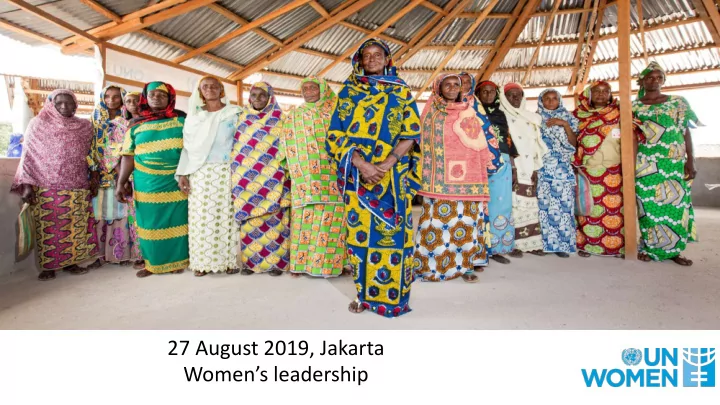
27 August 2019, Jakarta Womens leadership Wh What we e know: In - - PowerPoint PPT Presentation
27 August 2019, Jakarta Womens leadership Wh What we e know: In humanitarian and crisis settings: situation for women and girls deteriorates Women are first responders, agents of change, womens organisations are active
Wh What we e know:
- In humanitarian and crisis settings:
situation for women and girls deteriorates
- Women are first responders, agents of
change, women’s organisations are active
- Limited funding for women’s
- rganisations and gender often seen
as not ‘life saving’ (UNFPA: only 1 % of funds go to GBV protection)
- Limited access decision-making on
humanitarian and crisis response
- Ongoing changes!
Grand Bargain (2016) and Localisation
- 2016 at WHS: 30 donors and aid
- rganisations commit to change working
practices
- LOCALISATION: commitment for
increased institutional support and direct funding for local and national responders
- Aim: 2020: 25% of budget to local actors
- 2016: initiative to set up informal Grand
Bargain Friends of Gender group
- 4 workstreams identified as key for
women: cash, needs assessments, participation, LOCALISATION
Key aspects for the localization agenda
- Greater use of
tools (including pooled funding mechanisms) that increase assistance delivered by local and national responders
- Support and
complement national coordination mechanisms
- Include national and
local actors (with focus on WROs and WLOs engagement in HCT)
- Reinforce not
replace local capacities and systems
- Institutional
transformation for WROs and WLOs (scale up engagement and interventions)
- Capacity
strengthening considerations in partnership agreements
- Remove barriers to
equal partnerships
Partnership Institutional strengthening Financing Coordination
What UN Women and FoG achieve:
- Technical guidance notes (summary LOCALISATION)
- Research on transformative gender responsive
localization and participation –community perceptions (Jordan, Bangladesh, Uganda and Colombia)
- Global meetings/Global Dialogue
- Ongoing engagement in operationalization of
workstream work plans (enhance gender dimensions)
- Global advocacy (GB Annual Meeting)
- Accountability through gender
indicator integration in the GB Annual Reporting Format
Asia-Pacific regional Consultation
- Ongoing initiatives: International, regional,
national/ local level
- Also beyond GB (Feminist humanitarian policy,
Leadership, IASC Gender Policy and Accountability Framework)
- Workstream on Localisation: regional
conferences (Addis Abeba, Amman, Jakarta)
- UN Women, FoG and co-hosts Oxfam, Care and
OCHA: pre-consultation with WOMEN’s GROUPS
- Aim: bring women’s organisations together for
joint thinking and recommendations from their practices
- For Regional Conference on Localisation of Aid
(27-28 August) and TGNs
- Donors to internally track direct funding to women’s organisations and
partnerships/ improve FTS indicators
- Engage women’s groups in committees that set criteria for partner
selection
- Include women’s organisations in the humanitarian coordination processes
- Invest in the capacity of women’s organisations (also with flexible multi
year funding)
- Promote long-term equal partnerships
- Women’s organisations linking up for better coordination/advocacy and