26 February, 2020 # Action Points/ Subjects to Follow Up - - PowerPoint PPT Presentation
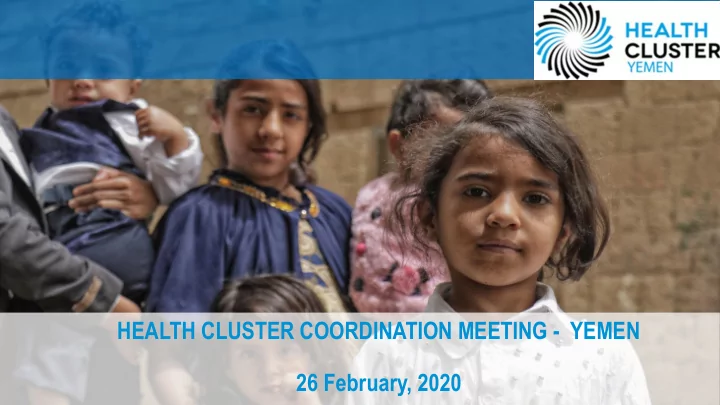
HEALTH CLUSTER COORDINATION MEETING - YEMEN 26 February, 2020 # Action Points/ Subjects to Follow Up Responsibility Status HNO/HRP workshop meeting is to be held on March 15 th , 2020. 1 Health Cluster In Process 2 To be COVID-19
# Action Points/ Subjects to Follow Up Responsibility Status 1 HNO/HRP workshop meeting is to be held on March 15th, 2020. Health Cluster In Process 2 COVID-19 Preparedness plan MoPHP To be presented today 3 WASH in Health Facilities resource mapping WASH in HF TWG 4 The distribution plan of the RH Kits is to be shared by UNFPA with the Cluster to be shared with all partners with minutes UNFPA Done 5 Joint Health and WASH Cholera Review Meeting
- 4-5 March, 2020 - Aden.
- 10-11 March 2020 – Sana’a.
Health/WASH Clusters WHO/UNICEF MoPHP/MoWE In Process 6 Brief on the outcomes of the Brussels Meeting (Donors). Health Cluster To be presented today 7 Updated on Quality of Care 8 eIDEWS bulletins to be shared with partners on a regular basis. Health Cluster Ongoing 9 Reporting is mandatory for all Health Cluster Partners on a monthly
- basis. Deadline is the 10th of each month.
Partners Ongoing 10 Health Cluster Infographics, Central Level and Hubs, to be shared with partners on a monthly basis. Yemen Health Cluster Website: www.Yemenhc.org Health Cluster Ongoing
Updates from other coordination fora
- Humanitarian Country Team (HCT) - monthly
- Operations Centre (OPSCEN) - bimonthly
- Inter-Cluster coordination Mechanism (ICCM) - bimonthly
Bri riefing – Outcomes Brussels Donor meeting (12-13 Feb, 2020)
OPSCEN MEETING
Marib/Al-Jawf/Sana
Health response to IDPS
IOM operates a mobile health clinic and provides support to two hospitals in Marib City including referral services. CSSW is supporting 14 health facilities and operating 4 medical mobile clinics; can be mobilized where needed. UNFPA deployed a mobile clinical team through BFD. WHO is mobilizing medical kits both basic and supplementary to BFD, IOM and CSSW and three hospitals for referral cases, UNFPA supports two hospitals, one health center, and one health unit in Marib for provision of reproductive health services.
- Needs:
- Steady essential medication (Interagency Emergency Health Kits - IEHKs)
supply to support the provision of health care either through static facilities or mobile clinics/teams.
- Strengthen the referral mechanism to secondary hospitals especially for
pregnant women and trauma victims.
- Due to massive displacement, the risk of vaccine preventable disease has
increased, therefore a focus on immunization activities is needed.
- Strengthening disease surveillance – to respond in a timely manner to any
new outbreaks which might be caused by displacement and environmental factors.
Outcomes -Cholera Task Force Updates on outbreak
nCOV-19, Dengue, SARI and Cholera Current situation Challenges Way forward
MoPHP – EOC
Coronavirus Disease 2019 (COVID-19) Preparedness in Yemen
Sit ituation Overv rview and Ris isk Assessment
- Global: As of 24 February 2020, a total of 79,424 (laboratory-confirmed and
clinically diagnosed cases) of COVID-19, including 2,626 associated deaths (CFR=3.3%), have been reported from 34 countries.
- Regional: First laboratory-confirmed cases were reported in Afghanistan (1),
Bahrain (2), Kuwait (3), Iraq (1) and Oman (2). All cases reported have a travel history to Iran, which has reported 61 cases including 12 deaths.
- Yemen: No confirmed cases reported (as of 26 Feb)
- The current risk of COVID-19 in Yemen is low → risk can change over time.
- The risk is slightly higher in the south vs. the north
- It is possible to interrupt virus spread, provided that the country puts in place strong measures
to detect disease early, isolate and treat cases, trace contacts, and promote social distancing measures commensurate with the risk.
Transmission of COVID-19 19
- The spread of COVID-19 between humans is being driven by droplet
transmission
21/02/2020
- The virus is transmitted from a sick person to a healthy person through respiratory
droplets when the sick person coughs or talks close to another person.
- Current diagnostic tests have yielded positive results from a variety of specimens
including throat swabs from asymptomatic people and feces.
- These positive results are not a conclusive indication that people are contagious.
People may have been exposed and infected but are NOT necessarily transmitting the disease. More investigations into potential other routes of transmission are
- ngoing.
- What has been reported so far it that the main driver of transmission is droplet
transmission from people with symptoms.
Symptoms
Remember: It’s not in Yemen yet!
Prevention – what does NOT work
▪ Drinking herbal teas ▪ Smoking ▪ Wearing multiple masks over your mouth/nose ▪ Self-medicating
Preventio ion measures th that do work rk
(f (for COVID-19 an and man any oth
- ther dis
iseases)
- Wash your hands frequently with soap and water or use an
alcohol-based rub
- Avoid close contact with people, especially those who are
coughing, sneezing and have a fever. Stand at least 1 meter away from them.
- Avoid direct contact with animals
- When coughing and sneezing, cover your mouth and nose with
your flexed elbow or tissue
- Proper fit of masks
- Avoid touching your eyes, nose or mouth and do not eat food
that has not been thoroughly
- Avoid traveling if you have a fever or are coughing
- Contact your nearest health care provider if you have a fever
and are coughing or have difficulty breathing – especially if you have visited a country where people have gotten COVID-19.
Myth Busters
For more info, visit WHO coronavirus website: https://www.who.int/news-room/q-a-detail/q-a-coronaviruses
Preparedness activities
- Passenger screening upon arrival at the airports and infection prevention and control
measures in place at the ports of entry
- Identification of hospitals for patient isolation
- Repurposing of diphtheria ICUs as additional isolation units
- Various training conducted and more to come:
- Risk communication and community engagement – ToT done in Aden
- Infection prevention and control
- Laboratory detection of COVID-19
- Case investigation and contact tracing for rapid response teams
- Prepositioning of equipment and supplies
- Personal protective equipment (already in place as part of influenza preparedness & response)
- Laboratory reagents & testing of controls
- More materials expected through our regional office
- Appropriate messaging of the risk to the public to control fear and minimize stigma
- Development of the national operational plan
Points of f Entry ry Assessment
Assessed 24 points of entry across Yemen for IHR core capacity at PoE
No Yes Total Airport 2 5 7 Ground crossing 4 2 6 Port 8 3 11 Grand Total 14 10 24
Competent authorities identified at PoE No Yes No response Total Airport 3 3 1 7 Ground crossing 6 6 Port 11 11 Grand Total 9 3 12 24 Availability of public health contingency plan at PoE
n Airport 3 Ground crossing 2 Port 5 Grand Total 10
Number of points at level 1 IHR capacity
Level of core capacity
Le Level of f effective public health response
What to do if if a case gets in into Yemen
- Stop human-to-human transmission:
- Intensify surveillance: immediate investigation of suspected cases to understand risk factors (e.g.,
travel history, close contact with a probable or confirmed case) and perform laboratory testing, as appropriate
- Based on the assessed risk, isolation of the individual and contact tracing, followed by 14 days of
monitoring for symptoms. (If any contacts develop symptoms, repeat above)
- Provide medical care to patients and reinforce behaviors to prevent transmission
- Communicate critical risk and information; engage communities
- Enhanced coordination between the north and the south will become critical, especially
if cases travel to/from the north/south → implications on case investigation & contact tracing and IHR reporting
WCO Yemen Joint Operations Review 16-18 February 2020
IEC Medications Equipment Vector control Capacity building
2018: 46 2019: 271 2018: 28,054 2019: 76,768 Al Hudaydah Taiz Hajjah Aden
79% of the cases are from 4 governorates
WCO Yemen Joint Operations Review 16-18 February 2020
Dengue fever
- utbreak
response
HEALTH CLUSTER UPDATES HRP-2020 (plan)
HNO and Health Response Pla lan (2 (2020) tim imeline
- Bi-lateral meetings with MoPHPs – Done
- Severity maps, Identifications of needs/Gaps,
- Analyze the available data based on other source of information (eDEWS, HeRAMS,
Cholera etc) based on our approved indicators
- HRP consultative meeting with partners/MoPHPs:
- Aden – 3 March (Coral Hotel)
- Sanaa – 15 March (Sheba Hotel)
- Activities and indicators development
- (1st & 2nd Line response & Full Cluster response)
CFR from 0.21% in 2017 to 0.12% in 2019
858 619 total beneficiaries
Provision of:
- WASH supplies for infection control
- Cholera kits and medications for treatment
- Incentives to 4,607 DTCs/ORC staff to provide health services
Accessibility to treatment centers - Health Cluster Partners
WCO Yemen Joint Operations Review 16-18 February 2020
Coordination
Case Management WASH Vaccination Surveillance Monitoring & Evaluation
- EOCs
- MoPHP, Ministry of Water &
Env., Ministry of Agriculture
- Health Cluster, UN Agencies,
NGOs
- DTCs and ORCs
- Capacity building
- Cholera kits and medical
supplies
- Third Party Monitoring
and beneficiaries engagement
- eIDEWS sites
- DRRTs & GRRTs
- Laboratory detection
- Water trucking
- Water chlorination
- Water quality monitoring
- Hygiene promotion
- IPC /Training
- OCV Campaigns
Mult ltisectoral & multidisciplinary ry response
9
Susp spected chole lera case ses in in 2017, 2018 and 2019
Suspected cholera cases CFR%
Suspected cholera cases and associated cholera deaths by month
2017-2018-2019
CFR=
0.12%
1,023 Deaths
858,619
Suspected Cases
96% (22/23) Governorates
95% (318/333) Districts CFR=
0.22%
2,238 Deaths
1,022,436
Suspected Cases
96% (22/23) Governorates
92% (305/333) Districts CFR=
0.14%
505 Deaths
371,326
Suspected Cases
96% (22/23) Governorates
83% (276/333) Districts
Cholera cases per District
2019 1 Jan to 29 Dec
Se Seasonal dis isease pattern, Yemen (2 (2020)
In Information Management
In Info-graphic ics Reporting Status Healt lth Clu luster Achie ievements 4Ws – Healt lth Partners by y Governorate
Information Management
- Registration:
– Cluster members – Active!! – To join the Yemen cluster list: https://forms.gle/cjBRNhjTgGRHusgy6 – Membership Criteria
- Regular reporting – DHIS
– Monitoring and updating
- Matrix prepared
- Non-reporting partners after 60days will be withdrawn from Health Cluster
- IM products
– Availability through dedicated websites
- Health Cluster & OCHA website (link will be shared)
Health Clu luster Membership
Membership Process Minimum Requirement Application Form Membership Process Cluster Coordination Meetings Start OCHA Partnership Eligibility Process Encourage partnership with
- ther active partners
Probation period→ 6 months
Min inim imum requir irements for r jo join inin ing the Healt lth Clu luster
- Provide the profile of the organization including the Mandate, Structure, Name & CVs of
Health Coordinator and Information Management officer that are related to Health Programs.
- Provide the name and location of health facilities currently active and being supported/run by
your organization.
- Provide the current funding status of the health projects most importantly.
- What kind of health activities you are implementing in the ground (mainly in health facilities)
– Indicate Start and End date.
- Indicate the status of the membership eligibility for Yemen Humanitarian Fund (OCHA
Partnership eligibility.
- Indicate if you are currently running activities in partnership with any other agencies.
- Have you been able to establish any partnership with other NGOs?
- Provide proof of registration with the Government of Yemen.
- APPLICATION FORM WILL BE PROVIDED ONLY IF THE NEW NGO MEETS THE MINIMUM
REQUIREMENTS. NGO will be given a period between 3 – 6 months (probation) so that it can find opportunities to have partnership with other active partners to implement few activities as sub-implementer.
Current Reporting Sit ituation for partners
Sr. No Color Coding # of Partners (AUG) % (AUG) # of Partners (Sep) % (Sep) # of Partners (Oct) % (Oct) # of Partners (Nov) % (Nov) # of Partners (Dec) % (Dec) # of Partners (Jan) % (Jan)
1 0% - 50% 6 13% 5 11% 1 2% 0% 0% 0% 2 64% - 50% 10 23% 8 18% 3 7% 4 9% 5 11% 5 11% 3 79% - 65% 6 13% 7 16% 9 20% 9 20% 10 22% 9 20% 4 100% - 80% 23 51% 25 55% 32 71% 32 71% 30 67% 31 69%
Achievement infographic normally prepared at the last week of the month
- Data received from partners between 10-15 of month
- IM unit – verification, analysis 15-20 of month
- Development of updated infographics 22-25 of month
- www.yemenhc.org
- www.humanitarianresponse.org
Working groups and Taskforce - Updates
- Mental Health & Psychosocial Service Support (MHPSS)
- WASH in Health Facilities
- Reproductive Health
- Nutrition Surveillance System –WHO
- Quality of HealthCare Task Team
WASH in Healthcare facilities
Technical Working Group
Actio ion points
- Participation of MOPHP and Ministry of Water
- General waste disposal guidelines to be discussed with UNOPS and Cleaning
fund
- Training manual including SOPS developed by MOPHP on Infection
Prevention Control (IPC)
- Guideline on water sanitation and hygiene to be reviewed to finalize the
dashboard
- Guidelines and best practices to be shared:
- Fecal sludge management and healthcare waste disposal
- Liquid waste treatment-best practices
Pil ilot test of the Matrix ix
Health Facilities to conduct the pilot testing of the matrix
- Bani Matar General Hospital
- Sayan Hospital District Hospital
Process
- 1. Assessment by using the matrix
- 2. Organizing the meeting of stakeholders to present the findings
- 3. Agree on the indicators and share with partners
- 4. Monitoring of WASH services
Indicators for Health cluster to evaluate the performance of WASH in HF’s – (HRP2020)
- 1. Healthcare facilities with improved WASH services
- 2. Healthcare facilities with compliance to IPC and HCWM practices
National Reproductive Health IAWG Updates
EPI/Vaccination Updates No Major Updates – Next Cluster meeting
Mental Health & Psychosocial Support Services (MHPSS) No Major Updates – Next Cluster meeting
Nutrition Surveillance System/ WHO No major updates
Quality Im Improvement in Health care
Updates on Quality of Care (QoC)
Hospitals PHC
Improveme nt Planning Implementation
- f Improvement
plans
Assessme nt of QoC
- QoC task team under the numeral of Health Cluster
- QoC Basic Standards were developed/ drafted
- Assessment tools were also developed based on those
standards
- Pilot Plan was discussed and endorsed by MOH, Health Cluster
Quality of f Care Assessment: : Concluded Work rk
Critical Quality Standards Quality Assessment Tools Quality Task Team/Health Cluster
Assessment Pilot
- Gov. Hospital
Inter District Hosp. District Hospital PHC Center PHC Unit
HF Type HF Name
- No. Days
Assessors
PHC Unit Al-Oroq 1 2 PHC Center Faj Attan 1 2 District Hosp. Al-Rawdah 2 3 Inter district Zayed Hosp. 2 3
- Gov. Hosp.
Al-Jomhuri 3 3
Objectives:
➢ identify and correct the gaps of the tool ➢To ensure the applicability of the tools at each level of care ➢ To understand the number of days and resources, including human resources, required for each level of care Next steps:
Patient Safety Assessment
➢Two Hospitals: 26 September Hospital in Sana’a; 22 May Hospital in Amran gov ➢ 2 Day Training for Quality Teams from MOPH & targeted hospitals ➢ Team of five assessors in each hospital ➢Methodology of the assessment: ✓ Observation rounds for each department ✓ Interviews with management, clinical staff, patients ✓ Desk review e.g. plans policies, guidelines, reports etc.
Next xt Steps: Quality Im Improvement
- Enhance quality/patient safety
management: hospital priority, staffing, budget, activities etc.
- Develop/adopt policies and
procedures; guidelines
- Capacity building for clinical staff,
management, HR, etc (based on areas)
- Strengthen monitoring mechanisms
QoC assessment Pilot plan
Day Date Type of Facility Name of Facility Wed 12 Feb PHC Center Faj Attan PHC Mon-Tues 24- 25 Feb Inter district Hosp. Zayed Hospital. Wed-Thurs 26-27 Feb District Hospital Al-Rawdah Hosp. Sun-Tues 1-3 March
- Gov. Hospital
Al-Jumhory Hosp. Wed 4 March PHC Unit Al-Oroq Unit