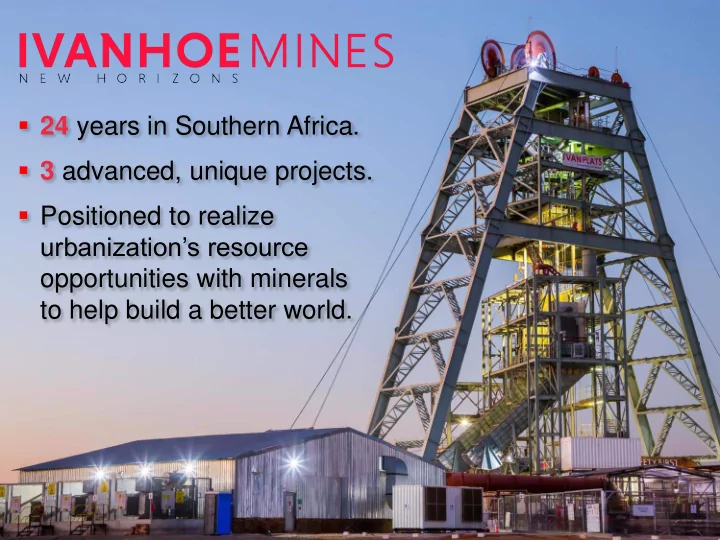
- 24 years in Southern Africa.
- 3 advanced, unique projects.
- Positioned to realize
urbanization’s resource
- pportunities with minerals
24 years in Southern Africa. 3 advanced, unique projects. - - PowerPoint PPT Presentation
24 years in Southern Africa. 3 advanced, unique projects. Positioned to realize urbanizations resource opportunities with minerals to help build a better world. Forward-looking statements & Qualified Person Certain statements
Certain statements in presentation constitute “forward-looking statements” or “forward-looking information” within the meaning of applicable securities laws, including, without limitation, the timing and results of: (i) statements regarding the ongoing development and exploration work at the Kamoa-Kakula Project, including drilling, decline development, and feasibility, pre-feasibility and preliminary economic assessment (PEA) studies; (ii) statements regarding the ongoing development work, including shaft sinking, and the feasibility study at the Platreef Project; and (iii) statements regarding ongoing upgrading and development work and the pre-feasibility study at the Kipushi Project. As well, the results of the prefeasibility study and PEA of the Kamoa-Kakula Project, the prefeasibility study of the Platreef Project and the PEA of the Kipushi Project constitute forward-looking information, and include future estimates of internal rates of return, net present value, future production, estimates of cash cost, proposed mining plans and methods, mine life estimates, cash flow forecasts, metal recoveries, and estimates of capital and operating costs. Such statements involve known and unknown risks, uncertainties and other factors which may cause the actual results, performance or achievements of Ivanhoe, its mineral projects, or industry results, to be materially different from any future results, performance or achievements expressed or implied by such forward-looking statements or information. Such statements can be identified by the use of words such as "may", "would", "could", "will", "intend", "expect", "believe", "plan", "anticipate", "estimate", "scheduled", "forecast", "predict" and other similar terminology, or state that certain actions, events or results "may", "could", "would", "might" or "will" be taken, occur or be achieved. These statements reflect Ivanhoe’s current expectations regarding future events, performance and results and speak only as of the date of this presentation. In making such statements, Ivanhoe has made assumptions regarding, among other things: the accuracy of the estimation of mineral resources; that exploration activities and studies will provide results that support anticipated development and extraction activities; that studies of estimated mine life and production rates at the Kamoa-Kakula, Kipushi and Platreef projects will provide results that support anticipated development and extraction activities; that Ivanhoe will be able to obtain additional financing on satisfactory terms; that infrastructure anticipated to be developed or operated by third parties, including electrical generation and transmission capacity, will be developed and/or operated as currently anticipated; that laws, rules and regulations are fairly and impartially observed and enforced; that the market prices for relevant commodities remain at levels that justify development and/or operation; that Ivanhoe will be able to successfully negotiate land access with holders of surface rights; and that war, civil strife and/or insurrection do not impact Ivanhoe’s exploration activities or development plans. Although the forward-looking statements or information contained in this presentation are based upon what management of Ivanhoe believes are reasonable assumptions, Ivanhoe cannot assure investors that actual results will be consistent with these forward-looking statements. They should not be should not be read as guarantees of future performance or
under "Risk Factors" in Ivanhoe’s most recent Annual Information Form. These forward-looking statements are made as of the date of this presentation and are expressly qualified in their entirety by this cautionary statement. Subject to applicable securities laws, Ivanhoe does not assume any obligation to update or revise the forward-looking statements contained herein to reflect events or circumstances occurring after the date of this
This presentation also contains references to estimates of Mineral Resources. The estimation of Mineral Resources is inherently uncertain and involves subjective judgments about many relevant factors. Mineral Resources that are not Mineral Reserves do not have demonstrated economic viability. The accuracy of any such estimates is a function of the quantity and quality of available data, and of the assumptions made and judgments used in engineering and geological interpretation (including estimated future production from the company’s projects, the anticipated tonnages and grades that will be mined and the estimated level of recovery that will be realized), which may prove to be unreliable and depend, to a certain extent, upon the analysis of drilling results and statistical inferences that ultimately may prove to be inaccurate. Mineral Resource estimates may have to be re-estimated based on: (i) fluctuations in copper, nickel, platinum-group elements (PGE), gold or other mineral prices; (ii) results of drilling, (iii) metallurgical testing and other studies; (iv) proposed mining
Disclosures of a scientific or technical nature in this presentation have been reviewed and approved by Stephen Torr, who is considered, by virtue of his education, experience and professional association, a Qualified Person under the terms of NI 43-101. Ivanhoe has prepared a NI 43-101 compliant technical report for each of the Kamoa-Kakula Project, the Platreef Project and the Kipushi Project, which are available under the company’s SEDAR profile at www.sedar.com. These technical reports include relevant information regarding the effective date and the assumptions, parameters and methods of the mineral resource estimates on the Kamoa-Kakula Project, Kipushi Project and Platreef Project cited in this presentation, as well as information regarding data verification, exploration procedures and other matters relevant to the scientific and technical disclosure contained in this presentation in respect of the Kamoa-Kakula Project, Platreef Project and Kipushi Project.
Copper 39.6%-owned Democratic Republic
African Copperbelt Platinum-group elements
& gold-nickel-copper
64%-owned South Africa’s Bushveld Complex Zinc-copper- silver-germanium 68%-owned D.R. Congo’s Copperbelt
Sources: Wood Mackenzie, Bernstein Research, Reuters, Natural Resources Canada, USGS
DRC:
tonnes Canada: 720,000 tonnes
Drilling at Kakula West
Kamoa Mining Licence
2017 drilling at Kakula West and saddle area
September 2017
Results show a rapidly growing area
characterized by finely disseminated chalcocite in siltstone and maroon
geometry of mineralization are typical
east.
Massive chalcocite Disseminated massive chalcocite
3.23% copper, containing 24.9 billion pounds of copper at a 1% copper cut-off. At a 3% copper cut-off, Indicated Resources total 116 million tonnes at 6.09% copper, containing 15.6 billion pounds of copper.
approximately 1.0 billion tonnes grading 3.02% copper, containing 66.3 billion pounds of copper, at a 1.4% copper cut-off.
tonnes grading 2.37% copper and containing 10.0 billion pounds of copper, at a 1.4% copper cut-off. Kamoa-Kakula now ranks among the five largest copper deposits in the world, and is the largest copper discovery ever made
Deposit Category Tonnes (millions) Area (Sq. km) Copper Grade True Thickness (metres-m) Contained Copper (kTonnes) Contained Copper (billion lbs)
Kamoa Indicated 752 50.5 2.67% 5.2 (m) 20,110 44.3 Inferred 185 16.8 2.08% 3.8 (m) 3,840 8.5 Kakula Indicated 349 9.8 3.23% 12.0m 11,281 24.9 Inferred 59 3.0 2.26% 6.4m 1,338 3.0 Total Kamoa Project Indicated 1101 60.3 2.85% 6.3m 31,391 69.2 Inferred 244 19.8 2.12% 4.3m 5,178 11.5
Notes to accompany Kamoa Project Mineral Resource Table: 1. Ivanhoe’s Mineral Resources Manager, George Gilchrist, Professional Natural Scientist (Pr. Sci. Nat) with the South African Council for Natural Scientific Professions (SACNASP), estimated the Mineral Resources under the supervision of Dr. Harry Parker and Gordon Seibel, both RM of Society of Mining, Metallurgy and Exploration (SME), who are the Qualified Persons for the Mineral Resource estimate. The effective date of the estimate is May 16, 2017. Mineral Resources are estimated using the 2014 CIM Definition Standards for Mineral Resources and Mineral Reserves. 2. Mineral Resources are estimated assuming underground mining methods, a copper price of US$3.30/lb (Kamoa) and US$3.00/lb (Kakula Deposit), a cut-off of 1% total copper, an approximate minimum thickness of 3 m, and that concentrates will be produced and sent to a smelter. 3. Tonnage and contained-copper tonnes are reported in metric units, contained-copper pounds are reported in imperial units and grades are reported as percentages. 4. Rounding as required by reporting guidelines may result in apparent summation differences between tonnes, grade and contained metal content.
Mine Kakula Kakula + Kansoko Annual mining rate 4 million tonnes 4 + 4 million tonnes(1) Average head grade; first 10 years 6.90% copper 5.81% copper Annual copper production first 10 years 216,000 tonnes 292,000 tonnes Mine-site cash cost first 10 years $0.37/lb copper $0.42/lb copper Initial capex $1.0 billion $1.0 billion NPV8 @ $3.00/lb Copper $3.7 billion (2) $4.7 billion (2) Internal rate of return @ $3.00/lb copper 38% (3) 34.6% (3) Payback period @ $3.00/lb copper 2.3 years (3) 3.5 years (3)
All in US dollars, unless otherwise indicated The Kakula 2016 PEA is preliminary in nature and includes an economic analysis that is based, in part, on Inferred Mineral
them that would allow them to be categorized as Mineral Reserves, and there is no certainty that the results will be realized. Mineral Resources do not have demonstrated economic viability and are not Mineral Reserves. 1. Two-stage development of both Kakula and Kamoa deposits. 2. After-tax NPV, discounted at 8%, assuming a long-term copper price of US$3.00/lb. 3. After tax.
*Source: Wood Mackenzie
Note: Selected based on contained copper (Measured & Indicated Mineral Resources, inclusive of Mineral Reserves, and Inferred Mineral Resources), ranked on contained copper in Measured and Indicated resources (2017)
Contained Copper (Mt) Copper Grade (%)
Measured & Indicated Resource and Grade Inferred Resource and Grade
Kamoa-Kakula now ranks among the five largest copper deposits in the world*
1.0% 1.5% 2.0% 2.5% 3.0%
50.0 75.0 100.0 125.0 150.0
Source: Wood Mackenzie *Note: Contained copper in high-grade deposits (Measured & Indicated Mineral Resources, inclusive of Mineral Reserves, and Inferred Mineral Resources) with grades above 2.5% copper (2017)
Contained Copper (Mt)
Measured & Indicated Resource Inferred Resource
31.4 16.9 10.1 4.6 2.2 1.3 0.7 0.6 0.5 5.2 11.7 6.4 9.8 0.1 0.4 0.0 0.3
1.0% 1.5% 2.0% 2.5% 3.0% 3.5%
10.0 15.0 20.0 25.0 30.0 35.0 40.0
*Source: Wood Mackenzie
Note: Contained copper in undeveloped deposits (Measured and Indicated Resources, inclusive of Mineral Reserves, and Inferred Resources) ranked by contained copper in Measured and Indicated Resources (2017).
Contained Copper (Mt) Copper Grade (%)
Measured & Indicated Resource and Grade Inferred Resource and Grade
Historical Production
10 15 20 25 30 35 40 Measured & Indicated Resource Inferred Resource
Contained Copper (Mt)
Source: Wood Mackenzie and USGS
DRC that Ivanhoe will upgrade to secure a supply of clean, sustainable electricity for the development of Kamoa.
in September 2016.
reconditioned, will produce a combined 200 MW for the grid.
Reconstruction completed to Dilolo station in DRC.
Sources: Railwaysafrica.com, enr.com, Stratfor & Grindrod
In 1924, Kipushi began mining 18% copper from a surface open pit, before transitioning to Africa’s richest underground copper, zinc and germanium
1928
Source: Wood Mackenzie. World’s major zinc mines defined as the world’s 10 largest zinc mines ranked by forecasted production by 2018. Note: Independent research by Wood Mackenzie concludes that at the forecast production and head grade, the Kipushi Project could be expected to rank among the world’s 10 largest zinc mines. Wood Mackenzie compared the Kipushi Project’s life-of-mine average annual zinc production and zinc head grade of 281,000 tonnes and 32%, respectively, against production and zinc head grade forecasts for 2018.
10% 15% 20% 25% 30% 35%
200 300 400 500 600
Zinc Head Grade (%) Annual Zinc Production (kt)
Contained Zinc Zinc grade (%)
10% 15% 20% 25% 30% 35% 40% 45% 50%
4 6 8 10 12 14 16 Zinc grade (%) Contained zinc Zinc grade (%) Zinc equivalent grade (%)
Source: Wood Mackenzie. Note: All tonnes and metal grades of individual metals used in the equivalency calculation of the above-mentioned projects (except for Kipushi) are based on public disclosure and have been compiled by Wood Mackenzie. All metal grades have been converted by Wood Mackenzie to a zinc equivalent grade at Wood Mackenzie's respective long-term price assumptions.
Contained zinc in Measured & Indicated resources (Mt)
Steady-state mining rate 1.1 million tonnes/year Average head grades 32.2% zinc and 5.4% copper Zinc concentrate production 530,000 tonnes/year @ 53% zinc Total cash costs (after credits) $0.54/lb zinc Initial capex $409 million After-tax NPV8 @ $1.01/lb zinc $533 million (1) After-tax NPV8 @ $1.25/lb zinc $1.03 billion (1) Internal rate of return @ $1.25/lb zinc 30.9% (2) Payback period @ $1.25/lb zinc 2.2 years (1)
All in US dollars, unless otherwise indicated. The Kipushi 2016 PEA is preliminary in nature and includes an economic analysis that is based, in part, on Inferred Mineral Resources. There is no certainty that the PEA results will be realized. 1. Assuming a long-term copper price of US$3.00/lb and a long-term zinc price of US$1.01/lb and US$1.25/lb, respectively. 2. After tax.
Source: SFA (Oxford). Data for Platreef Project and Waterberg are based on each project’s reported DFS and PFS parameters respectively, and are not representative of SFA's view.
Ivanhoe’s Platreef Project at the bottom
Source: Production estimates for projects other than Ivanhoe’s Platreef Project have been prepared by SFA (Oxford). Production data for the Platreef Project (platinum, palladium, rhodium, gold, nickel and copper) is based on reported DFS and PEA data and is not representative of SFA's view. All metals have been converted by SFA (Oxford) to platinum equivalent ounces at price assumptions of US$1,076/oz platinum, US$761/oz palladium, US$1,235/oz gold, US$821/oz rhodium, US$5.07/lb nickel and US$2.42/lb copper. Note: As the figures are platinum-equivalent
Illustration shows two perspectives of Shaft 2’s 103-metre-tall concrete headgear and internal permanent hoisting facilities.
vs.
Conceptual
Purpose Production shaft Production shaft Location Northern Limb of Bushveld Complex Western Limb of Bushveld Complex Total depth
1,657 metres Diameter 10 metres 10 metres Hoisting capacity 6 million tonnes/year 2.7 million tonnes/year Start of construction 2017 2004 Operation date 2019 est. November 2014
grade of 2 g/t.
totalling between 245 – 410 million tonnes in areas that are contiguous with the current Mineral Resource areas.
beyond these exploration target areas on the property under which the prospective stratigraphy is projected to lie.
Tonnage (Mt) 3PE+ Au (g/t) Nickel % Copper % Contained Metal 3PE+Au (Moz) Nickel (M lbs) Copper (M lbs) Indicated Resource
Inferred Resource
Platreef 43-101-Compliant Mineral Resource, April 22, 2016 @ 2 g/t 3PE+Au cut-off
Note: Mineral Resources estimated assuming underground selective mining methods. 3PE+Au = (Pt+Pd+Au+Rh). Nominal cut-off criteria for 2 g/t grade shell is minimum 3 metres.
Source: Platreef 2015 Pre-Feasibility Study; Mineral Resources have an effective date of April 22, 2016; Platreef Project – NI 43-101 Technical Report on Updated Mineral Resource Estimate, April 2016; all available at www.sedar.com.
Production Statistics Platreef (2015 PEA) Mogalakwena (2015A) Tonnes Mined (ktpa)
8,000 12,000 11,725
Head Grade (g/t 3PE + Au)
3.87 3.87 3.09
3PE + Au Production (kozpa)
785 1,109 941
Nickel Production (ktpa)
18 24 15
Measured & Indicated Resources Platreef Mogalakwena Tonnes (Mt)
346 2,521 (3)
Grade (g/t 3PE + Au)
3.77 2.61 (3)
Nickel (%)
0.32 0.18
Copper (%)
0.16 0.10
Prill Split (%) - Pt / Pd / Rh / Au
45 / 45 / 3 / 7 42 / 50 / 3 / 5
Platinum Equivalent Grade (g/t) (1)
3.17 1.99
Nickel Equivalent Grade (%) (1)
0.74 0.46
Implied Value (US$ / t) (1)
$124 (2) $78 (4)
Inferred Resources
506 Mt at 3.2 g/t 3PE + Au 1,175 Mt at 1.86 g/t 3PE + Au
Exploration Potential – Target I
150 – 250 Mt at 2.6 – 4.3 g/t 3PE+Au
50 – 90 Mt at 2.9 – 4.9 g/t 3PE+Au
5 – 10 Mt at 2.7 – 4.6 g/t 3PE+Au
Open to expansion to the south and west, beyond the area of the current Indicated Resources (in green) and Inferred Resources (in blue). Four target areas contain an estimated 245 – 410 million tonnes. Approximately 48km2
ground beyond these exploration target areas.
Shaft 1 is expected to reach its projected, final depth of 980 metres below surface in 2018.
includes:
rhodium and gold (3PE+Au)
a 1 g/t 2PE+Au cut-off;
6.88 grams per tonne 3PE+Au at a 3 g/t 2PE+Au cut-off;
plus a platinum-to-palladium ratio of approximately 1 to 1,
intersection.
(includes
90-metre intercept) TMT006
Shaft 1
Typical Merensky Reef, Western Limb
Merensky Reef Flatreef(1) Grade 4 - 10 g/t 3PE 3.8 g/t 4PE True thickness ~ 0.4 – 1.5 m 19 m Grade - thickness (m-g/t) < 5 - 15 85.6
(1) Indicated Mineral Resource, cumulative TCU only, Based on a 2g/t 4PE (Pt + Pd + Rh + Au) cut-off, T2MZ Thickness and TCU grade used. m-g/t calculated from all data.
25-metre intercept @ 9.90 g/t 4PE, 0.45% Ni & 0.22% Cu grade thickness 248 m-g/t Drill hole UMT378
1091.63m 1117.00m
Shaft 1
SOUTH AFRICA
Medupi power station started generating power in March 2015; expected to be fully operational by 2020, providing 4,800 MW of power to national grid. Kusile started generating power in Dec 2016; expected to provide a total of 4,800 MW of power by 2022.
Safe working conditions Highly skilled
The Flatreef Deposit average thickness
5m 5m
Highly mechanized mining
Blast-hole drifts Mucking drifts
will slightly lift regional supply until 2021 – when the decline will resume.
still will be below the average demand, net of recycling, of the past 3 years.
(’000 oz.)
Southern Africa’s projected platinum production plunge (2)
2020: EXPECTED START OF INITIAL PRODUCTION FROM IVANHOE’S PLATREEF PROJECT
PwC Source: “Platinum on a knife-edge”, PwC, September 2016