23/01/2020 A BEGINNERS GUIDE TO WHATS COMING UP WRITING AN - - PDF document

23 01 2020
SMART_READER_LITE
LIVE PREVIEW

23/01/2020 A BEGINNERS GUIDE TO WHATS COMING UP WRITING AN - - PDF document

23/01/2020 A BEGINNERS GUIDE TO WHATS COMING UP WRITING AN OUTREACH STRATEGY FOR OUTREACH What is a strategy and why do I need one? S U Z A N N A M A R S H , U N IV E R S IT Y O F OX F O R D & PA U L W IG G IN S , U N IV E


slide-1
SLIDE 1

23/01/2020 1

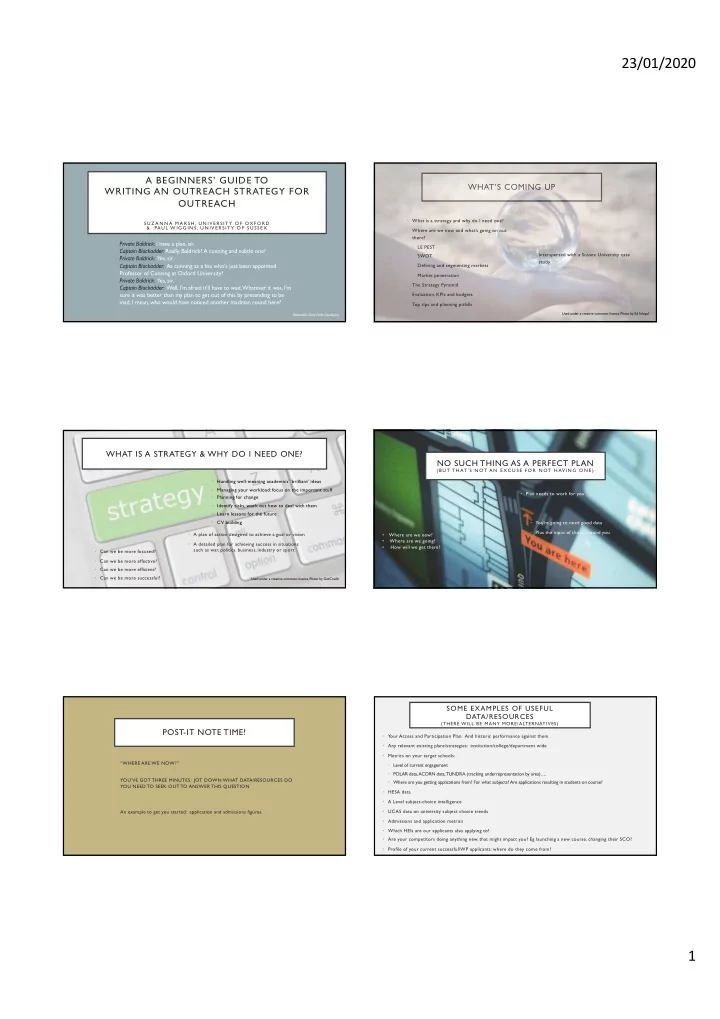
A BEGINNERS’ GUIDE TO WRITING AN OUTREACH STRATEGY FOR OUTREACH

S U Z A N N A M A R S H , U N IV E R S IT Y O F OX F O R D & PA U L W IG G IN S , U N IV E R S IT Y O F S U S S E X

Private Baldrick: I have a plan, sir. Captain Blackadder: Really, Baldrick? A cunning and subtle one? Private Baldrick: Yes, sir. Captain Blackadder: As cunning as a fox who's just been appointed Professor of Cunning at Oxford University? Private Baldrick: Yes, sir. Captain Blackadder: Well, I'm afraid it'll have to wait. Whatever it was, I'm sure it was better than my plan to get out of this by pretending to be

  • mad. I mean, who would have noticed another madman round here?

Blackadder Goes Forth: Goodbyeee

WHAT’S COMING UP

  • What is a strategy and why do I need one?
  • Where are we now and what’s going on out

there?

  • LE PEST
  • SWOT
  • Defining and segmenting markets
  • Market penetration
  • The Strategy Pyramid
  • Evaluation, KPIs and budgets
  • Top tips and planning pitfalls

Used under a creative commons license. Photo by Ed Schipul

  • Interspersed with a Sussex University case

study

WHAT IS A STRATEGY & WHY DO I NEED ONE?

  • Can we be more focused?
  • Can we be more effective?
  • Can we be more efficient?
  • Can we be more successful?

Used under a creative commons license. Photo by GotCredit

  • Handling well-meaning academics’ ‘brilliant’ ideas
  • Managing your workload: focus on the important stuff
  • Planning for change
  • Identify risks, work out how to deal with them
  • Learn lessons for the future
  • CV building
  • A plan of action designed to achieve a goal or vision
  • A detailed plan for achieving success in situations

such as war, politics, business, industry or sport

NO SUCH THING AS A PERFECT PLAN

( B U T T H AT ’S N OT A N E X C U S E F O R N OT H AV IN G O N E )

  • Plan needs to work for you
  • Where are we now?
  • Where are we going?
  • How will we get there?
  • You’re going to need good data
  • Plus the input of those around you

POST-IT NOTE TIME!

“WHERE ARE WE NOW?” YOU’VE GOT THREE MINUTES: JOT DOWN WHAT DATA/RESOURCES DO YOU NEED TO SEEK OUT TO ANSWER THIS QUESTION An example to get you started: application and admissions figures

SOME EXAMPLES OF USEFUL DATA/RESOURCES

(THERE WILL BE MANY MORE/ALTERNATIVES)

  • Your Access and Participation Plan. And historic performance against them.
  • Any relevant existing plans/strategies: institution/college/department wide
  • Metrics on your target schools:
  • Level of current engagement
  • POLAR data, ACORN data, TUNDRA (tracking underrepresentation by area)….
  • Where are you getting applications from? For what subjects? Are applications resulting in students on course?
  • HESA data
  • A Level subject-choice intelligence
  • UCAS data on university subject choice trends
  • Admissions and application metrics
  • Which HEIs are our applicants also applying to?
  • Are your competitors doing anything new, that might impact you? Eg launching a new course, changing their SCO?
  • Profile of your current successful/WP applicants: where do they come from?
slide-2
SLIDE 2

23/01/2020 2

WHERE ARE WE NOW? WHAT’S GOING OUT THERE?

U sed under a creative com m ons license. Photo by C haram elody

  • Competitive advantage – why are we better than the rest?
  • What is our unique selling point? (USP)
  • What do we need to worry about?

PEST

Political Economic

LE

Social T echnical/T echnological Legal Environmental

A-level reform Increase in places for medicine Immigration reform Falling number of 18 year-olds (smaller market) MOOCs Rising tuition fees? Cuts to nursing funding

U sed under a creative com m ons license. Photo by Anne W orner

Impact on subject choice at degree (eg interest in Earth Sciences, Materials etc)

POST-IT NOTE TIME!

YOU’VE GOT THREE MINUTES: USING THE “LE PEST” FRAMEWORK, JOT DOWN SOME MACRO- ENVIRONMENTAL FACTORS THAT INFLUENCE YOUR OUTREACH WORK IN THE COMING THREE YEARS GO! Reminder: Legal, Environmental+ Political, Economic, Social, Technological. Internal External Positive Negative Weaknesses Strengths Opportunities Threats Internal capabilities that may help you reach your goals Internal limitations that may interfere with your ability to achieve your goals External factors that you may be able to exploit to your advantage Current or emerging external factors that may challenge your performance

S W O T

POST-IT NOTE TIME!

YOU’VE GOT TWO MINUTES: START YOUR OWN SWOT ANALYSIS. WHAT ARE THE STRENGTHS AND WEAKNESSES OF YOUR ORGANISATION THAT ARE LIKELY TO AFFECT YOUR OUTREACH WORK? WHAT EXTERNAL OPPORTUNITIES AND THREATS ARE THERE? GO!

CASE STUDY: TARGET SCHOOL STRATEGY SUSSEX

Review the Data Assess our Goals Build the Strategy

slide-3
SLIDE 3

23/01/2020 3

HOW WE USED THE DATA AT SUSSEX

Feeder School Analysis Patterns over the last 5 years Applications and Entrants WP Profile Recruitment radii mapping Comparisons with ‘Partner Schools’ WP Partner School Analysis Progression to Sussex WP Profile Levels of Engagement Broader Schools Analysis Density of WP Students ‘Hub Regions’ Market Share Analysis UK Regions South East Regions Gaps Changes Where else do our potential applicants go? 1 2 3

SEGMENT & DEFINE YOUR TARGET MARKETS: POST-IT NOTE TIME!

  • YOU’VE GOT A COUPLE OF MINUTES TO DEFINE SOME OF YOUR TARGET
  • MARKETS. HOW CAN YOU MEASURE YOUR MARKET PENETRATION?
  • GO!

Hint: think about product/service benefits sought, demographic variables, geographic variables, behavioral variables... Bonus points if you can figure out where you might find these groups of people.

THE STRATEGY PYRAMID

Objectives Mission Strategies Goals Tactics What you'd like to accomplish: the big idea Why do we exist? Things you'll actually do to accomplish the goals (detailed activities) What you'd like to accomplish: sub-goals What are you going to do to get there (high-level approach) Objectives Where are we now? Where are we going? How are we going to get there?

MISSION (PURPOSE) + VISION (AMBITION)

National Trust T

  • combat issues such as climate change and

safeguard these special places for future generations. Sainsbury’s T

  • be the most

trusted retailer where people love to work and shop.

O M S G T

Cancer Research UK T

  • accelerate progress and see

three-quarters of people surviving the disease within the next 20 years.

U sed under a creative com m ons license. Photo by Bronx

MISSION (PURPOSE) + VISION (AMBITION)

A better university for a better world…. Designed to be different, the University of Sussex has a distinguished tradition of disruptive and experimental interventions. The University of Oxford aims to lead the world in research and

  • education. We seek to do this in ways

which benefit society on a national and a global scale. Over the period of this Plan we will build on the University’s long traditions of independent scholarship and academic freedom while fostering a culture in which innovation plays an important role….To fulfil the aims that no potential student should be deterred from applying to Oxford by financial or other barriers and that no student’s success should be hampered by financial difficulties. O M S G T The mission of the University of Cambridge is to contribute to society through the pursuit of education, learning, and research at the highest international levels of excellence. The University's core values are as follows:

  • freedom of thought and expression
  • freedom from discrimination.

…to achieve the highest international standards in education and research, while continuing to serve its local communities through public engagement and the promotion of opportunity to individuals less favoured by financial or social background. Queen Mary University of Sussex Cambridge University Oxford University

POST-IT NOTE TIME!

  • YOU HAVE ONE MINUTE:
  • DOES YOUR COLLEGE OR DEPARTMENT HAVE ITS OWN MISSION

STATEMENT? WOULD YOU LIKE IT TO? WRITE DOWN YOUR IDEAS HERE!

  • GO!
  • HINT: WHAT DO WE EXIST TO DO? WHY ARE WE HERE?
slide-4
SLIDE 4

23/01/2020 4

GOALS

  • A broad aim toward which your efforts

are directed

  • Expect to have several of them
  • What (not how)

O M S G T

GOALS: SIMILAR ACROSS INSTITUTIONS

  • …to solve real world problems, while providing transformational

experiences for learners.

  • University of Idaho
  • Provision and promotion of programs and support which

ameliorate the challenges faced by students in groups of disadvantage - transition, retention, progress and success programs, scholarships, financial aid, employment, housing.

  • University of Melbourne
  • Bristol University
  • …lead in the design and delivery of innovative and

accessible outreach activities.

O M S G T

  • Undertake sustainable growth in student numbers, with a

greater proportion of students as defined by widening participation criteria engaged in undergraduate and postgraduate programmes.

  • University of Kent
  • To develop robust measures of success to help determine

current and future priorities for widening participation and

  • utreach.
  • University of Surrey
  • to encourage appropriately qualified young people from

currently under-represented groups to enter higher education.

  • University of Sheffield

SUSSEX CASE STUDY: OUR GOALS OBJECTIVES

  • Specific, significant, simple
  • Measurable, manageable
  • Achievable, agreed, assignable
  • Relevant, resourced
  • Time bound, trackable.

Not SMART: “We want more state-school students on our courses.” SMART: “Make 65% of home student offers to those from state schools by 2021.” O M S G T

  • The areas in which your effort is directed to drive

your mission and vision

  • Mini goals – with detail.

U sed under a creative com m ons license. Photo by Therese Banström

OBJECTIVES: STUDY HIGHER EXAMPLE

O M S G T

Study Higher’s…objectives as submitted to HEFCE in operating plan:

  • increase in progression to HE in target wards by 3% between

2016-2020

  • increase application to HE rates in target schools by 5% by

2020

  • increase in BME participation in HE by 5%

by 2020 POST-IT NOTE TIME!

  • YOU’VE GOT FOUR MINUTES:
  • START WRITING DOWN SOME GOALS AND OBJECTIVES.
  • GO!

O M S G T Hint: Goal: A broad aim toward which your efforts are directed. Objectives are more detailed, sub-goals.

slide-5
SLIDE 5

23/01/2020 5

STRATEGIES & TACTICS

O M S G T

  • Strategy is what Generals do; Tactics are what Captains and Lieutenants do.
  • Tactics are fun and easy while Strategy is not fun and hard. (Apparently.)
  • Strategy is the “what” part of the equation and helps you answer the questions

“What are we trying to accomplish?” & “What approach are we taking?” Happens over time. Broad.

  • Tactics is the ”how & who”. Often a short, or one off item. Narrow, focused.
  • Strategy: Work with external organisations to reach hard-to contact prospective

students from Polar quintiles 1&2.

  • Tactic: Host one Brilliant Club graduation day per year.
  • Strategy: Use non-traditional routes, including social media to engage with students.

Tactic: Create10 short videos on access and outreach, featuring current students, for the website.

SOME EXAMPLE STRATEGIES

  • The development and maintenance of successful

partnerships with schools, FE colleges, voluntary sector and HEIs on an individual and collaborative basis.

  • University of Kent
  • Place careers development as a central theme in our
  • utreach activities, equipping young people with the skills

and knowledge needed to make well informed decisions about their futures

  • City University
  • Bristol University
  • … enhancing our relationships with key influencers

such as parents and teachers. It must also involve collaboration with our regional and national partners. O M S G T

  • Grounding work in available research and data and

growing the evidence base through better evaluation and monitoring of widening participation work throughout all areas of the student lifecycle

  • Queen Mary

GOST

  • GOAL 1: To have a diverse student body

OBJECTIVE A: 30% of science students to be women OBJECTIVE B: 80% of home students to be from state schools OBJECTIVE C 5% of undergraduates to have a disability STRATEGY A1: Work with teachers to promote the uptake of of Further Maths & Physics at A- level by women STRATEGY A2: Work with teachers to promote the uptake of of triple- science GCSEs in state schools STRATEGY A3: Maximise support for science-related events already being run in the local community TACTIC 1 Host a Further Maths Network event for teachers TACTIC 2 Hold two Women in Science events for year 10s TACTIC 3 Offer academic speakers to the city’s science festival kids’ programme.

SUSSEX STRATEGY & TACTICS: SCHOOLS MATRIX

School Number of KS5 students POLAR4 Q1 IMD Q1 BAME POLAR4 Q5 Number of HEAT subscribers % Receiving 9-4 GCSE's in Eng. and Maths Average A level point score Proportion of KS5 entering HE Score <25 Score rank 86 70.4% 22.1% 9.6% 5.7% 7 71% 21.12 27% 1.40 1 237 53.7% 2.8% 45.6% 2.8% 14 57% 27.74 59% 1.40 1 205 69.1% 51.1% 13.5% 8.9% 4 48% 20 22% 1.35 3 202 21.3% 4.8% 9.2% 9.0% 6 75% 34.22 48% 1.35 3 238 0.2% 0.0% 5.2% 38.4% 7 75% 32.36 49% 1.30 5 40.6% 20.6% 23.3% 4.8% 7 83% 1.30 5 324 7.2% 0.3% 48.5% 4.0% 11 69% 31.76 67% 1.30 5 210 61.6% 9.4% 9.7% 0.9% 13 73% 27.63 28% 1.25 8 344 4.1% 1.4% 4.0% 23.7% 14 78% 34.35 43% 1.20 9 224 11.3% 0.0% 13.3% 38.2% 16 75% 29.91 28% 1.20 9 116 70.1% 4.6% 21.6% 1.7% 9 39% 24.92 31% 1.20 9 182 45.9% 4.0% 5.4% 12.6% 7 53% 31.24 32% 1.15 12 174 22.1% 22.5% 27.8% 25.7% 11 66% 21.9 45% 1.10 13 30.5% 14.3% 18.3% 31.0% 1 77% 1.10 13 71.1% 35.8% 13.0% 16.0% 6 41% 1.10 13 340 0.2% 0.0% 5.2% 42.5% 10 74% 35.07 47% 1.10 13

POST-IT NOTE TIME!

  • YOU’VE GOT ANOTHER FEW MINUTES:
  • START WRITING DOWN SOME STATEGIES AND TACTICS TO ACHIEVE

THEM

  • GO!

O M S G T

EVALUATION/SCORECARDS/KPI/BUDGETS

  • How will you measure progress?
  • Quantitative: Event attendance, website visitors, donations, column inches,

downloads, views, application numbers, POLAR & ACORN data

  • Qualitative: Feedback forms, focus groups, key messages in the media
  • Budget.

KPI – Key Performance Indicators

slide-6
SLIDE 6

23/01/2020 6

TOP TIPS & PLANNING PITFALLS

  • Get the right people involved
  • Each stage should be consistent with the previous stages
  • Do a sanity check: Is it financially viable? Does it make sense?
  • Is it based on good data? Have you understood what the data is telling you?
  • Include a timeline of activity
  • It’s not a door stop
  • Feed into your PDR/review/appraisal.
  • Remember it’s not a perfect document: it should change and evolve.

U sed under a creative com m ons license. Photo by H abeebee

WHAT THE DATA CAN’T TELL US

(AND WHY UNIVERSITIES NEED A PARTNERSHIP MANAGER)

Recent changes – closed/new sixth forms, mergers Schools readiness/willingness to engage Broader Support Available to Schools – universities not on HEAT, charities, local authority Local infrastructure

QUESTIONS?

O M S G T

POST-IT NOTE TIME!

  • YOU’VE GOT UNITL THE END OF THE SESSION
  • GO BACK THROUGH THE STRUCTURE WE’VE TALKED ABOUT, AND

FLESH OUT SOME OF THE IDEAS

  • GO!

O M S G T