2020: Annus horribilis 2020 in Chinese culture is known as the Year - - PDF document

2020 annus horribilis
SMART_READER_LITE
LIVE PREVIEW

2020: Annus horribilis 2020 in Chinese culture is known as the Year - - PDF document

4/28/20 Ch China: Cr Cros ossroa oads 2020 2020Un Under erstan andin ing Un Uncer ertain ain Fu Futu tures es Yasheng Huang Epoch Foundation Professor MIT Sloan School of Management 1 2020: Annus horribilis 2020 in


slide-1
SLIDE 1

4/28/20 1

Ch China: Cr Cros

  • ssroa
  • ads 2020

2020—Un Under erstan andin ing Un Uncer ertain ain Fu Futu tures es

Yasheng Huang Epoch Foundation Professor MIT Sloan School of Management

1

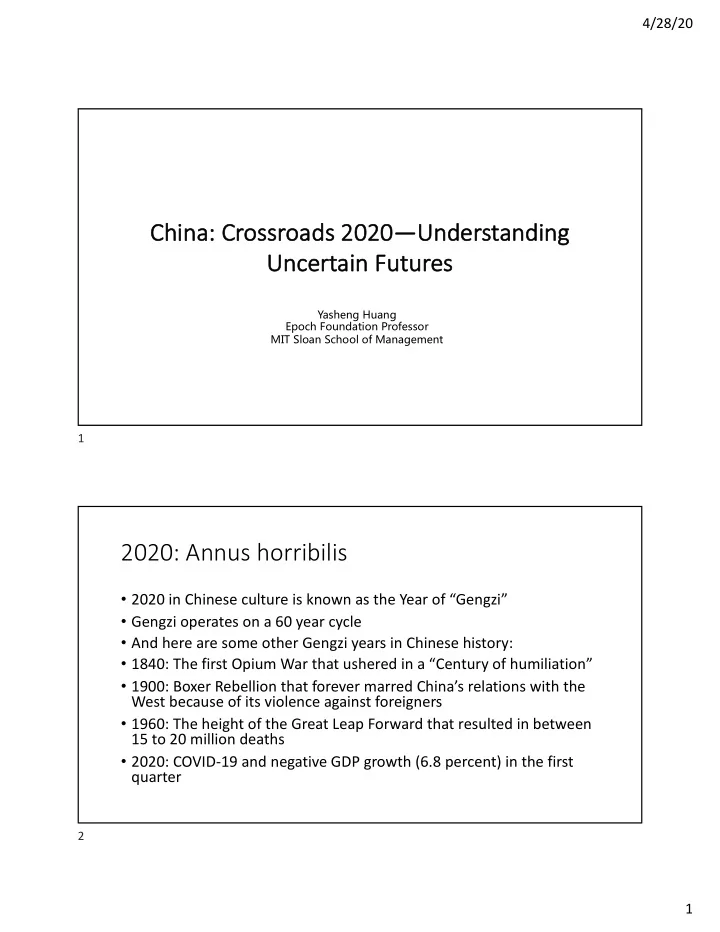
2020: Annus horribilis

  • 2020 in Chinese culture is known as the Year of “Gengzi”
  • Gengzi operates on a 60 year cycle
  • And here are some other Gengzi years in Chinese history:
  • 1840: The first Opium War that ushered in a “Century of humiliation”
  • 1900: Boxer Rebellion that forever marred China’s relations with the

West because of its violence against foreigners

  • 1960: The height of the Great Leap Forward that resulted in between

15 to 20 million deaths

  • 2020: COVID-19 and negative GDP growth (6.8 percent) in the first

quarter

2

slide-2
SLIDE 2

4/28/20 2

My presentation

  • US-China relations: Grim prospects
  • We need a more rational and more cool-headed debate
  • Potential implications of a decoupling between China and the United

States for US high-tech industry

  • (The role of technology in China’s COVID-19 response)

3

  • Republican strategy in the 2020 election:
  • Blame China for the failings of the Trump administration’s handling of COVID-19
  • China misreported and hid information from US
  • Will attack Democrats for being soft on China
  • Multiple lawsuits filed against China seeking damages associated with COVID-19

(although unlikely to succeed because of foreign immunity)

  • But also lawsuits in some other countries too
  • Europe and Japan joined the call for holding China accountable for lack of transparency

and suppression of information

  • Many calls for trust, safety and redundancy of global supply chains
  • Japanese government to provide subsidies to firms to move their operations to

Southeast Asia

US-China Relations: Grim Prospects

4

slide-3
SLIDE 3

4/28/20 3

We need to be rational and cool-headed

  • Yes, Chinese government suppressed information and most likely

misreported data

  • Extremely costly delays in the initial response to COVID-19
  • Containment and mitigation actions implemented three weeks earlier

would have led to 95% fewer infection cases, according to a study by University of South Kempton

  • But South Korea, Singapore, Taiwan, Hong Kong, Israel and Germany all

acted on the same information from China

  • They have done a far better job than the United States
  • We do not need a less parsimonious explanation than a president who

advocated injecting bleach as a treatment

5

De-globalization in fact undermined US preparedness for COVID-19

  • PIIE’s study: Trump’s trade war reduced US hospitals’ imports of

critical medical equipment from China

6

slide-4
SLIDE 4

4/28/20 4

It is hard to replace China, at least in the short run

7

Implications for US high-tech industry

8

slide-5
SLIDE 5

4/28/20 5

  • US high-tech business model
  • Scale and structure of government’s expenditure on R&D
  • Applications market
  • Human capital

Four perspectives on decoupling

9

Th The impact of a“dec ecoupling upling”on

  • n b

business mod models of

  • f th

the US US Te Tech Fir Firms

10

slide-6
SLIDE 6

4/28/20 6

  • US R&D funding by operating income and investors’ money in anticipation of
  • perating income.
  • According to US investment Bank Jefferies’s report in 2018, “U.S. technology

companies generate roughly $100 billion to $150 billion in revenues from China annually.”

  • “Apple and Intel are on a list of 16 U.S. companies that made a total $105.5

billion from China last year, or 23 percent of overall revenues, the analysts

  • said. Other names include Microsoft and Qualcomm.”
  • “Including HP, Dell and other companies that don’t break out their China

revenues brings the total estimate to around $150 billion.”

US Tech Firms Revenue in China

11

Data Source: Goldman Saches

  • The list of the US companies that rely the most on China: Many are

tech firms

US Tech Firms Revenue in China

12

slide-7
SLIDE 7

4/28/20 7

Huawei’s American Suppliers

Data Source: Reuters

13

Th The Sc Scale an and th the St Stru ruct cture of

  • f R&

R&D Expe Expendi nditur ures s in Ch China an and th the US US

14

slide-8
SLIDE 8

4/28/20 8

Overview

  • The federal R&D investments have not increased for many years and

the private tech firms are the main sources for the US R&D funding.

  • Research in the US increasingly depends on the rising international,

collaborative funding, including from China

  • The R&D investments in the tech domain can be complementary

between the US and China.

15

Global and US R&D Investments

Data Source: UN Data Source: AAAS

Global R&D Investment in 2016 Comparison US R&D Investment (1953——2017)

16

slide-9
SLIDE 9

4/28/20 9

Analysis of the R&D Investment in US

Data Source: AAAS

US Federal R&D Investment Trends (1976——2018) US Federal R&D Investment Trends (Discipline) (1970—— 2017)

Data Source: AAAS

  • Rising Concentration of US federal R&D expenditure: 1) Defense and 2)

Life science)

17

Data Source: OECD

Comparative Analysis on Global R&D Investment

  • Complementary structures of US and Chinese R&D spending: US’s

basic research and China’s experimental research

18

slide-10
SLIDE 10

4/28/20 10

Data Source: EU

  • China has a more

even distribution of funded disciplines (excl “Others”): 1) Top three in US: 77.6% and 2) Top three in China: 60.2%

Comparative Analysis on Global R&D Investment

19

Data Source: EU

  • Huawei is now a R&D

Powerhouse

  • Huawei ranked in the

5th place in the 2017- 2018 on R&D investment among all private enterprises in the world.

Comparative Analysis on Global R&D Investment

20

slide-11
SLIDE 11

4/28/20 11

Th The ap applic licatio tions of

  • f S&

S&E Inno Innovatio tions ns

21

  • In some areas, China may have a larger application market than US,

such as AI, materials and renewable energy.

Overview

22

slide-12
SLIDE 12

4/28/20 12

Case Study — AI

Data Source: Center for Data Innovation

  • China’s advantage in AI applications over US and EU.

23

  • China’s data capabilities run long and deep

Case Study — AI

24

slide-13
SLIDE 13

4/28/20 13

  • Alibaba, Tencent, Baidu all operate in multiple business arenas:

E-commerce Gaming Search engine Finance Insurance Entertainment Social media

  • Chinese high-tech firms are all conglomerates

Case Study — AI

25

BIG data: Volume of data Diversity and multiplicity of data Integration and aggregation by Chinese firms are unrivaled

  • Implications of conglomeration business model:

Case Study — AI

26

slide-14
SLIDE 14

4/28/20 14

  • The 2018 Digital Society Index (DSI): 73% of

Chinese believe that the future impact of digital technology will be positive overall, as well as in terms of its ability to create jobs and address societal challenges.

  • Also according to DSI, in comparison to

negative perceptions in the West, 65% believe that emerging digital technologies (e.g. AI, robotics) will create job opportunities

  • ver the next 5 to 10 years.

AI — Attitudinal Support

27

  • Survey by German sinologist Genia Kostka in China in 2018: 80 percent of

respondents approve of social credit systems in China, with just 1 percent reporting either strong or moderate disapproval.

  • Genia Kostka shows socially advantaged citizens — wealthier, better-educated

urban residents — report the strongest approval levels of social credit systems, along with older people.

  • Genia Kostka shows 76 percent of respondents flagged a general lack of trust in

Chinese society as a problem. Respondents see social credit as a helpful means

  • f striking back at con artists, or punishing polluting and otherwise negligent

firms.

AI — Big Data and Surveillance State

28

slide-15
SLIDE 15

4/28/20 15

  • China’s Dominance in Global AI Funding
  • Geographical Distribution of Global AI

Investment and Financing (2013-2018 Q1)

AI — Global Trend

Note: Deal share means number of projects, Funding share means amount of money

29

  • Chinese AI patents 37.1% of the global

share

  • Fastest growth trend

AI — Global Trend

30

slide-16
SLIDE 16

4/28/20 16

The power of data and contact-tracing in China’s COVID-19 response

31

China Unicom: Using cell phone data to track population mobility

  • China Unicom: One of China’s largest mobile service providers
  • Assembled a big-data team on January 20th, 2020 (the same day Xi Jinping signaled his

decision)

  • On January 22nd, China Uniform shared mobile phone data with China’s health commission,

Chinese CDC and provincial authorities on population movement, especially that out of Wuhan

  • One day before lockdown of Wuhan
  • Provided key data that justified decisions to implement lockdown and shutdown
  • à This is a concrete example of data-based decision

32

slide-17
SLIDE 17

4/28/20 17

Tracking individual health status: Zhejiang

  • Zhejiang Province: Widely considered as success story in mitigating virus

spread

  • On February 11th, Alibaba launched smartphone app Hangzhou Health Code to

monitor health conditions of Hangzhou residents

  • Most likely implemented with a decree of the city: Every resident required to fill out

questionnaire on personal health condition and recent travel history

  • Information shared with police according to NYT
  • Questionnaire data checked against Alipay/WeChat account history in verifying travel

history

  • All-in-one function is extremely important
  • App then generates color-based QR code:
  • Green: Movement permitted with few restrictions
  • Yellow: Self-quarantine for 7 days and report personal health condition on the app on a daily

basis

  • Red: Self-quarantine for 14 days and report personal health condition on the app on a daily

basis

33

Contact Tracing

  • Tracking individual travel history:

Qihoo360: Internet security company known for antivirus and web browser: Using user interface to construct travel history

34

slide-18
SLIDE 18

4/28/20 18

Robots and applications during COVID-19

35

Data Source: Tsinghua University

  • Industrial robotics applications are driven by the size of manufacturing

sector.

Industrial Robots

36

slide-19
SLIDE 19

4/28/20 19

  • Huawei
  • According to newspaper Yangtze Daily

(the newspaper of Wuhan government), Huawei sent first two 5G self-driving medical vehicles to Wuhan on Feb 4th. Huawei kept sending more after Feb 4th.

  • The vehicles are used in the isolated

wards of the hospitals to transport patients.

  • Traditional transportation methods in the

isolated wards of the hospitals would create risks for medical care workers to be infected. Self-driving medical vehicle

reduces the risk by minimizing the contacts between patients and medical care workers. Source of the pictures: Yangtze Daily & Zhihu

37

  • DaLu Robotech
  • DaLu Robot, a tech company in Changshu City,

Jiangsu Province, collaborated with Huawei to produce an intelligent inspection robot: ANDI.

  • ANDI has been delivered to hospitals in Wuhan

in early March.

  • ANDI can achieve multiple tasks:
  • Contactless body temperature detection

based on infrared thermal imaging device

  • 24 hours non-stop patrol based on pre-

determined route

  • Spraying disinfectant sprays based on pre-

determined route

  • Detecting and warning people who don’t

wear masks based on AI facial recognition

Source of the pictures: Changshu Party Media

38

slide-20
SLIDE 20

4/28/20 20

  • Cheetah Mobile

Source of the picture: Xinhua

  • Cheetah Mobile delivered dozens of robots to

hospitals in Beijing and Hubei province in late January/early February.

  • The robot can:
  • Connect the patient with doctors remotely.
  • Deliver supplies, clinic laboratory sheets,

medicines.

  • Detect a fever within an accuracy of 0.3°C

based on a combination of AI algorithms and infrared thermal technology.

39

  • Saite Robot

Source of the picture: voorp

  • Saite Robot, a robotic firm based in Guangdong

province, delivered multiple robots to hospitals in Guangdong and Hubei provinces in late January/early February.

  • The robot can:
  • Take elevators and swipe ID before gates

automatically

  • Deliver food/medical supplies within the

hospitals

  • Spray infectant sprays
  • Detect body temperature

40

slide-21
SLIDE 21

4/28/20 21

China’s efforts on material science application:

  • Launched in 2016, the Materials Genome Engineering (MGE) project of China aimed

to match the scope of the Materials Genome Initiative in the United States, a $250- million federal program designed to shepherd advanced materials science into industrial applications. The project has a budget with 1-billion-yuan (US$150-million).

  • In the nanoscience domain, China now (2019) has the highest number of graphene

businesses in the world — nearly 3,000, according to government figures. The country also accounts for around two-thirds of global production.

Material Science

Data Source: Nature

41

Data Source: Oxford

  • China has more applications on solar PV and wind energy than any

countries in the world.

Renewable Energy

42

slide-22
SLIDE 22

4/28/20 22

The he hum human n capi pital per perspec pective

43

  • The S&E labs in the US universities depend heavily on human capital

from abroad, China in particular.

Overview

44

slide-23
SLIDE 23

4/28/20 23

Higher Education in the US

Data Source: NSF

U.S. S&E Doctoral Degree Recipients (Asian country or economy 1995——2015)

45

Data Source: NSF

Higher Education in the US

46

slide-24
SLIDE 24

4/28/20 24

Data Source: NSF

US Trained S&E PhDs in Academia (1973—2015)

S&E PhDs in US academia

47

  • In 2019, 2 Chinese passport holders were elected

into the US Academy of Science as academicians and 2 Chinese Americans were also elected into the US Academy of Science.

  • By 2019, 107 Chinese or Chinese American scientists

have been elected into the US Academy of Science,

  • Among all Chinese American academicians in the

history of the US Academy of Science, 26 of them were born or lived in mainland China.

  • The picture on the right shows that among all

international scholars at MIT, 44% of them are from Asia.

Data Source: MIT

US Academy of Sciences

48

slide-25
SLIDE 25

4/28/20 25

Data Source: NSF

  • Coauthored papers between Chinese and American scientists have

increased dramatically

Research Collaborations

49

Data source: Tsinghua University

  • R&D collaborations are particularly substantial in AI.

Research Collaborations

50

slide-26
SLIDE 26

4/28/20 26

  • Undermining US high-tech industry will slow down global rate of scientific and

technological progress

  • US is still the global powerhouse of science and technology
  • US progress benefits the whole world, including China
  • Drug discoveries, discovery of gravitational waves, new algorithms benefit and

satisfy the curiosity of Chinese as well

  • Wrong for the Chinese to cheer Donald Trump for undermining US

A decoupling will have a substantial, long-term damaging impact on BOTH countries

51

Are there smarter ways to challenge China? Some general principles

  • Goals should be specific and targeted
  • Current trade war fails this test
  • Multiple and unclear objectives:
  • Trade imbalance
  • Intellectual property
  • Market entry
  • Investment reciprocity
  • Human rights
  • This is a “maximum pressure” strategy that will likely fail or will be

gamed

52

slide-27
SLIDE 27

4/28/20 27

Some general principles

  • Tit-for-tat is the most effective bilateral strategy (known as Axelrod

Tournament):

  • Use the market access to demand reciprocity and revoke that access if

reciprocity fails to be supplied

  • Create business-specific licensing power
  • Give the government this power on a case-by-case basis of market economy

determination

  • Combine tit-for-tat with a linkage strategy:
  • CFIUS conditions inward investment approvals on host treatments of outward

investments

  • The countermeasure should be proportional to the measure being

countered

53

Alibaba operates content delivery network (CDN) freely across the globe

  • But the ability of US high-tech

industries to provide cloud computing services in China is severely limited

  • Joint ventures required
  • Minority equity stakes are

mandated

54

slide-28
SLIDE 28

4/28/20 28

We need a new approach

  • Many other examples
  • New York Times vis-a-vis China Daily
  • CNN vis-à-vis CCTV
  • Google vis-à-vis Baidu
  • Devise specific investment approval, market access controls, and

licensing power to deal with these asymmetries

  • A fundamental challenge is whether our system based on process

compliance (such as disclosure requirement) is capable of this approach

  • The unprecedented challenge of China warrants a rethinking of our

system

55

Thank you!

56

slide-29
SLIDE 29

4/28/20 29

Case Study——Sino-US R&D Cooperation on Energy

  • Chinese and the US governments have jointly established U.S.-China

Clean Energy Research Center (CERC) in 2011. The total investment by the U.S. and China reach 150 million USD spread over five years. It is the chance to prove the long-term utility of meaningful and deeper S&T cooperation. CERC will promote collaborative approaches in clean energy technology research, development and commercialization.

57

What is “decoupling”?

  • According to Oxford Dictionary, “decoupling” means “a situation in

which two or more activities are separated, or do not develop in the same way.”

  • According to an article on NYT in 2019 April, “The move, known

as decoupling, is a major goal of those who believe the world has grown far too dependent on China as a manufacturing giant. ”

58

slide-30
SLIDE 30

4/28/20 30

  • Many Tech firms in the US depend on the Chinese market and the

partnerships with Chinese firms. The “decoupling” could harm these firms and thus harm the overall development of technology in the US.

Overview

59

Huawei’s American Suppliers

Data source: UK <The Independent>

60

slide-31
SLIDE 31

4/28/20 31

The Impacts of Export Controls on the US Tech Firms

Data source:ITIF

  • The U.S. Commerce Department’s

Bureau of Industry and Security (BIS) is developing (2019) rulemaking regarding extending export controls to an enlarged set

  • f emerging and foundational

technologies (EFTs). Information Technology & Innovation Foundation (ITIF) has calculated the impacts on the US tech industries when the export control reduce export by 5%, 10% and 20%.

61

Back Up Graphs

62

slide-32
SLIDE 32

4/28/20 32

Back Up Graphs

63

Back Up Graphs

64

slide-33
SLIDE 33

4/28/20 33

Back Up Graphs

65

Back Up Graphs

66

slide-34
SLIDE 34

4/28/20 34

Back Up Graphs

67