2019 WVAHC Medicaid Summit The National View: Medicaid in Schools - - PowerPoint PPT Presentation

2019 wvahc medicaid summit the national view medicaid in
SMART_READER_LITE
LIVE PREVIEW

2019 WVAHC Medicaid Summit The National View: Medicaid in Schools - - PowerPoint PPT Presentation

2019 WVAHC Medicaid Summit The National View: Medicaid in Schools Kyle Marie Stock, J.D. Senior Policy Analyst Community Catalysts System of Advocacy Thank You Connecting Health & Education Medicaid Billing in Schools: What Tools Do


slide-1
SLIDE 1

2019 WVAHC Medicaid Summit
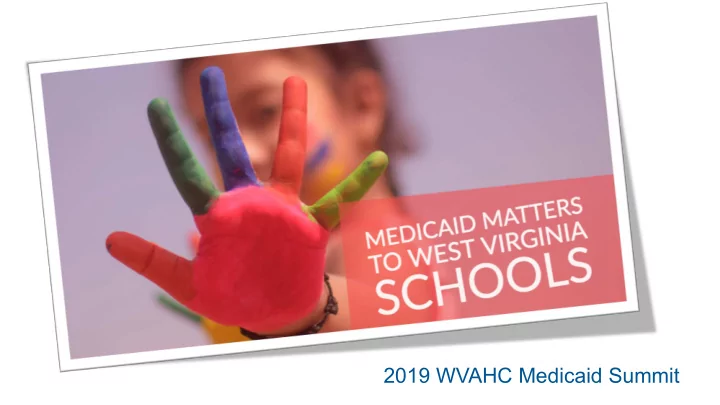
slide-2
SLIDE 2

Kyle Marie Stock, J.D.

Senior Policy Analyst

The National View: Medicaid in Schools

slide-3
SLIDE 3

Community Catalyst’s System of Advocacy

slide-4
SLIDE 4

Thank You

slide-5
SLIDE 5

Connecting Health & Education

slide-6
SLIDE 6

Medicaid Billing in Schools: What Tools Do We Have?

  • IDEA related services for students
  • Other health services for

Medicaid-eligible students

  • School-based health centers
  • Outreach & enrollment
slide-7
SLIDE 7

What is the “Free Care” Policy Reversal?

  • CMS reversed the “free care”

policy in 2014

  • Allows schools to bill for

services provided to any Medicaid enrolled student

  • Some states are moving

forward with implementation

slide-8
SLIDE 8

Case Study: South Carolina

  • Did not need State Plan Amendment
  • Now permits billing for all Medicaid

enrolled students

slide-9
SLIDE 9

Case Study: Louisiana

  • 2015 State Plan Amendment
  • Limited to school-based nursing services
  • Unofficial estimates show:
  • Increased Medicaid revenue
  • More nurses in schools
slide-10
SLIDE 10

Case Study: Massachusetts

  • 2016 State Plan Amendment
  • Effective for school year 2019-2020
  • What changed?
  • Permits billing for all Medicaid

enrolled students

  • Adds services & provider types
  • New methodology
slide-11
SLIDE 11

Case Study: North Carolina

  • 2019 State Plan Amendment
  • What changed?
  • Permits billing for all Medicaid

enrolled students

  • Adds services & provider types
slide-12
SLIDE 12

Other States in Process

  • Approved SPA
  • FL
  • SPA Submitted
  • CA, GA, KY
  • Moving Toward Policy Change
  • CO, MO, NV, NH, UT
slide-13
SLIDE 13

Thank you.

slide-14
SLIDE 14

The WVAHC Perspective

slide-15
SLIDE 15

Kelli Caseman

Kelli is the Director of Child Health for West Virginians For Affordable Health Care and the West Virginia Kids’ Health Partnership. She has over 15 years of experience working in the fields of children’s health and education. She is a member of the Robert Wood Johnson Foundation’s Interdisciplinary Research Leaders program, studying the linkages between health care and public education in rural West Virginia with researchers at Child Trends and Penn State University.

slide-16
SLIDE 16

Agenda

  • Medicaid and School Health from the West

Virginia Perspective - Highlights from the Brief

Federal rules vs. state flexibility State Medicaid plan When can schools bill? IDEA, IEP and 13 categories of special education State Stats: How much is WV billing?

  • Putting It into Perspective: The Need for More Health

Services in Schools

  • The Children’s Health Collaborative Project
slide-17
SLIDE 17

A Snapshot of Our Kids’ Health

  • The 2019 Kids Count Data Book ranks West Virginia 43

43rd in the well-being of children in the state.

  • Rural West Virginians struggle with accessibility to health care, with 52

52 of 55 55 counties designated as Medically Underserved Areas/Populations by the Health Resources and Services Administration (HRSA).

  • According to the WV Department of Health and Human Resources, between 2014 and 2017, our state

saw a 46% 46% increase of children in state custody, a 22% 22% increase in abuse/neglect referrals and a 34% 34% increase in open CPS cases over 3 years. We remain number one in the country for child removals. Around 85% 85% of these cases involve drug use.

slide-18
SLIDE 18

A Snapshot

  • f Our

Kids’ Health

slide-19
SLIDE 19

Copies are in Summit attendee packets.

Also available for download at our website, www.wvahc.org, or via USPS by emailing info@wvahc.org.

slide-20
SLIDE 20

The Federal Rules for Medicaid Funding for Student Health Services

Three Ways Medicaid Can Pay:

  • 1. IDEA related services for students with Individualized Education Program (IEP)
  • 2. School-based health centers

3. Other health services for Medicaid-eligible students

slide-21
SLIDE 21

Medicaid Matters to WV Schools: In a Nutshell

 Public schools bill Medicaid for services to students with an IEP & parental consent.  School-Based Health Clinics can bill for any Medicaid services that are covered under the Medicaid State Plan & under authority of EPSDT (but not for IEP-related services).

  • WV public schools (school nurses & other school-employed

Medicaid qualified providers) do NOT bill Medicaid for services provided to Medicaid enrolled students that are provided free to other students, such health exams or chronic disease management - even though federal “free care rule” that prohibited this billing is no longer in place.

slide-22
SLIDE 22

WV Medicaid: Fills in IDEA Funding Shortfalls

To qualify for IDEA Medicaid funding, State Plan Amendment 12-006

  • 1. Fit under one of 13 categories of disabilities
  • 2. Individualized Education Plan (IEP)
  • Team with required members
  • Written document
  • Reviewed annually – re-evaluated every 3 years
  • Broad range of services – but does not cover:
  • IEP plan development
  • Other changes to how certain ancillary services billed
  • SFY 2017 $23.4 million
slide-23
SLIDE 23

West Virginia: Medicaid and Schools

  • IDEA services pursuant to an IEP plan- There were 47,183 students

ages 3 through 21 with an IEP as of 12/18– about 17.8% of all West Virginia public school students.

  • School-based health centers (SBHCs)- Nearly 170 SBHCs (For

context, there are 690 public schools in WV)

slide-24
SLIDE 24

Putting It Into Perspective: The Need for More Health Services in Schools

slide-25
SLIDE 25

Putting It Into Perspective

  • As part of the Children’s Health

Collaborative Project, WVAHC surveyed

  • ver 4000 school personnel, health care

providers and community stakeholders around the state. We received 789 auditable responses.

  • Key findings: 88% believed there were

children in their communities in need of health care but not receiving it; 87% of respondents believed that schools are appropriate place to receive health care. Mental health care was identified as the #1 needed service students weren’t receiving.

slide-26
SLIDE 26

The Political Landscape

  • WV Governor Jim Justice signed HB 206– “The

Education Bill”—on June 28. One of the few areas of agreement between legislative Republicans and Democrats on education reform included wraparound services for students with emotional or developmental needs. HB 206 includes more than $30 million for putting more mental health professionals — counselors, psychologists, and nurses — in schools. The funding will allow for five mental health professionals per every 1,000

  • students. The bill also requires counselors to spend

80 percent of their time on direct counseling — up from 75 percent previously.

slide-27
SLIDE 27

In 2017, WVAHC received a Community Transformation Grant to create the Children’s Health Collaborative Project. Our work entailed bridging health care and schools at the community level, with the end goal of creating policy reform and cultivating grassroots support.

WVAHC’s Work to Expand School Health Services

  • Conducted a statewide surveying project
  • Wrote a survey project report and “launched” the CHC project via press conference
  • Held a meeting/webinar highlighting WVDE/WVDHHR efforts to address mental health services in schools
  • Wrote a second brief, detailing Medicaid services in WV schools
  • Held a joint webinar with Community Catalyst to report our brief findings
  • Held four community dinner/discussion meetings around community-level policies connecting health care and schools

What have we learned (so far)?

  • Few county school systems/schools have health care policies in place, such as procedures for collecting

health insurance or referring kids to care.

  • Few policymakers/legislators understand the complexities of Medicaid billing.
  • Few school health staff “like” billing Medicaid-- it takes time, is complex, and

reimbursement is low. Sometimes, they don’t do it.

  • No one disagrees that our kids are in crisis.
slide-28
SLIDE 28

Next Steps

  • Hold at least three more community meetings (and maybe more)
  • Disseminate Medicaid Matters to West Virginia Schools, Part II–

which will focus on opportunities for expanding Medicaid services

  • Hold a webinar exclusively for parents- a pseudo-focus

group/listening session to hear their thoughts on expanding health services in schools.

  • Conduct a two-hour session on school health services at WVAHC’s

upcoming annual Medicaid Summit.

  • Draft a three-year strategic plan to carry on this work after the RWJF

grant ends in September.

slide-29
SLIDE 29

Cynthia A.Parsons Program Director Behavioral Health & Long Term Care Services West Virginia Bureau for Medical Services

A State Director’s Perspective

slide-30
SLIDE 30

Brenda C. Isaac BSN, RN, MA, NCSN Lead School Nurse Kanawha County Schools

A School Nurse’s Perspective

slide-31
SLIDE 31

Discussion