
SLIDE 1
1/9/2018 1
2018 Navigating the Annual Report and Proxy Season
2018: Looking Ahead
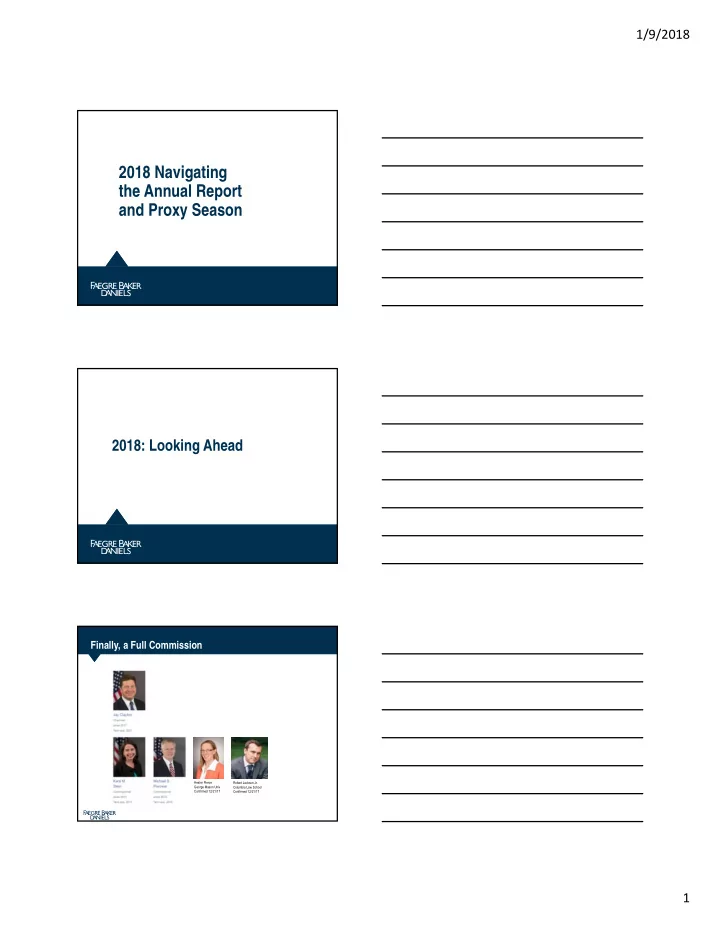
Finally, a Full Commission
Hester Pierce George Mason Univ Confirmed 12/21/17 Robert Jackson Jr. Columbia Law School Confirmed 12/21/17
2018 Navigating the Annual Report and Proxy Season 2018: Looking - - PDF document
1/9/2018 2018 Navigating the Annual Report and Proxy Season 2018: Looking Ahead Finally, a Full Commission Hester Pierce Robert Jackson Jr. George Mason Univ Columbia Law School Confirmed 12/21/17 Confirmed 12/21/17 1 1/9/2018 SEC
Hester Pierce George Mason Univ Confirmed 12/21/17 Robert Jackson Jr. Columbia Law School Confirmed 12/21/17
►Representative Priorities on the Reg Flex Agenda:
Enforcement and examinations (but not “broken windows”) Capital formation (confidential filings) Disclosure reform
►Moved to long-term agenda:
Unfinished Dodd-Frank rulemaking
►Pay for performance disclosure ►Hedging policies ►Clawback rule
Universal proxy ballot Conflict minerals amendments Board diversity disclosure
►Proposed on October 11 as required by FAST Act ►Representative proposed changes:
Require only period-to-period comparison for two most recent years in MD&A, so long as discussion of third year is not material to understanding the financial statements and it is discussed in a prior 10-K Require Section 16(a) discussion only if there are late filings and change heading to “Delinquent Section 16(a) Reports” Include description of capital stock as an exhibit to 10-K Allow the omission of attachments and schedules to exhibits unless they contain material information that has not been disclosed otherwise; may require a listing of the schedules/exhibits
►Total number of proposals voted on was down about 8% from 2016,
Largely driven by decline in proxy access proposals as more companies “voluntarily” adopted
► Environmental, social and political proposals remain common
Notable themes included climate change, sustainability disclosure, gender pay equity, board diversity, political contributions and lobbying These proposals rarely passed, though support levels for environmental proposals increased
►3 resolutions on climate change won majority support at energy companies ►Vast majority of shareholder proposals were received by large-cap
S&P 500 companies received nearly 80% of all proposals voted
Proposal Topic
Proxy Access (includes adoptions and amendments) 45% Climate Change / GHG Emissions 33% Political Contributions 25% Environment & Sustainability 27% Separate Chair/CEO 30% Lobbying 26% Board Diversity 28% Call Special Meetings 42% Simple Majority Vote 74% Gender Pay Gap 13% EEO 29%
►Workforce Diversity ►Gender Pay Gap ►Pay Disparity ►Human Capital Management ►Minimum Wage Increase ►Human Lead Exposure ►Pharmaceutical Pricing ►Religious Freedom Principles ►Expansion of Clawback Policies
►Proxy contests decreased from last year, but still get lots of attention
38 contests, down from 47 last year 63 board seats won by activists, down from 139 last year No one is immune
►Recent P&G success narrowly defeating Nelson Peltz despite proxy
advisory firms’ support for Peltz
►Placeholder slate tactic – The Williams Companies
Corvex listed 10 of its employees for election to the board as placeholders until Corvex could identify more suitable candidates prior to the election Contest ultimately withdrawn Consider requiring nominee to submit written representation that he or she intends to serve as a director and remain on board for full term
►Proxy access remains most common corporate governance topic for
Most companies adopted proxy access, resulting in fewer proposals going to a vote
►Of the 49 proxy access proposals voted on in 2017 at S&P 500
“Fix it” proposal topics:
►Increase director cap from 20% to 25% of the board ►Remove or increase limits on the size of shareholder groups ►Remove various other limitations on use of proxy access
None of the “fix it” proposals passed
►Over 60% of S&P 500 now have proxy access
Most follow 3/3/20/20 formulation
►Ordinary business exception (Rule 14a-8(i)(7))
Proposals excludable if they deal with a matter relating to the company’s
to solve such problems Proposals not excludable if they raise sufficiently significant policy issues that transcend ordinary business SEC expects no-action request to include a discussion that reflects the board’s analysis of the particular policy issue raised and its significance
►Explanation would be most helpful if it detailed the specific processes
employed by the board to ensure that its conclusions are well-informed and well-reasoned
►SEC rejected Apple no-action letter including discussion of board’s
►Economic relevance exception (Rule 14a-8(i)(5))
Proposals excludable if they relate to operations that account for less than 5% of the company’s total assets and less than 5% of its net earnings and gross sales and are not otherwise significantly related to the company’s business SEC expects no-action letter to reflect the board’s analysis of the proposal’s significance to the company
►Proposals by Proxy – permitted so long as shareholder delegation:
Identifies the shareholder-proponent and the person or entity selected as proxy Identifies the company to which the proposal is directed Identifies the annual or special meeting for which proposal is submitted Identifies the specific proposal to be submitted Signed and dated by the shareholder
►Use of images in shareholder proposals
Images are not prohibited, but any words in the image/graphic counts toward 500 word limit Some images may be excludable under other grounds (false, vague, misleading, impugn character, so irrelevant as to create uncertainty)
►Financial CHOICE Act proposed updates to 14a-8:
Increase ownership threshold to 1% for a period of 3 years
►Up from $2,000 for one year
Raise the resubmission thresholds to 6%, 15% and 30%
►Up from 3%, 6% and 10%
Prohibit shareholder proposals by proxy
►Reform could have unintended consequences
Could pull some larger, previously passive investors into the mix Could result in more “vote no” campaigns or other against votes
►ISS recommended votes “against” over 1,000 directors at more than
Only 27 directors failed to get a majority vote 102 directors at S&P 500 companies (2.4%) received less than 80% shareholder support, the highest level since 2011
►Main reasons for “against” recommendations include:
Independence issues Shareholders not permitted to amend bylaws (new basis for 2017) Absence of formal nominating committee Compensation issues (lack of responsiveness to low say-on-pay vote) Poor attendance (<75% of meetings)** Failure of risk oversight due to pledging of shares by executives Overboarding
►Poison Pills – ISS will recommend against all board nominees every
►Shareholder Engagement – If a company receives less than 70%
Timing and frequency of engagement Whether independent directors participated Specific concerns raised by shareholders and actions taken in response
►Pledging by Executive Officers and Directors – ISS will
►Board Diversity – ISS will “highlight” companies that do not have any
►Director Attendance Policy – Directors who served for only part of
►Change in Director Classification – Not a substantive change, but
Executive Director (previously Inside Director) Non-Independent Non-Executive Director (previously Affiliated Outside Director) Independent Director (previously Outside Director)
►Shareholder Proposals on Gender Pay Gap and Climate Change
Case-by-case on gender pay gap proposals based on certain factors Guidance on assessing requests for disclosure on climate change
►Pay Ratio: ISS will public pay ratio in its proxy reports, but will not
►2019: Non-Employee Director Compensation – ISS will recommend
►Dual-Class Share Structures – Reviewed with heightened scrutiny ►Board Responsiveness – GL will evaluate board responsiveness to
►Director Commitments – GL clarified that a director who is an
►Pay for Performance – GL clarified that its pay-for-performance
A grade of “C” means that pay and performance are aligned
►Pay Ratio – GL will disclose the CEO pay ratio in its proxy papers, but
►2019: Board Gender Diversity – GL will recommend against/withhold
►2019: Virtual Shareholder Meetings – GL will recommend against
Key issue may be “live” audio/video participation
►QualityScore name stays the same
CGQ to GRId to QuickScore (up to 3.0) to QualityScore No substantive changes for US companies
►ISS is launching an E&S QualityScore to rate companies’
Disclosure and Transparency Signal Data verification from Dec 18 – Jan 12 Initial industries include automobiles/components, capital goods, consumer durables & apparel, energy, materials and transportation
►Roughly 1,500 companies’ scores released in Jan 2018 ►Additional 3,500 companies in Q2 2018
►Step 1: Determine your measurement date
Must be a date within the last three months of your fiscal year The date is a required disclosure
►Step 2: Identify all of your employees
Median employee must be identified from among all of your employees employed on the selected measurement date Employees include the following categories of employees of the company and all of its consolidated subsidiaries:
►Full-time and part-time employees ►Seasonal and temporary employees ►Foreign employees ►Salaried and non-salaried employees ►Certain independent contractors ►Furloughed workers if they are considered employees
►Step 3: Consider possible exclusions from your employee population
Red Light: Data Privacy Exemption
►You may exclude non-U.S. employees if gathering data necessary would
violate foreign data privacy rules
►Disclosure Required: Yes, and it is lengthy
Yellow Light: Recent Acquisition Exemption
►You may exclude the employees of an acquired business (only applicable
in year of acquisition)
►Disclosure Required: Yes, minimal
Green Light: De Minimis Exemption
►You may exclude non-U.S. employees constituting 5% or less of the total
employees (5% inclusive of data privacy exemption)
►Disclosure Required: Yes, but fairly minimal
► What is a Consistently Applied Compensation Measure (CACM)?
A CACM used to identify the median employee must reasonably reflect the annual compensation of your employees The SEC clarified this point (regarding use of internal records) in its September 2017 guidance Internal records may be used Document the analysis, including material assumptions, adjustments or estimates Common CACMs include:
►Base salary / wages - be clear whether you are including overtime pay ►Total cash compensation, which includes base salary and cash bonuses or
wages and commissions/bonuses
►Taxable wages
►CACM 101
CACM may use a period different from the company’s fiscal year The CACM is not required to include the Measurement Date You may annualize compensation of permanent employees who were
You may not adjust compensation on a full-time equivalent basis for part- time, temporary or seasonal employees Cost of living adjustments (COLAs) may be used to identify the median employee WARNING: COLA disclosure is lengthy and you are still required to disclose your non-COLA pay ratio as well
►Identify the ME from among all employees other than the CEO using
►ME must be an actual employee ►If ME is an “outlier” you may substitute another similarly situated
►The ME only needs to be identified once every three years, unless
significant changes in your employee population OR significant changes in your employee compensation arrangements
►If changes are significant as compared to last year, re-run calculations
►Our Company Is Too Complicated For All That - The Case for
Statistical sampling may be a useful alternative if you have:
►a complex workforce utilizing many different pay structures; or ►incompatible payroll systems across the world making it difficult to identify
the actual ME
You can use ≥ 1 sampling method or a combination of methods combined with reasonable estimates Proceed with caution. Sampling may be challenging to use without input from statistical consultants If pursuing sampling, consult the final rules, SEC interpretive guidance and your compensation consultant well in advance
►Step 1: Calculate the Total Compensation of the Median Employee
Calculate ME’s total compensation consistent with the SCT rules You can include perquisites (>$10,000) and non-discriminatory benefits in ME’s total compensation. However, if you do so, include parallel CEO benefits in the CEO’s total compensation for ratio purposes Explain difference between the CEO’s total compensation used for pay ratio versus the amount listed in the SCT
►Step 2: Calculate the Pay Ratio
Present a reasonable estimate of the pay ratio, as either a ratio (e.g., 20 to 1 or 20:1) or a multiple (e.g., 20 times) If labeling ratio as a “reasonable estimate,” also state that it has been calculated consistent with Reg. S-K Item 402(u)
►Step 3: Crafting Your Disclosure
Required Disclosure Voluntary Disclosure
employees of the company (excluding the CEO and any employees excluded under a permitted exemption).
that it was calculated in a manner consistent with Item 402(u) of Regulation S-K. (*FBD Recommendation)
personally identifiable information). For example, position, geographic location, hourly v. salaried, etc.
CACM, use of de minimis exemption, etc.
period (disclose what it includes; it may be helpful to note what it excludes as well).
(may not be misleading or more prominent than required ratio).(Warning: consider precedential value)
exemption-specific disclosures).
company-specific, making comparisons to peers’ pay ratio information challenging or possibly inaccurate.
(e.g., annualizing adjustments, COLAs, substitutions if not using the actual median because he/she was an outlier).
identifying the median employee or to determine total compensation or elements thereof (including Statistical sampling methods, if applicable).
►Step 4: Where Should It Go?
Pay ratio disclosure need not be included in CD&A Possibly a separate section following the executive compensation disclosure (including all tables)
►Step 5: What’s My Liability? / Best Practices
Pay ratio disclosure is “filed” with the SEC (rather than “furnished”) and subject to Section 18 of the Exchange Act SEC has stated if your estimates, assumptions and methodology are reasonable, pay ratio disclosure would not provide the SEC with a basis for enforcement actions unless the disclosure was made or reaffirmed without a reasonable basis or provided other than in good faith Consider whether to adjust SOX back-up certifications Study whether additional disclosure controls and procedures should be implemented
►Step 6: Documenting Your Process For Internal Purposes
Your process should be reasonable, reliable and repeatable What does this mean?
►Make sure someone can recreate it next year if you win the Powerball and
move to Tahiti
►Document the analysis, including material assumptions, adjustments or
estimates, you use to “determine total compensation or any elements of total compensation”
►Also consider documenting (for internal purposes only):
► your employee workforce data collection process, including assumptions made
and questions examined; and
► other CACMs you considered but ultimately did not choose, noting why they were
not chosen
►Preparing Pay Ratio Related Communications (In Advance of
Anticipate constituencies who may be interested in your pay ratio, including: Develop a cohesive and tailored communications strategy in advance of required disclosure Strategy should consider the communication’s timing, method and medium Consider potential audience sensitivities Determine whether communication will trigger additional SEC disclosure
Employees Institutional Investors Labor Unions ISS / Glass Lewis Local Press
►Increase in number of points required to get favorable voting
►Change in control vesting
Full credit given if:
►Time-based awards are not subject to automatic single trigger accelerated
vesting or discretionary accelerated vesting
►Performance-based awards :
Forfeit or terminate or Are not subject to accelerated vesting or Accelerate either on a pro rata basis at target or actual performance as of CIC
No points if plan provides for automatic or discretionary accelerated vesting for time-based awards or above actual or pro rata target level for performance-based awards (no partial credit)
►Retained discretion over acceleration events
Full points if committee does not have discretion to accelerate in events
Credit no longer available if discretion retained over acceleration for CIC
►CEO vesting
Full points if vesting is ≥ 3 years from the date of grant for all award types (time-based and performance-based) No points if vesting is < 3 years (no partial credit)
►Holding period
Full points if holding period is at least 12 months or to the end of employment No points if holding period is less than 12 months or if holding period applies until stock ownership guidelines are met (no partial credit)
►Threshold for “medium” level of concern on the Multiple of Median
►First and last months of TSR measurement period will be averaged to
►Financial Performance Assessment added to quantitative P4P screen;
ROIC ROA ROE EBITDA Growth
►Say-on-pay proposals continue to receive high levels of support
99% pass with majority support (99.5% for S&P 500) ISS recommended against approximately 12% of proposals (only 9% at S&P 500 companies)
►Average support where ISS recommended “for” was 95% ►Average support where ISS recommended “against” 70% ►Approximately 720 equity plan proposals submitted by Russell 3000
ISS recommended against approximately 20% of the proposals (only 4%
►Average support where ISS recommended “for” was 93% ►Average support where ISS recommend “against” was 77%
Only three proposals failed to get majority support
►Tax reform changes take effect for tax years beginning on or after
►Corporate rate will decrease from 35% to 21% ►Several companies took advantage of opportunity to accrue and
Some companies deducted for bonuses routinely even before tax reform Companies generally had compensation committee approve a minimum bonus pool amount for deduction purposes, which was a percentage (perhaps 85-95%) of the expected amount of bonuses to be paid Process for certifying actual payouts after end of performance period remains the same If amount ultimately paid is no less than the amount of the pool, the amount of the pool should be deductible in 2017
►Eliminates exemption for performance-based compensation
Any and all compensation over $1 million to a “covered employee” will be non-deductible
►“Covered employee” includes:
CEOs during fiscal year CFOs during fiscal year (previously not covered) Three highest paid executive officers (other than CEOs/CFOs)
►Anyone who is a covered employee based on 2018 proxy statement
►Transition provision retains exemption for written binding agreements
Must be an obligation to pay the award
►No need to comply with certain 162(m) requirements:
No more need to use umbrella plans (plan-within-a-plan) structure Positive discretion can be exercised Awards can be based on subjective factors Performance criteria can be set or amended more than 90 days (25%) into performance period Compensation committee members won’t need to qualify as “outside directors” Performance metrics don’t need to be approved by shareholders every five years
►HOWEVER, exercising positive discretion, using subjective factors
►Don’t get so carried away as to forget that other requirements still
Stock exchange rules Section 16 approval requirements 409A Disclosure considerations
►Until you have a firm handle on which awards may be grandfathered,
►Do I need to amend any of my plan documents?
Probably not. Most plan documents provide that stricter 162(m) provisions only apply to awards intended to qualify as performance- based under 162(m), but also permit performance awards that are not intended to so qualify.
►Do I need to supplement or amend my plan prospectuses?
Technically yes. The Form S-8 prospectus rules require that the prospectus briefly describe the tax effect to employees as well as the tax effect, if any, upon the registrant. Accordingly, many prospectuses describe the impact of 162(m)-qualified performance-based
since the change to 162(m) does not affect the tax effects on employees, there is probably little practical risk if the prospectus is not amended/supplemented timely.
►Do I need to disclose the amount of executive compensation that is
current and reflects the status of tax reform, but we don’t see a reason why you need to quantify the amount of non-deductible compensation.
►Is this expected to result in substantive changes to compensation
performance-based initially, performance-based pay is here to stay for
approved pay types or amounts because they were deductible. Rather, they approved the types/amounts they thought were appropriate and sought to make them deductible when and to the extent possible.
►2015 appellate decision reaffirmed that the rule
Violates First Amendment
►April 2017 judgment remanded case to the SEC ►Division of Corporation Finance guidance = no recommendation for
Only perform reasonable country of origin inquiry (RCOI) and provide
Even if they don’t provide detailed supply chain due diligence disclosure, Conflict Minerals Report (CMR) or independent private sector audit
►Most companies just did the same thing as in the prior year
►For 2017, annual say-on-pay recommended by management &
>88% of Russell 3000 >95% of S&P500
►Support for triennial say-on-pay declined from nearly 20% in 2011 to
A few notable institutions prefer triennial vote (BlackRock) Rationale is that they can vote against compensation committee members for poor pay practices when say on pay is not on the ballot
►Decision about frequency must be disclosed in 8-K reporting meeting
►Next frequency vote in 2023
►Delaware Supreme Court applied “entire fairness” test to director
Court said board must be divested of all discretion in awarding itself compensation before business judgment rule applies
►Stockholders approve specific director awards or ►Plan needs to be self-executing
Departure from the prior “meaningful, director-specific limits” approach
►Limit in the shareholder-approved plan provided that 30% of all options or
restricted shares available could be awarded to directors
►Bad facts make bad law?
Awards averaged $2M, granted days after shareholder approval of plan Peer company awards averaged $175,817
►Effective September 1, 2017 for all accelerated filers
September 1, 2018 for non-accelerated & smaller reporting companies
►All exhibits, including those filed with the report/registration statement,
Exhibits filed in paper under hardship exemptions (requires notation) XBRL exhibits Exhibits that pre-date electronic filings (i.e., re-filing is NOT required)
►If some “old” exhibits are contained in single ASCII file:
hyperlink to entire filing, but identify the specific exhibit; or re-file the exhibit and hyperlink to refiled version
►Hyperlinked exhibit list must appear before the signatures
Second “exhibit index” before the exhibits no longer appropriate
►No new questions required this year! ►But:
Confirm that your AS 18 questions reflect best practices and satisfy your current audit team If you intend to disclose gender and/or race diversity of your directors, consider whether you should ask them to self-identify You can delete questions targeted solely to “outside director” status once all performance-based pay under “old” 162(m) exemption has been paid
►NYSE adopted rule requiring companies to delay release of material
publication of the company’s official closing price; or five (5) minutes after official market close (i.e., 3:05 pm CT)
►NYSE proposed rule would eliminate requirement to send in paper
SEC proposed rule on December 6 Could be effective as early as late January 2018
►Nasdaq issued rulemaking on October 23, 2017
Rulemaking was effective immediately Described as non-substantive corporate branding change
►Nasdaq website and even recent emails from various Nasdaq
►Issuer adoption has been spotty
►It depends, but probably not. ►If you are only re-measuring your deferred tax assets, then no 8-K
SEC issued interp on Dec 22 confirming this approach
►If you conclude that a material impairment of a deferred tax asset is
However, note instruction to Item 2.06: if the impairment occurs in connection with or coincident to preparation of the financial statements, then no 8-K
►Financial Statements and MD&A
Be sure to discuss material impact(s) of tax reform on tax rate(s)
►Non-GAAP financial measures
Once impact of tax law changes are reflected in financial statements, excluding impact of change generally creates a non-GAAP financial measure
►Impact(s) on incentive compensation
Follow appropriate procedures and disclose adjustment(s) to any performance metrics impacted by change in tax rates
►Significant accounting changes coming:
Revenues (effective for interim/annual periods beginning after December 15, 2017)
►Full retrospective ►Modified retrospective
Leases (effective for interim/annual periods beginning after December 15, 2018)
►SEC comments remind issuers to disclose impact of changes
If unable to quantify impact, provide qualitative disclosures of potential impact on financial statements Describe status of process to implement new standard and any significant implementation matters not yet addressed
►Changes coming to audit reports for fiscal years ending on/after
New format w/ headings New disclosure about auditor tenure
►Most significant change will require disclosure of critical audit matters
Audit matters that involve especially challenging, subjective or complex judgment, as determined by a reasonable auditor Use the next two years to do a dry-run and understand what your auditor may view to be a CAM CAM disclosure will apply to audits for fiscal years ending on/after June 30, 2019 for large accelerated filers
►Fiscal years ending on/after December 15, 2020 for all other non-EGCs
►Center for Audit Quality released most recent
Increase from 31% (2016) to 37% (2017) of companies disclosing audit committee considerations in appointing audit firm Other disclosures on the rise include:
►63% disclose length of audit firm tenure ►20% state that audit committee is responsible for fee negotiations ►38% discuss criteria for evaluating audit firm ►21% disclose that audit firm is evaluated annually ►49% state audit committee is involved in selection of audit engagement
partner
►46% state that engagement partner rotates every five years
►S-K Item 303 (MD&A) requires disclosure of ►Circuit split on private securities fraud claims under this requirement
Second Circuit – yes, private right of action Third and Ninth Circuits – no private right of action
►SCOTUS granted cert on case involving this issue for oral argument in
Case settled in advance, no SCOTUS decision forthcoming
►Reminders:
Consider this disclosure requirement for each filing; seek out any such trends or uncertainties that may be disclosed on earnings call
“known trends or uncertainties that have had or that the registrant reasonably expects will have a material favorable or unfavorable impact on net sales or revenues or income from continuing operations”
►68% of comment letters
►75% of comments resolved
7,610 5,916 5,352 4,683 3,551 2,905 2,761 2011 2012 2013 2014 2015 2016 2017
Number of SEC comment letters
1.
2.
3.
4.
5.
6.
7.
8.
9.
►Focused on disclosure of material sustainability information in
Disclosure guidance Accounting standards on sustainability topics
►Basis for Conclusions compendium and Exposure Draft of the
►2018 Calendar: January 24 & 25 (tentative): SASB Board Meeting * February: Publish Update on Public Comment Period March 8 & 9 (tentative): SASB Board Meeting * Q1/Q2: Publish Response to Public Comments Q1/Q2: Publish Final Codified Standards
►Over 4,400 tips
Up nearly 50% since 2012
►$50M paid to 12 individuals
$160 million since inception
►Areas of focus in compliance:
Eliminating retaliation Prohibiting chilling activities
►83% of whistleblowers reported
28% 22% 22% 11% 8% 9%
Primary Securities Violations for Covered Actions
Misrepresentation/ omission Issuer disclosure (including FCPA, accounting, and offering documents) Offering fraud (including Ponzi and pyramid schemes) Trading (including insider trading) Sales and advisory practices Other (including operational, registration, and fees/markups/commissions)
►Nasdaq / US Chamber Survey
93% of respondents had proxy advisor recommendations on proxy 35% believe the proxy advisor carefully researched the issue
►Up from 25% in 2016
Of the 52% of companies that requested to meet and discuss issues with proxy advisor firm, 38% were denied 91% of companies claim to engage in some form of year-round institutional investor engagement 92% support proxy advisory firm reforms
►Transparency ►Conflicts of interest ►Reasonable opportunity to review/comment/correct
►Virtual-only shareholder meetings increased to 163, up from 122
14% of those companies were in the S&P 500
►Q&A opportunities varied: ►CII issued best practices guidance for virtual meetings ►NYC Pension Funds may vote against governance committee
►New Glass Lewis policy for 2019 mentioned earlier 3% 22% 95% Allowed questions over live phone line Collected questions in advance Allowed online questions during meeting
►SEC reported that test filings on EDGAR were hacked
hack discovered in 2016; not disclosed publicly until 2017 no personally identifiable information (PII) disclosed evidence that information was used to facilitate insider trading
►SEC Statement on Cybersecurity
Information about SEC hack was buried in longer article
►SEC advice to issuers
Don’t include confidential information or PII in test filings Longstanding staff position allows omission of PII from ALL filed exhibits without a confidential treatment request (CTR)
►Executive summaries (full proxy and CD&A) ►Committee composition and information ►Performance graphs/charts (including pay for performance) ►Compensation disclosures
Compensation elements Mix of compensation Peer groups
►Who is the letter from?
CEO/Chair CEO and Independent Chair/Lead Director Only Independent/Lead Director All Board Members
►What does it cover?
Procedural matters and invitation to meeting Key business highlights Key governance highlights Particular recent developments (comings and goings)
►Committee specific letters – Compensation Committee
►Evolution of governance enhancements
How does this look next year and each year after?
►Executive compensation process ►Director recruitment process ►Shareholder engagement process ►Compensation decision process ►Incentive award lifecycle ►NY Comptroller letter and sample skills matrix ►Format alternatives:
Identify particular directors/nominees with particular skills/experience Indicate number of directors/nominees with particular skills/experience (without individual identification)
►What you say can and will be used against you
►Percentage of directors who are:
Independent Diverse (gender and racial/ethnic) Various tenures Various ages Factors noted less often:
►CEO experience ►Public company board experience ►Reside outside of the US
►Process – most common disclosure
Use of questionnaires Use of third party facilitators Individual self or peer evaluations
►Topics ►Results/Findings
►Add pictures
Can show diversity of board without talking about diversity
►Avoid all block text biographies
Bullet points to identify changes in positions Separate disclosure of:
►Other board positions
Public versus not public
►Skills and experience
Provide easy identification of:
►Age ►Year director joined board
►Possible topics include:
Engagement statistics
►How many shareholders ►What percentage of shares ►Different types of engagement – offered to meet, versus actually met ►Participation of management and/or board
Engagement topics
►What were primary topics ►What was the feedback ►What changes (if any) were made ►Remember, the counterparties to this engagement will be reading this
►Highlight role of board versus management ►Identify full board’s and each committee’s areas of risk oversight
►Possible topics include:
Political contributions/lobbying policies Health, safety Social – employment policies Environment Sustainability Community
►Remember that you have liability for this disclosure
Need to have adequate controls and procedures Consider forward-looking statements Boilerplate disclosure probably worse than none
►A picture tells a thousand words – but, just adding a picture (without
►Use graphics that you are willing to commit to – year after year, for
►Pictures (graphs/charts) can be transparent – sometimes too
Think about all constituents
►Start early – get buy-in, you may need technical resources