
SLIDE 1
1/6/2017 1
2017 Navigating the Annual Report and Proxy Season 2017: Looking Ahead A Cloudy Crystal Ball
Steven Kennedy
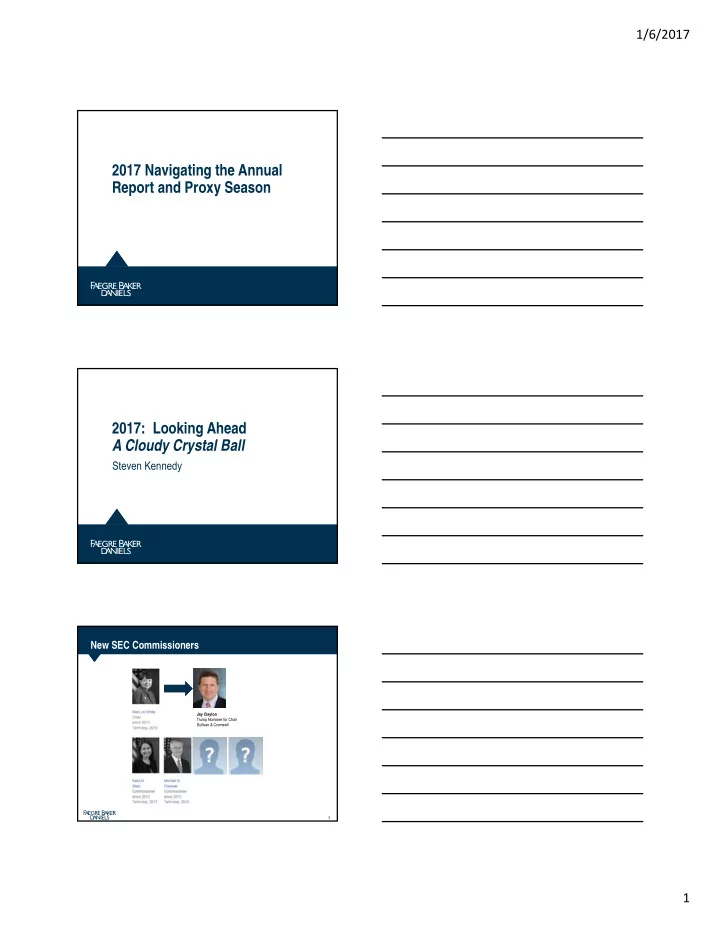
New SEC Commissioners
3 Jay Clayton Trump Nominee for Chair Sullivan & Cromwell
2017 Navigating the Annual Report and Proxy Season 2017: Looking - - PDF document
1/6/2017 2017 Navigating the Annual Report and Proxy Season 2017: Looking Ahead A Cloudy Crystal Ball Steven Kennedy New SEC Commissioners Jay Clayton Trump Nominee for Chair Sullivan & Cromwell 3 1 1/6/2017 Will We See More
3 Jay Clayton Trump Nominee for Chair Sullivan & Cromwell
►Will E&S shareholder proposals and other campaigns pick up where
►Would we rather have an SEC-mandated, but non-binding, vote on
►Important Take-Away from Today: Shareholder Engagement
4
►Number of proposals down 9.5% from 2015 ►Number of proposals going to a vote down 20% from 2015
6
Governance/Shareholder Rights Compensation ES&G
Proxy access Eliminate accelerated vesting upon CIC/termination Report lobbying/political payments Independent board chair Require equity to be retained Climate change Special meetings/written consents Recoupment/clawback policy Sustainability Policy preferring buybacks to dividends Sustainability performance measure Diversity/discrimination Majority voting Animal welfare
►Assets under management at activist funds declined by about 8% in
►Of 37 proxy fights:
►Of 24 proxy fights going to a vote:
►Activists continue to push for M&A and spin-offs
7
►Approximately 208 shareholder proposals submitted; only 80 went to a vote ►Average support over 50%
►Proxy access adoptions
8
Proxy Access Bylaw Provision % of Proxy Access Bylaws Common Shareholder Requests 3% Ownership Threshold 99% Same Three Year Holding Requirement All Same Aggregation up to 20 Holders 91% 40-50 or no cap 20% of the Board (usually with a minimum of two directors) 87% 25% (min 2) Count Certain Incumbent Proxy Access Directors Against Current Year Limit (Creeping Control) 82% N/A Prohibit or Limit Proxy Access when Concurrent Proxy Contest 80% N/A Preclude Resubmission of Failed Candidate (usually <25%) for Period of Years Following Failed Vote 69% No resubmission rule Include Loaned Stock as Shares Owned 94% Include loaned shares on reasonable terms Do Not Require Post-Meeting Ownership of Stock 66% Same
►ISS generally recommends in favor of
►ISS announced provisions that are
Ownership threshold above 3% Ownership duration longer than 3 years Aggregation below 20 shareholders Cap on nominees below 20% of Board ►ISS will assess responsiveness to
Shareholder engagement/outreach Potentially problematic restrictions:
► Prohibitions on resubmissions ► Restrictions on third-party compensation ► Restrictions on use of proxy access and
proxy contests at same meeting
► How long elected shareholder nominee
will count towards maximum
► When the right will be fully implemented ► Counting individual funds within a fund
family as separate shareholders
► Imposing post-meeting shareholding
requirements
10
►Glass Lewis generally recommends in
►Case-by-case factors include: Company size Board independence and diversity of skills, experience, background and tenure The shareholder proponent and its rationale The proposal’s ownership threshold and holding period requirement Shareholder base Responsiveness of board and management to shareholders evidenced by progressive shareholder rights policies Company performance Existence of anti-takeover protections Opportunities for shareholder action ►Glass Lewis will analyze dueling
The nature of the underlying issue The benefit to shareholders from implementation The materiality of the differences between the terms
proposal The appropriateness of the provisions in the context
and other relevant circumstances A company’s overall governance profile and, specifically, its responsiveness to shareholders as evidenced by a company’s response to previous shareholder proposals and its adoption of progressive shareholder rights provisions
11
►Latest development in proxy access are “fix it” proposals ►SEC no-action precedent:
►H&R Block unable to exclude proposal calling for changes to existing proxy
access bylaw
►Oshkosh able to exclude proposal where Oshkosh made some, but not all,
►Even if “fix it” proposals aren’t excludable, they will likely not garner
significant support if proxy access bylaw is otherwise standard (3/3/20/20)
12
►Board approval
►Disclosure on Form 8-K (Item 5.03) – due within four business days of
►Disclosure of proxy access bylaw and proxy access deadline in future
►Explain approach to adoption and shareholder engagement ►Review proxy access bylaw terms periodically against best practices
13
►First shareholder to use proxy access – GAMCO Investors
►In 2015, GAMCO submitted shareholder proposal asking NFG to hire an
investment banker to explore a spin-off of its utility segment
►National Fuel Gas rejected the submission and GAMCO withdrew it
►In October 2016, the SEC proposed rules that would mandate
►Proposed rule would require proxy contestants to includes names of
►Modify “bona fide nominee” rule to include any nominee named in any
►Universal proxy card would be attractive to activist shareholders; main
►Future of proposed rule uncertain under incoming Trump
►Restrictions on Shareholder Right to Amend Bylaws
►Outright prohibition on submission of binding shareholder proposals, or ►Share ownership or time holding requirements in excess of 14a-8
requirements (e.g., $2,000 or 1% of outstanding for at least one year) Impact on MN companies where statute permits 3% holders to propose amendment of bylaws is uncertain.
16
►Clarification that Glass Lewis is focused on robust board evaluation
17
►Non-GAAP measures are:
►The following are not non-GAAP measures:
19
►Look for measure on GAAP financial statements – if it isn’t there,
►Look for words like “excluding,” “including,” “before,” “after” or
►Examples:
20
►The most directly comparable GAAP measure and a reconciliation of
►Example: Earnings call – may refer to earnings release
21
►Disclosure of non-GAAP measures that are used as performance
►Non-GAAP measures otherwise used in the proxy statement must
►Investors and proxy advisory firms are suspicious of non-GAAP
22
►Reconciliation for historical measures must be quantitative ►Reconciliation for future measure (i.e., guidance) need not be
23
►Express Scripts fiscal 2017 guidance
Due to the inherent difficulty of forecasting the timing and amount of certain items that would impact EPS and net income, including discrete tax items, the Company is unable to reasonably estimate the related impact of such items to EPS and net income, the GAAP financial measures most directly comparable to adjusted EPS and EBITDA, respectively. Accordingly, the Company is unable to provide a reconciliation of either adjusted EPS to EPS or EBITDA to net income. For the same reasons, the Company is unable to address the probable significance of the unavailable information, which could have a significant impact on the Company's full-year 2017 GAAP financial results. In 2017, amortization of intangible assets is expected to be approximately $1.54 per share.
24
Regulation G Item 10 Applies to all public disclosures of non-GAAP measures, whether written or oral [Press releases, earnings calls, investor presentations, “glossy” annual report/wrap] Applies only to non-GAAP measures in SEC filings (including earnings release furnished under Item 2.02) [10-Ks, 10-Qs, Item 2.02 8-Ks, Proxy Statements, Registration Statements] Non-GAAP measure can’t be misleading Requires presentation of most directly comparable GAAP measure and a reconciliation must accompany the non-GAAP measure Must disclose why management believes non-GAAP measures are useful and any additional purposes for which management uses the non-GAAP measures GAAP measure be of equal or greater prominence (which means “greater or greater”)
cash settlement from non-GAAP liquidity measures (other than EBIT/EBITDA)
unusual items that occurred within last two years
25
►Certain adjustments may be misleading and thus prohibited, such as:
►Need to identify any differences ►May need to recast prior measures to conform to current presentation
26
►What violates the greater or equal prominence requirement?
Omitting comparable GAAP measures from headlines or captions containing non-GAAP measures Presenting non-GAAP measures using an emphasized style of presentation (bold, larger font) Non-GAAP measures preceding GAAP measures (“greater or equal” means GAAP must come first) Descriptions of non-GAAP measures as “record performance” or “exceptional” without equally prominent descriptions of GAAP Tabular disclosures of non-GAAP measures without equally prominent GAAP measures Discussion and analysis of non-GAAP measure without a similar discussion and analysis of GAAP measure
27
►Examples of comments:
28
29 Source: CFA Institute, “Investor Uses, Expectations, and Concerns on Non-GAAP Financial Measures,” September 2016
►What is a “whistleblower”?
►Any individual who provides information relating to a violation of the
securities laws to the SEC in a manner established by the SEC
►State whistleblower laws ►False Claims Act ►Environmental Protection Act ►Federal and state discrimination laws
31
►What type of report is required?
►Original knowledge of whistleblower ►Not required to report internally first ►“Reasonable belief” of violation ►8th Circuit: reasonable person in the same position, with the same training
and experience, would not have believed there was a securities violation to report
32
►No retaliation
►No impediments to reporting
33
►KBR – April 2015
►I understand that in order to protect the integrity of this review, I am
prohibited from discussing any particulars regarding this interview and the subject matter discussed during the interview, without the prior authorization of the Law Department. I understand that the unauthorized disclosure of information may be ground for disciplinary action up to and including termination of employment.
34
►August 2016 – BlueLinx and Health Net
Employee has not and in the future will not use or disclose to any third party Confidential Information, unless compelled by law and after notice to BlueLinx. … Employee understands and agrees that Employee is waiving the right to any monetary recovery in connection with any such complaint or charge that Employee may file with an administrative agency. Penalty: $265,000 and $340,000
►Increasing whistleblower awards
35
►Code of Conduct, Reporting Policies, Other Internal Policies and
►Cannot require internal reporting first ►Cannot incentivize employees to report internally instead of to SEC
►Investigations
►Employment /Confidentiality/Non-Compete/Severance Agreements
36
37
►SEC Staff stopped requiring “Tandy” representations effective October
►Not intended to be a substantive change as companies are still
To Do: Be careful when using prior response letters as templates
40
As specifically requested by the Commission, we acknowledge that:
foreclose the Commission from taking any action with respect tot eh filings; and
Commission or any person under the federal securities laws of the United States.
►Approximately 50% of registrants are reviewed each year ►Majority of comment letters go to larger companies
►75% of comment letters are resolved with one letter
►Most common topics include
41 Source: Ernst & Young, Technical Line, “2016 Trends in SEC Comment Letters”
7,610 5,916 5,352 4,683 3,551 2,905 2011 2012 2013 2014 2015 2016
Number of SEC comment letters
►Women hold 21% of S&P 500 board seats (up from 15% in 2009)
►Minority directors remain steady at 15%
►Women filled 32% of open director seats in 2016 (all-time high) ►Shareholder proposals calling for boardroom diversity remain common
42
►Glass Lewis announced Issuer Data Report access for companies to
►Pilot program for 2017 – details available on Glass Lewis website
43
►Effective July 31, 2016
►Requires disclosure of any arrangements/agreements relating to
►S-K Item 402(k) already requires disclosure of compensation paid for
►Not required by NYSE, but consider complying as a best practice To Do: Add question to D&O questionnaire
44
►Audit teams still developing procedures to comply with
►Most surveys report that at least two-thirds of companies added
To Do: (Re-)Confirm sufficiency of current questions with auditors
45
►September 2016 - First SEC enforcement action for auditor
►E&Y clients may be asked to inquire about close relationships with
46
“Do you have a close relationship with any member of the audit engagement team or have you vacationed with a member of the audit engagement team?”
Examples of a "close relationship” include, but may not be limited to, immediate family members as well as, aunts, uncles, grandparents, nieces, nephews, cousins, in-laws, step relatives, boy/girlfriends, close or best friends, intimate or other close relationships with individuals employed by
entertaining, sharing a residence, vacationing, or non-business related
►Continuing uptick in virtual-only shareholder meetings
►Remember to check state law requirements
47
27 35 53 90 136 2012 2013 2014 2015 2016
Virtual-Only Shareholder Meetings*
*Based on proxies mailed during “proxy season” (March through mid-June). Source: Broadridge Financial Solutions
►June 2016 proposal to increase small reporting company threshold
►SRC benefits include, among others:
48
Registrant Category Current Definition Proposed Definition Reporting Registrant < $75 million of public float < $250 million of public float Registrant Filing Initial Registration Statement < $75 million of public float < $250 million of public float Non-Smaller Reporting Seeking to Qualify as a Smaller Reporting Company < $50 million of public float < $200 million of public float
►Status unchanged from 2016 season
►SEC did not seek petition for certiorari to SCOTUS
►In the meantime:
49
►ISS recommended votes “against” over 1,000 directors at 430+
►Main reasons for “against” recommendations include:
50
►14a-8 deadline to include proposal in proxy statement
►Bylaw deadline for shareholder to solicit own proxies for a proposal or
►Proxy access bylaw to include nominee in company’s proxy statement
51
►ISS policy on overboarding:
►Glass Lewis policy on overboarding:
Safe policy (lowest common denominator):
52
►Review audit committee report and audit committee charter for
To Do: Adopt alternative language to avoid future citation changes:
53
“Our Audit Committee discussed with [auditor] the matters required to be discussed by the applicable Public Company Accounting Oversight Board standards.”
►SEC issued interim final rule allowing (but not requiring) companies to
To Do: List Item 16 in Table of Contents (especially if you list other
54
►Interactive annual reports (www.ge.com/ar2015/)
55
►Commonsense Principles of Corporate Governance
►Key topics include:
56
►Uncertainty is probably not a valid risk factor ►Specific risk factors may be relevant for certain industries:
“Once Mr. Trump becomes President, there is uncertainty with respect to the impact his Administration may have, if any, and any changes will likely take time to unfold, and could have an impact on coverage and reimbursement for healthcare items and services covered by plans that were authorized by the Affordable Care Act.”
“If President-elect Donald Trump follows through with his threats to put significant tariffs or
materially harmed.”
57
►March 2016 C&DI requires clear and impartial presentation of
► Examples of unacceptable presentations include:
58
FOR
AGAINST
ABSTAIN
FOR
AGAINST
ABSTAIN
FOR
AGAINST
ABSTAIN
FOR
AGAINST
ABSTAIN
►November 2016 C&DI advises that requirement to send 7 copies of
59
►Original vote held at meetings occurring on or after January 21, 2011
►Actions to take:
►Board may act upon recommendation of Comp or Nom/Gov Committee
►Consider and disclose applicable voting standard
►Every 1 year, every 2 years, every 3 years or abstain
►Consider timing of board decision
61
62
Rulemaking Status Pay Ratio Rule
Requires disclosure of ratio of CEO pay to median employee pay
SEC adopted final rule August 2015 Effective for 2017 compensation year, reported in 2018 proxy statement Hedging Disclosure
Requires disclosure of whether companies prohibit hedging by directors, officers and employees
SEC proposed rule February 2015 Comments under review Pay-for-Performance Disclosure
Requires disclosure of the relationship between compensation actually paid and company TSR, as well as TSR relative to peers
SEC proposed rule April 2015 Comments under review Clawback Requirement
Requires adoption of a policy requiring executive
erroneously paid upon certain financial restatements
SEC proposed rule July 2015 Comments under review Further stock exchange rulemaking required
►Final rule
►Disclosure requirement – part of Item 402 disclosures:
63
►Furloughed workers included if employees ►Independent contractors and leased workers
Specifying minimum level of comp does not constitute “determining” comp Self-employed independent contractor may be an “unaffiliated third party”
►Selection of “consistently applied compensation measure” can be any
Total cash compensation probably OK (unless equity distributed widely) Social security taxes withheld probably not OK
►Use of hourly or annual rates of pay not permitted ►Selection of time period for identifying median employee:
Need not include determination date Need not include full annual period May use annual total compensation from prior fiscal year if no significant change
64
►Equity Plan Scorecard changes:
► If fully prohibited, full points ► If not fully prohibited, no points
►Ratification of director compensation programs factors: Relative magnitude of director comp compared to peers Existence of “problematic” pay practices Director stock ownership/holding requirements “Meaningful” limits on director compensation Availability of retirement benefits or perqs Quality of disclosure
65
►ISS will now evaluate performance relative to peer group on up to six
ROIC ROA ROE Revenue growth Growth in EBITDA Growth in cash flow from operations ►These metrics, and TSR, will be evaluated on a three-year basis, and
►Weighted financial performance metric will be measured against
►Won’t be part of quantitative analysis for 2017
66
►Effective for fiscal years beginning after December 15, 2016 ►Permits share withholding up to the maximum individual tax rate
►Many plans prohibit withholding above minimum statutory rate
►Administrative complexity in permitting withholding above minimum
67
►Pro se shareholder has submitted letters to public companies
Non-exempt acquisition (open market purchase) within six months of payment of withholding taxes or option exercise price through share withholding ►Claim is that withholding is only exempt if “automatic” Not automatic if insider can elect payment of taxes in other manner Not sufficiently pre-approved by comp committee because not specific to a particular withholding transaction ►Best practices to avoid Conservative: Make share withholding mandatory Ensure comp committee has approved share withholding (perhaps with authority to disallow), ideally in award agreement or at least in resolution, and with public disclosure At a minimum, avoid language giving company discretion
68