2016 AN EVENTFUL YEAR Los Angeles-Long Beach at a Crossroads Bill - - PowerPoint PPT Presentation

2016 an eventful year
SMART_READER_LITE
LIVE PREVIEW

2016 AN EVENTFUL YEAR Los Angeles-Long Beach at a Crossroads Bill - - PowerPoint PPT Presentation

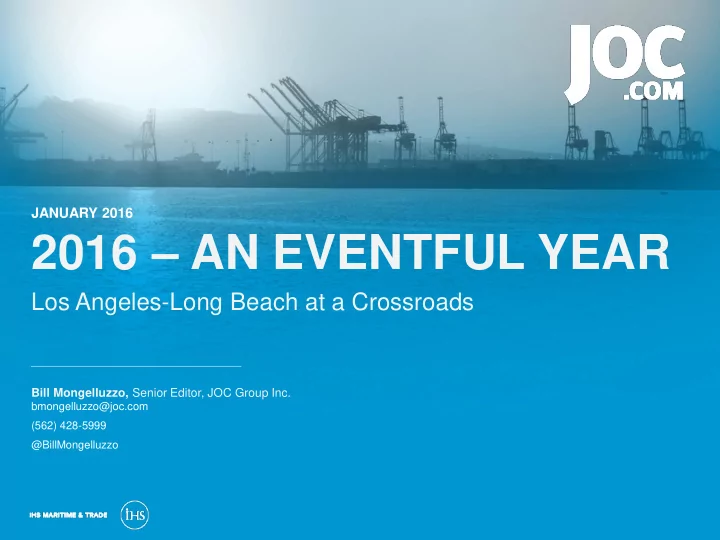
JANUARY 2016 2016 AN EVENTFUL YEAR Los Angeles-Long Beach at a Crossroads Bill Mongelluzzo, Senior Editor, JOC Group Inc. bmongelluzzo@joc.com (562) 428-5999 @BillMongelluzzo 2016 AN EVENTFUL YEAR | JANUARY 2016 2015 RIP

slide-1
SLIDE 1

2016 – AN EVENTFUL YEAR

Los Angeles-Long Beach at a Crossroads

JANUARY 2016

Bill Mongelluzzo, Senior Editor, JOC Group Inc.

bmongelluzzo@joc.com (562) 428-5999 @BillMongelluzzo

slide-2
SLIDE 2

2016 – AN EVENTFUL YEAR | JANUARY 2016

The issues

  • 2015 — RIP
  • Impact of labor issues on container

volume

  • The mega-ships have arrived
  • 2016 —Year of the carrier mergers?
  • Going forward, port productivity will

rule

  • Los Angeles-Long Beach leading

the port industry into the future

2

slide-3
SLIDE 3

2016 – AN EVENTFUL YEAR | JANUARY 2016 3

2015 — RIP

slide-4
SLIDE 4

2016 – AN EVENTFUL YEAR | JANUARY 2016

2015 Was an Eventful Year – For the Wrong Reasons

  • West Coast ports began 2015 in the throes
  • f the worst labor problems since the 2002

ILWU contract negotiations

  • ILWU work slowdowns crippled the ports and

caused severe congestion

  • In Los Angeles-Long Beach, ILWU reduced

by two-thirds the daily dispatch of yard crane

  • perators
  • Employers retaliated by slashing night and

weekend work

  • Ports went into total gridlock
  • 28 container ships at anchor during the

depths of the port congestion

  • In terms of container volume, January and

February almost didn’t happen

4

slide-5
SLIDE 5

2016 – AN EVENTFUL YEAR | JANUARY 2016

Cargo Diversion Reared its Ugly Head

  • West Coast ports, historically the gateway for

50-55% of U.S. containerized imports, dropped to 46% in January-February

  • Cargo volumes in Vancouver and Prince

Rupert exploded

  • East and Gulf Coast ports enjoyed double-

digit growth while West Coast ports languished

  • ILWU work slowdowns ended with tentative

agreement on Feb. 20

  • West Coast ports began to claw their way

back

  • By summer, volumes had returned to normal
  • Year-to-date through November West Coast

down 3 percent from same period in 2014; LA-Long Beach 2 percent less than 2014

5

slide-6
SLIDE 6

2016 – AN EVENTFUL YEAR | JANUARY 2016

The Mega-Ships have Arrived

  • LA-Long Beach has been served by

13,000-14,000-TEU ships for several years now

  • That’s one of the reasons why the

Southern California gateway has experienced more congestion than most ports

  • Term “Big Ship” took on a whole new

meaning in December with the arrival in LA of the 15,000-TEU Maersk Edmonton

  • Four days later, the 18,000-TEU CMA

CGM Benjamin Franklin also docked at the APM Pier 400 terminal

  • Carriers continue to order big ships.

Why?

6

slide-7
SLIDE 7

2016 – AN EVENTFUL YEAR | JANUARY 2016 7

Big ships and their impact on ports

Cost per TEU comparison

Scale is the way to cut costs

slide-8
SLIDE 8

2016 – AN EVENTFUL YEAR | JANUARY 2016

Carriers Ordering Big Ships at Unprecedented Pace

  • 2010, the biggest ship in service was

14,000 TEUs

  • Today, carriers taking delivery of 20,000-

TEU ships

  • By 2020, more than 100 vessels with

capacities of greater than 18,000-TEUs will be in service in the major east-west trade lanes (McKinsey)

8

slide-9
SLIDE 9

2016 – AN EVENTFUL YEAR | JANUARY 2016

Carriers Ordering Big Ships at Unprecedented Pace

  • 2015 saw a new record for vessel

deliveries – 212 containerships with total capacity of 1.7 million TEUs (Alphaliner)

  • 32 of those ships have capacity of

10,000-TEUs or greater

  • 20 of the ships 18,000 TEUs+
  • 28 ranged from 13,800-17,900
  • That means 80 ships that are too large

for even the expanded Panama Canal entered service last year!

9

slide-10
SLIDE 10

2016 – AN EVENTFUL YEAR | JANUARY 2016

Big ships and their impact

  • n ports
  • Big ships are good for West Coast

ports

  • Already have deep harbors; excellent

intermodal connections to eastern half

  • f country
  • West Coast ports have made he

billions of dollars needed to prepare for big ships

  • But billions more needed for super

post-Panamax cranes, automated stacking cranes, AGVs, etc.

  • Most of all, ports must make process

changes to handle cargo surges

10

slide-11
SLIDE 11

2016 – AN EVENTFUL YEAR | JANUARY 2016

There is too much vessel capacity in global shipping!

  • Container volumes in a slump
  • Q3 2015 container throughput at top 30

global ports declined 0.9 percent (Alphaliner)

  • Full-year growth in volume in 2015

globally estimated to be 0.8 percent

  • Yet total capacity in global container fleet

increasing 6-7% per year.

  • As one would suspect, freight rates

crashed in 2015 and should stay low

  • In Asia-U.S. trades, spot rate to West

Coast last month below $800/FEU

  • East Coast AWS rate down to

$1,600/FEU

11

slide-12
SLIDE 12

2016 – AN EVENTFUL YEAR | JANUARY 2016

Big ships and their impact

  • n ports
  • So, where is the money for port

improvements going to come from?

  • Carriers are forcing down the per-lift

rates they pay to terminal operators

  • Ports must be careful not to increase

their fees too high in competitive environment

  • But improvements needed: Ports are

straining to handle big ships. Congestion and long lines at MTO gates

  • Inland infrastructure and intermodal

connectors are likewise stressed

12

slide-13
SLIDE 13

2016 – AN EVENTFUL YEAR | JANUARY 2016

Carriers could not stop the bleeding

  • No matter what they did last year

carriers couldn’t raise their rates

  • Blank (void) sailings in Asia-Europe

trade totaled 145, or 8 percent of all scheduled sailings

  • Asia-Europe rates as low as $100/TEU
  • Carriers filed for GRIs almost every

month, to no avail. Increases lasted only

  • ne or two weeks
  • Bunker fuel prices plunged to $140/ton

from $547 in 2014, but carriers gave the savings to customers

  • Only answer: CONSOLIDATION

13

slide-14
SLIDE 14

2016 – AN EVENTFUL YEAR | JANUARY 2016

Big ships and their impact

  • n ports
  • We could see more carrier consolidation

the next two years than ever before

  • 2015: Hapag-Lloyd-CSAV and Hamburg

Sud-CCNI

  • 2016: CMA CGM in talks to purchase

APL

  • COSCO and China Shipping Container

Line in merger discussions

  • Koreans talking about merger of Hyundai

and Hanjin

  • Do Japan and Taiwan each need three

container lines?

14

slide-15
SLIDE 15

2016 – AN EVENTFUL YEAR | JANUARY 2016 15

Port Productivity Will Rule The Day

slide-16
SLIDE 16

2016 – AN EVENTFUL YEAR | JANUARY 2016

Working the mega-ships requires a team effort

  • Before the Benjamin Franklin arrived at

Pier 400, APM had meetings with CMA CGM, labor, BCOs and other stakeholders

  • Equipment was ready – up to nine cranes

working simultaneously

  • Ensured there would be a sufficient

supply of labor for seven work shifts over three and one-half days

  • Ensured sufficient truck capacity, chassis,

etc.

  • This effort must be repeated every week a

mega-ship is in port

16

slide-17
SLIDE 17

2016 – AN EVENTFUL YEAR | JANUARY 2016

Ports and terminals must invest big bucks for big ships

17

  • A big need for big cranes. APM has 14

cranes, but none tall enough to handle 18,000-TEU ship with containers 10 high

  • n deck
  • Will probably raise all cranes to167-foot

height

  • But wait! With four berths, can APM work

up to 9 cranes against three or four ships at berth simultaneously?

  • An 18,000-TEU ship at 90% utilization

can generate 17,800 container moves per vessel call

  • Where are all of those containers going

to go as they are loaded on/off the ship?

slide-18
SLIDE 18

2016 – AN EVENTFUL YEAR | JANUARY 2016

Big investments in terminals ahead

  • APM Pier 400, at 440 acres, is largest

terminal in LA-Long Beach

  • But if APM needs to do more to handle

the big ships, what must the other 12 terminals in the port complex do?

  • This also begs the question, what about

the ports themselves in terms of roadway and intermodal rail connectors?

  • LA-Long Beach has no choice but to

invest – No other U.S. gateway comes close to Southern California in ability to handle big volumes and big ships

18

slide-19
SLIDE 19

2016 – AN EVENTFUL YEAR | JANUARY 2016 19

ILWU-PMA CONTRACT

slide-20
SLIDE 20

2016 – AN EVENTFUL YEAR | JANUARY 2016

ILWU-PMA contract negotiations

“I believe in corporations; I believe in trade-unions. Both have come to stay, and are necessities in

  • ur present industrial system.

But where, in either the one or the other, there develops corruption

  • r mere brutal indifference to

rights of others, and short-sighted refusal to look beyond the moment’s gain, then the offender, whether union or corporation, must be fought, and if the public sentiment is calloused to the iniquity of either, by just so much the whole public is damaged.”

20

President Roosevelt in McClure’s Magazine:

slide-21
SLIDE 21

2016 – AN EVENTFUL YEAR | JANUARY 2016

ILWU-PMA contract negotiations

  • Work slowdowns did NOT have to

happen this year

  • 2014 contract was not a watershed

contract like those in 2002 and 2008

  • Everything the ILWU (local) leaders

held out for was out of greed. Nothing was out of need.

  • But that was then and this is now.
  • One issue is for certain – current

contract does not promote the level of productivity needed to handle big ships

  • perated by big alliances

21

slide-22
SLIDE 22

2016 – AN EVENTFUL YEAR | JANUARY 2016

Need for improved port productivity

  • RELIABILITY is absolutely needed
  • Even minor slowdowns and work

stoppages can not be tolerated

  • New three-member arbitration board

in each port should keep maverick work stoppages to a minimum

  • Yes, small, repetitive delays in cargo

delivery add up and kill productivity, such as mandatory ILWU roadability inspections of chassis

  • Are these inspections even legal?

22

slide-23
SLIDE 23

2016 – AN EVENTFUL YEAR | JANUARY 2016

Need for improved port productivity

  • Macro Issues (Everywhere in U.S.):
  • Biggest problem: Each member of

supply chain operates in silos

  • Shipping lines, terminals, truckers,

railroads, retailers, exporters don’t communicate with each other

  • Shippers squeeze carriers on rates,

carriers squeeze terminals, etc.

  • Service requires compensatory pricing

in all sectors of the supply chain

  • How can ports/MTOs build necessary

infrastructure if rates are too low?

23

slide-24
SLIDE 24

2016 – AN EVENTFUL YEAR | JANUARY 2016 24

SOLUTIONS

slide-25
SLIDE 25

2016 – AN EVENTFUL YEAR | JANUARY 2016

Solutions

  • Macro Solutions (every port):
  • Supply-chain partners must
  • communicate. Starts with vessel

stowage in Asia

  • Creative operating solutions at MTOs:

dray-offs, free-flow, short-haul rail

  • Reduce or eliminate free storage of

containers at terminals. Carriers can no longer absorb excess storage charges for large retailers.

  • Port-wide trucker appointments? Ten of

13 terminals will have mandatory appointments this year!

25

slide-26
SLIDE 26

2016 – AN EVENTFUL YEAR | JANUARY 2016

Solutions: West Coast specific

  • ILWU work rules and practices

developed in 1970s for smaller ships are outdated

  • Asian terminals are most productive in

world because they work close to 24/7

  • Employers must staff up so gates are

not closed for lunch breaks

  • Hoot shift is anachronism. Need full

night shift

  • Arbitration in new contract: three-

person panel with neutral member. Good!

  • Senseless work slowdowns and

maverick walk-offs must stop now.

26

slide-27
SLIDE 27

2016 – AN EVENTFUL YEAR | JANUARY 2016

Solutions: Automation

  • Automation of terminals is coming.

Today’s terminals are not large enough, under manual operations, to accommodate surges from big ships

  • Automation allows terminals to stack

containers higher, wider, denser

  • Automation = electricity (green)
  • Automation is safer – no workers in

cargo-handling area

  • Automation significantly reduces labor

costs (headcount reduced 40-50 percent

  • Automation creates new positions for

highly-trained workers

27

slide-28
SLIDE 28

2016 – AN EVENTFUL YEAR | JANUARY 2016

Solutions: Automation

  • LA-Long Beach leading the way in

automation

  • TraPac and Middle Harbor will be first

two completely automated terminals in US.

  • Densified operations will significantly

increase handling capacity on existing footprint

  • Middle Harbor: 3 million TEUs/year
  • TraPac: more than 2 million TEUs/year
  • Reduce labor costs
  • Other terminals will have two choices:

automate, or sell out to terminal

  • perators willing to automate

28

slide-29
SLIDE 29

2016 – AN EVENTFUL YEAR | JANUARY 2016

Solutions: LA-Long Beach

  • 18,000-TEU ships are here, and more

are coming to West Coast

  • Carrier mergers will happen this year

and next as carries seek leverage through size

  • Consolidation in the terminal operating

industry is also likely

  • The ports are doing their part,

investing in total about $8 billion

  • If the ports and terminals continue to

invest in modern plant and equipment and labor/employers improve productivity….

  • BRING ON THE PANAMA CANAL!

29

slide-30
SLIDE 30

2016 – AN EVENTFUL YEAR | JANUARY 2016

THANK YOU!

Bill Mongelluzzo Senior Editor, JOC Group Inc. bmongelluzzo@joc.com (562) 428-5999 @BillMongelluzzo

30

Use the code JOCVIPBM to receive a 10% discount on JOC.com