2006 King County Flood Hazard 2006 King County Flood Hazard - - PowerPoint PPT Presentation

2006 king county flood hazard 2006 king county flood
SMART_READER_LITE
LIVE PREVIEW

2006 King County Flood Hazard 2006 King County Flood Hazard - - PowerPoint PPT Presentation

2006 King County Flood Hazard 2006 King County Flood Hazard Management Plan Recap Management Plan Recap Presentation to Metropolitan King County Council Presentation to Metropolitan King County Council Committee of the Whole Committee of the


slide-1
SLIDE 1

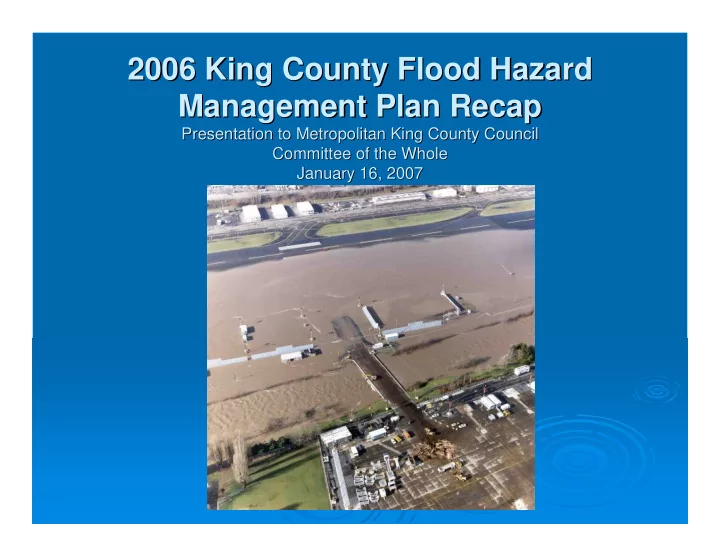
2006 King County Flood Hazard 2006 King County Flood Hazard Management Plan Recap Management Plan Recap

Presentation to Metropolitan King County Council Presentation to Metropolitan King County Council Committee of the Whole Committee of the Whole January 16, 2007 January 16, 2007

slide-2
SLIDE 2

Presentation Overview Presentation Overview

  • Background

Background – – Pam Bissonnette Pam Bissonnette, Director, KC DNRP , Director, KC DNRP

  • Flood Plan Overview

Flood Plan Overview – – Mark Isaacson Mark Isaacson, Director, WRLD , Director, WRLD

  • Levee Certification Issues

Levee Certification Issues – – Pam Bissonnette Pam Bissonnette

  • Climate Impacts on Flooding

Climate Impacts on Flooding – – Dr. Richard Palmer, PhD, PE

  • Dr. Richard Palmer, PhD, PE
  • Conclusion and Next Steps

Conclusion and Next Steps – – Pam Bissonnette Pam Bissonnette

slide-3
SLIDE 3

History and Current Status History and Current Status

  • Last Plan Adopted in 1993

Last Plan Adopted in 1993

  • Insufficient Funding

Insufficient Funding

  • Current funding: $3.5 million per year

Current funding: $3.5 million per year

  • Current need: $15

Current need: $15-

  • 30 million per year

30 million per year

  • 2006 Plan recommends Flood Control Zone District for

2006 Plan recommends Flood Control Zone District for funding and project implementation funding and project implementation

  • Adoption of 2006 Plan will result in additional

Adoption of 2006 Plan will result in additional flood flood insurance discounts insurance discounts. .

  • Adoption of 2006 Plan will

Adoption of 2006 Plan will increase eligibility for increase eligibility for federal funding federal funding. .

slide-4
SLIDE 4

Lessons From Hurricane Katrina Lessons From Hurricane Katrina

  • Independent expert review of reasons for catastrophic

Independent expert review of reasons for catastrophic New Orleans Levee Failures New Orleans Levee Failures

  • U.C. Berkley

U.C. Berkley

  • National Science Foundation

National Science Foundation

  • New Orleans levees that failed were certified

New Orleans levees that failed were certified

  • Factors of safety were inappropriately low for a system

Factors of safety were inappropriately low for a system that protected a major metropolitan area that protected a major metropolitan area

  • Designs should have incorporated the latest technical

Designs should have incorporated the latest technical advances in flood protection and been reviewed by advances in flood protection and been reviewed by independent experts independent experts

  • State and local governments should have provided a

State and local governments should have provided a second check and opinion second check and opinion

slide-5
SLIDE 5

Lessons From Hurricane Katrina Lessons From Hurricane Katrina

  • Safety was

Safety was “ “traded for mediocrity, lower traded for mediocrity, lower expenditures, and getting along expenditures, and getting along” ”

  • Deficiencies in

Deficiencies in “ “maintenance of a deliberate maintenance of a deliberate culture of diligence in seeking overall system culture of diligence in seeking overall system reliability reliability” ”

Investigation of the Performance of the New Orleans Flood Protec Investigation of the Performance of the New Orleans Flood Protection Systems in tion Systems in Hurricane Katrina on August 29, 2005 Hurricane Katrina on August 29, 2005

slide-6
SLIDE 6

Flood Plan Heeds Lessons of Katrina Flood Plan Heeds Lessons of Katrina

  • Local independent review of facility design

Local independent review of facility design – – including by national experts including by national experts

  • Ensuring designs incorporate latest technical

Ensuring designs incorporate latest technical advances in flood protection advances in flood protection

  • Adaptive management to update approaches

Adaptive management to update approaches based on new information based on new information

  • Factors of safety appropriate for protecting a

Factors of safety appropriate for protecting a major metropolitan area major metropolitan area

  • Proposing adequate funding

Proposing adequate funding

slide-7
SLIDE 7

Flooding is a Regional Hazard Flooding is a Regional Hazard

  • Since 1990, King County has been declared a federal

Since 1990, King County has been declared a federal disaster area disaster area eight eight times times

  • Major damage to flood protection facilities from Nov.

Major damage to flood protection facilities from Nov. ’ ’06 storm 06 storm -

  • repair estimate is $25M to $38M

repair estimate is $25M to $38M

  • Flooding occurs on all six major rivers in King County:

Flooding occurs on all six major rivers in King County: South Fork Skykomish, Snoqualmie, Sammamish, South Fork Skykomish, Snoqualmie, Sammamish, Cedar, Green, and White Rivers Cedar, Green, and White Rivers

  • Warmer winters are predicted to exacerbate flooding

Warmer winters are predicted to exacerbate flooding in the future in the future

slide-8
SLIDE 8

Flooding is a Regional Hazard Flooding is a Regional Hazard

  • $7+ Billion Total

$7+ Billion Total AV Protected AV Protected

  • $.5M

$.5M -

  • $160M

$160M Total AV per Total AV per property property

  • FEMA mapped

FEMA mapped floodplain floodplain

slide-9
SLIDE 9

November November ’ ’06 Flood Disaster 06 Flood Disaster

  • Mt. Si High School – City of Snoqualmie
slide-10
SLIDE 10

November November ’ ’06 Flood Disaster 06 Flood Disaster

Kimball Creek

slide-11
SLIDE 11

November November ’ ’06 Flood Disaster 06 Flood Disaster

Snoqualmie Basin Flooding

slide-12
SLIDE 12

November November ’ ’06 Flood Disaster 06 Flood Disaster

Upper Preston Road Failure - Raging River

slide-13
SLIDE 13

November November ’ ’06 Flood Disaster 06 Flood Disaster

Upper Preston Road Repair – Raging River

slide-14
SLIDE 14

November November ’ ’06 Flood Disaster 06 Flood Disaster

Shamrock Park – South Fork Snoqualmie

slide-15
SLIDE 15

November November ’ ’06 Flood Disaster 06 Flood Disaster

South 104th Street Emergency Road Repair – Lower Green River

slide-16
SLIDE 16

November November ’ ’06 Flood Disaster 06 Flood Disaster

86th Ave South – Lower Green River

slide-17
SLIDE 17

November November ’ ’06 Flood Disaster 06 Flood Disaster

Raging River

slide-18
SLIDE 18

November November ’ ’06 Flood Disaster 06 Flood Disaster

Upper Preston Road failure - Raging River

slide-19
SLIDE 19

November November ’ ’06 Flood Disaster 06 Flood Disaster

  • 78 damaged facilities

78 damaged facilities

  • Cracking, slumping, failures, and erosion

Cracking, slumping, failures, and erosion

  • Record rainfall in

Record rainfall in ‘ ‘06 revealed many levee deficiencies 06 revealed many levee deficiencies

Slope erosion and slumping failure - Lower Green River Levee cracking - Lower Green River

slide-20
SLIDE 20

78 County Flood Facilities Damaged by Nov. 2006 Flooding 78 County Flood Facilities Damaged by Nov. 2006 Flooding

slide-21
SLIDE 21

2006 King County Flood Hazard 2006 King County Flood Hazard Management Plan Management Plan

Capital Improvement Projects Capital Improvement Projects

  • Levee and revetment repair and replacement

Levee and revetment repair and replacement

  • Home elevations

Home elevations

  • Acquisition of repetitive loss properties

Acquisition of repetitive loss properties

Floodplain Management Programs Floodplain Management Programs

  • Regional Flood Warning Center and emergency

Regional Flood Warning Center and emergency response response

  • Public education and outreach

Public education and outreach

  • Mapping and technical studies

Mapping and technical studies

  • Citizen inquiries and public response

Citizen inquiries and public response

  • Partnerships with state and federal agencies

Partnerships with state and federal agencies

Plan Implementation Plan Implementation

  • $179M to $335M

$179M to $335M

slide-22
SLIDE 22

Criteria for Project Selection Criteria for Project Selection

  • Flood Plan projects on main stems of rivers

Flood Plan projects on main stems of rivers

  • Projects selected based upon:

Projects selected based upon:

  • Consequences

Consequences – – public safety/property loss public safety/property loss

  • Urgency

Urgency

  • Contractual Requirements

Contractual Requirements

  • Funding and partnerships

Funding and partnerships

  • Annual legislative approval of final project lists

Annual legislative approval of final project lists

  • Other projects may meet criteria

Other projects may meet criteria

slide-23
SLIDE 23

Levee Certification Issues Levee Certification Issues

  • Certification:

Certification:

  • Flood plain property is treated as not being in the flood plain

Flood plain property is treated as not being in the flood plain for for purposes of development regulations and insurance purposes of development regulations and insurance

  • Tukwila 205 Levee is only currently certified levee in

Tukwila 205 Levee is only currently certified levee in King County. King County.

  • Certification currently under reevaluation

Certification currently under reevaluation

  • Exception to freeboard requirements was made at the time of

Exception to freeboard requirements was made at the time of last certification. last certification.

  • Reconstruction needed regardless of evaluation

Reconstruction needed regardless of evaluation

  • National experts: levee fails to meet minimum federal factors of

National experts: levee fails to meet minimum federal factors of safety. safety.

  • Problems with slope angles, original construction materials

Problems with slope angles, original construction materials causing seepage, piping, cracks, and slides. causing seepage, piping, cracks, and slides.

  • Segale Levee repairs over 10 years: 10% of total spending for

Segale Levee repairs over 10 years: 10% of total spending for 2.5% of total facilities 2.5% of total facilities

  • Flood Plan project to achieve federal factors of safety.

Flood Plan project to achieve federal factors of safety.
slide-24
SLIDE 24

Potential Consequences Potential Consequences Tukwila 205 Levee Failure/Decertification Tukwila 205 Levee Failure/Decertification

slide-25
SLIDE 25

Process for Completing Segale Levee Project Process for Completing Segale Levee Project

slide-26
SLIDE 26

Impacts of Impacts of Climate Change Climate Change

  • n Flooding
  • n Flooding

Presented by: Presented by:

Richard Palmer Richard Palmer

Department of Civil and Environmental Engineering Department of Civil and Environmental Engineering Principal, Climate Impact Group Principal, Climate Impact Group University of Washington University of Washington Seattle, WA 98105 Seattle, WA 98105 www.tag.washington.edu www.tag.washington.edu January 2007 January 2007

slide-27
SLIDE 27

Climate Change Climate Change

  • Climate change impacts on water

Climate change impacts on water resources are recognized as resources are recognized as extremely important. extremely important.

  • It is useful for the region to get a

It is useful for the region to get a clear statement of the present clear statement of the present status of science status of science

  • Desire to be science

Desire to be science-

  • based (Peer

based (Peer reviewed, scientific/engineering reviewed, scientific/engineering literature, and IPCC reports) literature, and IPCC reports)

slide-28
SLIDE 28

Building Blocks Document Building Blocks Document

  • Document identifies the changes

Document identifies the changes that are occurring that are occurring

  • As with other science, our

As with other science, our understanding will improve with understanding will improve with time time

  • Uncertainties exist, but much in

Uncertainties exist, but much in known known

  • A principal concern identified was

A principal concern identified was increased flooding due to climate increased flooding due to climate change change

(Source: http://agexted.cas.psu.edu/FCS/mk/imag es/BuildingBlocks.jpg)

slide-29
SLIDE 29

Building Blocks Building Blocks

4.

  • 4. Global precipitation is projected to increase in the

Global precipitation is projected to increase in the future, although there is less certainty in predicting future, although there is less certainty in predicting changes in precipitation than in temperature. changes in precipitation than in temperature.

  • 5. The occurrence of heavy precipitation events has
  • 5. The occurrence of heavy precipitation events has

increased over the U.S. during the 20th century. This increased over the U.S. during the 20th century. This trend is projected to continue during the 21st century. trend is projected to continue during the 21st century.

  • 9. Climate change is projected to increase the frequency
  • 9. Climate change is projected to increase the frequency
  • f flood events in most western Washington river
  • f flood events in most western Washington river

basins. basins.

slide-30
SLIDE 30

Historic Trend Evaluation Historic Trend Evaluation

  • f Daily Precipitation
  • f Daily Precipitation
  • Preliminary Results suggest:

Preliminary Results suggest:

  • Most significant trend is in November

Most significant trend is in November

  • Larger percentage of annual rainfall occurring in

Larger percentage of annual rainfall occurring in November, total annual precipitation has November, total annual precipitation has remained relatively constant remained relatively constant

  • Difficult to identify an increase in extreme events

Difficult to identify an increase in extreme events to date, models do forecast an increase. to date, models do forecast an increase.

slide-31
SLIDE 31

Decadal Trends in November Decadal Trends in November Monthly Precipitation Monthly Precipitation

50 100 150 200 250 300 350 400 450 500 Buck Cedar Everett Kent Landburg Palmer Snoq Station Average Cumulative Precipitation (mm) 1930 1940 1950 1960 1970 1980 1990

slide-32
SLIDE 32

Extreme Events Extreme Events

Taken from: Groisman et al, 2005. Trends in Intense Precipitation in the Climate Record. Journal of Climate, Vol. 18, May 2005, 1326-1350

  • Global models

Global models suggest a 5 suggest a 5-

  • 15%

15% increase in increase in extreme extreme precipitation precipitation events events (Typically occur (Typically occur November) November)

slide-33
SLIDE 33

Average Percent Change in 20 Year Storm

  • 5.00%

0.00% 5.00% 10.00% 15.00% 20.00% 25.00%

ABERDEEN20NNE BREMERTON BUCKLEY CEDAR CULMBACK CUSHMAN_POWER DARRINGTON ELMA ELWHA EVERETT FORKS KENT LANDSBURG LONGMIRE MCMILLIN MONROE MUDMT OLYMPIA PALMER PARADISE PORTANGELES PORTTOWNSEND QUILCENE SEATAC SFTOLT SNOQUALMIE STAMPEDE STARTUP

Percent Change relative to ECHAM5 2000

slide-34
SLIDE 34

MM5 Climate Projections MM5 Climate Projections – – Percent Change in Precipitation Percent Change in Precipitation

slide-35
SLIDE 35

Monthly Streamflows Forecasted w/ ECHAM5

Howard Hanson Inflow

500 1000 1500 2000 2500 3000 O c t

  • b

e r N

  • v

e m b e r D e c e m b e r J a n u a r y F e b r u a r y M a r c h A p r i l M a y J u n e J u l y A u g u s t S e p t e m b e r

Month of Year Flow Rate (cfs)

DHSVM Historic ECHAM5 2000 ECHAM5 2025 ECHAM5 2050 ECHAM5 2075

slide-36
SLIDE 36

Climate Change Impacts Climate Change Impacts

  • n Flooding
  • n Flooding
  • All indications that climate change will result

All indications that climate change will result in more extreme flood conditions in more extreme flood conditions

  • Increase intensity in hydrologic cycle

Increase intensity in hydrologic cycle

  • Recent decades show increase in monthly

Recent decades show increase in monthly precipitation in November precipitation in November

  • Global and local models emphasize this trend

Global and local models emphasize this trend will continue will continue

slide-37
SLIDE 37

Timeline and Next Steps Timeline and Next Steps

Implementation of flood protection Implementation of flood protection through District begins through District begins

  • Jan. 1, 2008
  • Jan. 1, 2008

Action on FCZD CIP and funding (by Action on FCZD CIP and funding (by Board of Supervisors/County Board of Supervisors/County Council) Council)

  • Nov. 19, 2007
  • Nov. 19, 2007

FCZD Advisory Board appointments FCZD Advisory Board appointments and meetings and meetings May May – – Oct. 2007

  • Oct. 2007

Council action on FCZD Formation Council action on FCZD Formation Ordinance Ordinance March 1 March 1 – – May 7 2007 May 7 2007 Flood Control Zone District Flood Control Zone District Formation Ordinance in committee Formation Ordinance in committee Jan.

  • Jan. –

– Mar. 2007

  • Mar. 2007

Council action on Flood Plan Council action on Flood Plan Jan.

  • Jan. –

– Feb. 2007

  • Feb. 2007

Flood Plan public hearing Flood Plan public hearing

  • Jan. 16, 2007
  • Jan. 16, 2007

Action Action Date Date

slide-38
SLIDE 38

“ “We live in a region with the potential of natural disasters that We live in a region with the potential of natural disasters that can be can be exacerbated by inadequate infrastructure. It makes sense to inv exacerbated by inadequate infrastructure. It makes sense to invest est in safeguards now instead of paying for widespread destruction in safeguards now instead of paying for widespread destruction

  • later. New Orleans taught us that.
  • later. New Orleans taught us that.”

  • - Seattle Times Editorial Board, July 10, 2006

Seattle Times Editorial Board, July 10, 2006 “ “[This] investment would amount to as much as $335 million in [This] investment would amount to as much as $335 million in repairs over the next 10 years, funded by a property tax increas repairs over the next 10 years, funded by a property tax increase of e of as much as $30 a year on a $300,000 home. It would seem to be as much as $30 a year on a $300,000 home. It would seem to be the cheapest insurance a homeowner could buy. the cheapest insurance a homeowner could buy.” ”

  • - Seattle Post Intelligencer Editorial Board, July 10, 2006

Seattle Post Intelligencer Editorial Board, July 10, 2006