2000-02-04 Lecture 12: Vector fields Hedgehogs Warping and - - PowerPoint PPT Presentation

2000 02 04
SMART_READER_LITE
LIVE PREVIEW

2000-02-04 Lecture 12: Vector fields Hedgehogs Warping and - - PowerPoint PPT Presentation

Mats Nyl en February 4, 2000 Slide 1 of 29 2000-02-04 Lecture 12: Vector fields Hedgehogs Warping and displacement plots Particle traces LIC Lecture 13: Modelling algorithms Source objects: implicit functions


slide-1
SLIDE 1

Mats Nyl´ en February 4, 2000 Slide 1 of 29

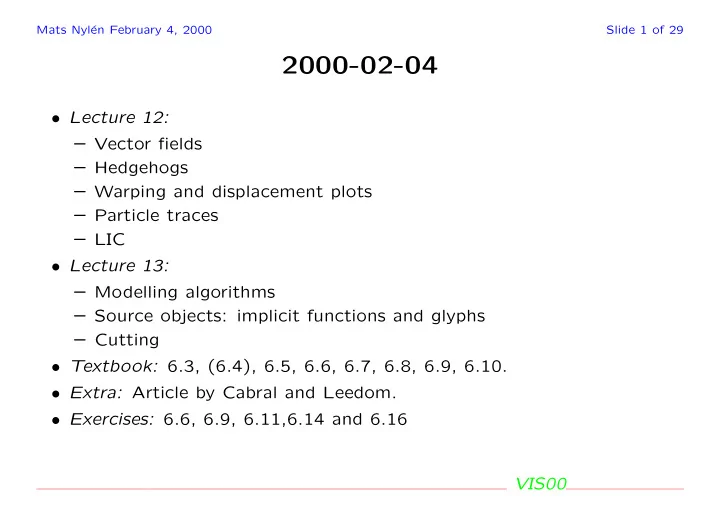
2000-02-04

  • Lecture 12:

– Vector fields – Hedgehogs – Warping and displacement plots – Particle traces – LIC

  • Lecture 13:

– Modelling algorithms – Source objects: implicit functions and glyphs – Cutting

  • Textbook: 6.3, (6.4), 6.5, 6.6, 6.7, 6.8, 6.9, 6.10.
  • Extra: Article by Cabral and Leedom.
  • Exercises: 6.6, 6.9, 6.11,6.14 and 6.16

VIS00

slide-2
SLIDE 2

Mats Nyl´ en February 4, 2000 Slide 2 of 29

Vector fields

A vector is an object with direction and length, we typically respresent a vector with it’s three Cartesian components:

  • V = (Vx, Vy, Vz)

A Vector field is a field which associates a vector with each point in space. Examples include:

  • Electromagnetic fields

E, B

  • Flow velicities (or momentum)

v

  • The gradient of any scalar field

A = ∇T VIS00

slide-3
SLIDE 3

Mats Nyl´ en February 4, 2000 Slide 3 of 29

Electromagnetic field equations

These are Maxwell’s equations

  • ∇ ×

B = µ0

  • J + ε0

∂ E ∂t

  • ∇ ×

E = −∂ B ∂t

  • ∇ ·

E = ρ/ε0

  • ∇ ·

B = defining the Electric field, E, and the Magnetic field,

  • B. ρ is charge density

and J is the electric current. VIS00

slide-4
SLIDE 4

Mats Nyl´ en February 4, 2000 Slide 4 of 29

The Navier-Stokes equation

The Navier-Stokes equation describes incompressible flow ∂ v ∂t + ( v · ∇) v = f − 1 ρ

  • ∇p + ν∇2

v relating the flow velocity, v, to an external force, f, the pressure, p and the density ρ. ν is the (kinematic) viscosity. Sometimes the flow momentum, p = ρ v is used instead. VIS00

slide-5
SLIDE 5

Mats Nyl´ en February 4, 2000 Slide 5 of 29

Steady state

We call time-independent vector-fields for steady VIS00

slide-6
SLIDE 6

Mats Nyl´ en February 4, 2000 Slide 6 of 29

Vector algorithms

These are the basic vector algorithms:

  • hedgehogs
  • warping
  • particle tracing or advection algorithms
  • line integral convolution or LIC

VIS00

slide-7
SLIDE 7

Mats Nyl´ en February 4, 2000 Slide 7 of 29

Hedgehogs

Draw a small directed line at some points in space VIS00

slide-8
SLIDE 8

Mats Nyl´ en February 4, 2000 Slide 8 of 29

Problems with hedgehogs

There are some obvious problems with hedgehogs:

  • visual impression depends a lot on the spatial distribution of the glyphs
  • using a lot of glyphs produces unwieldly pictures

VIS00

slide-9
SLIDE 9

Mats Nyl´ en February 4, 2000 Slide 9 of 29

Scaling of glyphs

When using scaled and oriented glyphs, the impression depends a lot on the dimensionality of the glyph. This is somtimes called the “visualization lie”. VIS00

slide-10
SLIDE 10

Mats Nyl´ en February 4, 2000 Slide 10 of 29

Warping

Vector data which is associated with “motion” can effectively be visualised using warping. VIS00

slide-11
SLIDE 11

Mats Nyl´ en February 4, 2000 Slide 11 of 29

Displacement plots

We can also show displacements on a surface, plot a displacement propor- tional to s = V · n Where n is the surface normal. Useful for illustrating normal modes for example VIS00

slide-12
SLIDE 12

Mats Nyl´ en February 4, 2000 Slide 12 of 29

Advection for steady fields

For steady fields (i.e. time-independant) we may define field lines or stream-

  • lines. Given a vector field

V we may define paths r(τ) with the property d r = V dτ (where r is a point in space). Or, as an ordinary differential equation d r dτ = V ( r) These curves forms the fieldlines or streamlines and can be used to visualize a steady field. The differential equation can be solved using standard numerical techniques, typically Runge-Kutta of order 2 or 4 is sufficient. VIS00

slide-13
SLIDE 13

Mats Nyl´ en February 4, 2000 Slide 13 of 29

Tracing techniques

The parametrised streamlines can be used in various ways

  • plot the streamlines, colour code the lines with some scalar, e.g., ve-

locity, pressure etc.

  • plot tubes along stream, use one scalar for colour coding and another

for the diameter of the tube

  • realease a set of particles at some initial positions and let them advect

along the streamline, show this as an animation

  • instead of simply plotting particles, plot a glyph at the postion, this

becomes a “moving” hedgehog. VIS00

slide-14
SLIDE 14

Mats Nyl´ en February 4, 2000 Slide 14 of 29

Streamlines through an office

This shows an example of streamlines The colours indicate pressure VIS00

slide-15
SLIDE 15

Mats Nyl´ en February 4, 2000 Slide 15 of 29

Getting fancy - Streamtubes

The same data but with a single streamtube, diameter of tube indicates flow-velocity. A thinner tube indicates faster flow. VIS00

slide-16
SLIDE 16

Mats Nyl´ en February 4, 2000 Slide 16 of 29

Line integral convolution

A slightly different idea is the line integral convolution or LIC methods. Given a vectorfield V we generate the fieldlines that passes thorugh a given point when τ = 0 and convolve this with some texture s( r) =

∆τ

−∆τ T(

r(τ))dτ Where T is some texture. I.e. we average a texture over a short piece of the streamline that passes through r. Typically one uses white noise for the texture. LIC is a fairly recent invention (1993), see paper by Cabral. VIS00

slide-17
SLIDE 17

Mats Nyl´ en February 4, 2000 Slide 17 of 29

A recent LIC example

Visualization of flow around a car tyre VIS00

slide-18
SLIDE 18

Mats Nyl´ en February 4, 2000 Slide 18 of 29

But you can also lic a flower

VIS00

slide-19
SLIDE 19

Mats Nyl´ en February 4, 2000 Slide 19 of 29

Tensors

Tensors are 3 × 3 matrices, a general tensor is thus

T =

  

txx txy txz tyx tyy tyz tzx tzy tzz

  

A tensor is called symmetric if tαβ = tβα. A Tensor field is then a field which which associates a tensor with each point in space. VIS00

slide-20
SLIDE 20

Mats Nyl´ en February 4, 2000 Slide 20 of 29

Tensor algorithms

Below are two example tensor visualizations To the left tensor ellipsiods, to the right Hyperstreamlines VIS00

slide-21
SLIDE 21

Mats Nyl´ en February 4, 2000 Slide 21 of 29

Modelling

Modelling is our catch-all category of algorithms, we’ll briefly discuss some elements of modelling algorithms. VIS00

slide-22
SLIDE 22

Mats Nyl´ en February 4, 2000 Slide 22 of 29

Source objects

Source objects starts the visualization pipeline, inserted source objects can be classified

  • Modelling simple geometry, e.g. a sphere, a cone, an arrow etc.
  • Supporting geometry, e.g.

three lines to indicate the axes or tybes wrpped around lines or supplemental input to filters such as probes or streamlines

  • Data attribute creation, texture data, scalar data over uniform grid.

One important type of source object is an implicit function. VIS00

slide-23
SLIDE 23

Mats Nyl´ en February 4, 2000 Slide 23 of 29

Implicit functions

An implicit function defining a surface is f(x, y, z) = c this splits 3-space into 3 different domains: 1 : f(x, y, z) > c 2 : f(x, y, z) = c 3 : f(x, y, z) < c As an example consider a sphere modelled by x2 + y2 + z2 = R2. We can also define operations for combining imiplicit functions. Implict functions extends to implicit modelling VIS00

slide-24
SLIDE 24

Mats Nyl´ en February 4, 2000 Slide 24 of 29

More about glyphs

Glyphs are very useful in visualizations of various types. A glyph is any

  • bject which is parametrised by some data
  • may be positioned on several points
  • may be scaled and rotated according to vector data
  • shape and colour may depend on scalar (and/or combinations of scalars

and vector)

  • etc.

VIS00

slide-25
SLIDE 25

Mats Nyl´ en February 4, 2000 Slide 25 of 29

Another glyph example

A face with surface normals indicated by cones VIS00

slide-26
SLIDE 26

Mats Nyl´ en February 4, 2000 Slide 26 of 29

Cutting

Creating cuts (like orthoslices) is a very useful visualization technique. The cuts can be generated from an implicit function F(x, y, z) = 0

  • Generate the F(x, y, z) = 0 iso-surface
  • interpolate the attribute data (fields) onto this surface

VIS00

slide-27
SLIDE 27

Mats Nyl´ en February 4, 2000 Slide 27 of 29

Cutting example

Yet another look at a GE cobustion chamber. The wireframe indicates the grid, colour codes the flow momentum. VIS00

slide-28
SLIDE 28

Mats Nyl´ en February 4, 2000 Slide 28 of 29

Stacking cuts

By stacking several semitransparent cuts we get a technique to render entire volumes VIS00

slide-29
SLIDE 29

Mats Nyl´ en February 4, 2000 Slide 29 of 29

Summary and outlook

With

  • Scalar algorithms
  • Vector algorithms
  • Modelling algorithms

we are ready to start and dive into applications! One question remains: what about time-dependent data sets. VIS00