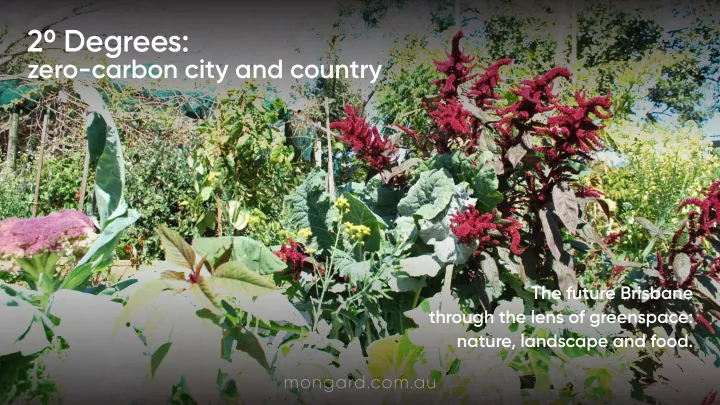
SLIDE 1
The future Brisbane through the lens of greenspace: nature, landscape and food.
20 Degrees:
zero-carbon city and country
mongard.com.au
SLIDE 2
Why do children have to strike to make us save the planet?
mongard.com.au
SLIDE 3 How do we adapt
and collectively?
Climate Crisis = Place Crisis
mongard.com.au
SLIDE 4
Climate adaptation
starts in PLACE
We love our families, friends and special places: Let that drive neighbourhood climate adaptation. mongard.com.au
SLIDE 5
Communities are drivers of climate action
We need to give them the tools to help
them adapt their places and worlds
mongard.com.au
SLIDE 6
mongard.com.au
A template for neighbourhood climate adaptation
Kurilpa Climate Strategy:
a collaborative process for neighbourhood action
SLIDE 7 This desert land
Indigenous Australians have known for millennia how to live without leaving a footprint on this land. Droughts, fjres and episodic fmooding were all part of their way of life. We need to relearn how to survive and thrive in even hotter and dryer landscapes… Where there are more frequent storms and fmood events. Where we can also create local food.
( after John Williams, The Guardian,4 /10/19, p.28)
We need to relearn our landscape: its soil, its plants, its very nature. We will need to be self-reliant and resilient local communities, much like the old days. We need to learn how to nurture the landscape and create local food as if it really matters for our survival.
mongard.com.au
SLIDE 8 How do we change the prevalent pattern of our growing cities, without destroying the very landscape which will support us into the turbulent future?
"We have squandered our fertile, high rainfall lands around our coastlines: instead of growing food, we have chosen to use these lands for urban sprawl, tourism and hobby
- farms. We have pushed out into an arid, infertile continent drained its rivers and cleared
its fragile forests in order to make food in a place where there is high risk of failure and destruction."
(John Williams, The Guardian,4 /10/19, p.28)
mongard.com.au
SLIDE 9 Is this the city of the future?
Green Wattle Gardens, Burpengary, Qld Casey City, Victoria Craigmore, Adelaide, SA Glenmore Park, Western Sydney, NSW
Large houses + small lots + less garden = heat stress + big carbon footprint + waste + lost nature
= 2 degrees + mongard.com.au
SLIDE 10
Imagine a world where you and your children can live...
mongard.com.au To make this place, we will need to adapt our communities, places, energy, transport and manufacturing production to be zero carbon.
SLIDE 11 The trees may save us
37% of carbon draw down
can be achieved with natural landscape based solutions
(https://www.naturalclimate.solutions/the-science)
1 trillion new trees
can cancel 60%
(Bastin et al, Science 2019)
10 billion
more trees currently lost than planted every year
(McAlpine. C, Guardian 1/11/19, p.24)
mongard.com.au
SLIDE 12 Food and the city
30%
- f our carbon footprint is food
50%
- f food is currently wasted
(Guardian 30/8/2019, p.24)
0%
is the world's current food capacity beyond 20C heating
(Smith P. in Guardian 16/8/2019, p. 23)
mongard.com.au
SLIDE 13 mongard.com.au
What will our zero-carbon world look like?
The town of Bingara aims to feed itself by 2020
The Living Classroom
SLIDE 14 Incorporation
Landscape and agriculture incorporated into metropolis vertical growth high-tech solutions. mongard.com.au
Ref: (Marot, S. Taking the Country’s Side Agriculture and Architecture, Polígrafa and Lisbon Architecture Triennale, 2019)
SLIDE 15 Negotiation
Landscape and agriculture negotiated into metropolis horizontal growth but greener. mongard.com.au
Ref: (Marot, S. Taking the Country’s Side Agriculture and Architecture, Polígrafa and Lisbon Architecture Triennale, 2019)
SLIDE 16 mongard.com.au
Infjltration
Landscape and agriculture permeate gaps in metropolis business as usual growth with grassroots infjltration.
Ref: (Marot, S. Taking the Country’s Side Agriculture and Architecture, Polígrafa and Lisbon Architecture Triennale, 2019)
SLIDE 17 Secession
Nature and agriculture become drivers of new worlds ‘unplugged’ settlements with self-supporting systems. mongard.com.au
Ref: (Marot, S. Taking the Country’s Side Agriculture and Architecture, Polígrafa and Lisbon Architecture Triennale, 2019)
SLIDE 18 Copenhagen: Zero Carbon by 2030
25% Growth 42% CO2 emissions reduction 15% reduction in heat consumption 66% of city trips not in cars
mongard.com.au
Image Ref: https://www.citylab.com/design/2016/01/copenhagen-parks-ponds-climate-change-community-engagement/426618/ I Ref: (https://www.theguardian.com/cities/2019/oct/11/ inside-copenhagens-race-to-be-the-fjrst-carbon-neutral-city)
SLIDE 19 20C Summer heat reduction through: 30% soft / natural / permeable landscape areas in cities 35% cool paving
(www.lowcarbonlivingcrc.com.au)
Heat strategies
mongard.com.au
Image Ref: https://www.sla.dk/files/1814/2892/9998/Large_skt._kjeld_it_is_an_event.jpeg
SLIDE 20 Heat
"Urban heat island: evenly distribute landscape to maximize cooling and counter heat stress."
Sarah Chapman (A Snapshot of Heat in Brisbane in the Future)
mongard.com.au
Map Ref:Deilami K., et.al. (2016). https://www.mdpi.com
SLIDE 21 Heat + Water + Landscape + Food =
Green Space Strategies:
Through community action in the next ten years we can draw down carbon by creating green space plans throughout Australia.
11 hectares:
Underutilized crown land in the Kurilpa neighbourhood that could be re-purposed into green space and biodiversity areas.
SLIDE 22
Local biodiversity
Verge In Kurilpa Peninsula mongard.com.au
SLIDE 23 mongard.com.au
BEFORE - Street as bitumen INDICATIVE Section Pavement Green space Green space Green space Green space Pavement AFTER BEFORE
Units Units Units Units Shop top
Bike loop Lookout park Children‘s playspace Community shelter Community shelter Mt Coot-tha lookout pocket park Fruit and nut tree grove Fruit and nut tree grove activity node Toilets Youth skate park Samoan Church Retirement Village Torbreck
D
n
h T c e Hampstead Rd H a m p s t e a d R d V u l t u r e S t
State High
From Hampstead Road to Hampstead Common:
1Ha new green space
SLIDE 24 Urban forests and urban sponge parks are a community priority in renewal
inner city West End. mongard.com.au
Biodiversity strategies
SLIDE 25
mongard.com.au
The Blue & Green Strategy in the The Green Space Plan identifjes ideas for managing local fmooding in the West End peninsula.
Water
SLIDE 26 Brolga Lakes
71 hectares
50%
for Koala conservation areas
90%
regenerated landscapes
100,000
trees grown on site nursery
Peri-urban not suburban?
mongard.com.au
SLIDE 27 Orchards Food gardens Nursery Lane meanders on road reserve Rural character roads Homes clustered to form hamlets Lakeside trails Conservation areas Community greenspaces Recycling hub Commons Wetlands Lakes Social ecology Separated bike/walk trails Commons Lakes Terraces
Brolga Lakes
mongard.com.au
SLIDE 28
Wasted water
mongard.com.au All wastewater is a valuable resource in the landscape.
SLIDE 29 mongard.com.au
Shifting climate / shifting places: Design led or disaster led?
A transformational shift in planning and design is required now
20 Climate adaptation required Current sustainable planning Business as usual 10 years