20 April Presentations 1 Chile : Green Innovation Policies and - - PDF document

20 april presentations
SMART_READER_LITE
LIVE PREVIEW

20 April Presentations 1 Chile : Green Innovation Policies and - - PDF document

20 April Presentations 1 Chile : Green Innovation Policies and Experiences (Conrad Von Igel, Head of Innovation Division, Ministry of Economy) 2 Philippines : Greening SMEs in the Philippines - Initial Steps (Gladina Aquino, Chief Trade and


slide-1
SLIDE 1

20 April Presentations

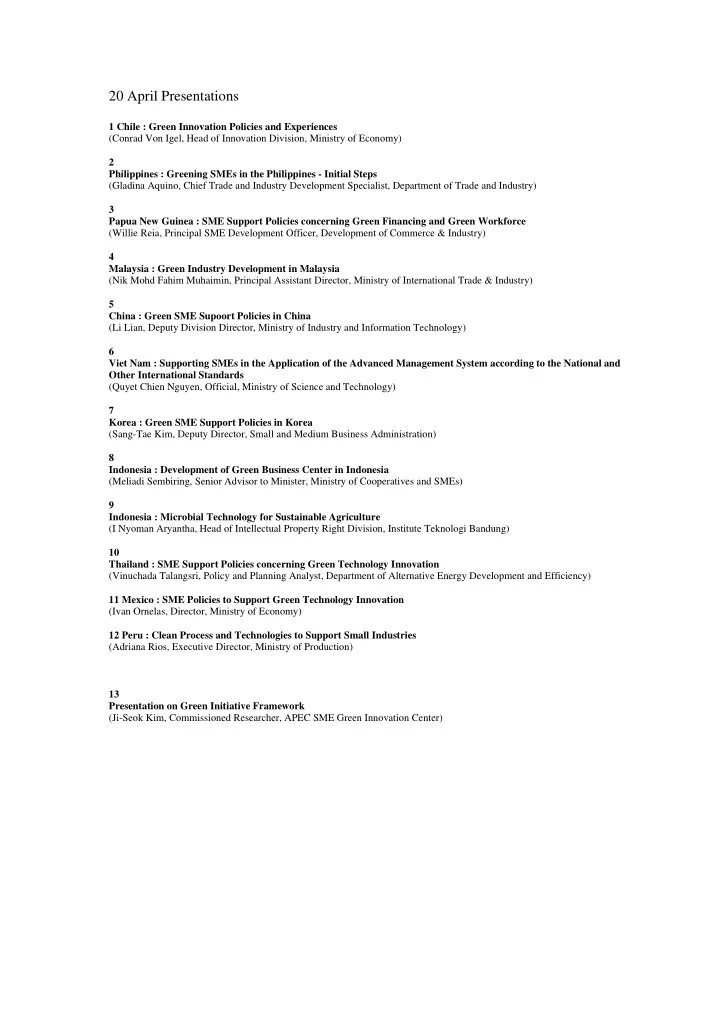
1 Chile : Green Innovation Policies and Experiences (Conrad Von Igel, Head of Innovation Division, Ministry of Economy) 2 Philippines : Greening SMEs in the Philippines - Initial Steps (Gladina Aquino, Chief Trade and Industry Development Specialist, Department of Trade and Industry) 3 Papua New Guinea : SME Support Policies concerning Green Financing and Green Workforce (Willie Reia, Principal SME Development Officer, Development of Commerce & Industry) 4 Malaysia : Green Industry Development in Malaysia (Nik Mohd Fahim Muhaimin, Principal Assistant Director, Ministry of International Trade & Industry) 5 China : Green SME Supoort Policies in China (Li Lian, Deputy Division Director, Ministry of Industry and Information Technology) 6 Viet Nam : Supporting SMEs in the Application of the Advanced Management System according to the National and Other International Standards (Quyet Chien Nguyen, Official, Ministry of Science and Technology) 7 Korea : Green SME Support Policies in Korea (Sang-Tae Kim, Deputy Director, Small and Medium Business Administration) 8 Indonesia : Development of Green Business Center in Indonesia (Meliadi Sembiring, Senior Advisor to Minister, Ministry of Cooperatives and SMEs) 9 Indonesia : Microbial Technology for Sustainable Agriculture (I Nyoman Aryantha, Head of Intellectual Property Right Division, Institute Teknologi Bandung) 10 Thailand : SME Support Policies concerning Green Technology Innovation (Vinuchada Talangsri, Policy and Planning Analyst, Department of Alternative Energy Development and Efficiency) 11 Mexico : SME Policies to Support Green Technology Innovation (Ivan Ornelas, Director, Ministry of Economy) 12 Peru : Clean Process and Technologies to Support Small Industries (Adriana Rios, Executive Director, Ministry of Production) 13 Presentation on Green Initiative Framework (Ji-Seok Kim, Commissioned Researcher, APEC SME Green Innovation Center)
slide-2
SLIDE 2

Chile : Green Innovation Policies and Experiences: are we ready to start walking?

Conrad Von Igel

Head Innovation Division Ministry of Economy

“Instead of changing the world through revolution, we can change the world through innovation” —Minister of Economy J.A. Fontaine

slide-3
SLIDE 3

Source: IMF

Our MISSION »

Development by 2020

3

Chilean Government | Ministry of Economy
slide-4
SLIDE 4

Our MISSION »

Development by 2020

4

Chilean Government | Ministry of Economy

Source: OECD except Chile (Dipres)

slide-5
SLIDE 5

Our MISSION » Chile » Innovation Hub of South America

5

Chilean Government | Ministry of Economy
slide-6
SLIDE 6

2010-2014 Innovation Program Our FOCUS »

Pillars

6

Chilean Government | Ministry of Economy
slide-7
SLIDE 7

7

Chilean Government | Ministry of Economy

Start-Up Chile is a program of the Chilean Government in 2010 to attract world-class early stage entrepreneurs to start their businesses in Chile with $40K + 1yr visa.

24

Teams already in CHILE

+ 300

are you ready?

more During 2011

Newly inspired Globally Thinking Risk Taking Entrepreneurs Connecting Chile Creating jobs in Chile

slide-8
SLIDE 8

Our STRATEGY »

Innovation Strategy

8

Chilean Government | Ministry of Economy
  • Attraction of prestigious International Research Centers:

Fraunhofer Institute.

  • Outward and inward Advanced Human Capital scholarships.
  • Outward and inward Global Entrepreneurship programs.
slide-9
SLIDE 9

GREEN INNOVATION POLICIES

slide-10
SLIDE 10

Our STRATEGY »

Clean Production

12

Chilean Government | Ministry of Economy
  • Productive and environmental management strategy, applied to

productive activities, to increase efficiency and productivity, and reduce impact on the human being and the environment.

  • Correct productive processes in their origin, when they generate

waste or pollution due to human, operational, technological or product design flaws.

  • Voluntary Agreements, legally binding.
  • Economic, regulative and reputational

incentives.

High Impact sectorial intervention (Clean Production Agreements)

  • Technical Support Programs.
  • Helpline answered by experts; onsite tech

support; training.

  • Raise information and awareness about best

available CP techniques, specially for SMEs.

Technical Support Mechanisms for SMEs

COMPANIES

slide-11
SLIDE 11

Our STRATEGY »

Clean Production Agreements

13

Chilean Government | Ministry of Economy
  • Production of Pisco and Grape Processors:
  • Reuse of vinasse, a liquid residual of

must fermentation.

  • Reduction in road maintenance costs in

a 600% , and reduction of mites that harm production.

  • Sausages and Fresh Meat:
  • Reuse of heat produced in cooling

process to heat water.

  • Investment is recovered in 1,3 years.
slide-12
SLIDE 12

Our STRATEGY »

Clean Production Agreements

14

Chilean Government | Ministry of Economy
  • 62 CPA
  • 7000 installations
  • 200 certifications
  • 85% were

signed by SMEs

  • 18% of GDP

Results for 19 CPA:

  • Social NPV: USD $ 239 MM
  • Private NPV: USD $ 326 MM
  • IRRTotal: 68%
  • Private Investment: USD $ 53 MM

Results for 16 CPA:

Reduction of

4.050.973,6 t CO2eq 565 MM

slide-13
SLIDE 13

Our STRATEGY »

Strengthening of Institutions

15

Chilean Government | Ministry of Economy
  • Creation of Ministry of Environment (2010) and Environmental

Assessment Service (SEA) (2010).

2008-12 National Plan of Action on Climate Change

  • Adapting to the impacts of climate change
  • Mitigating GHG emissions
  • Building and promoting capacity to address the issue
  • Current mitigation measures focus on renewable energy and

energy efficiency:

  • Over USD 10 million for biofuels research
  • USD 80 million government granted fund for investment in renewable

energy and energy efficiency technologies and pilot projects.

  • Renewable Energy Center with over USD1 million annual budget
  • Targets of 10% of non-conventional renewable energy sales over total

energy sales by 2024 (discussions under way to increase target).

  • Subsidies for construction and retrofitting of energy-efficient public housing
slide-14
SLIDE 14

Our STRATEGY »

Non-Conventional Renewable Energies

16

Chilean Government | Ministry of Economy

100 200 300 400 500 600 700 Antes 2000 2001 2002 2003 2004 2005 2006 2007 2008 2009 2010 Installed Power [ MW] Year

Development of Installed Power [MW] NCRE

Wind Bio-mass Hydraulic run-of-the-river central < 20 MW

Other NCRE 1.3% Other 3.6%

NCRE in Power Grid

Conventional 96.4% NCRE according to law 20,257 2.3%

Source: Renewable Energy Center (CER), Chile (2011) Source: Renewable Energy Center (CER), Chile (2011)

slide-15
SLIDE 15

Our STRATEGY »

Non-Conventional Renewable Energies

17

Chilean Government | Ministry of Economy

Solar Panels

  • Chile has high radiation exposure, specially in northern

regions.

  • Tax benefit for solar panels in housing under USD 200,000.
  • Net-metering Bill

Biofuel Consortiums

  • Generation of Bioethanol from lignocellulosic materials:

Biocomsa and Bioenercel.

  • Generation of Biofuels from microalgae: Desert Bioenergy

and AlgaeFuels.

  • Generation of Biofuels from macroalgae: BAL Biofuels
slide-16
SLIDE 16

SANTIAGO CLIMATE EXCHANGE

18

Chilean Government | Ministry of Economy
  • Chile has participated in CDMs, with 40 projects completed since

2004, from landfill methane gas capture to wind energy projects, yielding some USD300 million in trades carbon credits for Chilean enterprises in foreign carbon trade markets.

  • Santiago Climate Exchange, SCX, the first emission trading

scheme in Latin America will start operating in June 2011. Carbon Credits are approved by the VCS, and the system is based in voluntary carbon emission reductions.

  • Carbon offsetting today is expensive for SMEs. One of SCX goals

is to make the market more transparent and reduce this costs.

  • The Chilean market has a higher demand for carbon reductions in

their own territory, so SCX will also allow SMEs to sell their carbon reductions in the market. There are plans to reduce the certification costs.

slide-17
SLIDE 17

19

Chilean Government | Ministry of Economy
  • Already 2 out of 24 projects selected can be considered green

innovations. Photovoltaic (PV) panels with artificial intelligence added into the mounting structures. The project improves the efficiency of PV panels by 30%, cuts installation costs by 50%, reduces installation time by 10X or more, and requires ½ the land area of other dual-axis tracking solutions Using mobile phones to collect and map water data. The projects help communities and industries understand the dynamics of their water resources. H2020’s projects range from building mapping tools for monitoring watersheds to quantifying the effects of water poverty on the people who live in the bottom of the economic pyramid.

slide-18
SLIDE 18

Our STRATEGY »

20

Chilean Government | Ministry of Economy
  • Wenco S.A now produces Plastic Wood

(60% wood, 30% polypropylene and 10% additives).

  • Capel S.A produces biogas from liquid

industrial wastes.

  • Fundación Chile developed environmentally

friendly packaging.

  • Elissalde y Cia Ltda. produces woodflex.
  • P&P Architects use “plastic bricks” to build

social housing. Plastic has been recycled.

slide-19
SLIDE 19

Our CHALLENGES »

Concluding Remarks

21

Chilean Government | Ministry of Economy
  • Green innovation is on the rise, driven mainly by private

demand.

  • Industries are investing slowly.
  • In the near future, public policies will have to further

encourage the process.

CHILE IS STILL CRAWLING,

AND ANXIOUS TO WALK.

slide-20
SLIDE 20

Thanks.

slide-21
SLIDE 21

Greening SMEs in the Philippines: Initial Steps

Philippine Participants:

  • Ms. Vilma Elpa
  • Ms. Gladina M. Aquino

2011 APEC SME Green Innovation Conference “Greening SMEs: Champions of APEC’s New Growth” 19-20 March 2011 Seoul, Korea

slide-22
SLIDE 22

Outline of Presentation

  • Overview of Philippine SMEs
  • Programs and Initiatives Towards Greening

SMEs

slide-23
SLIDE 23

Philippine MSMEs are categorized based on asset size (excluding land) and number of employees.

Category Total asset value*

  • No. of employees

Micro Enterprise

P 3,000,000 or less 1-9

Small Enterprise

P 3,000,001-15,000,000 10-99

Medium Enterprise

P 15,000,001-100,000,000 100-199

* RA 6977, as amended by RA 8289 and further amended by RA 9501 or the Magna Carta for Micro, Small and Medium Enterprises defines MSMEs according to assets. However, available statistics from NSO are still categorized according to the number of employees.

Overview of Philippine SMEs

slide-24
SLIDE 24

Source: 2009 List of Establishments, NSO

Contribution of MSMEs

Micro - 91.1% (710,822) Philippine Enterprises (780,437) MSMEs - 99.6% (777,357) Large - 0.4% (3,080) Small - 8.1% (63,529) Medium - 0.4% (3,006)

  • 99.6% of total firms
  • 61% of employment
  • 35.7% of value-added

Overview of Philippine SMEs

slide-25
SLIDE 25

20,000 40,000 60,000 80,000 100,000 120,000 140,000 160,000 180,000 200,000

Source: 2009 List of Establishments, NSO

Distribution of MSMEs by Region, by Ranking

Overview of Philippine SMEs

slide-26
SLIDE 26

Source: 2009 List of Establishments, NSO

Wholesale and Retail Trade 49.6% Manufacturing 14.4% Hotels and Restaurants 12.5% Others* 11.6% Real Estate, Renting and Business Activities 6.1% Other Community, Social and Personal Service Activities 5.7%

* Includes the following industries:

  • Agriculture, Hunting & Forestry – 3,892 MSMEs
  • Fishery - 1,169 MSMEs
  • Health & Social Work - 31,573 MSMEs
  • Financial Intermediation – 26,443 MSMEs
  • Mining & Quarrying; Electricity, Gas and Water,

Construction; Transport, Storage & Communications; and Education

Overview of Philippine SMEs

slide-27
SLIDE 27

Programs and Initiatives Towards Greening Industries

  • Advocacy on Pollution Prevention for MSMEs
  • Department of Environment and Natural Resources
  • Industrial Ecowatch - Department of Environment

and Natural Resources

  • Environment Friendly-Economic Zones -

Department of Trade and Industry

  • Eco-Tourism Program - Department of Tourism
  • Integrated Program on Cleaner Production -

Department of Science and Technologies

slide-28
SLIDE 28
  • Orientation and familiarization workshops to Local Government

Units, non-government organizations, and women

  • rganizations on the various environmental laws relevant to the

micro, small and medium enterprises

Objective

To increase awareness on environmental laws and regulations for the prevention of pollution and protection of the environment

Programs and Initiatives Towards Greening Industries:

Advocacy on Pollution Prevention for mSMEs

slide-29
SLIDE 29

Programs and Initiatives Towards Greening Industries:

Advocacy on Pollution Prevention for mSMEs

  • Environmental laws advocated:

 Ecological Solid Waste Management Act

  • laws aims to protect the health of the people from harmful effects of pollution due to

solid wastes dumped either in water bodies or other public places

 Philippine Clean Water Act

  • enacted to ensure a comprehensive strategy to protect water quality

 Philippine Clean Air Act

  • to maintain the quality of air and protect human life from the dangers of pollution

 Toxic Substances, Hazardous and Nuclear Waste Control Act

  • chemicals and their wastes are to be managed to ensure the safety of the people

 The Philippine Environment Impact System

  • help mSMEs and the affected communities decide whether the benefits of

the project to be undertaken will outweigh the negative consequences or risks on the environment

slide-30
SLIDE 30

Programs and Initiatives Towards Greening Industries:

Industrial Ecowatch

Firms are rated for their environmental efforts that go beyond legal requirements Objectives

 Build and enhance the capability of establishments and or their associations in developing internal environmental management system  Promote the use of International environmental standards such as the ISO 140000 series  Promote mandatory self-monitoring and compliance with environmental standards  Encourage voluntary self-regulation among establishments for improved environmental performance  Encourage pollution reduction beyond compliance through public recognition and praise

slide-31
SLIDE 31

Scope

Sugar mills and refineries Beverage manufacturing Pulp and Paper mills Cement plants

Programs and Initiatives Towards Greening Industries:

Industrial Ecowatch

slide-32
SLIDE 32

Gold

  • Pre-requisite: Silver rating for the past 2 years
  • Waste reduction program in place

Silver

  • Pre-requisite: Green rating in the previous rating
  • Clean technology, energy & water conservation program in use

Green

  • Pre-requisite: Blue rating in the previous rating
  • Well-functioning monitoring equipment e.g. flowmeter

Blue

  • Pollution level of effluent/emission is within standards within the

rating period of one year

  • Well maintained pollution control facility/system

Red

  • Failure to comply with effluent/emission standards despite

presence of fully-operational pollution control devices Black

  • Failure to comply with effluent/emission standards
  • Absence or lack of required pollution control devices/s

Rating Criteria

Programs and Initiatives Towards Greening Industries:

Industrial Ecowatch

slide-33
SLIDE 33

DTI promotes the establishment of world class, environment friendly zones to respond to the demands

  • f ready-to-occupy locations for foreign investments

PEZA grants fiscal and non-fiscal incentives to developers of economic zones, export producers, and information technology service exporters  promotes efficiency in production and the use of low carbon technologies among industries

Programs and Initiatives Towards Greening Industries:

Environment Friendly-Economic Zones

slide-34
SLIDE 34

Programs and Initiatives Towards Greening Industries:

Eco-Tourism Program

  • aims to promote the conservation of natural and cultural sites

to ensure the long-term sustainability of natural resources

  • create models that can be adapted by local communities to

engage in non-exploitative and sustainable utilization of natural resources

  • conduct awareness and education programs
slide-35
SLIDE 35

Programs and Initiatives Towards Greening Industries:

Integrated Program on Cleaner Production

 aims to promote sustainable development and strengthen the competitiveness of Philippine industries through the adoption of cleaner production technologies  mSMEs are assisted on how to reduce their pollution load with corresponding decrease in operating costs and comply with environmental standards through research and development

slide-36
SLIDE 36

Th Than ank k yo you.

slide-37
SLIDE 37

2011 APEC SME GREEN INNOVATION CONFERENCE APRIL 19 - 20, 2011 THEME: GREEN SMES: “CHAMPIONS OF APEC’S NEW GROWTH “

PAPUA NEW GUINEA SME SUPPORT POLICIES:

GREEN FINANCING AND GREEN WORKFORCE

slide-38
SLIDE 38

PRESENTATION OUTLINE

 OVERVIEW OF PNG ECONOMY  MAIN ECONOMIC GROWTH POLICIES &

FRAMEWORK;

  • SECTORAL POLICIES SUPPORTING SME

GROWTH AND EXPANSION;

SME RISK SHARING FACILITIES SME REVOLVING FUND

slide-39
SLIDE 39

OVER VIEW OF PNG ECONOMY

 PNG is an agro-based economy and

agriculture plays a dominant role. PNG produce and export coffee, cocoa, copra, palm kernels, tea, sugar, rubber and vanilla.

 However, recently Mining & LNG

has overtaken agriculture, becoming the dominant players, spurring economic growth.

slide-40
SLIDE 40

OVERVIEW OF PNG ECONOMY

 Major Exports includes minerals, petroleum and

agricultural products(eg. minerals; gold, copper, silver, nickel, crude oil. agriculture; timber, coffee, palm oil, cocoa & copra.

 Major Imports includes chemicals, machineries, motor

vehicles, electronic and other manufactured goods.

slide-41
SLIDE 41

MAIN ECONOMIC GROWTH POLICIES AND FRAMEWORK

 VISION 2050  An overarching road

map that spelt out clearly the future direction for the country and reflects the aspiration of the people of PNG.

 Underpinned by

Seven Strategic Focus Areas called “7 PILLARS.

slide-42
SLIDE 42

VISION 2050 & THE 7-STRATEGIC PILLARS

slide-43
SLIDE 43

SECTORAL POLICIES SUPPORTING SME GROWTH

 SMEs in PNG is very small, underdeveloped and

very difficult to identify due to non-availability of reliable data.

 The National SME Policy identifies various constraints

such as lack of access to finance, information, technology, infrastructure, technical and managerial skills including.

slide-44
SLIDE 44

GOPNG VISION, OBJECTIVE & GOALS

 SMEs are seen as the backbone of PNG Economy

and as a vehicle to achieve economic growth, reduce poverty and create a healthy-wealthy society by 2030.

slide-45
SLIDE 45

CURRENT STATUE OF SMEs IN PNG

 The Construction of US$18 billion LNG Projects has

created the best opportunity for SME activity and participation.

 GoPNG acknowledged the impact of LNG on the

Economy including the SME sector and hence has put strategic measures in place including K120m (US$50million) setting aside for SMEs to have access to participate in the LNG Project.

 Strategic planning were put in place to cater for huge

benefits deriving from the project including setting up Sovereign Fund for save keeping proceeds from the LNG Projects;

 GoPNG is currently in the process of developing

institutional framework and landscape conducive for SME growth and expansion.

slide-46
SLIDE 46

CURRENT STATUE OF SMEs IN PNG

 SME Policy is currently under review to clearly

define SME in the current PNG context and effectively address the challenges and explore

  • pportunities in the sector.

 Targets 87% of the total population in rural areas

to participate in SME activities by way of creating a supportive environment for them to engage in economic activity;

 Examples:  SME Access to Finance Facility  SME Revolving Fund  SME Seed Capital  SME Credit Facility

slide-47
SLIDE 47

SME ACCESS TO FINANCE FACILITY (RSF)

 An SME Financing Facility established between

GoPNG & World Bank.

 Being developed to assist SME growth by provide

financing & develop capacity building for SMEs (i. e providing 50% credit guarantee protection against possible risk of loan default to SMEs).

 SMEs lacking managerial skills would have access to

training and other up-to-date information on SMEs.

 Facility does not fund projects or SMEs operating in

environmentally sensitive areas; e.g. logging activities are strictly not funded due to the Government’s strong stand on the Carbon Trade Programme

slide-48
SLIDE 48

SEED CAPITAL OR BUSINESS DEVELOPMENT GRANT

 Established by way of an NEC Decision to set up

a separate Business Development Grant for SMEs owned and operated by landowners within

  • r along the major resource project areas to

actively participate in the spin-off business activities.

slide-49
SLIDE 49

SME REVOLVING FUND

 Established to assist SMEs owned and managed

by co-operative societies to have access to funds available through the National Development Bank (NDB) for start-up capital or to improve and expand business activities.

 Gives SMEs the opportunity to borrow at a very

reduced interest rate with minimum borrowing conditions.

 Borrowers take advantage of the above program

by repaying the loan over a long-term period; e.g: 2 – 3 years.

slide-50
SLIDE 50

SME CREDIT GUARENTEE SCHEME

 Established under the SME Development

Programme with Small Business Development Corporation (SBDC) – the intention of the SME Credit Guarantee Scheme is to assist SMEs having access to credit facility and obtain loan for capital re-investment or expansion in business activities. And as a start-up financing facility for new SMEs.

 E.g: current existing credit facilities are with

National Development Bank, ANZ and the Nationwide Micro Bank

slide-51
SLIDE 51

CONCLUSION

 While SMEs in PNG is quite difficult to identify due

to non-availability of SME Data, PNG has in place all regulatory and policies framework that guides sectorial policies and alignment with national investment policies taking into account environmental sustainability through the REDD+ Programme.

 Given the many constraints SME in PNG face,

access to credit facilities is one important area that

  • ur Gov’t. is now looking into addressing
slide-52
SLIDE 52
slide-53
SLIDE 53

Front page

APEC SME Green Innovation Conference

April 19-20, 2011

slide-54
SLIDE 54

PM’s COP15 Pledge

United Nations Climate Change Conference 2009, Copenhagen To reduce carbon emission up to 40% in terms of emission intensity of GDP (Gross Domestic Product) by 2020 compared with its 2005 levels

slide-55
SLIDE 55

Why Green Technology?

Due to Negative Impacts From Development

  • Loss of income form polluted resources

Rivers, beaches and etc.

  • Health costs for individual and government
  • Health costs for individual and government

Asthma, water contamination, food contamination and, etc

  • Loss of ecosystem services

For instance healthy mangroves act as natural nurseries of fisheries industry and protection of coastal erosion

  • Clean-up costs for government

Cleaning up of rivers, cleaning up of illegal dumping of hazardous waste

slide-56
SLIDE 56

What the Government Thinks?

  • Failure to incorporate climate change mitigation and adaptation into

development policy has a great potential to undermine future economic growth.

  • The degree to which climate change will intensify depends on the

development trajectory (low carbon development OR business as usual (BAU) high emissions scenario) usual (BAU) high emissions scenario)

  • Encourage win-win policy initiatives that can yield co-benefits
  • Mitigation efforts – curtail GHG, increase carbon sinks
  • Adaptation – increase adaptive capacity, reduce vulnerability, build

resilience

slide-57
SLIDE 57

Government Initiatives

  • Energy Supply Sector (Power

Transportation infrastructure and vehicles, in biofuels and public road transport.

  • Energy Supply Sector (Power

generation and energy supply side management)

  • Energy Utilization Sector (All energy

utilization sectors and in demand side management programs.) Construction, management, maintenance and demolition of buildings. Management and utilization of water resources, waste water treatment, solid waste and sanitary landfill.

slide-58
SLIDE 58

Government Initiatives

In April 2009, the Ministry of Energy, Green Technology and Water was established MINISTRY OF ENERGY, GREEN TECHNOLOGY AND WATER (KeTTHA) in a cabinet reshuffle to replace the Ministry

  • f Energy, Water and

Communications. Low Energy Office (LEO) Ministry of Energy, Green Technology and Water (KeTTHA), Putrajaya

slide-59
SLIDE 59

Government Initiatives

Policy Statement Green Technology shall be a driver to accelerate the national economy and promote sustainable The National Green Technology Policy was launched by the Honorable Prime Minister of Malaysia on 24 July 2009. NATIONAL GREEN TECHNOLOGY POLICY economy and promote sustainable development.

slide-60
SLIDE 60

Government Initiatives

NATIONAL GREEN TECHNOLOGY POLICY

ENERGY Seek to attain energy independence & promote efficient utilisation

4 PILLARS

ENVIRONMENT Conserve and minimise the impact

  • n the environment

ECONOMY Enhance the national Economic development through the use

  • f technology

SOCIAL Improve the quality

  • f life for all
slide-61
SLIDE 61

Government Initiatives

NATIONAL GREEN TECHNOLOGY POLICY

STRATEGIC THRUST

  • 1. Strengthen The Institutional Frameworks
  • 2. Provide A Conducive Environment For Green

Technology Development

  • 3. Intensify Human Capital Development In Green
  • 3. Intensify Human Capital Development In Green

Technology

  • 4. Intensify Green Technology Research And Innovations
  • 5. Promotion And Public Awareness
slide-62
SLIDE 62

Government Initiatives

  • To have high level coordination among Ministries, Agencies, the private

sector and all other stakeholders.

  • The council is chaired by the Honorable Prime Minister of Malaysia.
  • The council (MTH) is supported by a Steering Committee and five (5)

working groups on (i) Industry; (ii) Research & Innovation; (iii) Human Capital; (iv) Promotion and Public Awareness; and (v) Transportation.

  • The first meeting was held on 26 January 2010.

NATIONAL GREEN TECHNOLOGY COUNCIL

  • The National Green Technology Council is now known as the National

Green Technology and Climate Change Council.

slide-63
SLIDE 63

Government Initiatives

  • Restructuring from National

Energy Centre to Malaysian Green Technology Corporation (GreenTech Malaysia)

MALAYSIAN GREEN TECHNOLOGY CORPORATION (GreenTech Malaysia)

  • To enhance the position of the

Malaysian Green Technology Corporation to become a Focal Point for Green Technology Development in the country

Green Energy Office (GEO) Malaysian Green Technology Corporation, Bangi

slide-64
SLIDE 64

Government Initiatives

  • RM1.5 billion soft loan
  • Up to RM50.0 million for producers and

RM10.0 million for users of green technology

  • 2% interest subsidy by the government
  • 60% government guarantee

GREEN TECHNOLOGY FINANCING SCHEME (GTFS)

  • 60% government guarantee
  • 140 companies are expected to benefit

from the scheme

  • GreenTech Malaysia to administrator all

applications

  • Effective in January 2010
slide-65
SLIDE 65

Government Initiatives

Its objective is to develop Putrajaya and Cyberjaya as pioneer townships

GREEN TOWNSHIP IN PUTRAJAYA AND CYBERJAYA

pioneer townships in green technology, as a showcase for the development of

  • ther townships in

the country.

slide-66
SLIDE 66

Government Initiatives

  • KeTTHA is working with the Ministry of Finance (MoF) to

develop a mechanism for Green Procurement to be implemented in government agencies.

  • KeTTHA is working with the Standards and Industrial

Research Institute of Malaysia (SIRIM) to develop standards, certifications and labeling mechanisms including green procurement manuals and procedure to GREEN PROCUREMENT AND ECO LABELING including green procurement manuals and procedure to enable government and private sector to embark on green purchasing. Examples of Eco-Labeling:

slide-67
SLIDE 67

Government Initiatives

KeTTHA is working with the Ministry of Transport and the Ministry of International

ELECTRIC VEHICLES

Trade and Industry to develop the infrastructure roadmap for the use of electric vehicles in Malaysia.

slide-68
SLIDE 68

Government Initiatives

  • Exhibition

INTERNATIONAL GREENTECH AND ECO PRODUCTS EXHIBITION AND CONFERENCE MALAYSIA (IGEM) 2010

  • Conference/Seminar
  • Cooperation between

local and foreign universities

  • Workshops
  • Documentaries /

Videos

  • Business Matching

Sessions

  • Business Networking

Date 14 - 17 October 2010 Venue Kuala Lumpur Convention Center

slide-69
SLIDE 69

Developed to identify suitable and capable SMEs who are eligible be placed in a Fast Track Programme (FTP) / Green Lane Policy to shorten time-to-market by providing ready access to capital risk, including for technology acquisition The premier award to recognise the most innovative SME, out

  • f six (6) sectors, including Green Technology

Government Initiatives

THE SME INNOVATION AWARD

Manufacturing Sector Services & Construction Sector ICT, Electrical & Electronics Engineering & Industrial Design Biotech & Agrotech Green Technology

slide-70
SLIDE 70

A full-fledged Green Technology Building

Block Original Design Manufacturer

Government Initiatives

THE SME INNOVATION AWARD

2010 winner for Green Technology category…

Block Original Design Manufacturer producing High Power LED Light Engine and Solar Concentrated Photo Voltaic receivers for Energy Efficient Solid State Lightings (SSL) and Renewable Energy applications.

slide-71
SLIDE 71

Government Initiatives

Government Agencies’ Cooperation

slide-72
SLIDE 72

Government Initiatives

Government Agencies’ Cooperation

slide-73
SLIDE 73

Challenges

  • Changing mindset, attitude and

habits of the public;

  • Lack of knowledge and expertise

among professionals and among professionals and regulators in green technology;

  • Duplication of tasks and

jurisdictional implications; and

  • Political will.
slide-74
SLIDE 74

The Way Forward

  • Green technology becomes the main choice for the

products and services and has larger local market;

  • Increase of research, development and innovation by

local university/research institution to be commercialized through local industry cooperation/multinational company;

  • Increase of local SME dan SMI businesses to global

market;

  • Widespread of green technology to reduce overall

resource utilization, by maintaining country’s economic growth;

  • Significant reduction in energy consumption in the

country and applications of technology green in Malaysian culture;

  • Increase of cooperation at international level between

local university/research institution and industry;

  • More active on awareness promotion, publicity and

green technology education;

  • Application of green technology values in life;
  • Increase of encouragement through incentive and tax,

and rule and legislation related to green technology.

slide-75
SLIDE 75
  • NIK MOHD FAHIM BIN MUHAIMIN

Ministry of International Trade & Industry, Malaysia

slide-76
SLIDE 76

The policies and measures for promoting SME green innovation development in China

——"2011 APEC SME Green Innovation Conference" (April 19—20, 2011, Seoul, Korea) MIIT, China LIAN LI

slide-77
SLIDE 77

basic situation of the development of China’s SMEs

  • China’s SMEs have an irreplaceable

important role in economic growth and social development, and play an important role in boosting economic growth, expanding employment and driving forward innovation.

slide-78
SLIDE 78

the policies and measures for promoting the development of SMEs in green innovation

  • In 2009, the "Sate Council Leading Group

for Promoting SME development" was set up

  • Vice Premier Zhang Dejiang acted as

head of the Group,

  • and 16 members
slide-79
SLIDE 79

the policies and measures for promoting the development of SMEs in green innovation

  • In recent years, China has issued a series
  • f policies and measures to actively create

a favorable environment for the development of SMEs, and encourage SMEs’ green innovation and sustainable development.

slide-80
SLIDE 80

First,law and policy for the development of SME green innovation

  • In 2003, promulgated by the National

People’s Congress, "SME Promotion Law

  • f the People's Republic of China"

proposed 45 stimulation measures .

slide-81
SLIDE 81

First,law and policy for the development of SME green innovation

  • In 2009, the State Council put out the

"Several Opinions on Further Promoting the Development of SMEs" to protect SMEs against the effects of the financial crisis,

  • which provided 29 concrete preferential

policies in 8 aspects.

slide-82
SLIDE 82

Second, promote SME green innovation development through training.

  • The central finance has given a supporting

from special subsidies for the SME service system since the "National SME Galaxy Training Project" was carried out in 2003. SME trainings have achieved positive results.

slide-83
SLIDE 83

Third, encourage SMEs to save energy and reduce greenhouse gas emission,

  • In April 2010, for the main problems faced

by SMEs in green innovation and energy savings, the China’s MIIT issued the "Guiding Suggestions on Further Strengthening SME Energy Conservation Work",

slide-84
SLIDE 84

Fourth, perfect the public service platform building of innovation

  • Both the China’s Ministry of Industry and

Information Technology and local authorities take the public service platform construction as an important work to guide SME innovation and green development.

slide-85
SLIDE 85

Thanks!