2 Y X Not linear in variables 0 1 Y X 1 Not - - PDF document

2 y x not linear in variables 0 1 y x 1 not linear in
SMART_READER_LITE
LIVE PREVIEW

2 Y X Not linear in variables 0 1 Y X 1 Not - - PDF document

Lecture : Discuss HW#1 Discuss Binge drinking research Econometrics: The quantitative measurement and analysis of economic, business and sometimes social phenomena. Three major uses Description Hypothesis testing (theory testing) Forecasting Intro


slide-1
SLIDE 1

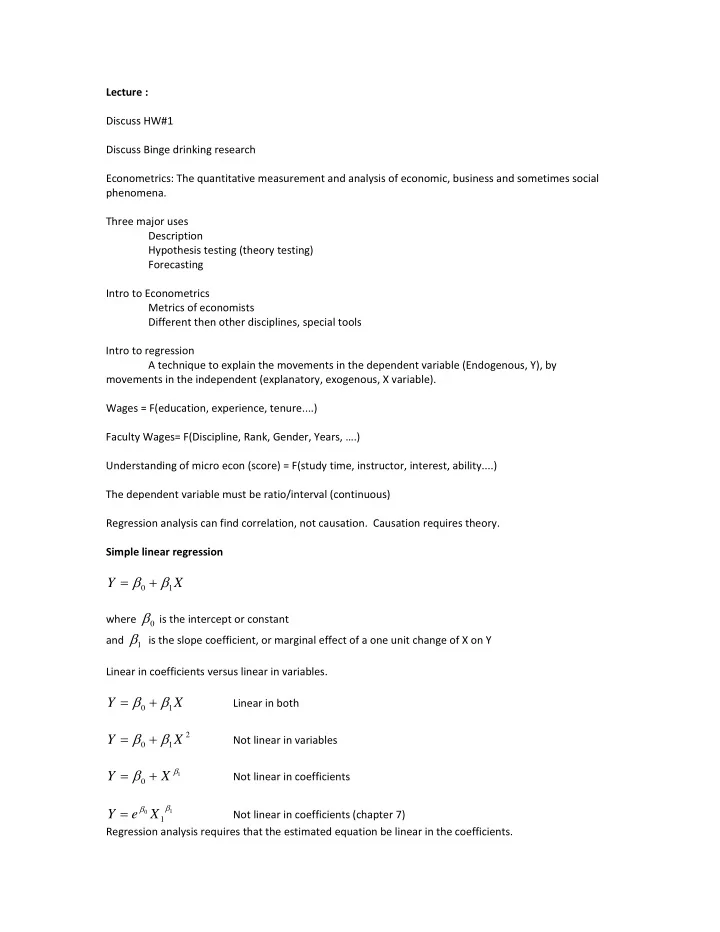
Lecture : Discuss HW#1 Discuss Binge drinking research Econometrics: The quantitative measurement and analysis of economic, business and sometimes social phenomena. Three major uses Description Hypothesis testing (theory testing) Forecasting Intro to Econometrics Metrics of economists Different then other disciplines, special tools Intro to regression A technique to explain the movements in the dependent variable (Endogenous, Y), by movements in the independent (explanatory, exogenous, X variable). Wages = F(education, experience, tenure....) Faculty Wages= F(Discipline, Rank, Gender, Years, ….) Understanding of micro econ (score) = F(study time, instructor, interest, ability....) The dependent variable must be ratio/interval (continuous) Regression analysis can find correlation, not causation. Causation requires theory. Simple linear regression

X Y

1

   

where

 is the intercept or constant

and

1

 is the slope coefficient, or marginal effect of a one unit change of X on Y

Linear in coefficients versus linear in variables.

X Y

1

   

Linear in both

2 1

X Y    

Not linear in variables

1

 X Y  

Not linear in coefficients

1

1   X

e Y 

Not linear in coefficients (chapter 7) Regression analysis requires that the estimated equation be linear in the coefficients.

slide-2
SLIDE 2

The dependent variable *must* be ratio/interval (continuous) (there are some caveats) General form

) ( ) (

1

X f Y f    

The Stochastic Error Term There is always some variation in Y that can’t be explained. Example (performance in micro)

  • 1. Omitted variables
  • 2. Measurement error
  • 3. Incorrect functional form
  • 4. Random chance

so we add a term to our equation

      X Y

1

Two parts, deterministic, and stochastic (random)

X X Y E

1

) | (    

Expanded notation

i i i

X Y      

1

where

) .. 1 ( n i 

and indexes individual observations so

1 1 1 1

      X Y

2 2 1 2

      X Y

....

n n n

X Y      

1

REGRESSION /MISSING LISTWISE /STATISTICS COEFF OUTS R ANOVA /CRITERIA=PIN(.05) POUT(.10) /NOORIGIN /DEPENDENT salary /METHOD=ENTER market. Model Summary

slide-3
SLIDE 3

Model R R Square Adjusted R Square

  • Std. Error of the

Estimate 1 .407a .166 .164 11585.82899

  • a. Predictors: (Constant), market

Coefficientsa Model Unstandardized Coefficients Standardized Coefficients t Sig. B

  • Std. Error

Beta 1 (Constant) 18096.994 3288.009 5.504 .000 market 34545.219 3424.333 .407 10.088 .000

  • a. Dependent Variable: salary

_cons 18096. 99 3288. 009

  • 18096. 99 3288. 009 5. 50 0. 000 11637. 35
  • 5. 50 0. 000 11637. 35 24556. 64
  • 24556. 64

m ar ket 34545. 22 3424. 333 1

  • 34545. 22 3424. 333 10. 09 0. 000 27817. 75
  • 0. 09 0. 000 27817. 75 41272. 69
  • 41272. 69

sal ar y Coef . St d. Er r . t P>| t | [ 95% Conf . I nt er val ] Tot al 8. 2387e+10 513 160599

  • 8. 2387e+10 513 160599133

133 Root M SE = 11586 11586 Adj R- squar ed = 0. 1642

  • 0. 1642

Resi dual 6. 8726e+10 512 134231

  • 6. 8726e+10 512 134231433

433 R- squar ed = 0. 1658

  • 0. 1658

M

  • del 1. 3661e+10 1 1. 3661e
  • 1. 3661e+10 1 1. 3661e+10

+10 Pr ob > F = 0. 0000

  • 0. 0000

F( 1, 512) = 101. 77

  • 101. 77

Sour ce SS df M S Num ber of obs = 514 514 . r egr ess sal ar y m ar ket

slide-4
SLIDE 4

20000 40000 60000 80000 100000

Academic salary

.6 .8 1 1.2 1.4

Marketability

salary Linear prediction

slide-5
SLIDE 5

Lecture 9: Again the multivariate representation is

i ki k i i i

x x x y            ...

2 2 1 1

Again the

s ' 

represent the partial effects of the x Constant is a junk collector, so that the residuals sum to zero. Be careful about making inferences on the value of the constant

 

 

  

     

2 2 2 1 1 2 2

ˆ ˆ ˆ ˆ

i i i i i i

x x y y y    

Minimizing by differentiating with respect to the betas and solving them simultaneously yields the normal equations. http://en.wikibooks.org/wiki/Econometric_Theory/Normal_Equations_Proof (Note: There is a mistake in the derivation of the above. The solution is correct, but an n appears in front

  • f the alpha a few equations early.)

Where the solutions for the multivariate case are given here:

     

  

2 2 1 2 2 2 1 2 1 2 2 2 1 1

) ( ˆ x x x x x x yx x yx 

     

  

2 2 1 2 2 2 1 2 1 1 2 1 2 2

) ( ˆ x x x x x x yx x yx 

21 2 1 1

ˆ ˆ ˆ x x y      

where the lower case letters immediately above represent deviations form their mean

1 1 1

x x x

i 

and

2 2 2

x x x

i 

Evaluating the quality of a regression. Spend time before running the regression thinking about the expected output.

  • 1. Is the estimated equation supported by the theory?
  • 2. How well does it fit the data?
  • 3. Is the dataset reasonable large and accurate?
  • 4. Is OLS the best estimator for this case?
  • 5. How well do estimates match your prediction?
  • 6. Any important omitted variables?
  • 7. Has the most logical functional form been used?
  • 8. Is the regression free from other econometric problems?

Describing the fit:

slide-6
SLIDE 6
slide-7
SLIDE 7

Total, explained and residual sum of squares. TSS, ESS, RSS

 

2

) ( y y TSS

i

deviation of observation from mean (picture in upper left) which can be decomposed into two parts TSS= ESS+RSS

  

    

2 2 2

) ˆ ( ) ˆ ( ) (

i i i i

y y y y y y

The explained portion (ESS), from the fitted line to the mean (this is represented by the solid vertical lines in the upper right hand picture. The Residual or unexplained portion is depicted in the lowest picture. From the fitted line to the

  • bservation.

2

R (R squared) coefficient of determination

2

R = (ESS/TSS) = 1‐(RSS/TSS)

slide-8
SLIDE 8

 

 

2 2

) ( 1 y y e

i i

1

2 

 R

Be careful when comparing time series vs cross section. R squared in the .9 range is common for time series and unheard almost unheard of on cross sectional analysis. What happens when you add an explanatory variable? TSS doesn’t change, but ESS goes up. So we would always want to add a variable, but then the degrees of freedom fall. Degrees of freedom reflect the reliability of our estimates.

i i i

X Y      

1

we are estimating 2 coefficients degrees of freedom = observations‐2. n‐2. More generally

i ki k i i i

x x x y            ...

2 2 1 1

we are estimating k+1 coefficients so degrees of freedom = n‐(k+1) we can use this information to “penalize” the inclusion of an additional variable to better reflect the tradeoff. NOTE: We cannot estimate the model if there are negative DOF. We effectively have less information than coefficients to estimate. The solution is not unique. n>k+1 is a requirement Adjusted

2

R or sometimes referred to as r‐bar squared

     

1 1 1

2

     n TSS k n RSS R

by a simple rearrangement we get

 

     

           1 1 1 1

2 2

k n n R R

note as k rises so does the penalty, whether or not it offsets the increase in R squared will impact R bar squared. Note Adjusted R squared (sometimes called R bar Squared) can be less then 0, but it is bounded above by 1. Appropriate and inappropriate uses of R bar squared

COMMENT lets run our first regression. REGRESSION /MISSING LISTWISE /STATISTICS COEFF OUTS R /*I've removed the ANOVA from the default */ /CRITERIA=PIN(.05) POUT(.10) /NOORIGIN

slide-9
SLIDE 9

/DEPENDENT salary /METHOD=ENTER market. Model Summary Model R R Square Adjusted R Square

  • Std. Error of the

Estimate 1 .407a .166 .164 11585.82899

  • a. Predictors: (Constant), market

Coefficientsa Model Unstandardized Coefficients Standardized Coefficients t Sig. B

  • Std. Error

Beta 1 (Constant) 18096.994 3288.009 5.504 .000 market 34545.219 3424.333 .407 10.088 .000

  • a. Dependent Variable: salary

COMMENT lets run our second regression adding yearsdg. REGRESSION /MISSING LISTWISE /STATISTICS COEFF OUTS R /*I've removed the ANOVA from the default */ /CRITERIA=PIN(.05) POUT(.10) /NOORIGIN /DEPENDENT salary /METHOD=ENTER market yearsdg. Model Summary Model R R Square Adjusted R Square

  • Std. Error of the

Estimate 1 .824a .680 .678 7187.88271

  • a. Predictors: (Constant), yearsdg, market

Coefficientsa Model Unstandardized Coefficients Standardized Coefficients t Sig.

slide-10
SLIDE 10

B

  • Std. Error

Beta 1 (Constant)

  • 1685.118

2153.797

  • .782

.434 market 39630.458 2131.883 .467 18.589 .000 yearsdg 979.458 34.221 .719 28.622 .000

  • a. Dependent Variable: salary
slide-11
SLIDE 11

Lecture 10: October 5 LAB Review appropriate and inappropriate use of R_squared Theory should still drive the inclusion of variables and the fit in terms of expected coefficient

  • signs. You should not dump variables into the regression solely to increase R_squared.

Forecasting water demand in So Cal Insert example from book here Using regression analysis in research

  • 1. Review literature and develop theoretical model
  • 2. Specify model: select variables and specify functional form
  • 3. Hypothesize coefficient signs
  • 4. Collect data
  • 5. Estimate and evaluate Equation
  • 6. Document results
  • 1. Review literature

Look for theoretical model to test Look for previous empirical work to use as a basis for further research with additional data, different country, different time period, different data. Look for models that may exclude potential important variables. Use database to search for articles. Econ lit is a good start

slide-12
SLIDE 12

Lecture 11: October 10

  • 2. Specify the theoretical model

Select the dependent variable Select the independent variables and how they are measured. Select the functional form of the variables Select the form of the error Mistakes here result in what is known as specification error. Explain dummy variables. Dummy variables sometimes called indicator variables take the value of one if the observation has the attribute of interest and zero otherwise.

  • 3. Hypothesize coefficient signs

performance in ECO 110 = F (variables,....)

  • 4. Collect data

How you measure the data is important. Time series data: what is the frequency or periodicity? Quarterly, monthly, annual? All variables must be measured over the same time span. Aggregation bias When looking at cross sectional data, the variable should be measured for the unit of observation. If the dependent variable is different for different states, you don’t want to include a variable that is measured for the entire country. More data More better...use all available data. Units of measure matter only for the scale of the coefficient, it doesn’t matter for its sign or statistical significance.

  • 5. Estimate and evaluate Equation
  • a. Use OLS as a first pass
  • b. look at the data again
  • c. Evaluate..be careful of fixup, problems arise from errors in variables
  • 6. Document results

Example Woodys Example CLL Paper

slide-13
SLIDE 13

Lecture 12: The Classical Assumptions I The regression model is linear in the coefficients, is correctly specified, and has an additive error term

  • II. The error has mean zero  

i

E 

  • III. All included variables are uncorrelated with the error term 

j i x E

j i

, 0  

  • IV. Observations on the error term are uncorrelated with each other, they are independent.

 

j i E

j i

   0  

  • V. The error term has constant variance 

2 2

  

i

E

  • VI. No explanatory variable is a linear function of another variable, i.e. no perfect colliniearity
  • VII. The error term is normally distributed.

I‐V classical error term I‐V, VII classical normal error term I The regression model is linear in the coefficients, is correctly specified, and has an additive error term

i ki k i i i

x x x y            ...

2 2 1 1

Y=XB+E Central Limit Theorem The mean of an iid random variable will tend to be normally distributed if their number is large enough. Omitted variables Sampling distribution of Beta_hat Beta_hat are normally distributed if you use OLS and the errors are normally distributed. Each sample will produce an estimate. If we resample, and calculate OLS estimates many times we will have the sampling distribution of beta_hat. We want the mean of the sampling distribution to equal the true coefficient.

 

k k

E    ˆ

then we have an unbiased estimator if an estimator produces a distribution of Beta_hat not centered around the true value then it is a biased estimator Properties of the Variance Beta_hat variance should be as small as possible as sample size increases variance in estimator decreases as errors increase so does the variance in beta_hat

slide-14
SLIDE 14

 

   

2 12 1 1 2 1

1 3 ˆ . . r x x n e E S

i i

    

where

  

     

2 2 2 2 1 1 2 2 1 1 21 12

) ( ) ( ) )( ( x x x x x x x x r r

as n increases Betas are normally distributed Monte Carlo Experiment

  • 1. Assume True model and error distribution
  • 2. Select (fix) values for independent variables
  • 3. Select estimating technique
  • 4. Create sample by drawing an error from the specific distribution being used and combining it with the x

values according to the pre‐specified “true” model to generate y values for a specific sample size.

  • 5. Calculate coefficient estimates using specified technique
  • 6. evaluate results
  • 7. Repeat 5,000 or 10,000 times collecting the coefficient estimates, plot them, giving you an empirical

estimate if the sampling distribution of the estimator.

  • 8. Sensitivity analysis. Choose different error distribution or different values for the x’s
slide-15
SLIDE 15

Lecture 13: Lecture 14: Gauss Markov Theorem Given assumptions I‐VI OLS is minimum variance among all linear unbiased estimators Efficient unbiased smallest variance Given all 7 assumptions OLS

  • 1. Unbiased
  • 2. Min variance
  • 3. Consistent
  • 4. normally distributed

t‐test test one coefficient versus F‐test which is a joint test of all coefficients T‐test of slope coefficient. HO: Beta=0 Ha: Beta ~=0

   

k Ho k k

E S t    ˆ . . ˆ  

degrees of freedom = n‐(k+1) Critical value (Tcrit) for T with large degrees of freedom at the 5% level is 1.96 confidence interval =

)) ˆ .( . ( ˆ

k crit k

E S t   

Don’t misuse t‐scores. They are only a test of statistical significance, not economic importance F‐test HO: Beta_1=Beta_2=..=Beta_k=0 HA: HO not true

)) 1 ( (    k n RSS k ESS F

slide-16
SLIDE 16

Examples: From Before:

COMMENT lets run our second regression adding yearsdg. REGRESSION /MISSING LISTWISE /STATISTICS COEFF OUTS R /*I've removed the ANOVA from the default */ /CRITERIA=PIN(.05) POUT(.10) /NOORIGIN /DEPENDENT salary /METHOD=ENTER market yearsdg. Model Summary Model R R Square Adjusted R Square

  • Std. Error of the

Estimate 1 .824a .680 .678 7187.88271

  • a. Predictors: (Constant), yearsdg, market

ANOVAb Model Sum of Squares df Mean Square F Sig. 1 Regression 5.599E10 2 2.799E10 541.813 .000a Residual 2.640E10 511 5.167E7 Total 8.239E10 513

  • a. Predictors: (Constant), yearsdg, market
  • b. Dependent Variable: salary

Coefficientsa Model Unstandardized Coefficients Standardized Coefficients t Sig. B

  • Std. Error

Beta 1 (Constant)

  • 1685.118

2153.797

  • .782

.434 market 39630.458 2131.883 .467 18.589 .000 yearsdg 979.458 34.221 .719 28.622 .000

  • a. Dependent Variable: salary
slide-17
SLIDE 17

A t‐test of the slope coefficients for the previous regression would go as follows. For the coefficient on the market variable

   

k Ho k k

E S t    ˆ . . ˆ   T= (39630.458‐0)/(2131.883) = 18.589 Which is greater than 1.96 so reject HO For the coefficient on the yearsdg variable T= (979.458‐0)/(34.221) = 28.622 Which is greater than 1.96 so reject HO Remember the F Test )) 1 ( (    k n RSS k ESS F

F=(5.599E10/2)/( 2.640E10/(513-(2+1))) = 541.83 Lecture 15: October 22 EXAM I Chapter 16, 1‐5