2. Write a function has path that takes in a tree t and a string word - - PDF document

2 write a function has path that takes in a tree t and a
SMART_READER_LITE
LIVE PREVIEW

2. Write a function has path that takes in a tree t and a string word - - PDF document

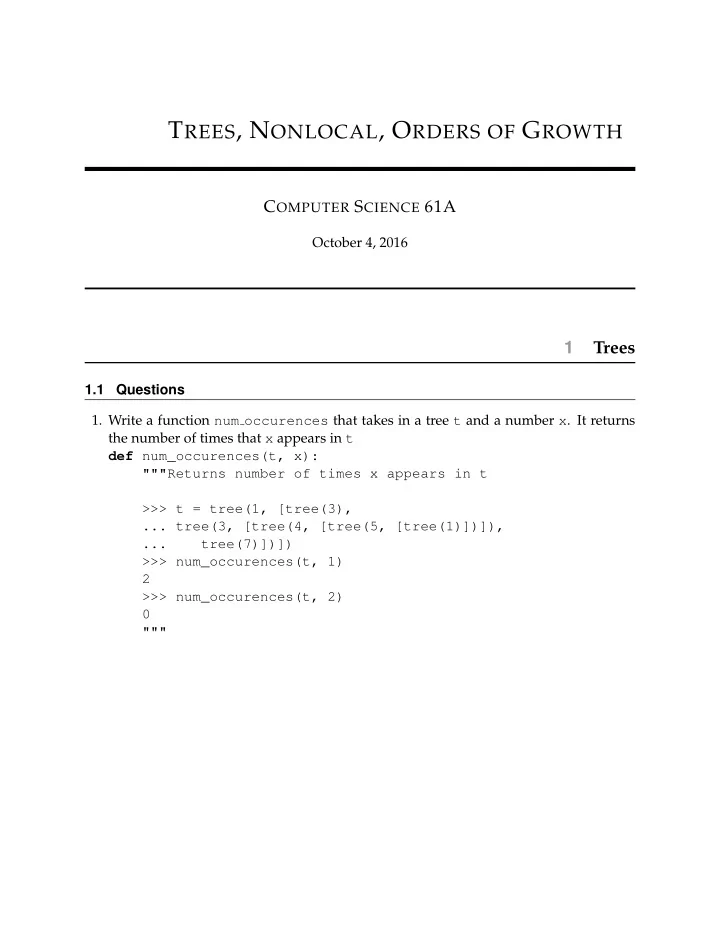
T REES , N ONLOCAL , O RDERS OF G ROWTH C OMPUTER S CIENCE 61A October 4, 2016 1 Trees 1.1 Questions 1. Write a function num occurences that takes in a tree t and a number x . It returns the number of times that x appears in t def


slide-1
SLIDE 1

TREES, NONLOCAL, ORDERS OF GROWTH

COMPUTER SCIENCE 61A

October 4, 2016

1 Trees

1.1 Questions

  • 1. Write a function num occurences that takes in a tree t and a number x. It returns

the number of times that x appears in t def num_occurences(t, x): """Returns number of times x appears in t >>> t = tree(1, [tree(3), ... tree(3, [tree(4, [tree(5, [tree(1)])]), ... tree(7)])]) >>> num_occurences(t, 1) 2 >>> num_occurences(t, 2) """

slide-2
SLIDE 2

DISCUSSION : TREES, NONLOCAL, ORDERS OF GROWTH Page 2

  • 2. Write a function has path that takes in a tree t and a string word. It returns True if

there is a path that starts from the root where the entries along the path spell out the word, and False otherwise. def has_path(t, word): """Return whether there is a path in a tree where the entries along the path spell out a particular word. >>> greetings = tree('h', [tree('i'), ... tree('e', [tree('l', [tree('l', [tree('o')])]), ... tree('y')])]) >>> print_tree(greetings) h i e l l

  • y

>>> has_path(greetings, 'h') True >>> has_path(greetings, 'i') False >>> has_path(greetings, 'hi') True >>> has_path(greetings, 'hello') True >>> has_path(greetings, 'hey') True >>> has_path(greetings, 'bye') False """

CS 61A Fall 2016

slide-3
SLIDE 3

DISCUSSION : TREES, NONLOCAL, ORDERS OF GROWTH Page 3

  • 3. In the first week of class, we learned that expressions like mul(sub(4, 5), add(2,

3)) can be represented as expression trees. In this problem we use our tree abstract data structure to further explore this idea. Write a function evaluate, which takes a binary expression tree, exp and returns what that expression would evaluate to. You may assume that all operators will take exactly 2 arguments, and that nodes always have either 0 or 2 children (never 1). def evaluate(exp): """Evaluates exp, which is an expression tree. >>> from operator import add, sub, mul >>> exp = tree(3) # 3 >>> evaluate(exp) 3 >>> exp = tree(add, [tree(3), tree(4)]) # add(3, 4) >>> evaluate(exp) 7 >>> exp = tree(mul, [tree(add, [tree(3), tree(5)]), tree(sub, [tree(5), tree(2)])]) # mul(add(3, 5), sub(5, 2)) >>> evaluate(exp) 24 """

CS 61A Fall 2016

slide-4
SLIDE 4

DISCUSSION : TREES, NONLOCAL, ORDERS OF GROWTH Page 4

2 Nonlocal

2.1 Questions

  • 1. Draw the environment diagram for the code below:

def sum(lst): total = 0 def help(you): nonlocal total total += lst[you] lst[you] = total - lst[you] me = 0 while me < len(lst): help(me) me += 1 return total a = sum([6, 1])

CS 61A Fall 2016

slide-5
SLIDE 5

DISCUSSION : TREES, NONLOCAL, ORDERS OF GROWTH Page 5

  • 2. Draw the environment diagram for the code below:

breakfast = 'waffles' def saturday(morning): def breakfast(cereal): nonlocal breakfast breakfast = cereal breakfast(morning) return breakfast saturday(lambda morning: breakfast)('cereal')

CS 61A Fall 2016

slide-6
SLIDE 6

DISCUSSION : TREES, NONLOCAL, ORDERS OF GROWTH Page 6

3 Orders of Growth

3.1 Questions

  • 1. What is the order of growth for a call to fizzle(n)?

def fizzle(n): if n <= 0: return n elif n % 23 == 0: return n return fizzle(n - 1)

  • 2. What is the order of growth for a call to explode(n)?

def boom(n): if n == 0: return "BOOM!" return boom(n - 1) def explode(n): if n == 0: return boom(n) i = 0 while i < n: boom(n) i += 1 return boom(n)

  • 3. What is the order of growth for a call to dreams(n)?

def dreams(n): if n <= 0: return n if n > 0: return n + dreams(n // 2)

CS 61A Fall 2016