2 Stage Ditch Demonstration Site Improving the function of - - PowerPoint PPT Presentation

2 stage ditch
SMART_READER_LITE
LIVE PREVIEW

2 Stage Ditch Demonstration Site Improving the function of - - PowerPoint PPT Presentation

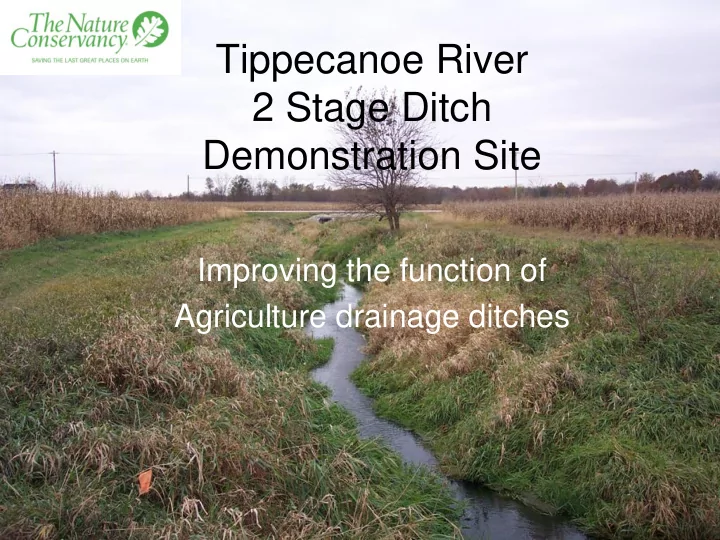
Tippecanoe River 2 Stage Ditch Demonstration Site Improving the function of Agriculture drainage ditches Received a IDEM 319 Grant to implement a 2 Stage Ditch The Nature Conservancy supplemented additional dollars to the project.


slide-1
SLIDE 1

Tippecanoe River 2 Stage Ditch Demonstration Site

Improving the function of Agriculture drainage ditches

slide-2
SLIDE 2
  • Received a IDEM 319 Grant to implement a 2 Stage

Ditch

  • The Nature Conservancy supplemented additional

dollars to the project.

  • County Surveyor (Dick Kemper) and NRCS District

Conservationist (Sam St. Clair) selected 5 potential ditches and it was narrowed down to the Shatto. Selection criteria was flow rate of the ditch, visibility, cooperative landowners, amount of woody species present, soil types and landuse.

  • US Army Core granted permission to implement the

practice.

  • Received approval from the County Drainage Board

and all affected landowners

  • Hired monitoring contractors and bid out the

excavation work.

slide-3
SLIDE 3

Channel Evolution

slide-4
SLIDE 4

Two-Stage Ditch Design

Benches a Minimum of 2X Channel width, with 3 or 4 times being more desired

slide-5
SLIDE 5

2 Stage Ditch

Example

  • Benches on both sides = 10-14ft wide
  • 5-6 foot wide channel width
slide-6
SLIDE 6

Current sampling design

  • Every other month we measure

– habitat cover – Transient storage – Denitrification

  • Daily measurements include

– Dissolved O2 – Specific conductivity – Temperature – Turbidity – pH

  • Fish and invertebrate sampling once a year
slide-7
SLIDE 7

Biological Response

  • Improvement of invertebrate community

diversity in the treatment reach of ditch

  • Fish assemblages have increased in

sensitivity, the treatment stretch is now holding more intolerant fishes.

  • Habitat is beginning to diversify– riffle/pool
  • Control still has no noticeable change
slide-8
SLIDE 8

Monitoring Conclusions

  • 105,000 pounds of sediment removed from

treatment reach each year.

  • 350% increase in denitrification potential
  • Isopods in 2 Stage Ditch segment went from

87% to 38% control section 79% to 58%

  • Sunfish species went from 1 to 4 species pre to

post construction, control stayed at 1 specie

  • Total suspended solids (TSS) - control increased

4%, decreased 49% in treatment reach

slide-9
SLIDE 9

Updates

  • Total reach N removal increases with 2 Stage

Construction

  • % of N removal is the most when loads are the

lowest – most effective when coupled with other strategies such as nutrient management.

Date

Sep 06 Nov 06 Feb 07 Apr 07 Jun 07 Aug 07 Oct 07 Dec 07 Feb 08 Apr 08 Jun 08 Aug 08 Oct 08 Dec 08

Total N Removal (g N/day)

200 400 600 800 1000 1200 1400 1600 1800 Sand Removal FBOM Removal Bench Removal

slide-10
SLIDE 10

Before Construction

slide-11
SLIDE 11

After Construction – Nov. 2007

slide-12
SLIDE 12

Just after the first of the year we had 2 bank full events – Jan/Feb 2008

slide-13
SLIDE 13

2-Stage Ditch Costs

  • Typical cost of 2-stage Construction

– $8 - $ 12 per linear foot

  • Factors that affect your cost of Installation
  • 1. Depth of the ditch (top of bank to waterline)
  • 2. Width of ditch channel (and benches)
  • 3. Amount of natural benches already starting

to form

  • 4. Absence of adequate area to spread spoil
  • 5. Number of tile outlets to be addressed
slide-14
SLIDE 14

Breakdown of Project costs

slide-15
SLIDE 15

Expected Payback Period

Two-Stage Costs $39,932 Two-Stage Construction Cost ($) 4,000 Project Length (feet) 30.0 Maintenance Frequency (yrs) $3.00 Maintenance Cost ($ per linear foot) Traditional Maintenance 5 Maintenance Frequency (yrs) $3.00 Maintenance Cost ($ per linear foot)

The payback period is 14 years

14.0 $0 $50,000 $100,000 $150,000 $200,000 $250,000 $300,000 10 20 30 40 50 60 70 80 90 100 Cost ($) Years

Two-Stage Trapezoidal

Solve

slide-16
SLIDE 16

Implemented and Planned Projects

slide-17
SLIDE 17

Closing Thoughts

  • When managed for water quality,

headwater streams and ditches have tremendous potential to improve downstream health of rivers.

  • Many times ditches do not need

maintenance performed but are viewed as functioning poorly because they “look bad”

  • As stream (ditch) habitat improves, fish

and invertebrate communities improve.

  • Presence of vegetation is more essential

than actual species type