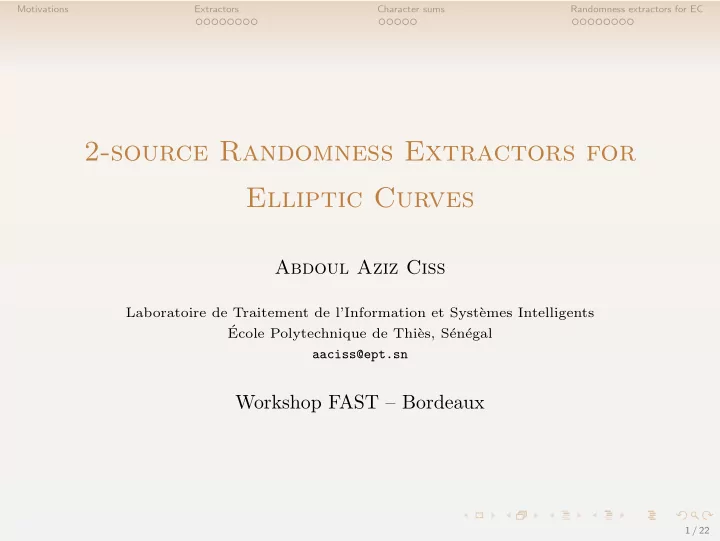
2-source Randomness Extractors for Elliptic Curves Abdoul Aziz Ciss - - PowerPoint PPT Presentation

2 source randomness extractors for elliptic curves
SMART_READER_LITE
LIVE PREVIEW

2-source Randomness Extractors for Elliptic Curves Abdoul Aziz Ciss - - PowerPoint PPT Presentation

Motivations Extractors Character sums Randomness extractors for EC 2-source Randomness Extractors for Elliptic Curves Abdoul Aziz Ciss Laboratoire de Traitement de lInformation et Syst` emes Intelligents Ecole Polytechnique de Thi`


slide-1
SLIDE 1

Motivations Extractors Character sums Randomness extractors for EC

2-source Randomness Extractors for Elliptic Curves

Abdoul Aziz Ciss

Laboratoire de Traitement de l’Information et Syst` emes Intelligents ´ Ecole Polytechnique de Thi` es, S´ en´ egal aaciss@ept.sn

Workshop FAST – Bordeaux

1 / 22

slide-2
SLIDE 2

Motivations Extractors Character sums Randomness extractors for EC

Randomness Extractors

Definition

A randomness extractor for a group G is a function which converts a random element of G into a uniformly random bit-string of fixed length.

Applications

  • Key derivation
  • Encryption, signatures
  • Construction of cryptographically secure pseudorandom numbers

generator

  • Error correcting codes

2 / 22

slide-3
SLIDE 3

Motivations Extractors Character sums Randomness extractors for EC

Statistical distance

Let X and Y be S-valued random variables, where S is a finite set. The statistical distance ∆(X, Y ) between X and Y is ∆(X, Y ) = 1

2

  • s∈S

|Pr[X = s] − Pr[Y = s]| Let US be a random variable uniformly distributed on S. Then a random variable X on S is said to be ε-uniform if ∆(X, US) ≤ ε

3 / 22

slide-4
SLIDE 4

Motivations Extractors Character sums Randomness extractors for EC

Extractor

Let S and T be two finite sets. A (T, ε)-extractor is a function Ext : S − → T such that for every distribution X on S, the distribution Ext(X) is ε-close to the uniform distribution on T. That is ∆(Ext(X), UT ) ≤ ε, where UT is the uniform distribution on T

4 / 22

slide-5
SLIDE 5

Motivations Extractors Character sums Randomness extractors for EC

Two-source extractor

Let R, S and T be finite sets. The function Ext : R × S − → T is a two-source extractor if the distribution Ext(X1, X2) is ε-close to the uniform distribution UT for every uniformly distributed random variables X1 in R and X2 in S. That is, ∆(Ext(X1, X2), UT ) ≤ ε,

5 / 22

slide-6
SLIDE 6

Motivations Extractors Character sums Randomness extractors for EC

Collision probability

Let S be a finite set and X be an S-valued random variable. The collision probability of X, denoted by Col(X), is the probability Col(X) =

  • s∈S

Pr[X = s]2 If X and X′ are identically distributed random variables on S, the collision probability of X is interpreted as Col(X) = Pr[X = X′]

6 / 22

slide-7
SLIDE 7

Motivations Extractors Character sums Randomness extractors for EC

Collision probability

Lemma

Let S be a finite set and let (αx)x∈S be a sequence of real numbers. Then, (

x∈S |αx|)2

|S| ≤

  • x∈S

α2

x.

(1) This inequality is a direct consequence of Cauchy-Schwarz inequality:

  • x∈S

|αx| =

  • x∈S

|αx|.1 ≤

  • x∈S

α2

x

  • x∈S

12 ≤

  • |S|
  • x∈S

α2

x.

If X is an S-valued random variable and if we consider that αx = Pr[X = x], then 1 |S| ≤ Col(X), (2)

7 / 22

slide-8
SLIDE 8

Motivations Extractors Character sums Randomness extractors for EC

Relation btw ∆ and Col

Lemma

Let X be a random variable over a finite S of size |S| and δ = ∆(X, US) be the statistical distance between X and US, the uniformly distributed random variable over S. Then, Col(X) ≥ 1 + 4δ2 |S|

8 / 22

slide-9
SLIDE 9

Motivations Extractors Character sums Randomness extractors for EC

Relation btw ∆ and Col

Proof. If δ = 0, then the result is an easy consequence of Equation 2. Let suppose that δ = 0 and define qx = |Pr[X = x] − 1/|S||/2δ. Then

x qx = 1 and by Equation 1, we have

1 |S| ≤

  • x∈S

q2

x =

  • x∈S

(Pr[X = x] − 1/|S|)2 4δ2 = 1 4δ2

  • x∈S

Pr[X = x]2 − 1/|S|

1 4δ2 (Col(X) − 1/|S|). The lemma can be deduced easily.

9 / 22

slide-10
SLIDE 10

Motivations Extractors Character sums Randomness extractors for EC

Character sums

Definition

Let G be a commutative group. A character χ of G is a homomorphism χ : G − → C∗. ˆ G = Hom(G, C∗) is a multiplicative group with neutral element χ0, the character defined by χ0(x) = 1, ∀ x ∈ G. If G is a cyclic group of order r, then χ(x)r = χ(xr) = χ(1) = 1. If x ∈ G, then χ(x) ∈ µr, the subgroup of C∗ of rth of unity.

10 / 22

slide-11
SLIDE 11

Motivations Extractors Character sums Randomness extractors for EC

Character sums

If χ ∈ ˆ G, then the inverse of χ in ˆ G is the conjugate character ¯ χ of χ defined by ¯ χ(x) = χ(x)

Proposition

Let K = Fq, with q = pn and let F be an n-variables polynomial with coefficients in K. If ϕ is a non-trivial additive character of K, then the number of solution of the equation F = 0 is given by N = q−1

y,x

yϕ(F(x1, x2, . . . , xn)), where the summation is extended to all points (y, x1, . . . , xn) of Kn+1

11 / 22

slide-12
SLIDE 12

Motivations Extractors Character sums Randomness extractors for EC

Character sums over prime fields

Let ep be the character on Fp such that, for all x ∈ Fp ep(x) = e

2iπx p

∈ C∗. Let S(a, G) =

  • x∈G

ep(ax), then M = max

a (|S(a, G)|) ≤ √p.

If I is an interval of integers, it’s well known that

  • x∈F∗

p

  • a∈I

ep(ax)

  • ≤ p log2(p).

12 / 22

slide-13
SLIDE 13

Motivations Extractors Character sums Randomness extractors for EC

Character sums over Fq

We denote by ψ the additive character in Fq such that for all z ∈ Fq, ψ(z) = ep(Tr(x)). Let G be a subgroup of Fq and let introduce the following Gauss sum T(a, G) =

  • x∈G

ψ(ax). Then, max

a∈F∗

q

|T(a, G)| ≤ q1/2. If V is an additive subgroup of Fq and if ψ is an additive character of Fq, then,

  • y∈Fq
  • z∈V

ψ(yz)

  • ≤ q.

13 / 22

slide-14
SLIDE 14

Motivations Extractors Character sums Randomness extractors for EC

Character sums over elliptic curves

Let E be an elliptic curve defined over Fq. For a point P = O on E we write P = (x(P), y(P)). Let ψ be a nonprincipal additive character

  • f Fq and let P and Q be two subsets of E(Fq). For arbitrary complex

functions ρ(P) and ϑ(Q) supported on P and Q we consider the bilinear sums of additive type: Vρ,ϑ(ψ, P, Q) =

  • P ∈P
  • Q∈Q

ρ(P)ϑ(Q)ψ(x(P ⊕ Q)). Let

  • P ∈P

|ρ(P)|2 ≤ R and

  • Q∈Q

|ϑ(Q)|2 ≤ T. Then, uniformly over all nontrivial additive character ψ of Fq, |Vρ,ϑ(ψ, P, Q)| ≪

  • qRT.

14 / 22

slide-15
SLIDE 15

Motivations Extractors Character sums Randomness extractors for EC

2-source randomness extractors for E(Fp)

Definition

Let E be an elliptic curve defined a finite field Fq, with q = p a prime greater than 5, and let P and Q be two subgroups of E(Fq) with #P = r and #Q = t. Define the function Ext1 : P × Q − → {0, 1}k (P, Q) − → lsbk(x(P ⊕ Q))

15 / 22

slide-16
SLIDE 16

Motivations Extractors Character sums Randomness extractors for EC

2-source randomness extractors for E(Fp)

Theorem

Let E be an elliptic curve defined over Fp and let P and Q be two subgroups of E(Fp), with #P = r and #Q = t. Let UP and UQ be two random variables uniformly distributed in P and Q respectively and let Uk be the uniform distribution in {0, 1}k. Then, ∆(Ext1(UP, UQ), Uk) ≪

  • 2k−1p log(p)

rt

16 / 22

slide-17
SLIDE 17

Motivations Extractors Character sums Randomness extractors for EC

2-source randomness extractors for E(Fp)

Corollary

Let m and l be the bit size of r and t respectively and let e be a positive integer. If k is a positive integer such that k ≤ m + l − (n + 2e + log2(n) + 1), then Ext1 is a (k, O(2−e))-deterministic extractor for P × Q.

17 / 22

slide-18
SLIDE 18

Motivations Extractors Character sums Randomness extractors for EC

Application to the Unified Model KE

Symetric key size Bit size of p Bit size of #P : |m|2 |k|2 = 64 : DES-64 521 378 384 309 256 245 |k|2 = 128 : AES-128 521 410 384 340 |k|2 = 256 : AES-256 521 474 Table: Parameters for Ext1(Ze, Zs) at the 80-bit security level

18 / 22

slide-19
SLIDE 19

Motivations Extractors Character sums Randomness extractors for EC

2-source randomness extractors for E(Fpn), with p > 5

Definition

Let E be an elliptic curve defined over the finite field Fpn, where p is a prime greater than 5 and n > 1. Consider two subgroups P and Q

  • f E(Fq). Define the function

Ext2 : P × Q − → Fk

p

(P, Q) − → (x1, x2, . . . , xk) where x(P ⊕ Q) = (x1, x2, . . . , xk, xk+1, . . . , xn). In other words, the function Ext2 output the k first Fp-coefficients of the abscissa of the point P ⊕ Q.

19 / 22

slide-20
SLIDE 20

Motivations Extractors Character sums Randomness extractors for EC

2-source randomness extractors for E(Fpn), with p > 5

Theorem

Let E be an elliptic curve defined over Fpn and let P and Q be two subgroup of E(Fpn) with #P = r and #Q = t. Denote by UP and UQ two random variables uniformly distributed on P and Q respectively. Then, ∆(Ext2(UP, UQ), UFk

p) ≪

  • pn+k

4rt

20 / 22

slide-21
SLIDE 21

Motivations Extractors Character sums Randomness extractors for EC

Future work

  • 1. Generalization of Ext1 and Ext2

Ext1 : P1 × P2 × . . . × Ps − → {0, 1}k (P1, P2, . . . , Ps) − → lsbk(x(P1 ⊕ P2 ⊕ . . . ⊕ Ps)) Ext2 : P1 × P2 × . . . × Ps − → Fk

p

(P1, P2, . . . , Ps) − → Dk(x(P1 ⊕ P2 ⊕ . . . ⊕ Ps))

  • 2. Construct good pseudorandom number generators with Ext1 and

Ext2

21 / 22

slide-22
SLIDE 22

Motivations Extractors Character sums Randomness extractors for EC

Thank you for your attention

22 / 22