2 8/4/2020 P IEDMONT Means At the foot of the Mountain Esteemed - - PDF document

2
SMART_READER_LITE
LIVE PREVIEW

2 8/4/2020 P IEDMONT Means At the foot of the Mountain Esteemed - - PDF document

8/4/2020 ITALY I T ALY SWE 2020 P IEDMONT VS T USCANY 1 ITALY I TALIAN W INE F ACTS Wine has been produced in Italy for over 4,000 years Ancient Greeks dubbed it Enotria - land of wine Romans propagated the cult of Bacchus -


slide-1
SLIDE 1

8/4/2020 1

ITALY

ITALY

SWE 2020 PIEDMONT VS TUSCANY

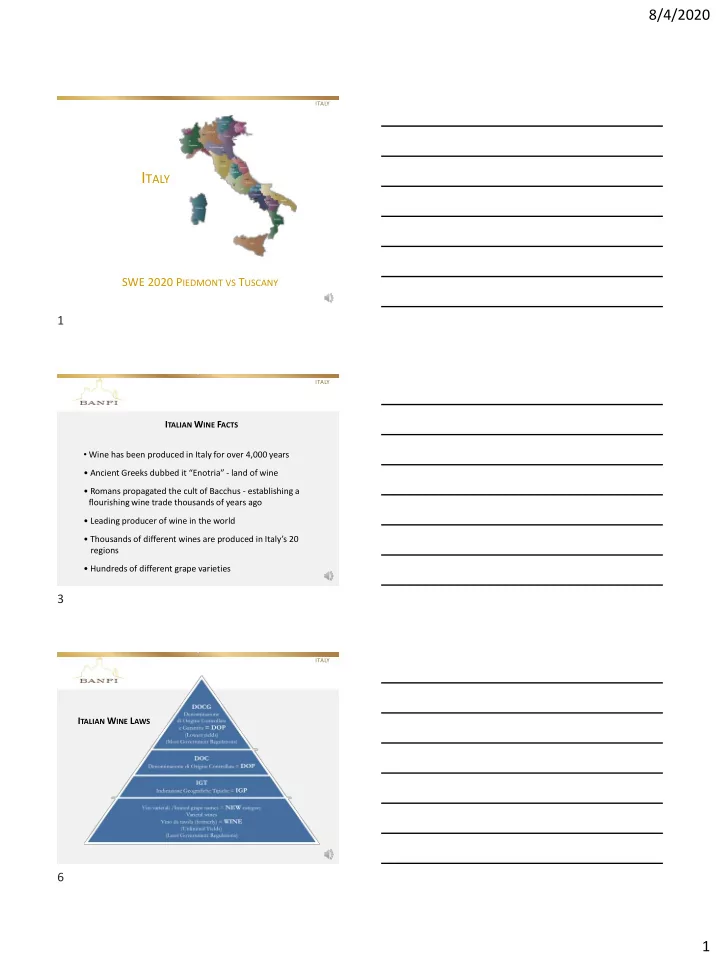
  • Wine has been produced in Italy for over 4,000 years
  • Ancient Greeks dubbed it “Enotria” - land of wine
  • Romans propagated the cult of Bacchus - establishing a

flourishing wine trade thousands of years ago

  • Leading producer of wine in the world
  • Thousands of different wines are produced in Italy’s 20

regions

  • Hundreds of different grape varieties

ITALIAN WINE FACTS

ITALY

ITALIAN WINE LAWS

ITALY

1 3 6

slide-2
SLIDE 2

8/4/2020 2

  • Grape Variety - Lambrusco, Sangiovese, Trebbiano, etc. Usually in

conjunction with an IGT or DOC

  • Area/Zone of Production - Barolo, Chianti, Gavi, Valpolicella, etc.
  • Grape Variety and Area/Zone - Brunello di Montalcino, Vernaccia

di San Gimignano, Brachetto d’Acqui, etc.

  • Fantasy /Proprietary Names - Excelsus, Sassicaia, Summus,

Tignanello, etc. Usually designated as part of an IGT or DOC

HOW ITALIAN WINES ARE NAMED…

ITALY

ITALIAN WINE TERMS

  • AMABILE - semi- sweet, off-dry
  • AMARO - bitter
  • AMARONE - means “bitter” as in Amarone della

Valpolicella to differentiate from the sweet dessert recioto wines

  • ANNATA - vintage year
  • BARRIQUE - small barrel
  • BIANCO - white
  • BOTTIGLIA - bottle
  • BOTTE - large cask or barrel
  • BRUT - dry (sparkling wine)
  • CANTINA - winery or wine cellar
  • CASTELLO - castle
  • CHIARETTO - pale red (rose’)
  • CLASSICO - historic or "classic" growing area of a specific

zone

  • COLLI - hills
  • CONSORZIO - group of producers of a specific wine
  • DOLCE - sweet
  • ENOTECA - wine library, public or commercial
  • FRIZZANTE - lightly sparkling
  • PASSITO - wine made from semi-dried grapes
  • POGGIO - hill.
  • RECIOTO - full tasting, sweet wine made from partly dried grapes
  • RISERVA - wine which has been aged a longer, specified time than

non-Riserva counterpart. Applies to DOC and DOCG

  • ROSATO - rose’
  • ROSSO - red wine
  • SECCO - dry
  • SPUMANTE - sparkling wine, dry or sweet
  • SUPERIORE - in DOC wines this indicates a higher level of alcohol or

ageing and sometimes a special geographic origin

  • VIVACE - synonym for frizzante

ITALY

PIEDMONT

Banfi Brut Cuvée Aurora Rosé La Lus L’Ardì Dolcetto d’Acqui Rosa Regale Principessa Gavia Gavi

7 9 13

slide-3
SLIDE 3

8/4/2020 3

PIEDMONT

▪ Means “At the foot of the Mountain” ▪ Esteemed for great reds made from the Nebbiolo grape (also called Spanna) ▪ Barbera is most widely planted red ▪ Moscato is the most widely planted white ▪ 17 DOCG’s - Barolo, Barbaresco, Gattinara, Ghemme, Moscato d’Asti/Asti, Gavi, Brachetto d’Acqui, Roero (Arneis and Nebbiolo, Dolcetto di Dogliani Superiore, Barbera d’Asti, Barbera del Monferrato Superiore, Dolcetto d’Ovada Superiore, Erbaluce di Caluso, Ruche’ di Castagnole Monferrato, Dolcetto di Diano d’Alba, Alta Langa, Nizza

In 1979, John and Harry Mariani, acquired a mid-19th century winery, known as Bruzzone, revitalized it and renamed the facility Banfi Piedmont. Here, with the same detailed care as a century ago, our skilled winemakers produce Gavi, Dolcetto and Barbera as well as exceptional sparkling wines: Cuvee Aurora Rose, Banfi Brut Metodo Tradizionale Classico, and “Rosa Regale” Brachetto d’Acqui D.O.C.G., from the La Rosa single vineyard. The rare Brachetto, a semi-dry, red sparkling wine cherished by the Courts of Europe two centuries ago, owes its reincarnation to Banfi.

ITALY

  • The Banfi name comes from the aunt of Giovanni F. Mariani Sr.,

Teodolinda Banfi: she was the head of household for Pope Pius XI and was a connoisseur of fine wine. She influenced and inspired her nephew Giovanni F. Mariani Sr. with her passion.

  • In 1919, in New York, Giovanni F. Mariani Sr. founded a small

company to import the wines of Italy, calling it Banfi in honor of his aunt and mother.

  • It was Giovanni’s two sons, John and Harry, who expanded

Banfi Vintners, and founded the Castello Banfi vineyard estate in Montalcino.

  • Today, Banfi is led by the founder’s granddaughter Cristina Mariani-

May, who is president and CEO. Her father, Chairman Emeritus Dr. John F. Mariani, continues as active counsel to the executive committee and is a member of the firm’s advisory board.

INTRODUCTION

3 Generations – Family Owned and Operated

14 17 18
slide-4
SLIDE 4

8/4/2020 4

3rd Generation Family Proprietor, President and CEO, Cristina Mariani-May Drinks Business 2018 Woman of the Year!

WOMAN OF THE YEAR

19 20 21

slide-5
SLIDE 5

8/4/2020 5

  • Gavi/Cortese di Gavi DOCG is a white wine that must be produced with 100% Cortese grapes

grown in the province of Alessandria. Still, sparkling and Riserva (aged at least until 14 October of the year following harvest) are produced.

  • CORTESE as a variety is said to be extremely ancient, yet evidence of its existence was first

noted in 1798 by the Agrarian Society of Turin. Count Nuvolone wrote of Cortese that the variety has “rather elongated clusters and somewhat large grapes. When they are ripe, they become yellow and are good to eat. They make good wine and in substantial quantity. And it keeps well.” Cortese’s, whimsical name may refer to the fact that the wine can be supple, subtle or almost “courteous” on the palate.

  • Gavi takes its name from the town around which the Cortese grape grows to perfection. By

law Gavi may not be fermented or aged in wood.

  • Gavi or Cortese di Gavi may be produced in still, frizzante, spumante, Riserva and Riserva

Spumante versions. DOC in 1974, DOCG in 1998. Gavi Riserva is required to age until November 1 of year following harvest. Gavi Spumente Metodo Classico requires minimum of 2 years of ageing (October 15) with at least 18 months on the lees.

  • Legend

GAVI

22 23 24

slide-6
SLIDE 6

8/4/2020 6

TUSCANY OR TOSCANA

ITALY

  • Tuscany takes its name from the Etruscans
  • Soils were formed millions of years ago leaving rich marine sediments
  • Ideal climate
  • Chianti most famous of Tuscan wines
  • Brunello the greatest
  • Super Tuscans a category (with no official status) created in the 80’s

and 90’s - includes both reds and whites

  • DOCG’s – Brunello, Chianti, Chianti Classico, Vino Nobile, Carmignano

Rosso, Morellino di Scansano, Vernaccia di San Gimignano, Elba Aleatico Passito, Montecucco Sangiovese, Suvereto, Val di Cornia Rosso

TUSCANY OR TOSCANA

ITALY

26 27 28

slide-7
SLIDE 7

8/4/2020 7

Castello Banfi is a family-owned vineyard estate and winery located in the Brunello region of

  • Tuscany. This award-winning estate was founded on the philosophy of blending tradition with

innovation, and is recognized as a pioneer in elevating the standards of Italian winemaking. Dedication to excellence has won the approval of aficionados the world over. Capturing honor after prestigious honor, Castello Banfi is a constellation of single vineyards encompassing over three dozen varying subsoils. The estate is renowned for its clonal research that allows noble grape varieties to thrive in their optimal terroir, creating not only a consistently outstanding Brunello, but the ultimate expression of Montalcino Super Tuscans.

ITALY

VERMENTINO

  • VERMENTINO was originally said to have been brought to the island of Corsica in the 13th or 14th

century but it was mentioned in Piemonte in 1658 as fermentino. Some scholars say the name Vermentino from the word vermene, a local dialect word describing a young, flexible shoot. However, it is likely based on fermentino, referring to the fizzy character of young wine.

  • Vermentino today in Piemonte, is known as Favorita, the favorite one. It is called Pigato in

Liguria after its “pigmented” skin…at harvest the grape develops freckles or measles which don’t interfere with the taste but the skin is definitely “pigmented or Pigato”.

  • While it was originally thought that Vermentino was introduced from Spain to Sardegna and

Corsiica between the 14th and 17th centuries, though the grape variety has never been found in Spain and DNA finds no connection with Spain.

30 31 32

slide-8
SLIDE 8

8/4/2020 8

34 35 36

slide-9
SLIDE 9

8/4/2020 9

37 38 39

slide-10
SLIDE 10

8/4/2020 10

ITALY

  • L’Ardi is produced with the Dolcetto grape from Acqui Terme (an old Roman spa

where people today go to enjoy the thermal waters or acqui terme)

  • Dolcetto – little sweet one – early maturing. Birds loved the sweetness, left the

noble Nebbiolo alone. Many years ago, Dolcetto was considered a throwaway grape – planted among the rows of Nebbiolo

  • Dolcetto belies its name as it produces not a sweet wine but one that is dry
  • L’Ardi – Piemontese dialect for a young man who is handsome, bright and brave
  • Stainless steel fermentation and ageing, no wood
  • L’Ardi is a quaffable red with a lively, juicy, fresh and fruity red with a hint of

marasca (sour) cherry, plum and raspberry. The wine has a lovely vein of acidity, soft tannins and a persistent finish.

  • L’Ardi is ideal with just about everything. In fact, in the middle of summer, chill it

for 15 minutes and it is perfect with sandwiches, grilled planked salmon, pork and poultry. Also superb with burgers and barbecue!

L'ARDI DOLCETTO d'ACQUI Rollicking red!

SANGIOVESE

ITALY

41 42 43

slide-11
SLIDE 11

8/4/2020 11

SANGIOVESE

  • Sangiovese, clearly a native, is the most widely planted of Italy's red grape varietals and is of

particular interest in Emilia Romagna, Tuscany, the Marches and Umbria. Some suggest that the grape may have even originated in Tuscany in the 12 or 1300’s when it may have been known by the name Sangiogheto.

  • Sangioveto or Sangiogheto is a word that has created much confusion and argument. Some

say that Sangioveto is a synonym for the Sangiovese of Chianti, still others insist that it is the "original" Sangiovese varietal of Montalcino.

  • Over 650 clones of Sangiovese have been identified in the Tuscany alone, approximately 15
  • f which have been studied and registered by Castello Banfi (the only winery to undertake

such a project).

  • Sangiovese is used in the production of Brunello di Montalcino, Chianti, Chianti Classico,

Vino Nobile di Montepulciano, Carmignano, Morellino di Scansano , Sangiovese di Romagna, Rosso Conero, among others.

  • It was believed (before DNA studies) that the Sangiovese of Chianti was a small berried, thin-

skinned grape while that of Montalcino (and Montepulciano and Scansano) was a larger, thicker skinned berry. This information has been proven false. In fact, the exact same clones when planted in these different zones (due to terroir, et al) produce significantly different wines. ITALY

CHI

HIAN ANTI, DOCG* Chianti Zones

  • Montespertoli -
  • Colline Pisane – (Pisa Hills)
  • Colli Fiorentini – (Florentine Hills)
  • Colli Aretini – (Arezzo Hills)
  • Rufina
  • Montalbano
  • Colli Senesi – (Siena Hills)
  • DOCG

* Chianti and Chianti Classico are two completely separate and distinct DOCG’s

Chianti - large light green area on map, may NOT use grapes from Classico

ITALY Chianti Classico

  • 12%
  • Can be released 1 October of the year after

harvest Chianti Classico Riserva

  • 12.5%
  • Requires two plus years of age.

Gran Selezione is a new classification. It requires at least 30 months of ageing.

  • Chianti and Chianti Classico are two completely separate and distinct DOCG’s

Chianti Classico - Small dark green area on map – Original/historic growing area )

Chianti Classico, DOCG

ITALY

44 48 49

slide-12
SLIDE 12

8/4/2020 12

▪ CHIANTI

  • 11.5%
  • Can be released 1 March of year following harvest

▪ CHIANTI SUPERIORE

  • 12%
  • Can be released 1 September of year after harvest

▪ CHIANTI RISERVA/CLASSICO RISERVA

  • Chianti Riserva 12%, Chianti Riserva with Subzone and

Chianti Classico Riserva 12.5%

  • Requires two plus years of age.

▪ GRAN SELEZIONE ▪ Requires 30 months of ageing and grapes grown on a single estate

ITALY

50 54 55

slide-13
SLIDE 13

8/4/2020 13

BANFI CELLARS - STREVI

BARBERA is the most widely planted of all Piemontese vines and likely an ancient varietal. However, little is known of the variety’s history before the 18th century. It was first

  • fficially mentioned by Count Nuvolone, head of the Agrarian Society when he listed the

grapes grown in Piedmont in 1798 and described it as “an imposing wine that is always rather severe but richly and exquisitely perfumed and with a flavor that couples strength and finesse.” “Il” or rather “La” Barbera as is Piemontese tradition is appreciated throughout Italy. Some, however, suggest that praise for this wine dated to 663 when Paul the Deacon in his account of the Battle of Refrancore wrote that the Longobards defeated the Franks after getting them drunk on wines from local cellars. He said the Longobards filled amphora with wine and scattered the containers throughout the fields. This jugs caught the attentionof the Franksand they happily quaffed the wine to defeat! Famous for its capacity to create warmth and engender vigor, Barbera was hailed by the

  • fficers of the Savoyard army as a “sincere companion.” For it was said to promote “level

headedness in the field of battle.” Piemontese drink more red than white and about half that red is Barbera. Some Barberas are well aged but this wine can also be very attractive in its lively,youthful fruity and lightly sparklingversion.

BARBERA

Racy Red!

56 57 59

slide-14
SLIDE 14

8/4/2020 14

Bolgheri

60 61 62

slide-15
SLIDE 15

8/4/2020 15

CABERNET Cabernet Franc/Cabernet Sauvignon

  • Vines in the Cabernet-Merlot family were known to the ancient Romans as Biturica after a

tribe in France's Gironde. It isn't clear whether they remained in Italy afterwards, but what was known in eighteenth-century Tuscany as uva francesca was probably a Cabernet. In the nineteenth century, vines were planted in much of Italy, though after phylloxera they remained mainly in the northeast where the productive Cabernet Franc was favored.

  • Today Cabernet Sauvignon is often preferred in the northeast and other regions for distinctive

varietal wines and used in Bordeaux blends with Merlot and Malbec, was well as with native varieties, notably Sangiovese in Tuscany. "Cabernet" on an Italian wine label usually means that the wine is a blend of Cabernet Franc and Sauvignon, usually more of the former than the latter.

  • Cabernet Franc is the most widely planted of the Cabernet family of vines. It dominates the

Cabernet plantings in the Tre Venezie; it is also planted as in the south as well as in Lombardy, Emilia-Romagna and in Tuscany. Quite interesting is the fact that Cabernet Sauvignon is a crossing of Cabernet Franc and Sauvignon Blanc!

  • Cabernet Franc wines tend to be similar in aroma to those made from Cabernet Sauvignon but

with a more pronounced herbaceous or bell pepper character. The Franc wines are generally considered softer and rounder. ITALY

Cabernet Franc

  • Cabernet Sauvignon has been less popular in Italy possibly due to its lower yields and the fact

that its wines usually require more ageing. It is, however, becoming more popular as plantings increase in Tuscany, Piedmont and in other parts of the peninsula. As in Bordeaux, Cabernet Sauvignon is frequently blended with Cabernet Franc or Merlot, although it blends well with Sangiovese in Tuscany or added to the region's Chianti blend. Cabernet Sauvignon produces deeply colored wines that are often hard and tannic in their youth, requiring time to soften and round out. In aroma these wines frequently offer suggestions of green olives, cassis or black currants, or cedar.

  • In Italy Cabernet Sauvignon is planted throughout the northeast as well as in Emilia-Romagna,

Toscana and Umbria. Plantings are found throughout the peninsula and in Sicily and Sardinia. ITALY

CABERNET Cabernet Sauvignon

Cabernet Sauvignon

63 64 66

slide-16
SLIDE 16

8/4/2020 16

Marchesi di Barolo historical cellars are located in the town of Barolo, in the building overlooking the Castle of the Marquis Falletti. It is here that more than 200 years ago a beautiful story began. The story of a wine cellar where, in the heart of the Langhe area and protected by gentle hills, a wine was born. That wine was then called Barolo, in honor of the town where it was produced for the first time.

ITALY 1807 - No one at that time could imagine that it was destined one day to be king: the King of Wines, the Wine of the Kings. The story begins precisely in Paris, when the Marquis of Barolo Carlo Tancredi Falletti married Juliette Colbert de Maulévrier, a French noblewoman and the great granddaughter of the Sun King’s well-known Minister of Finance. Juliette saw the great potential of the wine made in Barolo that, after a complete fermentation and a long aging in wood, would have been able to unveil all the qualities typical of the soil and

  • f the grape variety: Nebbiolo, powerful and austere, able to last long and to express all the

characteristics of this extraordinary terroir. In 1864, Juliette’s death marked the end of the prestigious Falletti dynasty: in order to perpetuate the Marquise’s memory and charitable work, the Opera Pia Barolo was founded. This story was meant to cross path with the story of another family in Barolo: the Abbona family who had its own wine cellars “Cavalier Felice Abbona e Figli” next to the Castle of Marquis Falletti. ITALY

67 68 69

slide-17
SLIDE 17

8/4/2020 17

1929 Indeed, at around the same time Pietro Abbona was born. Thanks to his skill and tenacity, Pietro, together with his brother Ernesto and his sisters Marina and Celestina, was eventually able to acquire the ancient cellars of vinification and refinement of the Marchesi di Barolo estate from the Opera Pia Barolo. Today the Abbona Family continues the work that began more than two centuries ago: producing high quality wines meant to enrich, year after year, the history of this important cellar where modernity and tradition meet and where a great heritage of vineyards and knowledge has been passed down from parents to children for over five generations.

ITALY ITALY

NEBBIOLO

Pliny noted in his "Natural History that good wines were produced in the area of Alba and Pollentia (now Pollenzo - located west of Alba)." The fame of the wines of Pollentia spread to Rome and Romagna where amphorae containing these wines have been unearthed. In his writings, Pliny makes note of a vine he called allobrogica, a late-ripening and cold resistant black grape. This describes the Nebbiolo. A variety that bursts early and ripens late, the harvest taking place when the valleys are filled with morning mists, nebbia, from which the vines takes the name that it is commonly known by today…or the name could refer to the waxy bloom that covers ripe grapes. Earlier it was referred to as vitis vinifera pedomontana, later nubiolum. The late Renato Ratti, who did extensive research on the wines of Piemonte, noted references to the "nibiol" in documents from the 1200's. References exist in 1268 to the "nebbiolo" being cultivated in Piemonte. In 1340, reference is made to the nubiola as being a marvelously vinous variety that makes an excellent wine, very strong, one to keep. It was then as it is now, a highly regarded variety in 1511, the local statues of the commune of La Morra refer to the Nebbiolo as a "precious variety" and one to be particularly protected. There is also a popular legend that explains the origin of the name Nebbiolo. It concerns a monk who cultivated a small garden near the hut in which he lived. He also tended a small vineyard from which he

  • btained the little wine that he himself consumed. One morning, he found that the garden and vineyard were

hidden by thick fog. He saw in that phenomenon a sign that the Lord was angry with him and he therefore ceased cultivating the earth to dedicate himself entirely to prayer. When the period of the harvest arrived, the fog finally dissipated, revealing clusters of grapes, now ripe, that gleamed like gems in the sunlight. NEBBIOLO & SUB-VARIETALS Nebbiolo has different names depending upon zone of production. In Aosta and Torino it is known as PICOTENER or

  • r
  • PUGNET. In Novara - Vercelli it is called SPANNA. In the Valtellina it is known as CHI
  • HIAVANNESCA. In the Lange-Monferrato

it is the NEBBIOLO. The Cobiano and Corosso of Ghemme are believed to be clones of Nebbiolo as is the Prunent of Valvigezzo. Recognized among the clones are MICHE HET or

  • r MICOT (Piemontese dialect) is named for its small, compact form, which is

likened to a small loaf of bread, it is the most esteemed subvariety. It produces a small quantity of high quality fruit but fares best only in those areas with the most favorable soils and microclimates. LAMP MPIA has longer, more loosely composed clusters. This is the most widely planted subvariety. It has a greater production, of consistent quality. It wines are noted for their elegance and perfume. There is very little of the sub-variety RO ROSE' planted. It is similar in appearance to michet but generally produces a wine with less color and less body than the other two. (Though many years ago, Vietti from the Briacca vineyard - 100% rose seemed to contradict this.) Nebbiolo produces deeply colored, robust wines, high in tannin and hard, even harsh, in their youth. Their deep ruby color turns to garnet, taking on a brickish hue with maturity which shades to orange and then onionskin. The youthful aroma of cherries takes on a floral aspect hinting of violets or roses and with age developing a complexity of nuances - tobacco, licorice, camphor, tartufi and a particularly characteristics note of goudron or tartufi.

ITALY

70 71 72

slide-18
SLIDE 18

8/4/2020 18

BAROLO The Marchesa Falletti deserves credit for changing Barolo, in about 1840, into the dry wine that it is today. Previously the wines of the Langhe always had some residual sugar. In the 1800's tastes were beginning to change in Europe and dry wines began to gain favor over the sweet or semisweet styles previously preferred. At Castello di Grinzane, Italy's future prime minister, Conte de Cavour, a cousin of the Marchesa, ran a model farm where he planted experimental vineyards and made a serious study of the

  • vineyards. Count Oudart, the Falletti's enologist, introduced new vinification methods as well an

innovations in the vineyards, which were considered the most advanced in the Langhe. Cavour collaborated with the Marchesa and Oudart to improve the quality of the region's wines and develop the new dry style. According to Ratti, Barolo was the first wine of the Langhe to be made completely dry, followed by Barbaresco, Dolcetto, Barbera, Grignolino, Bonarda, etc. until finally more than a century later, in the 1950's Nebbiolo d'Alba. Barolo is the most majestic of the Nebbiolo wines. It has been defined as the “king of wines and the wine of kings” because of its regal characteristics. This standard bearer of Italian enology began acquiring its royal standing as early as the Middle Ages and its reputation steadily grew in succeeding periods. It was customary for sovereigns, as well as many nobles, to enrich their tables with classic Bordelais or Burgundian bottles of wine. It is reported that Barolo was often found on the table of Louis XIV, while other admirers of the wine included Charles Albert and Maria Cristina of Savoy. Pontiffs were also enchanted by the wine. ITALY

Castello Banfi is a family-owned vineyard estate and winery located in the Brunello region of

  • Tuscany. This award-winning estate was founded on the philosophy of blending tradition with

innovation, and is recognized as a pioneer in elevating the standards of Italian winemaking. Dedication to excellence has won the approval of aficionados the world over. Capturing honor after prestigious honor, Castello Banfi is a constellation of single vineyards encompassing over three dozen varying subsoils. The estate is renowned for its clonal research that allows noble grape varieties to thrive in their optimal terroir, creating not only a consistently outstanding Brunello, but the ultimate expression of Montalcino Super Tuscans.

ITALY

74 79 80

slide-19
SLIDE 19

8/4/2020 19

Most Unique Vineyard Estate made up

  • f a Constellation of Single Vineyards

PIONEERING

The first decade is characterized by the Mariani family’s pioneering approach in Montalcino. Bold investment supported an audacious dream to elevate the region’s standards for fine wine, sparking a renaissance in Italian winemaking.

RESEARCH

In-depth study and intense research, from soil types and vine clones to the influence of wood and stainless steel in fermentation, in conjunction with leading

  • universities. Initial work lays

the foundation for cutting edge innovation as an integral part of our culture and philosophy.

INNOVATION

Parlaying the results of our research into concrete innovation in the vineyards as well as the winery. Results and developments shared with the greater

  • community. Our relentless

pursuit of excellence is dedicated to building a better wine world.

SUSTAINABILITY

Recognition for - and deepening of - our consideration for the environment, care for our colleagues, and service to the customer. As guardians

  • f the Tuscan Terroir we

preserve, nurture, protect and promote this precious land in perpetuity.

ITALY

Philosophy

81 82 83

slide-20
SLIDE 20

8/4/2020 20

HORIZON WINERY

THE WOOD

84 85 86

slide-21
SLIDE 21

8/4/2020 21

Sangiovese & Montalcino

Sangiovese = Brunello di Montalcino

  • The Montalcino region seems to have ideal

conditions for ripening Sangiovese with great potential for full ripeness.

  • The Brunello in numbers: the producers

have grown from 40 in the late ‘60s with 71 ha /175 ac) of vineyards up to more than 200 today with 2.100 ha/5.189 ac of vineyards, producing 8,000,000 + bottles annually.

  • Brunello was the first red wine to get the

DOCG status.

  • In addition to Brunello di Montalcino,

another 100% Sangiovese wine is the Rosso di Montalcino DOC. ITALY

BANFI ALBERELLO TRAINING SYSTEM

  • Created in 2002 to optimize

the management of red varietals

  • Allows for reduction in

technical means

  • Fewer canes
  • Bunches well exposed

ITALY BF 30

Sangiovese clones at Castello Banfi

JANUS 50 JANUS 10

The Sum is greater than its Parts

ITALY

87 88 89

slide-22
SLIDE 22

8/4/2020 22

90 91 92

slide-23
SLIDE 23

8/4/2020 23

HORIZON WINERY

Wood Aging

The use of wood to enhance the characteristics of sangiovese and the other noble grapes

Sweetness

10 20 30 40 50 60 70 80 90 100

Vanilla Spices Astringency Tipicity Wood Allier Troncais Fontainebleau Cher

DIFFERENT EFFECTS ON THE BASIS OF:

  • Geographic origin (Allier, Troncais…)
  • Grain (course/fine…)
  • Seasoning (24/36…months)
  • Toasting (temperature and length)

93 96 98

slide-24
SLIDE 24

8/4/2020 24

BRUNELLO VINTAGE STARS

1990 ***** 1991 **** 1992 ** 1993 **** 1994 **** 1995 ***** 1996 *** 1997 ***** 1998 **** 1999 **** 2000 *** 2001 **** 2002 ** 2003 **** 2004 ***** 2005 **** 2006 ***** 2007 ***** 2008 **** 2009 **** 2010 ***** 2011 **** 2012 ***** 2013 **** 2014 *** 2015 ***** 2016 ***** 2017 **** 2018 **** 2019 *****

ITALY

BRUNELLO di MONTALCINO

  • Brunello di Montalcino traces its roots to the 19th century when local farmers began

experimenting with a native grape variety cultivated in the surrounding territory.

  • This grape, known as "Brunello" or “Brunellino”, was identified as a variety of Sangiovese.
  • Today, this is one of Italy's most acclaimed wines - yet it was scarcely known 50 years ago.

Brunello was first produced in the 1860's by the Biondi-Santi family.

  • Only in the second half of the 20th century did it transition from an exquisite delicacy known by

the elite to an international symbol of the finest Italian wine.

  • With the introduction of the DOC quality appellation (Denomination of Origin Controlled),

Brunello rose to the ranks of the eight most important Italian wines bearing that designation. In 1966, it became a DOC wine, and a year later the Brunello Consortium was founded.

  • Brunello di Montalcino, In 1980, it was the first wine to become DOCG (Denomination of Origin

Controlled and Guaranteed), a superior designation for select wines in Italy bearing a specific seal from the government. ITALY

99 100 102

slide-25
SLIDE 25

8/4/2020 25

Thank you. For further information contact SWE

  • r Sharron McCarthy – smccarthy@banfi.com

ITALY

103