- 2 - literally means words of Chinese characters. In fact, the - - PDF document

2 literally means words of chinese characters in fact the
SMART_READER_LITE
LIVE PREVIEW

- 2 - literally means words of Chinese characters. In fact, the - - PDF document

- 1 - ISSKL-2, Seattle July 18, 2017 The Sino-Korean Morphemes Ki Joong SONG Professor of Korean Linguistics (retired) College of Humanities, Seoul National University e-mail: songkj@snu.ac.kr Since early 1980s the author has


slide-1
SLIDE 1
  • 1 -

ISSKL-2, Seattle July 18, 2017

The Sino-Korean Morphemes

Ki Joong SONG 宋基中

Professor of Korean Linguistics (retired) College of Humanities, Seoul National University e-mail: songkj@snu.ac.kr

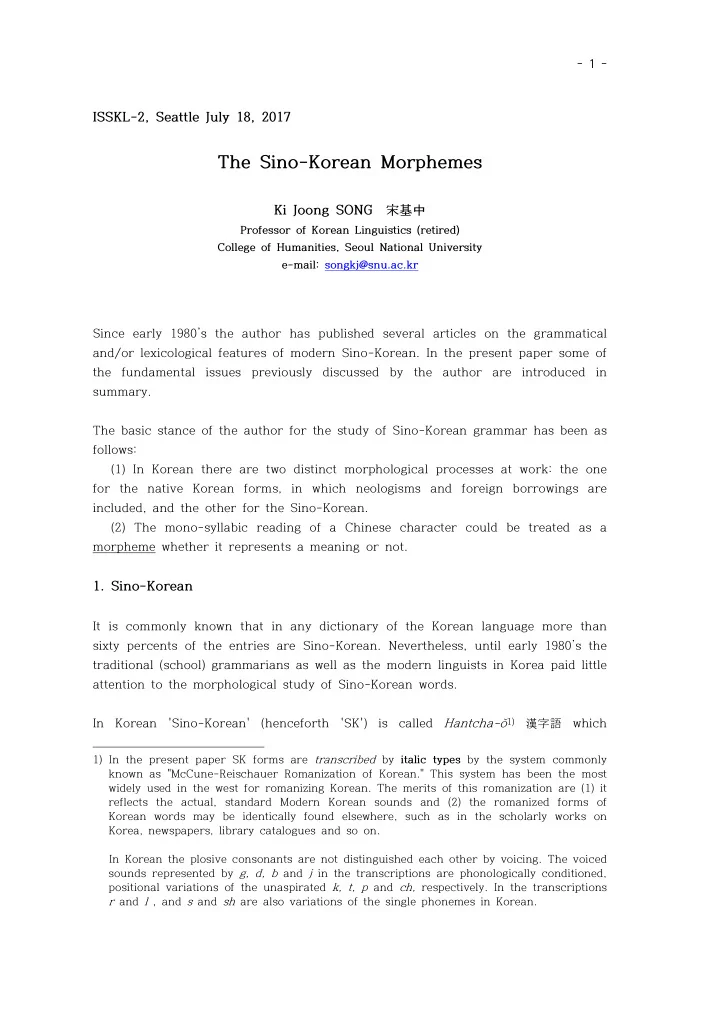
Since early 1980’s the author has published several articles on the grammatical and/or lexicological features of modern Sino-Korean. In the present paper some of the fundamental issues previously discussed by the author are introduced in summary. The basic stance of the author for the study of Sino-Korean grammar has been as follows: (1) In Korean there are two distinct morphological processes at work: the one for the native Korean forms, in which neologisms and foreign borrowings are included, and the other for the Sino-Korean. (2) The mono-syllabic reading of a Chinese character could be treated as a morpheme whether it represents a meaning or not.

  • 1. Sino-Korean

It is commonly known that in any dictionary of the Korean language more than sixty percents of the entries are Sino-Korean. Nevertheless, until early 1980’s the traditional (school) grammarians as well as the modern linguists in Korea paid little attention to the morphological study of Sino-Korean words. In Korean 'Sino-Korean' (henceforth 'SK') is called Hantcha-ǒ1) 漢字語 which

1) In the present paper SK forms are transcribed by italic types by the system commonly known as "McCune-Reischauer Romanization of Korean." This system has been the most widely used in the west for romanizing Korean. The merits of this romanization are (1) it reflects the actual, standard Modern Korean sounds and (2) the romanized forms of Korean words may be identically found elsewhere, such as in the scholarly works on Korea, newspapers, library catalogues and so on. In Korean the plosive consonants are not distinguished each other by voicing. The voiced sounds represented by g, d, b and j in the transcriptions are phonologically conditioned, positional variations of the unaspirated k, t, p and ch, respectively. In the transcriptions r and l , and s and sh are also variations of the single phonemes in Korean.

slide-2
SLIDE 2
  • 2 -

literally means “words of Chinese characters.” In fact, the necessary requirement being an SK word is that each syllable must be identified with the mono-syllabic, SK reading, or one of its variations phonologically conditioned, of a certain Chinese character. This fact suggests an infallible connection between a language and a writing that modern linguists have generally denied or ignored.

  • 2. The Chinese Characters for SK Words

The Chinese characters listed in the traditional character dictionaries (chajǒn 字典)

  • r rhyming books (unsǒ 韻書) number 6-7000 to around 50,000. But for the

practical purpose of reading and writing in any country at any historical period, less than 3000 characters were used. The number of characters of which readings are found in the customary words in Modern Korean would be less than 1,000. If the characters, which are rarely found in the personal names, are counted, the number would be well over 4,000. The Ministry of Education of ROK has provided 1,800 characters for high school education in Written Chinese (Hanmun 漢文). In the KSC 5601 (Korean Standard Character Set) 4,888 Chinese characters were

  • contained. (KSC5601 has been replaced by KSX1001.)

Chinese Characters Created in Korea. Most of the characters for SK are those which were originated in China and introduced to Korea since ancient times. There are a small number of those created by the Koreans, of which graphic features as well as the phonetic compositions and grammatical functions of their readings are not distinguished at all from those of Chinese origin. Chinese and Japanese students do not recognize these characters unless they have studied Korean. The readings of the following Korean-created characters are frequently found in the

  • rdinary words: 欌 {chang} 'storage, cage', 媤 {si} 'husband's family', 垈 {tae}

'house lot' and 畓 {tap} ‘rice-field'. E.g. changnong {chang-rong} 欌籠 'wardrobe, chest', ch'aektchang {ch'aek-chang} 冊欌 'book-case', shiga {si-ka} 媤家 ’husband's home/family', shibumo {si-pu-mo} 媤父母 'husband's parents-in-law', taeji {tae-chi} 垈地 'house lot', chǒndap {chǒn-tap} 田畓 '(dry) field and rice-field’.2)

The Korean vowels ae ㅐ, ǒ ㅓ, oe ㅚ and ǔ ㅡ represent, by IPA, [ɛ/æ], [ə/ʌ], [ø/ɶ/we] and [ʉ/ɯ] respectively. Phonetic transcriptions, other than those by the McCune- Reischauer Romanization of Korean, are presented in pairs of brackets '[ ]'. 2) The modern Korean orthography regulates a fixed spelling for each SK syllable. That is, the spelling of the reading of a character is maintained regardless of the phonological changes in actual speech. In this study the basic readings, that are mostly identical with the transliterations of the modern Korean orthography, are given in normal types in pairs of braces '{ }', with the syllables within a word hyphenated. Examples: Writings Transcriptions {SK Readings} Meanings 국어 國語 kugǒ [구거] {kuk-ǒ} ‘national language', 국민 國民 kungmin [궁민] {kuk-min} 'the people of a nation’

slide-3
SLIDE 3
  • 3 -

Characters Created for Native Korean Sounds. Historically Koreans created characters, resembling the Chinese, to write the unique, native Korean sounds. For example, 㖙 갓{kas} kat,  뿐{ppun}, 旕 엇{ǒs} ǒt and so on. The final [-t] and tensed plosive [pp] sounds are not found in the SK readings of the ordinary characters. Also, for the purpose of an easier understanding of a certain Written Chinese texts, mostly Buddhist sūtras and Confucian classics, full or simplified forms of Chinese characters, indicating the Korean grammatical forms, were superscribed along the lines of the texts. The additional writing is called kugyǒl 口訣. e.g.  {k}, {ka}, {kyǒ}, {ko}, {n}, {to}. The readings of the characters created solely for the purpose of writing a certain native Korean sounds have never constituted a part of the SK forms. All the characters of this sort have been forgotten but found only in the dictionaries.

  • 3. The SK Readings, or Phonetic Representations, of the Characters

Each Chinese character represents (i) one mono-syllablic sound, i.e., the reading. The SK readings are those (ii) originated in an Ancient Chinese language, introduced to Korea accompanying the graphics of the characters, adjusted to fit into the Korean phonemic system and have been changed along with the Korean

  • language. Exceptions to the two fundamental requirements of SK readings, (i) and

(ii) above, are not many.3) Initial [r/l] in SK. The phonological peculiarity of avoiding initial liquid sounds, [r] and/or [l], that is commonly found in the Altaic languages, is present in Modern Standard Korean. (This feature is unknown in Chinese and Japanese.) Accordingly, an initial [l-] of Ancient Chinese corresponds basically to an {r-}, but in the initial syllable of a word, to an {n-} with simple vowels other than [i], dropped out with [i] and [y]-diphthongs [ya, yǒ, yo, yu...] and to [r-] or [l-] in non-initial syllables. Chinese initial [n-] is also dropped out with [y]-diphthongs.4) North Korean

외국 外國

  • eguk [외국]

{oe-kuk} 'foreign country'. 3) Dual or triple readings per character: 惡 악{ak}/오{o}: sǒnak 善惡 'good and evil', hyǒmo 嫌惡 'dislike'; 車 차{ch'a}/거{kǒ}: chadongch'a 自動車 'car', chajǒn'gǒ 自轉車 'bicycle'; 樂 악 {ak}/락{rak}/요{yo}: ǔmak 音樂 'music', orak 娛樂 ‘amusement', yosanyosu 樂山樂水 ’enjoying the mountains and enjoying the waters', 省 성{sǒng}/생{saeng}: sǒngch'al 省察 'reflection', saengnyak 省略 'omission'. Readings of non-Chinese origin (mostly inherited misreadings): 歐 구{ku} 'Europe': kurap'a 歐羅巴 ‘Europe', sǒgu 西歐 'Western Europe'. (The reading of the character 歐 should have been {u}); ch'ǒp'yǒng 天秤 ’balance (scale)' (The correct reading of 秤 is {ch'ing}.)

slide-4
SLIDE 4
  • 4 -
  • rthography for Korean alphabets does not reflect the phonemic changes as above,

but writes by the single spellings [r-] and [n-] in all cases.5) Variations of a Reading. The reading of a character is subject to phonological changes by the neighboring sound(s) in a word. For example, the reading of the character 國/국 {kuk} 'nation' is realized as kuk- or ku-kk- in the word kukka 國 家/국가[구까~국까] ‘nation', as kung- in kungmin 國民/국민[궁민] 'the people of a nation', as ku-g- in kugǒ 國語/국어[구거] 'national language', as -guk in oeguk 外國 /외국[외국] ‘foreign country', as -kkuk in chǒkkuk 敵國/적국[저꾹~적꾹] 'hostile country' and as ku-k'- in kuk'oe 國會/국회[구쾨] 'national assembly' and so on. Morphophonemes? Underlying forms? As early as in the 1950s, when the American structural linguistics was introduced to Korea, a linguist identified the SK reading

  • f a character with a morphophoneme and its variations, allomorphs. Since the

transformational generative grammar appeared, a certain Korean linguists have explained the SK readings and the variations in terms of underlying forms and surface forms or realizations. A morphophoneme or an underlying form could be understood as an abstract medium that is set to explain the forms varying in sound but sharing a common

  • meaning. The relationship between the SK reading of a character and its variations

may be compared with that between a morphophoneme and its allomorphs or that between an underlying form and its realizations. However, the SK reading of a character should not be assumed to be identical or similar to the other two. Most of all, a morphophoneme or an underlying structure is a purely abstract, theoretical setting. Whereas, the SK reading of a character is a real syllable consisting of a fixed string of sounds. It is the basic realization, or the basic phonetic representation, of the character. (See the examples shown above.) Also, the range of meaning and morphological function of the SK reading

  • f a character are much wider than those of the conceptual forms proposed by

the linguistics of the 20th century. Readings by Meaning Values. Until early 20th century, a certain Chinese characters also read by the meaning values in native Korean as the Japanese practice of kundoku 訓讀 (SK: hundok). The SK geographical names in Seoul, Shinch’on 新村/

4) E.g. 羅 나{na}/라{ra}: nayǒl 羅列 ‘arranging in a row', Shilla {sin-ra} 新羅 'name of a historical kingdom'; 利 이{i}/리{ri}: isang 理想 'ideal', tori 道理 ‘reasonability', hamnijǒk {hap-ri-chǒk} 合理的 'rational', chilli {chin-ri} 眞理/진리[질리] 'truth'. 女 여{yǒ}/녀{nyǒ} yǒja 女子 ’female', chanyǒ 子女 ‘one's children', lit., 'boy and girl'. 5) E.g. 勞動 nodong 노동/ NK. 로동 rodong ’labor’, 理想 isang 이상 / NK. 리상 risang, ‘ideal’ 女子 yŏja 여자 / NK. 녀자 nyŏja ‘woman’. (‘NK’ stands for ‘North Korean’.

slide-5
SLIDE 5
  • 5 -

Sinchon,6) Moktong 木洞/Mokdong, Sǒkkwandong 石串洞/Seokgwandong and Chugyodong 舟橋洞/Jugyodong are said to have represented the sounds of native Korean forms of which meanings correspond to those of the Chinese charcters: saemaǔl 새마을 ‘new village’, namutkol 나뭇골 ‘(fire)wood town’, tolgoji 돌곶이 ‘rocks stringed' and baedari 배다리 'boat bridge' respectively. The readings by meaning values in native Korean, of course, are not SK forms. The practice of meaning-value reading has been completely forgotten in Korea.

  • 4. The Sino-Korean Morphemes

Until early 1980s, the traditional grammarians as well as the modern linguists in Korea paid little attention to the morphological features of SK. They seem to have generally thought that the study of SK structure belongs to the domain of Written Chinese grammar. Consequently, in their morphological descriptions of Korean SK forms were excluded. If anything mentioned about SK sturcture, it was done in light of Written Chinese grammar. For example, kungnip 國立 {kuk-rip} 'national establishment', literally, 'nation erecting' is a SV(subject+verb) construction, whereas ipkuk 立國 {rip-kuk} 'erecting a nation' is a VO(verb+object). The latter, VO is, of course, a Chinese syntactic structure unknown in Korean. The symbols S, V, O and so on refer to the syntactic units of a sentence, not those of the components of a word. The two syllables consisting the above mentioned words, which are readings of the two Chinese characters, {kuk} 國 'nation' and {rip} 立 ‘erecting', may be easily accepted as morphemes. Each of them seems to qualify the requirement of a morpheme in the conventional sense, i.e., "minimal meaningful unit." Empty Morphemes. As is well known, since antiquity ideographic Chinese characters have been also used phonographically. One of the six styles (yuksǒ 六 書), kach’a 假借 (Chi. jiajie), referred to the use of a character for a homophonic sense of which the latter became one of the principle meanings of the character. For example, lae 來 ‘coming’ was originally a pictograph of ‘ear of grain’; ki 其 ‘that’, that of ‘winnow’ and so on. However, the characters occurring in the proper names of any country at any period, with a small number of exceptions, have nothing to do with their

  • meanings. In SK there are also numerous proper names, domestically created or

introduced from China or elsewhere. It would be unnecessary to present examples

  • f proper names. To name a few Chinese or Japanese transcriptions, with or

6) The different spellings of the place names, following the Chinese charcters and a slash, are the Korean government’s official romanizations adopted since 2000.

slide-6
SLIDE 6
  • 6 -

without classifiers

  • r

modifiers representing the proper meanings

  • f

the characters, of western names introduced into SK since the late 19th century are Mi(guk) 美(國) ‘America’, Yŏng(guk) 英(國) ‘England’, Togil 獨逸 ‘Germany’, (Sŏ)gu (西)歐 ‘Western Europe’, Mat'ae 馬太/마태 'Matthew', Maga 馬可/마가 'Mark' and so

  • n. (The readings shown in pairs of parenthesis are classifiers or modifiers.)

There are also a few readings of unique characters, i.e., the characters used to write only one word like sanho 珊瑚/산호 ‘coral' and p'odo 葡萄/포도 'grapes'. If these words were not SK, each pair of syllables must be treated as a single

  • morpheme. The meaningless syllables of these words cannot be compared with the,

so called, unique morpheme such as cran- of cranberry. The cran- is a meaningless syllable attached to the meaningful unit berry. If the latter were also meaningless, canberry is an unanalysable single morpheme. The SK Morphemes. Although there are SK words consisting of meaningless syllables, all of them, without any exception, are clearly identified with the readings of a certain characters. Phonetically altered readings, other than the phonologically conditioned variations, are no longer recognized as SK. For simplicity all of them could unanimously be regarded as morphemes or SK morphemes to distinguisth them from the native Korean forms which do not share the characteristic features of SK morphemes. We may write such an equality as an SK morpheme = one syllable = the reading of a character.

  • 5. Phonemic Composition of the SK morphemes.

In the popular, large Chinese character-Korean dictionary, Chang Sam-shik 張三植, Tae Han-Han Sajǒn 大漢韓辭典, 554 kinds of SK syllabic readings are listed. The number includes that of the syllables of unique, native Korean sounds, such as {ppun} 哛/뿐 and {eos} 旕/엇 and others which are practically obsolete as SK

  • syllables. The rest numbers about 480 or less.

Phonemes in modern standard Korean include 19 consonants and 8(or 7) simple

  • vowels. In addition, 13 dipthongs are distinguished.

Consonants Unaspirated ㄱ k ㄷ t ㅂ p ㅅ s ㅈ ch Aspirated (ㅋ k') ㅌ t' ㅍ p' ㅊ ch' ㅎ h Tensed (ㄲ kk) ㄸ tt ㅃ pp (ㅆ ss) ㅉ tch Nasals, etc. ㆁ -ng ㄴ n ㄹ r ㅁ m ㅇ ' Vowels Simple Vowels ㅏ a ㅓ ǒ ㅗ o ㅜ u ㅡ ǔ ㅣ i ㅐ ae (ㅔ e) Diphthongs Diphthongs ㅑ ya ㅕ yǒ ㅛ yo ㅠ yu ㅒ yae ㅖ ye

slide-7
SLIDE 7
  • 7 -

ㅘ wa ㅝ wǒ ㅚ oe ㅟ wi ㅢ ǔi ㅙ wae ㅞ we

In SK morphemes the tensed consonants tt, pp and tch do not occur. The velar aspirated k'/ㅋ is found only in a syllable k'wae 快, which represents the readings

  • f several characters listed in the dictionaries, but practically limited to one

character 快 'refreshing'. The velar tensed kk/ㄲ is found in the reading of only

  • ne character {kkik} 喫 ‘to drink': kkigyǒn 喫煙 'smoking', literally 'drinking

smoke', kkiktta 喫茶 'drinking tea'. But the reading has been practically replaced by {kik} 긱. Another tensed consonant ss/ㅆ is found in two readings: ssang 雙 'pair' and ssi 氏 (honorific appellation). Both forms are so frequently used as a classifier and as a general appellation that they have become functioning both as SK and as native Korean. E.g. Kim ssi 金氏 ’Mr. Kim', se ssang 세雙 'three pairs'. Other than the readings of a few characters mentioned above, tensed plosives do not occur in SK readings, but are realized in the variations. There are two kinds

  • f tensification of the unaspirated plosives.

The one is a phonological sound change. Following a syllable-final stop an unaspirated plosive is tensified. E.g. kaktchong {kak-chong} 各種 ‘various kinds’, kukkka {kuk-ka} 國家 'nation', ipssi {ip-si} 入試 ‘entrance examination'. The other is an automatic tensification occurring on a certain morphemes regardless of the phonological environments. E.g. ikkwa 理科/이과 ‘science classes’,

  • cf. igwa 二課/이과 ’Lesson 2’; chŏngkka 定價/정가 ‘list price’, cf. chŏngga 政街/정

가 ‘politaical community’‘ In Korean all consonants are not released in the syllable-final positions. Consequently consonants are differentiated (in the terminology of IPA) only by the places of articulation, such as velar, alveolar-ridge, dental and labial, but not by the manners of articulation such as aspirated and tensed. As a result, out of the 19 consonants shown above, only seven [-k, -t, -p, -ng, -n, -m, -l] are contrasted each other in the final positions.7) As [-t] does not exist in SK, only six consonants [-k, -p, -ng, -n, -m] are possible.8)

  • 6. Characteristic Features of the SK morphemes.

Some of the characteristic features of the SK morphemes are briefly introduced. (1) Mono-syllabic. All SK morphemes are mono-syllabic. (See above.) A native morpheme

7) As Modern Korean orthography spells out the underlying forms, consonantal letters other than the seven appear in the syllable-final positions in modern Korean writings. E.g., nat 낯 {nach} 'face', nat 낟 {nat} 'grain, kernel', nat 낱 {nat'} 'a piece', nat 낫 {nas} ‘sickle'. 8) The entering sound (ipsŏng 入聲) [-t] in Ancient Chinese systematically corresponds to an SK [-l].

slide-8
SLIDE 8
  • 8 -

may consist of a single sound or several syllables. Examples of native Korean morphemes: ka-n 간 ‘gone', ka-m 감 'going', sarang 사랑 'love', abǒji 아버지 'father'. (2) Fixed Syllables. For an SK morpheme, any alteration, including deletion or addition of a sound(s), is not allowed. Once an alteration occurs, the form is no longer considered SK. Exceptions are the {r-} which alternates with {0-} or {n-}, and {n-} with {0-}. See above. The variations of a reading may be analyzed as morphemes, but are not recognized as SK independently. For example, if the variations of the morpheme {kuk} 國 ‘nation', ku-g, kung, -guk, -kkuk and ku-k'- (See above.), are singled

  • ut, they are hardly recognized as SK morphemes.

On the contrary to SK forms, the content sounds of native Korean morphemes may be altered without affecting the meanings. E.g., muǒsǔl {muǒs-ǔl} 무엇을 > muǒl 무얼 > mwǒl 뭘 'what?'(accusative); i-ai {i-ai} 이 아이 > i-ae 이 애 > yae 얘 'this child'. kanda {ka-n-da} 간다 ’one goes'> kaanda 가안다. (3) Nominal-Bound Forms. All SK morphemes are basically nominal in nature in the morphological constructions. And, most of them are bound forms. A limited number of morphemes function as free nouns and adverbs. (See below.) Those of the characters representing verbs in (Written) Chinese do not, of course, function as verbs, but are understood, although ambiguously, something like verbal nouns in English. E.g. sǒnggong 成功 'success', lit. 'achieving merit'; iphak 入學 ‘admission to school', lit., 'entering learning'. (4) Free Morphemes. The SK nominal morphemes which are frequently found in

  • rdinary vocables and of which counterparts in native Korean exist, are bound.

But, if the native counterparts are not found, the SK forms function as free

  • nouns. E.g.

Native Forms SK Meaning hanǔl (F) cǒn 天(B) 'heaven, sky' ttang (F) ji 地(B) 'the earth, ground' abǒji (F) pu 父(B) 'father' ǒmǒni(F) mo 母(B) 'mother' nara (F) kuk 國(B) 'nation, state' kkot (F) hwa 花(B) 'flower' saram (F) in 人(B) 'man, person' X pǒp 法(F) 'law' X pyǒng 甁(F) 'bottle'

slide-9
SLIDE 9
  • 9 -

X pyǒng 病(F) 'disease' X ch'aeg 冊(F) 'book' X ch'ang 窓(F) 'window' X tǒg 德(F) 'virtue' X tǔng 燈(F) 'lantern, lamp' X mun 門(F) 'door’ X chŭk 卽(F, adv) ’that is, namely’ X tan 但 (F, adv) ‘but, however, only’ X : non-existence B : bound form F : free form The SK free forms are naturalized to the extent to function like any native forms. (5) Multiple Functions. An SK bound form may function either as the modifier or as the modified, whereas a native bound form has a single function. {kuk} 國: ‘nation’ kugŏ 國語 ‘national language’, kuktchŏk 國籍 ‘nationality’ aguk 我國 ‘our country’, oeguk 外國 ‘foreign country’ {ha} 下: 'lower side', 'below', 'under', 'descending' sangha 上下 'upper and lower sides', hagǔp 下級 ‘lower class' hagyu 下校 ‘releasing from school', haya 下野 'resigning from public office' (6) Multiple Meanings. Virtually all Chinese characters signify multiple meanings. (This category may be treated as homophonic mophemes as 7 below.) {cha} 子 a) ‘son’: janyŏ 子女 ‘sons and daughters’, sonja 孫子 ‘grandson’, b) fossilized form of a Chinese enclitic form: ŭija 椅子 ‘chair’, moja 모자 ‘hat’ c) sage, master: Kongja 孔子 ‘Confucius’, Maengja 孟子 ‘Mencius’ (7) Homophonic morphemes. Homophones are common in SK. Among the 1800 characters provided by the Ministry of Education, thirty-two read {sa}/사 and ten, {ka}/가. Reading {sa} characters: 四 士 史 師 死 思 事 仕 射 謝 .... Reading {ka} characters: 家 佳 街 可 歌 加 價 假 架 and 暇. (8) No Grammatical Forms. SK morphemes form the roots of substantives and

  • predicates. No SK forms are found in the grammatical forms such as case,

conjugational and derivational suffixes.

slide-10
SLIDE 10
  • 10 -

(9) Psudo-Affixes. A certain SK morphemes appear as prefixes or suffixes. E.g., {pul} 不, {pi} 非 and {pan} 反 are frequently prefixed to a certain SK words, like the negative prefixes in English, ab-normal, un-clear, anti-communism and so on. The English examples correspond to SK pi-jŏngsang 非正常 ‘abnormal’, pul-myŏnghwak 不明確 ‘unclear’, pan-gongsanjuŭi 反共産主義 ‘anti-communism’ respectively. {chŏk} 的 often appears like a adjectival suffix. E.g. nolli-jŏk {ron-ri-chŏk} 論理的 ‘logical’, sasang-jǒk 思想的 'ideological', kukche-jǒk 國際的 'international'. The above SK forms cannot be fixed affixes. They are ordinary SK morphemes which may form SK words with other morphemes or be attached to already formed words as the examples above. Examples of word formation: pulga 不可 'not right', pisang 非常 'unusualness', pandae 反對 'opposition', shitchŏk 詩的 'poetic'. If {-chŏk}/的 is an adjectival suffix as commonly assumed, it cannot be followed by the copula {-ida}/이다. i keurim-ǔn maeu insangjǒgida. 이 그림은 매우 印象的이다. ‘This painting is very impressive.'

  • 7. Closing Remarks

Sino-Korean constitutes an indispensable part of the Korean language. Therefore, in the study of Korean grammar, SK should not be laid aside. Syntactically SK has little to do with native Korean. But, the morphological features

  • f SK are remarkably different from those of the latter.

As a matter of course, in the morphological investigation of any language, the units to be necessarily concerned with are the morphemes. A morpheme has been commonly defined as 'minimal meaningful unit' as a component of a word. However, morphemic analysis of any language often faces

  • ambiguities. Accordingly different definitions have appeared during the past several

decades. The SK forms, without any exception, consist of the mono-syllabic readings of Chinese characters. At a glance, the SK readings handsomely fit the conventional definition of a morpheme. However, from semantical point of view, there are unseparable combinations of readings as well as meaningless syllables frequently found in SK. Because of this fact anyone could be hesitant about treating every SK syllable as a morpheme. Nonetheless, it is obvious for anyone that the readings are unmistakable components of SK words that are clearly and easily analysed. The SK readings could be treated as morphemes and the non-conventional(?)

slide-11
SLIDE 11
  • 11 -

features could be explained as characteristics of SK morphemes. Author's works on Sino-Korean or related with the Use of Chinese Characters Ki Joong Song, “Remarks on Modern Sino-Korean," Language Research, Vol.22, No.4(1986.12.), 469-502면. in English. Ki Joong Song, "Duality in Korean Morphology," Seoul J ournal

  • f

Korean Studies, Institute

  • f

Korean Studies, Seoul National University, Vol.4(1991), pp.3-32. in English. 宋基中, 現代國語 漢字語의 構造 , 한국어문(한국정신문화연구원 어문연구실) 1(1992.6.), 1-85면. in Korean. [The Structure of Modern Sino-Korean] 宋基中, 現代國語 漢字語 形態論 , 國語學講座 3: 形態 (李秉根ㆍ蔡婉ㆍ金昌燮 編), 태 학사, 1993.8., 367-440면. 宋基中(1991)에서 “형태론” 부분만 발췌 수록. [Modern Sino-Korean Morphology] 宋基中, 借字表記의 文字論的 성격 , 새국어생활 제7권 제4호(1997.12.), 국립국어연구 원, 5-29면. [Grammatological Aspects of Loan-(Chinese)-Character Writing) 宋基中, 語彙 生成의 특수한 類型, ‘漢字借用語’ , 沈在箕編 國語 語彙의 基盤과 歷史 , 서울: 태학사, 1998. 6. 10. 593-615면. [A Particular Type of Borrowings, Borrowings by Chinese Characters] 송기중, 漢字文化圈 , 새국어생활, 제9권 제2호, 국립국어연구원, 1999.6.30. 5-16면. [The Cultural Sphere of Chinese Characters] 宋基中, 近代 地名에 남은 訓讀 表記 한국지명연구, 한국지명학회 地名學論文選 I, 한 국문화사, 2007. 5. 335-366 면. 地名學 6집(2001)의 재록. [H undok ('readings by meaning-values') Spellings

  • f

Chinese Characters Found in the Korean Geographical Names of Early Modern Times] 宋基中, 古代國語 語彙 表記 漢字의 字別 用例 硏究, 서울대학교 출판부, 2004. 12. 총 1100면. [The Use of Individual Chinese Characters in the Ancient Korean Words] The Chinese characters used to write the Ancient Korean words, found in all the extant sources, are fully collected, classified and discussed. 송기중, 한자문화권의 형성과 발전 동북아 제지역간의 문물교류, 진단학회ㆍ한국사학 회ㆍ인문사회연구회 공편, 2004.10. 19-26면. [Formation and Development of the Cultural Sphere of Chinese Characters] 宋基中, 東洋 三國 漢字 語彙 鳥瞰 國語學 49, 國語學會 2007. 6. 315-331. [An Overview

  • f

the Words

  • f

Chinese Characters in Chinese, Japanese and /Korean]