2. Knowledge Representation and Communication Part 2 Part 2: ems - - PDF document

2 knowledge representation and communication part 2 part 2
SMART_READER_LITE
LIVE PREVIEW

2. Knowledge Representation and Communication Part 2 Part 2: ems - - PDF document

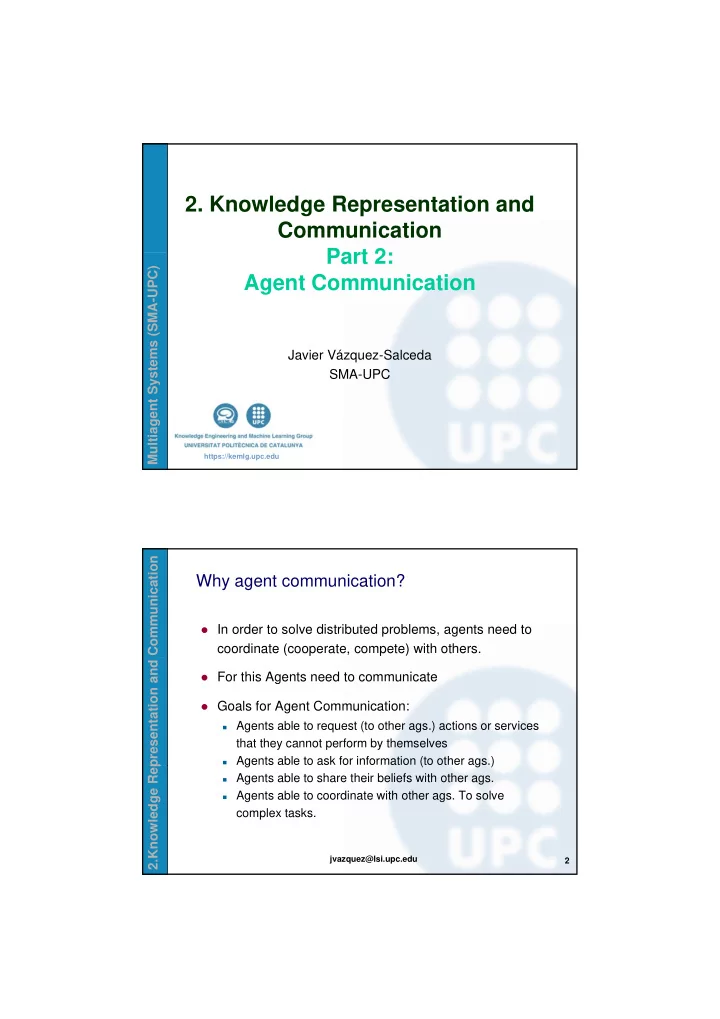
2. Knowledge Representation and Communication Part 2 Part 2: ems (SMA-UPC) Agent Communication Javier Vzquez-Salceda q Multiagent Syste SMA-UPC https://kemlg.upc.edu Communication Why agent communication? In order to solve


slide-1
SLIDE 1
  • 2. Knowledge Representation and

Communication Part 2

ems (SMA-UPC)

Part 2: Agent Communication

Javier Vázquez-Salceda Multiagent Syste

https://kemlg.upc.edu

q SMA-UPC Communication

Why agent communication?

 In order to solve distributed problems, agents need to

coordinate (cooperate, compete) with others. presentation and

 For this Agents need to communicate  Goals for Agent Communication:

 Agents able to request (to other ags.) actions or services

that they cannot perform by themselves

 Agents able to ask for information (to other ags.)

2.Knowledge Rep

jvazquez@lsi.upc.edu 2

g ( g )

 Agents able to share their beliefs with other ags.  Agents able to coordinate with other ags. To solve

complex tasks.

slide-2
SLIDE 2

Communication

Levels in Agent Communication

 Four levels in communication:

 Message Semantics

  • What does each message means?
  • 3 components

presentation and

3 components – Message type: gives intensionality – Message content: contains the information – Ontology (the message refers to)

 Message Sintaxis

  • How each message is expressed?
  • 2 components

– Message structure: Agent Communication Language Content codification: Content Language

2.Knowledge Rep

jvazquez@lsi.upc.edu 3

– Content codification: Content Language

 Interaction protocol

  • How are conversations/dialogues structured?

– Agent Protocols

 Transport protocol

  • How messages are actually sent and received by agents?

ems (SMA-UPC)

Message Semantics

  • Speech Act Theory

Multiagent Syste

https://kemlg.upc.edu

slide-3
SLIDE 3

Communication

 The analysis of the different types of messages that 2

individuals can exchange is within the area of linguistics, and more concretely, speech act theory.

 Speech act theories are pragmatic theories of language, i.e.,

Message Semantics: Speech Acts

presentation and p p g g g , , theories of language use

they attempt to account for how language is used by people every day to achieve their goals and intentions

 In “How to Do Things with Words” (1962), Austin noticed

that some utterances are rather like ‘physical actions’ that appear to change the state of the world

 Paradigm examples would be:

2.Knowledge Rep

jvazquez@lsi.upc.edu 5

g p

declaring war

christening

‘I now pronounce you man and wife’

 But more generally, everything we utter is uttered with the

intention of satisfying some goal or intention Communication

Speech Acts

Aspects

 Locutionary act or locution: what it is said or written (the

sentence, the sounds.

E.g. ‘It is raining’ performs the locutionary act of saying that it is

presentation and

raining.

 Illocutionary act or illocution: what it is not said or written

explicitly, but it is meant.

E.g. ‘I will repay you this money next week’ typically performs the illocutionary act of making a promise.

 Perlocutionary act or perlocution: the effect provoked on those

who hear a meaningful utterance. 2.Knowledge Rep

jvazquez@lsi.upc.edu 6

g

E.g. 1: ‘Shut up!’ usually has an effect on stopping another individual’s utterances

E.g. 2: telling a ghost story late at night may accomplish the cruel perlocutionary act of frightening a child.

slide-4
SLIDE 4

Communication

Speech Acts

Types

 Searle (1969) identified various different types of speech

act:

representatives:

presentation and

representatives: such as informing, e.g., ‘It is raining’

directives: attempts to get the hearer to do something e.g., ‘please make the tea’

commisives: which commit the speaker to doing something, e.g., ‘I promise to… ’ i

2.Knowledge Rep

jvazquez@lsi.upc.edu 7

expressives: whereby a speaker expresses a mental state, e.g., ‘thank you!’

declarations: such as declaring war or christening

Communication

Speech Acts

Components

 In general, a speech act can be seen to have two

components:

a performative verb: (e g request inform promise )

presentation and

(e.g., request, inform, promise, … )

propositional content: (e.g., “the door is closed”)

 E.g.:

performative = request content = “the door is closed” speech act = “please close the door”

2.Knowledge Rep

jvazquez@lsi.upc.edu 8

performative = inform content = “the door is closed” speech act = “the door is closed!”

performative = inquire content = “the door is closed” speech act = “is the door closed?”

slide-5
SLIDE 5

Communication

 How does one define the semantics of speech acts?

When can one say someone has uttered, e.g., a t i f ?

Speech Acts

Plan Based Semantics

presentation and request or an inform?

 Cohen & Perrault (1979) defined semantics of speech

acts using the precondition-delete-add list formalism of planning research

 Note that a speaker cannot (generally) force a hearer to

t d i d t l t t 2.Knowledge Rep

jvazquez@lsi.upc.edu 9

accept some desired mental state

 In other words, there is a separation between the

illocutionary act and the perlocutionary act Communication

Speech Acts

Plan Based Semantics

 E.g., semantics for request:

request(s h )

presentation and

request(s, h, ) pre:

s believes h can do  (you don’t ask someone to do something unless you think they can do it)

s believes h believe h can do  (you don’t ask someone unless they believe they can do it)

s believes s wants  (you don’t ask someone unless you want it!)

2.Knowledge Rep

jvazquez@lsi.upc.edu 10

(you don t ask someone unless you want it!)

post:

h believe s believes s wants  (the effect is to make them aware of your desire)

slide-6
SLIDE 6

ems (SMA-UPC)

Message Sintaxis

  • Agent Communication Language

Multiagent Syste

https://kemlg.upc.edu

Communication

Speech Acts in Agent Communication Langs.

 Agent communication is based in Speech Act Theory  Agents use a set of pre-defined performatives in order

presentation and to communicate their intentions

 The performative semantics allow the agent receiving a

message to interpret its content in a proper way

 There are two pre-defined performative sets used in

Multiagent Systems: 2.Knowledge Rep

jvazquez@lsi.upc.edu 12

 KQML Knowledge Query and Manipulation Language  FIPA-ACL Agent Communication Language

slide-7
SLIDE 7

Communication

 The first widely-spread ACL was KQML, developed by the

ARPA knowledge sharing initiative

 KQML is comprised of two parts:

KQML

presentation and p p

the knowledge query and manipulation language (KQML)

the content language (usually KIF)

 KQML is an ‘outer’ language, that defines a quite large set of

acceptable ‘communicative verbs’, or performatives for :

Basic requests (evaluate, ask-one, perform …)

Multiagent requests (stream-in, …) R ( )

2.Knowledge Rep

jvazquez@lsi.upc.edu 13

Responses (reply, sorry, …)

Information (tell, achieve, cancel, …)

Coordination (stand-by, ready, next, …)

Definition of capabilities (advertise, subscribe, …)

Networking (register, forward, broadcast, …)

Communication

KQML

Example

( ask-one

Performative

presentation and :sender joan :receiver stock-server :reply-with IPOD-stock :content (PRICE IPOD ?price) :language LISP :ontology NYSE-TICKS )

Message Content Communication parameters Content Language specification

2.Knowledge Rep

jvazquez@lsi.upc.edu 14

gy

Ontology specification

slide-8
SLIDE 8

Communication

KQML and KIF

 KIF is a language for expressing message content  E.g.,

presentation and g ,

 “The temperature of m1 is 83 Celsius”:

(= (temperature m1) (scalar 83 Celsius))

 “An object is a bachelor if the object is a man and is not

married”:

(defrelation bachelor (?x) := (and (man ?x) (not (married ?x))))

2.Knowledge Rep

jvazquez@lsi.upc.edu 15

 “Any individual with the property of being a person also

has the property of being a mammal”:

(defrelation person (?x) :=> (mammal ?x))

Communication

KQML and KIF

Example

( tell :sender stock-server :receiver joan presentation and :receiver joan :content (= (price IPOD) (scalar 199 Euro)) :language KIF :ontology NYSE-TICKS )

 In literature a short version of KQML/KIF messages is

used to specify dialogues: 2.Knowledge Rep

jvazquez@lsi.upc.edu 16

A to B: (ask-if (> (size chip1) (size chip2))) B to A: (reply true) B to A: (inform (= (size chip1) 20)) B to A: (inform (= (size chip2) 18)) A to B: (perform (print “Hello!” t)) B to A: (reply done)

slide-9
SLIDE 9

Communication

 More recently, the Foundation for Intelligent Physical Agents

(FIPA) started work on a program of agent standards — the centrepiece is an ACL

FIPA-ACL

presentation and

 Basic structure is quite similar to KQML:

Type of communicative act: performative 22 performatives in FIPA (reduction from KQML)

communication actors e.g., sender, receiver.

content the actual content of the message

2.Knowledge Rep

jvazquez@lsi.upc.edu 17

g

Content description e.g., language, encoding, ontology

Conversation control e.g., protocol, conversation-id, reply-with, in-reply-to, reply-by

Communication

FIPA-ACL

 Example:

presentation and (inform :sender agent1 :receiver agent5 :content (price good200 150) :language sl :ontology hpl-auction 2.Knowledge Rep

jvazquez@lsi.upc.edu 18

gy p )

slide-10
SLIDE 10

Communication

FIPA-ACL

performatives

presentation and 2.Knowledge Rep

jvazquez@lsi.upc.edu 19

Communication

FIPA-ACL

performatives for requests

 request, request-when, request-whenever: request

for an action to be performed unconditionally/when a given condition holds/each time the condition holds t ti t b f d h

presentation and

 propose: to propose an action to be performed when some

given conditions hold

 call-for-proposal: request for proposals from other

agents to perform actions under certain pre-conditions

 inform-if, inform-ref, query-if, query-ref: ask the

receiver if he believes that a given condition is true or that for a referred element a given condition holds

2.Knowledge Rep

jvazquez@lsi.upc.edu 20  propagate, proxy: request another agent to forward a

given message, either reading it and propagating it or propagating without reading

 subscribe: request to an agent to inform whenever a given

expression/object changes its value

slide-11
SLIDE 11

Communication

FIPA-ACL

performatives for responses

 inform: Informs that a given expression is true  accept-proposal, reject-proposal: A proposal (for

an action performance) is accepted or rejected

presentation and

an action performance) is accepted or rejected

 confirm, disconfirm: A fact’s truth value is

communicated to an agent which has some uncertainty about it

 agree: An agreement about performing an action  refuse: A refusal to perform an action (+ reason)  cancel: Cancellation of an agreed action

f il A ti ld t b f d l

2.Knowledge Rep

jvazquez@lsi.upc.edu 21  failure: Action could not be preformed properly  not-understood: Last message has not been understood

Communication

FIPA-ACL

Content Language

 Almost any content language can be used with

FIPA-ACL. Most used are KIF (ANSI-KIF, ISO-KIF), RDF, DAML, OWL and FIPA-SL presentation and , ,

 Others can be used such as PROLOG, SQL, …  FIPA-SL (Semantic Language)

 Allows representation of asserts in modal  It is designed for agents with BDI architecture (Beliefs,

Desires, Intentions)

 Defines 3 types of content:

  • Statements: expressions which can be associated with a

2.Knowledge Rep

jvazquez@lsi.upc.edu 22

p truth value

  • Actions: expressions defining an action that can be

performed

  • Reference expressions: quantified formulae referring to

domain objects which comply with that formulae

slide-12
SLIDE 12

Communication

FIPA-SL

Elements

 Expressions in FIPA-SL are in prefix notation (such as

in KIF) presentation and

 It includes connectives from First Order Logic

 not, and, or, implies, <=>, forall exist

BDI Operators

 (B <agent> <exp>) Agent believes the expression  (U <agent> <exp>) Agent has some uncertainty

about the expression (I t ) A t h i t ti th

2.Knowledge Rep

jvazquez@lsi.upc.edu 23

 (I <agent> <exp>) Agent has as an intention the one

in the expression

 (PG <agent> <exp>) Agent has as an objective the

  • ne in the expression

Communication

FIPA-SL

Elements

 Temporal Logic operators

 (feasible <action> <exp>): Action can be performed

when expression holds

presentation and

 (done <action> <exp>): Action was performed before

the expression held.

Relational and list operators

 (=, >, <, member, contains)

Reference expressions (evaluated through a Knowledge Base)

 (iota <terms> <exp>): refers to the unique object

2.Knowledge Rep

jvazquez@lsi.upc.edu 24

( p ) q j which, instantiating the terms, makes the expressions true

 (any <terms> <exp>): refers to a/some objects which,

instantiating the terms, make the expressions true

 (all <terms> <exp>): refers to all objects which,

instantiating the terms, make the expressions true

slide-13
SLIDE 13

Communication

FIPA-SL

Elements

 Functional Terms (predicates): expressions which refer to an

  • bject through its functional relation with other objects (e.g.,

3 = (+ 2 1) ). There are two alternative expressions: presentation and ) p

 (<predicate> <value1> … <valuen>),

e.g. (person “Juan” 23)

 (<predicate <prop1> <value1> … <propn> <valuen>)

e.g., (person :name “Juan” :age 23)

 FIPASL has some pre-defined functional terms (arithmetic

  • perators, set operators, list operators…)

2.Knowledge Rep

jvazquez@lsi.upc.edu 25

 Predicates over actions and results

 (action <agent> <exp>): we request the agent to perform

the action expressed in the expression

 (result <action> <exp>): informs about the result of a

given action

Communication

FIPA-SL

3 subsets

 FIPA-SL defines 3 subsets of the language with

different expressiveness, for computational reasons presentation and

 FIPA-SL0: Allows predicates action, result, done, simple

propositions, sets and sequences

 FIPA-SL1: Adds boolean connectives in expressions  FIPA-SL2: Adds referential expressions and the

modal/temporal operators but with some restrictions to

2.Knowledge Rep

jvazquez@lsi.upc.edu 26

modal/temporal operators, but with some restrictions to ensure that the demonstrations are decidable

slide-14
SLIDE 14

ems (SMA-UPC)

Interaction Protocols

  • Agent Protocols

Multiagent Syste

https://kemlg.upc.edu

Communication

What are (agent) communication protocols?

 Performatives cannot work alone, but they appear as

part of a protocol specification

 A protocol is a conversation between agents which

presentation and

 A protocol is a conversation between agents which

follows some rules defining which performatives to use and when in order to achieve a given goal

 Each protocol defines the sequencing of messages in a

given dialogue as a finite-state diagram

 Advantage: agents can easily keep the current state of

a dialogue and know which utterances follow in order 2.Knowledge Rep

jvazquez@lsi.upc.edu 28

a dialogue and know which utterances follow in order to comply with the protocol

 Each protocol is designed for a specific type of

dialogue  One should carefully choose which protocol to use for each situation.

slide-15
SLIDE 15

Communication

Protocols defined by FIPA

 They have two sides: initiator and responder.

 FIPA protocols: Request, Query, Contract Net, Iterated

Contract Net, Brokering, Recruiting, Subscribe, Propose The most sed are presentation and

 The most used are::

 Request: dialogue to ask an agent for an action to be performed.

The responder agent gives back the result, if possible

 Request-When: dialogue to ask an agent for an action to be

performed whenever some conditions hold

 Query: dialogue to ask an agent if a given expression is true.

The responder agent answers, if possible

 Propose: dialogue to propose another agent to perform a given

2.Knowledge Rep

jvazquez@lsi.upc.edu 29

  • pose d a ogue to p opose a ot e age t to pe o

a g e action under given conditions. The responder agent accepts or rejects the proposal

 Contract Net: dialogue to request a group of agents to send back

proposals for actions to solve a given task. The initiator agent selects the best proposals

Communication

FIPA protocols

Request-Response Protocols

 E.g. FIPA specification for FIPA-Query and FIPA-Request

presentation and

request/query (content) not-understood refuse (reason) agree Initiator Responder

2.Knowledge Rep

jvazquez@lsi.upc.edu 30

failure (reason) inform Done (action) inform (result)

slide-16
SLIDE 16

Communication

FIPA protocols

FIPA-Request

presentation and 2.Knowledge Rep

jvazquez@lsi.upc.edu 31

Communication

FIPA protocols

FIPA-Request-When

presentation and 2.Knowledge Rep

jvazquez@lsi.upc.edu 32

slide-17
SLIDE 17

Communication

FIPA protocols

FIPA-Query

presentation and 2.Knowledge Rep

jvazquez@lsi.upc.edu 33

Communication

FIPA protocols

FIPA-Contract-Net (I)

 E.g. FIPA specification for Contract Net

cfp Initiator

presentation and

p (action preconditions ) not -understood refuse (reason) propose (pre condicitions) Responder deadline

2.Knowledge Rep

jvazquez@lsi.upc.edu 34

failure (reason) inform Done (action) accept -proposal (proposal) reject -proposal (reason) cancel (reason)

slide-18
SLIDE 18

Communication

FIPA protocols

FIPA-Contract-Net (II)

presentation and 2.Knowledge Rep

jvazquez@lsi.upc.edu 35

Communication

FIPA protocols

FIPA-Propose

presentation and 2.Knowledge Rep

jvazquez@lsi.upc.edu 36

slide-19
SLIDE 19

Communication

References

1. Luck, M., McBurney, P., Shehory, Onn, Willmott, S. “Agent Technology: Computing as interaction. A Roadmap to Agent Based Computing”. Agentlink, 2005. ISBN 085432 845 9 2 Wooldridge M “Introduction to Multiagent Systems” John Wiley

[ ] [ ]

presentation and

2. Wooldridge, M. Introduction to Multiagent Systems . John Wiley and Sons, 2002. 3. FIPA Agent Communication specifications. http://www.fipa.org/repository/aclspecs.html 4. Haddadi, A. “Communication and Cooperation in Agent Systems: A Pragmatic Theory” Lecture Notes in Artificial Intelligence #1056. Springer-Verlag. 1996. ISBN 3-540-61044-8 5. Weiss, G. “Multiagent Systems: A modern Approach to Distributed

[ ] [ ] [ ] [ ]

2.Knowledge Rep

jvazquez@lsi.upc.edu 37

Artificial Intelligence”. MIT Press. 1999. ISBN 0262-23203

These slides are based mainly in material from [2] and from J. Bejar, with some additions from material by U. Cortés and A. Moreno