2/14/2020 Rise of the Byzantine Empire * Note : Diocletian begins - - PDF document

2 14 2020
SMART_READER_LITE
LIVE PREVIEW

2/14/2020 Rise of the Byzantine Empire * Note : Diocletian begins - - PDF document

2/14/2020 Rise of the Byzantine Empire * Note : Diocletian begins last (and worst) persecution of Christians Begins with Division of Roman Empire -- Diocletian -- 284AD* Germanic Invasions Frontiers Not Secure Tetrarchy Created (rule by the


slide-1
SLIDE 1

2/14/2020 1

Rise of the Byzantine Empire

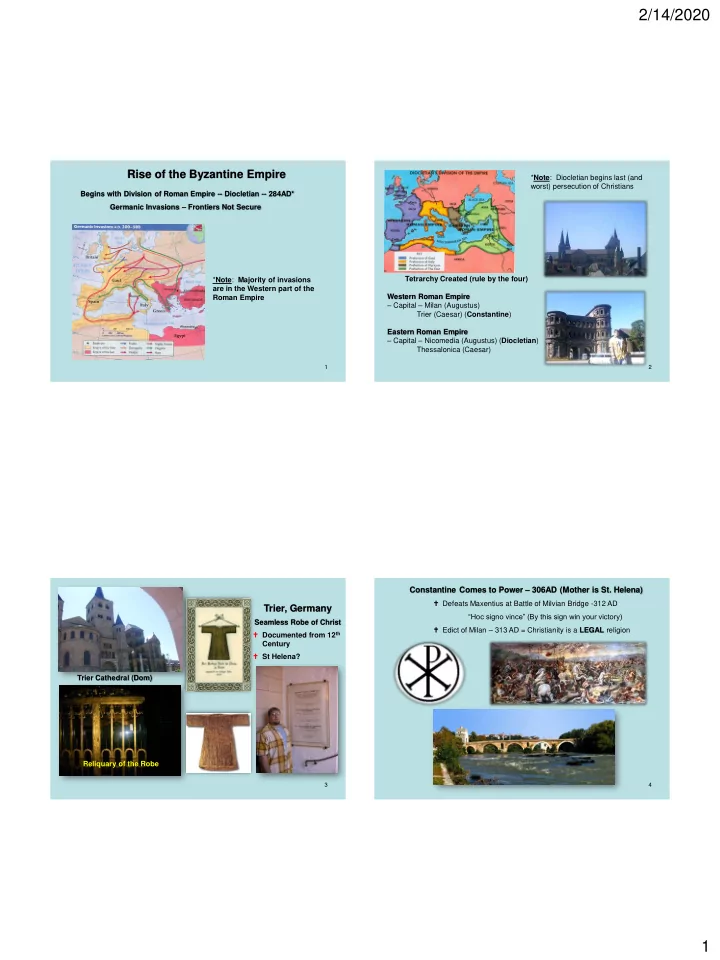
Begins with Division of Roman Empire -- Diocletian -- 284AD* Germanic Invasions – Frontiers Not Secure *Note: Majority of invasions are in the Western part of the Roman Empire

1

Tetrarchy Created (rule by the four) Western Roman Empire – Capital – Milan (Augustus) Trier (Caesar) (Constantine) Eastern Roman Empire – Capital – Nicomedia (Augustus) (Diocletian) Thessalonica (Caesar) *Note: Diocletian begins last (and worst) persecution of Christians

2 3

Trier, Germany

Seamless Robe of Christ  Documented from 12th Century  St Helena? Trier Cathedral (Dom) Reliquary of the Robe

Constantine Comes to Power – 306AD (Mother is St. Helena)

 Defeats Maxentius at Battle of Milvian Bridge -312 AD “Hoc signo vince” (By this sign win your victory)  Edict of Milan – 313 AD = Christianity is a LEGAL religion

4

slide-2
SLIDE 2

2/14/2020 2

Constantine

Becomes sole emperor by 324 AD  Decides to build new capital in the east (escape invasions) Byzantium – Greek trading colony New capital is opened 330 AD = Constantinople (“Constantinpolis”)

5

Constantinople develops

*East / West Crossroads by land *North / South Crossroads by sea

Trade!

6 7

Constantine’s original walls, reinforced by Theodosius double walls in 5th century Length was 13 miles with 50 towers

8

slide-3
SLIDE 3

2/14/2020 3

Western Roman Empire “Collapses” in 476

Christian Church (Pope/”papa”) remains in Rome

  • Accepts leadership role in west
  • Retains Latin
  • Roman Catholicism develops
  • St. Peter’s Basilica – From Constantine

9

Western Roman Empire “Collapses” in 476

Eastern Roman Empire continues Still Known as “Roman Empire” (Consider themselves to be Roman) Since 16th Century known as “Byzantine Empire” Cultural Blend of Greek, Roman (Latin) and Persian Cultures Greek eventually becomes the dominant language Distinctive form of Christianity develops – Eastern Orthodox

10

Byzantium and the West

Western Roman Empire now ruled by barbarian successor states. Many adopted Christianity (Orthodox / Arian) Gaul occupied by the Franks -- Clovis Ostragoths (Ost = East) occupy Italy – Ravenna is their capital.

  • Ruled by Theodoric
  • Arian Christian

Vandals occupy North Africa Early 6th century Byzantium attempts to reclaim parts of the west

Theodoric’s Sarcophagus and Tomb (Ravenna) 11

Emperor Justinian (527 – 565 A.D.)

Humble origins (Balkans) – Uncle Emperor Justin I Marries Theodora (19 years younger)

  • “actress” / beautiful / smart

Ultimate dynamic power couple of Byzantine age

  • shared power
  • saved Justinian in 532 during the Nika revolt
slide-4
SLIDE 4

2/14/2020 4

Justinian

Humble origins (Balkans) – Uncle Emperor Justin I Marries Theodora (19 years younger)

  • actress / beautiful / smart

Ultimate dynamic power couple of Byzantine age

  • shared power
  • saved Justinian in 532 during the Nika revolt

Each supports the other – both have their own courts – regal lifestyle

Ravenna Where have you seen this picture?

Justinian Theodora

Basilica of St. Vitale +548 A.D. 13

Ravenna = Best Preserved Byzantine Mosaics in the World Constantinople’s Mosaics destroyed by war Greek and Roman Mosaics were usually built/placed into the floor. Byzantine Mosaics were usually built/placed into the wall.

14

6th Century Byzantine Mosaics 11th Century Byzantine Mosaics 13th Century Byzantine Mosaics

15

Basilica of St. Vitale +548 A.D.

16

slide-5
SLIDE 5

2/14/2020 5

  • St. Apollinare in Classe +549 A.D.

17 18

Basilica of St. Vitale = 548 A.D.

Byzantine Architecture (Greek & Roman)

19

National Shrine of the Immaculate Conception Washington, D.C. Byzantine Architecture

20

slide-6
SLIDE 6

2/14/2020 6

Under Justinian

Byzantines attempt to regain parts of the old Western Roman Empire

General Belisarius Regains parts of North Africa Carthage 533 Regains Italy 535 – 540 Ravenna capital* Regains part of Spain 554 Maintain control of portions of these areas for 200+ years. Greatest Extent of Byzantine Empire *Ravenna Mosaics best preserved of all Byzantine art.

21

Justinian Dies in 565 Gains in the West begin to be lost

22

“Greek Fire”

23 24

Constantinople is considered to be one of the most beautiful cities in the world Considered to be the center of knowledge inherited from the Greeks and the Romans

slide-7
SLIDE 7

2/14/2020 7

Justinian’s Code of Laws

Roman law codes accumulated for 1,000 years Never organized into a useful system Under Tribonian updated legal system Corpus of Civil Law – “Justinian Code” Become the basis for the majority of European legal codes

Munchies Question!

What one State in the United States uses a form of the Justinian Code as a basis for their laws?

25

Justinian’s Code of Laws

Roman law codes accumulated for 1,000 years Never organized into a useful system Under Tribonian updated legal system Corpus of Civil Law – “Justinian Code” Become the basis for the majority of European legal codes Munchies Question!! What one State in the United States uses a form of the Justinian Code as a basis for their laws? Answer: Louisiana

26

Justinian and the Church

Construction of the Church of Hagia Sophia (“Holy Wisdom”) 532 – 537 (5 years to build!) Largest Christian / Catholic church for 1,000 years! Western Europe – Abbey of Cluny was the largest Catholic church.

  • St. Peter’s Basilica became the

largest church in the 17th century. Became a mosque! Today it is a museum!

27

Byzantine Emperor in Conflict with Roman Pope

Early Christian Church – Five Patriarchs (Bishops) Rome, Jerusalem, Constantinople, Antioch, Alexandria Originally the local people appoint the Bishop Rome and Constantinople most powerful / influential Byzantine Emperor influences (appoints) the Patriarch of Constantinople Tries to influence the Pope – give protection No ruler in west to direct Pope (He does as he feels necessary)

28

slide-8
SLIDE 8

2/14/2020 8

Byzantine Emperors and the Church

Heavily involved in church affairs. Appoint the Patriarch (Bishop) of Constantinople Majority of the people are involved in religion Dispute over Icons (Images) Images = God, Jesus, Saints Bible = Do not worship Images vs. Icons = Symbols of God & Saints Iconoclast (“Image Breaker”) Controversy (726 A.D.) Emperor Leo III – Removal of Icons from churches Pope Gregory II – Supported the use of Icons in churches Conflict between east and west Council of Nicaea 787 A.D. – icons were allowed – no statues.

29

Byzantine Emperor in Conflict with Roman Pope (con’t)

Lombards invade Italy in 700’s A.D. Byzantine Emperor cannot protect Pope Pope turns to Franks for help / protection Frankish kings come to Italy – Subdue Lombards – Crown Charlemagne Emperor Difference increase politically and spiritually

30 31

Great Schism (Split) – 1054

  • Eastern Catholic

(Orthodox / Greek) Church splits from Western (Roman / Latin) Church

  • No longer recognizes

authority of the Pope

Byzantine Economy

 Trade / Crossroads / Central location  River networks / Seaways  Northern goods – furs / wood products  Eastern goods – spices / silks / precious goods  Silk Industry develops in Constantinople

Education

 Universities develop 850 A.D.  Study for church and government jobs  Religious and classical subjects  Preserve ancient works of the early Greeks and Romans

32

slide-9
SLIDE 9

2/14/2020 9

Monasteries

St Catherine’s Monastery (Begun 527A.D.) One of the World’s earliest – Mt. Sinai, Egypt

  • Seek Isolation from the world
  • Get closer to God
  • Preserve Knowledge
  • Influence development of Western

monasticism

  • Illuminated Manuscripts

33

  • St. Simon Stylites the Elder – 390 - 459 A.D.

(39 years on a platform at the top of a pillar) Monastery in Syria

  • St. Simon Stylites the Younger – 521 - 597 A.D.

(68 years on a platform at the top of a pillar) Monastery in Antakya, Turkey

34

Spread of Christianity

Missionaries

  • St. Cyril & St. Methodius
  • Apostles to the Slavs
  • Cyrillic Alphabet

Development of monasticism

  • Mono = One/Alone

35 36

Major Events Hasten the Decline of the Byzantine Empire

  • Islamic Arab attacks beginning 630’s A.D.
  • Norman Seizure of Southern Italy – 1071
  • Battle of Manzikert – 1071

Byzantines vs. Seljuk Turks Byzantine Army decisively defeated

  • Capture of Constantinople – 1204 – 4th Crusade
  • Venetians – Trade Rivals
  • Latin Kingdom (1204 – 1261)

36

slide-10
SLIDE 10

2/14/2020 10

Seljuk Turks

  • From area north of Turkey,
  • Aral & Caspian Seas
  • Enter service of the Abbasid Caliphs
  • Begin to encroach on Byzantines in the

east

  • Nomadic horse archers

37 38

Seljuk leader Alp Arslan captures the Byzantine Emperor Romanus IV

Alp Arslan: "What would you do if I were brought before you as a prisoner?" Romanus: "Perhaps I'd kill you, or exhibit you in the streets of Constantinople." Alp Arslan: "My punishment is far heavier. I forgive you, and set you free."

38 39

Ottoman Turks -- 1453

40

slide-11
SLIDE 11

2/14/2020 11

Siege of Constantinople 1453 Sultan Mahmet II Spared the Hagia Sophia

41

Development of other Bordering Kingdoms

Armenia: First “officially” Christian Country in the world Will establish independent kingdom during the Crusades Georgia: Middle of the Silk Road Short period of independence during the crusades Bulgaria: Influenced by Byzantines Occupied by Ottoman Turks Serbia: Develop in the Balkans Adopt Eastern Orthodox Christianity Battle of Kosovo – 1389 Under Ottoman control 500 years

Battle of Hungary 1396

42

Attacked by Herds of ?

Development of the Slavic East and Russia

Dnieper River (North – South Commerce Route) Steppes – Vast Plains (Short Agriculture Season)

  • Heavily Wooded Forests in Parts
  • Little Urbanization
  • Poor Transportation Network

Three Slavic Groups West Slavs (Poland, Czech Republic, Slovakia) Latin/Western South Slavs (Balkans = Serbs, Croats, Slovenes) Latin/West & Orthodox/East East Slavs – Largest (Russians, Ukraine, Byelorussians) Orthodox/East Harsh Life / Brutal Winters / great use of Wood / Live off the Land

43

“Primary Chronicle” – Documents the early history of Russia

Begins in the north – Novgorod – Seeks order and protection

  • Invites (for a second time) the Varangians (Scandinavians)
  • Viking leader Rurik = Slavs called them the “Rus”
  • Novgorod important for northern trade
  • Novgorod controlled by assemblies of the people

Primary Chronicle Written 1100 A.D.

44

slide-12
SLIDE 12

2/14/2020 12

Early Novgorod

45 46

  • Oleg of Novgorod conquers Kiev to the south – Dnieper River
  • Location important for trade
  • Kiev = “Mother of Eastern Slavic Cities”
  • The Kievian Rus are ruled by “Grand Princes”
  • Raid Constantinople – Treaty 911 A.D.
  • Kiev becomes a collection of city-states
  • Wealthy merchants and nobles / Boyars

47

The First Russian State = Kiev Olga and the Drevlianians; 945 A.D.

48

slide-13
SLIDE 13

2/14/2020 13

Christianity arrives in Russia

Olga – First to Accept Christianity (Eastern) Grandson Vladimir – Grand Prince of Kiev Kievan ruler who accepts Christianity for the Slavic people Impact: Russians adopt Orthodox faith and Byzantine Practices Kiev / Russia becomes more isolated from the West

49

Vladimir Expands the Borders of Kievan Rus

50

Golden Age of Kiev

After Vladimir’s reign, his son Yaroslav comes to power Kiev enters what is called the “Golden Age of Kiev” Culture develops that follows example of Byzantines

  • Library
  • Legal system
  • Political marriages

– daughters

  • Trade flourishes

After Yaroslav’s death

  • No clear line of succession
  • Internal fighting
  • Begins to decline

Trade declines – problems in Constantinople (Latin’s) Trouble Arrives!!

51

Mongols Arrive at Europe’s Doorstep 120,000 – 130,000 Cavalry

52

slide-14
SLIDE 14

2/14/2020 14

53

Mongols Sack and Destroy Kiev 1240

54

Kiev loses importance for many decades

55

Mongols Sack and Destroy Baghdad; Home of the Islamic Abbasid Dynasty Mongols never conquer Novgorod in North

Mongol Rule of Russia

  • Lasts for approximately 200 years
  • Mongol culture does not contribute to Russia
  • All advances of the Kievan society were erased

Use many Russians to work for them – collect taxes

  • Some Russian city-states begin to rise in power/status
  • Moscow of note

Many from Kiev and other city-states under Mongol control move to Novgorod Novgorod becomes independent

  • Builds trade network
  • Comes into conflict
  • with West

Walls of Novgorod

56

slide-15
SLIDE 15

2/14/2020 15

Invasions of Early Russia ______________________

 Teutonic Knights

  • Roman Catholicism vs.

Eastern Orthodox  Economic ?  Nazi Germany

57

Alexander, Prince of Novgorod

Prince of Novgorod in early 13th century

  • Defeats Swedes at Neva River in 1240
  • Becomes known as Alexander “Nevsky” (of the Neva”)
  • Defeats German Teutonic Knights in 1242
  • Ensures prosperity for Novgorod

Alexander Nevsky becomes client ruler for Mongols

  • Son Daniel moves to Moscow, becomes ruler
  • Daniel is client ruler for Mongols

58 59

Alexander Nevsky recaptures Crusader castle and town of Koporye in 1241

60

slide-16
SLIDE 16

2/14/2020 16

Second great battle between west and Novgorod

  • Teutonic Knights vs. Russian

city-state of Novgorod under Alexander Nevsky

  • Teutonic Knights emerged

during the Crusades in the Holy Land

  • Teutonic Knights will later

serve as the model for Nazi Germany in the 1930’s

61

Battle begins at the territorial frontiers

62

Nevsky’s Forces Crusaders

63

Nevsky uses Turko - Mongol mercenaries Horse archers to defeat Crusaders

64

slide-17
SLIDE 17

2/14/2020 17

65

Bishop Hermann of Tartu Commander of the Crusader forces Majority of Crusader forces managed to escape Result:  No further invasions from Europeans  Novgorod develops a strong trade network and becomes the major city-state in the North of Russia  Joins the Hanseatic League with  access to Western markets

66

Emergence of Moscow as Successor to Kiev

Daniel Nevsky early ruler Moscow is under Mongol oversight Ivan I emerges as leader (son of Daniel Nevsky)

  • Moscow’s princes collect taxes, support the

Mongol policies, known as “Money Bag”

  • Ivan’s control of area expands
  • In 1380 Mongols begin to suffer defeats

By 1480 Mongols rule / presence is ended

  • Rise of Ivan III (the Great)
  • Expands the borders of Moscow
  • Brings Novgorod under Moscow’s

control

67

The City of Moscow / The Third Rome

After the fall of Constantinople (1453) – center of the Eastern Orthodox Church

  • Ivan III marries a Byzantine princess – successor of the Roman’s
  • Symbol of Russia = Double Headed Eagle
  • Rulers adopt the title Czar (Caesar)

Greek and Latin (Byzantine) influences are found in Moscow However, a unique Russian culture emerges that is reflected in the Slavic language, buildings, religion, arts (icons) Russian Orthodox religion stresses

  • bedience to the Czar as God’s

representative on earth.

City Plan

  • f Moscow

68