2/13/2014 What is Tamper Resistance? Resistance to tampering the - - PDF document

2 13 2014
SMART_READER_LITE
LIVE PREVIEW

2/13/2014 What is Tamper Resistance? Resistance to tampering the - - PDF document

2/13/2014 What is Tamper Resistance? Resistance to tampering the device by either normal users or systems or others with physical Physical Attacks and Tamper Resistance access to it


slide-1
SLIDE 1

2/13/2014 1

Physical Attacks and Tamper Resistance

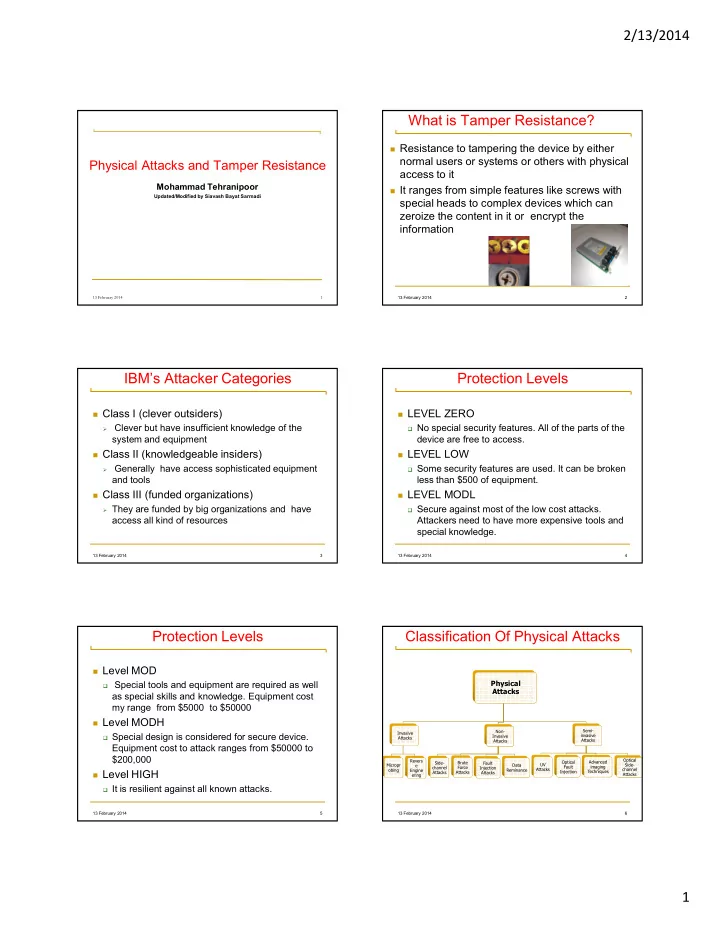
  • What is Tamper Resistance?

Resistance to tampering the device by either

normal users or systems or others with physical access to it

It ranges from simple features like screws with

special heads to complex devices which can zeroize the content in it or encrypt the information

13 February 2014 2

IBM’s Attacker Categories

Class I (clever outsiders)

Clever but have insufficient knowledge of the

system and equipment

Class II (knowledgeable insiders)

Generally have access sophisticated equipment

and tools

Class III (funded organizations)

They are funded by big organizations and have

access all kind of resources

13 February 2014 3

Protection Levels

LEVEL ZERO

No special security features. All of the parts of the

device are free to access.

LEVEL LOW

Some security features are used. It can be broken

less than $500 of equipment.

LEVEL MODL

Secure against most of the low cost attacks.

Attackers need to have more expensive tools and special knowledge.

13 February 2014 4

Protection Levels

Level MOD

Special tools and equipment are required as well

as special skills and knowledge. Equipment cost my range from $5000 to $50000

Level MODH

Special design is considered for secure device.

Equipment cost to attack ranges from $50000 to $200,000

Level HIGH

It is resilient against all known attacks.

13 February 2014 5

Classification Of Physical Attacks

  • !"
  • #
  • $%

#

  • 13 February 2014

6

slide-2
SLIDE 2

2/13/2014 2

Non=Invasive Attacks

Do not require decapsulation of the device,

so it is non=destructive

Do not require any initial preparation of the

device under test.

They can be done by tapping on a wire or

plugging the device in the test chip.

Easley reproducible, so that they are not

expensive

However, it can take a lot of time to find an

attack on an any particular device.

13 February 2014 7

Non=Invasive Attacks

& &

'

  • (&)*
  • ($

(

  • +

!

  • '

*,

13 February 2014 8

Invasive Attacks

Penetrative attacks: expensive to perform

require expensive equipment, knowledgeable

attackers and time

almost unlimited capabilities to extract information

from chips and understand their functionality

leave tamper evidence of the attack or even destroy

the device

getting more demanding as the device complexity

increases and the size shrinks

13 February 2014 9

Invasive Attacks

Tools

IC soldering/desoldering station simple chemical lab and high=resolution optical

microscope

wire bonding machine, laser cutting system,

microprobing station

  • scilloscope, logic analyser, signal generator

scanning electron microscope and focused ion

beam workstation

13 February 2014 10

Semi=Invasive Attacks

Relatively new type of attack, it fills the gap

between non=invasive and invasive attacks

Similar to the invasive attacks, they requires

depackaging of the device

But, the attacker do not need to have

expensive tools such as FIB.

Actually, these attacks are not entirely new

since UV light is used to disable security fuses in EPROM for many years

13 February 2014 11

Semi=Invasive

!"-

  • !"-
  • !

*. &# /#$&0

  • $%
  • $%
  • .
  • %

.) **

#

  • #
  • .

* )

  • #

' * # ' *

#. . 13 February 2014 12

slide-3
SLIDE 3

2/13/2014 3

Invasive Attacks

& &

  • #

.*

  • *

1

  • )

' . ' .

13 February 2014 13

Sample Preparation

It starts with partial or full of the

chip to expose the chip die

is the process of the removal of

the chip package

It can be done easily by anyone who has high school

chemistry knowledge

Only need to do some practice on a dozen of chip

13 February 2014 14

Manual Decapsulation

  • '&

( )*) ..*

  • .
  • '&

( )*) ..*

  • .

1

  • (

1.

  • ( $)
  • 2

34546'

1

  • (

1.

  • ( $)
  • 2

34546'

' .

  • ( .74842

*)* ( 2

  • .

' .

  • ( .74842

*)* ( 2

  • .

13 February 2014 15

  • Decapsulation can be done from the rear side of

the chip

Access to the chip die can be established without using any chemical It requires to mill down to the copper plate which can be then removed mechanically

slide-4
SLIDE 4

2/13/2014 4

Automated Decapsulation

For the large quantities, automated decapsulation systems can be used.

Very little skill and experience is

required to operate it

Such systems

cost over $15,000 and so that generally relatively large labs buy them

Also,

they consume ten times more acid than the manual decapsulation, so the disposal of the wastes should be done in proper way

.2&748

  • The

same partial decapsulation can be applied to smart card

Not all of them may

maintain their electrical integrity

Generally, smart cards

are decapsulated completely

  • Sample Preparation

is the opposite process of the

the chip fabrication

It has two main application;

Removing passivation layer to expose metal layers

for microprobing attack

Gaining access to the deep layers to observe internal

structure of the chip

Three basic deprocessing method are used;

Wet chemical etching Plasma etching, also known as dry etching Mechanical polishing

13 February 2014 21

Deprocessing

Wet Chemical Etching;

Each layer is removed by specific chemicals Its downside is its uniformity in all directions Each type of

material needs certain etchants to be used

Nitrox wet etchant is one of the most effective etching

agents for silicon nitride and silicon dioxide passivation layers which selectively removes the passivation layers

  • f

integrated circuits while preserving full device functionality.

13 February 2014 22

Deprocessing

7 '9:;'543'< ,$ * 1* *,=&'7959 ,$ * 1 *,

13 February 2014 23

Deprocessing

Plasma Etching

uses radicals created from gas inside a special

chamber.

  • nly the surfaces hit by the ions are removed

Similarly, each type of material needs certain

enchant

Mechanical polishing

performed with the use of abrasive materials Time=consuming and requires special machines

slide-5
SLIDE 5

2/13/2014 5

.>' &

  • Reverse Engineering

Reverse engineering is a technique used for

understanding of the structure of the device and its functioning

For ASIC, it means locations of all the

transistors and interconnections

All the layers of the chip are removed one by

  • ne in reverse order and photographed to

determine the internal structure of the chip

Eventually, by processing obtained information,

standard netlist can be created and used to simulate the device

13 February 2014 26

Reverse Engineering: Imaging

Optical Imaging:

For reverse engineering the silicon chips down to

0.18 Em feature size, an optical microscope with a digital camera can be used

SEM:

For semiconductor chips fabricated with 0.13 Em or

smaller technology, images are created using a SEM which has a resolution better than 10 nm.

13 February 2014 27

*,?

13 February 2014 28

Reverse Engineering

  • Reverse Engineering: Memory extraction

Memory extraction from Mask ROMs

  • nly possible for certain type of Mask ROM memory

For example; NOR Mask ROM with active layer

programming used in Motorola MC68HC705P6A Microcontroller can be read by removing the top metal layer

But, same Microcontroller with newer technology

requires deprocessing

13 February 2014 30

slide-6
SLIDE 6

2/13/2014 6

Reverse Engineering: Memory extraction

13 February 2014 31

Invasive Attacks: Microprobing

Microprobing

eavesdropping on signals inside a chip injection of test signals and observing the reaction can be used for extraction of secret keys and memory

contents

laser cutter can be used to remove passivation and

cut metal wires

limited use for 0.35Gm and smaller chips

13 February 2014 32

Invasive Attacks: Microprobing

Tools

The most important tool is microprobing station. It

consists of five elements

a microscope, stage, device test socket, micromanipulators

and probe tips.

13 February 2014 33

Invasive Attacks: Microprobing

Microprobing is applied to the internal CPU data

bus

Difficult to observe whole data bus at a time Two to four probes are used to observe data signals

which are combined as a whole data trace later.

13 February 2014 34

Microprobing: Laser Cutting

It is used to remove passivation layer to observe

the metal layer

Laser Cutting Systems consist of

laser head mounted on camera port of a microscope submicron=precision stage to move the sample

Carefully dosed laser flashes

remove patches of the passivation layer with micrometer precision

13 February 2014 35

Microprobing: Laser Cutting

13 February 2014 36

slide-7
SLIDE 7

2/13/2014 7

Microprobing: FIB Workstation

The devices fabricated

with 0.5 Em or smaller technology needs more sophisticated tools to establish contacts with the interconnect wires

  • FIB stations can be used

to create test point, imaging and repairing

Also, FIB can mill holes

and cut the wires

  • Invasive Attacks: Chip Modification

It is used to disable security protection circuitry

By cutting one of the internal metal

interconnection wires

by completely destroying the circuit associated

with the security protection using a laser cutter

For more sophisticated attacks FIB is used

connecting the wire that transmits the security

state to either the ground or the supply line.

Chip modification always requires at least partial

reverse engineering of the chip to find the point for possible attack.

13 February 2014 39

Invasive Attacks: Chip Modification

13 February 2014 40

Countermeasures

Bus Encryption Top=layer Sensor Meshes ASICs and custom ICs Internal Voltage and Clock Frequency Sensors Light Sensor

13 February 2014 41

Countermeasures: Bus Encryption

The bus encryption is used to protect the

sensitive information from probing .

Basically, the memory content is encrypted and then

sent to the CPU by data bus

Before the data used in CPU, it is decrypted

13 February 2014 42

slide-8
SLIDE 8

2/13/2014 8

Countermeasure: Bus Scrambling

Typical probing areas

Memory bus drivers Data bus itself where lines are organized in proper

CPU bus width

Bus order is 99.9% of the time in order (0..7 or 7..0)

13 February 2014 43

Countermeasure: Bus Scrambling

Data bus scrambling is used to confuse

attackers

Order of the data bus is changed to make it difficult to

  • bserve bus signals

13 February 2014 44

Bus Scrambling

13 February 2014 45

Counterme.: Top=layer Sensor Meshes

Additional metallization layers that

form a sensor mesh above the actual circuit do not carry any critical signals

All the paths in a sensor mesh are continuously

monitored for interruptions and short=circuits while power is available

It prevents laser cutter or selective etching access

to the bus lines.

Also, mesh layer hides the lower layer which

makes navigation on the chip surface for probing and FIB editing more tedious.

13 February 2014 46

Counterme.: Top=layer Sensor Meshes

13 February 2014 47

Countermeasure: ASICs and Custom ICs

Types of ASIC design

Glue logic design from VHDL or logic level (Netlist) Fully custom design with security requirements

13 February 2014 48

slide-9
SLIDE 9

2/13/2014 9

Countermeasures: Sensors

Different kind of sensors can be used to detect

attack attempt

Voltage and frequency sensors for glitching attacks Light sensor can be helpful against decapsulation of

the device

Special purpose sensors can be created to

detect probing.

Ring oscillator based detector (Probing Attempt

Detector)

13 February 2014 49

Sensors : Probing Attempt Detector

Exploits the fact that probing will change the

capacitance in the bus line.

Place ring oscillators on the bus lines When the probe touches the one or more bus lines,

frequency of the ring oscillator changes

PAD observes the bus lines continuously, when they

have significant difference, it sets a flag that there is a probing attempt on the one of the lines

13 February 2014 50

Sensors : Probing Attempt Detector

13 February 2014 51

Semi=Invasive Attacks

& &

  • %

&.

  • &.
  • !"
  • #
  • 13 February 2014

52

Semi=Invasive Attacks: Sample Preparation

Decapsulation of the chip to prepare it for

attacks.

For the modern chips, backside decapsulation is

used

There is no need to use chemicals

13 February 2014 53

Semi=Invasive Attacks: Imaging

Down to 0.8 Gm technology, it was possible to

identify all the major elements of microcontrollers – ROM, EEPROM, SRAM, CPU

Difficult to distinguish for newer technologies Can be observed with infrared light from rear

side

Backside imaging also is useful to extract the

Mask ROM content

13 February 2014 54

slide-10
SLIDE 10

2/13/2014 10

Semi=Invasive Attacks: Imaging

13 February 2014 55

Semi=Invasive Attacks: UV Attacks

They can be applied any OTP and UV EPROM

microcontrollers

Divided into two stages

Finding the fuse by using imaging techniques resetting it to the unprotected state with a UV light

13 February 2014 56

UV Attacks: Locating the Security Fuses

Security fuse

Controls access to the information stored in on=

chip memory

They are physically located in the chip die They are the separate memory cells from the main

memory array

If they are away from the main memory or next

to it, the security is not very high as the fuses can be found and disabled.

Better protection can be achieved when the security

fuses are located on the same memory array

13 February 2014 57

UV Attacks: Locating the Security Fuses

Several methods can be used to locate the

security fuses

Reverse engineering (expensive) Partial Reverse engineering ( could save time) High voltage used for memory programming, is

normally supplied from an external pin and could be traced down to all the EPROM memory cells including the fuses with optical microscope (if technology is down to 0.8 um)

Newer technologies requires deprocessing to

  • bserve the internal structure of the chip

13 February 2014 58

UV Attacks

If fuses are close the main memory, UV light can

be used to locate them

After, finding the security fuses, five to ten

minutes under UV light should give the proper result.

13 February 2014 59

Semi=Invasive Attacks: Active Photon Probing

Laser radiation can ionize an IC’s semiconductor

regions if its photon energy exceeds the semiconductor band gap

In active photon probing, a scanned photon beam

interacts with an IC.

Laser scanning techniques (LST)

One is called optical beam induced current (OBIC) and is

applied to an unbiased chip to find the active doped areas on its surface

Another is , called light=induced voltage alteration (LIVA),

applied to a chip under operation

13 February 2014 60

slide-11
SLIDE 11

2/13/2014 11

Reading the logic state of CMOS transistors

Red low power laser beams ionize active areas

Power off imaging identifies active areas Power on imaging distinguishes between closed and

  • pened transistor channels

13 February 2014 61

Semi=Invasive : Optical Fault injection attacks

Illumination of a target transistor causes it to

conduct, thereby inducing a transient fault

Such attacks

Practical Do not require expensive laser equipment Any individual bit of SRAM in microcontroller can be

set or reset

13 February 2014 62

Fault injection attacks: Changing SRAM contents

13 February 2014 63

Non=volatile memory contents modification

EPROM, EEPROM and Flash memory cells are

even more sensitive to fault injection attacks.

They can be changed by light This attacks can be used to disable security

fuses

The light should be focused down to the security fuse

These attacks do not work on modern chips built

in smaller sizes

13 February 2014 64

References

Semi=invasive attacks A new approach to

hardware security analysis,

Physical Attacks and Tamper Resistance

  • Hardware Engines for Bus Encryption: a Survey
  • f Existing Techniques
  • P. Guillemin, C. Anguille and C. Buatois, J. B.

Rigaud

Wet and Dry Etching

!" #$

Security Failures in Secure Devices, %&

'()*%

13 February 2014 65

References

"(+ http://www.siliconzoo.org/ Smart Card Handbook, , ,"

""

Detection of Probing Attempts in Secure ICs,

!(!-,$

13 February 2014 66