2/10/2016 Assessment of Patients with Chronic Pain and Co-Occurring - - PDF document

2 10 2016 assessment of patients with chronic pain and co
SMART_READER_LITE
LIVE PREVIEW

2/10/2016 Assessment of Patients with Chronic Pain and Co-Occurring - - PDF document

2/10/2016 Assessment of Patients with Chronic Pain and Co-Occurring Substance Use Jon Streltzer, M.D. Professor of Psychiatry University of Hawaii School of Medicine (No conflicts to disclose) Unintentional Overdose Deaths Involving Opioid


slide-1
SLIDE 1

2/10/2016 1 Assessment of Patients with Chronic Pain and Co-Occurring Substance Use

Jon Streltzer, M.D. Professor of Psychiatry University of Hawaii School of Medicine (No conflicts to disclose)

3

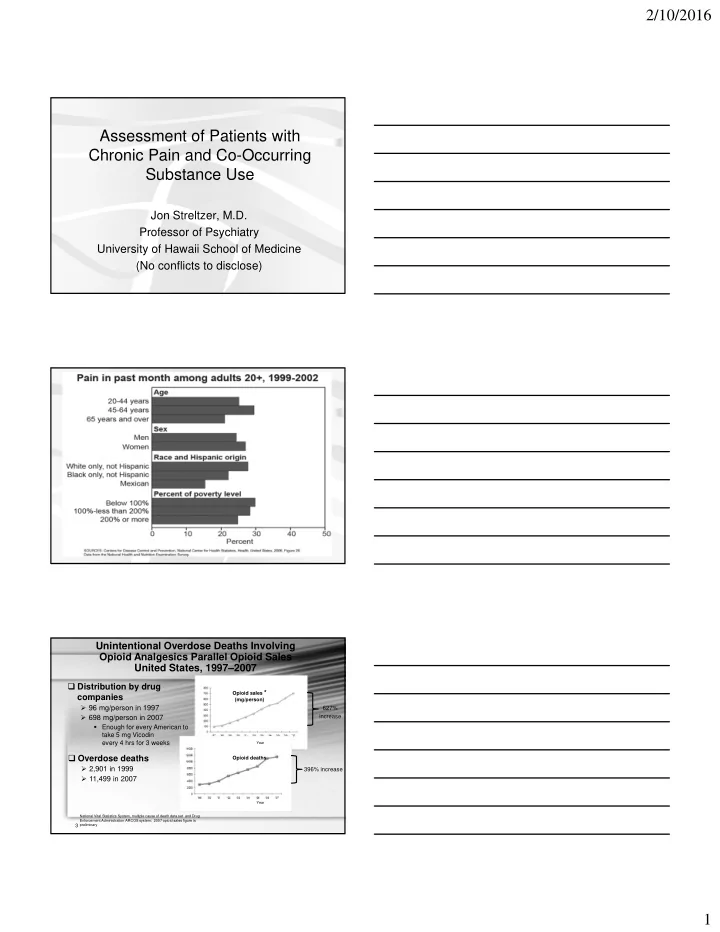
Unintentional Overdose Deaths Involving Opioid Analgesics Parallel Opioid Sales United States, 1997–2007

National Vital Statistics System, multiple cause of death data set and Drug Enforcement Administration ARCOS system; 2007 opioid sales figure is preliminary

Distribution by drug companies

96 mg/person in 1997 698 mg/person in 2007

Enough for every American to take 5 mg Vicodin every 4 hrs for 3 weeks

Overdose deaths

2,901 in 1999 11,499 in 2007

Opioid sales * (mg/person) Opioid deaths

627% increase 396% increase

Year Year

slide-2
SLIDE 2

2/10/2016 2

Okie, NEJM:363:1981-4, 2010

In 2001, the Joint Commission

  • n the Accreditation of Healthcare

Organizations (JCAHO) introduced the concept that pain was the “fifth vital sign.”

“Rate your pain from 0-10”

slide-3
SLIDE 3

2/10/2016 3 The Puzzle of Chronic Pain

Why do some patients recover and others become disabled?

  • 80 to 90% of low back pain episodes remit in

6-8 weeks ( Nachemson, 1982; Waddell et al, 1984; Klenerman, 1995)

  • 25% of cases of low back pain account for

90% of total cost ( Snook, 1988)

  • Most patients with low back pain show no

evidence of disease or structural abnormality (Waddell, 1987)

Problem Case Prototype

50 yo man Back pain, (+neck, shoulder, knee, HA) Oxycodone 60+ mg/day (+Vicodin, morphine) + employed; ↑ sick leave Zolpidem (clonazepam etc) Stress (depression) Hx PT, TENS, acupuncture (epidurals,surgery) + hx alc/drugs

Portenoy and Foley (1986)

Pain, 25:171-186

24 of 38 pts reported less pain with chronic opiates (low doses) No improvement in functioning

slide-4
SLIDE 4

2/10/2016 4

APS & AAPM 1997 Guides

Tolerance, or decreasing pain relief with the same dose over time, has not proven to be a prevalent limitation to long term

  • pioid use.

The undertreatment of pain in today's society is not justified. This joint consensus statement has been produced pursuant to the missions of both organizations, to help foster a practice environment in which opioids may be used appropriately to reduce needless suffering from pain.

The use of opioids for the treatment of chronic pain. A consensus statement from the American Academy of Pain Medicine and the American Pain Society. Clin J Pain. 1997;13:6–8.

  • A survey of physicians who were members of

the American Pain Society found that many pain specialists believe that long-term opioid treatment is beneficial in selected patients with chronic, noncancer pain; that this treatment is underutilized; and that addiction, tolerance, and physical dependence are generally not significant problems.

West J Med. 2000 February; 172(2): 107–115.

The Problem of Under Treated Pain

The relief of suffering is universally acknowledged as a cardinal goal of the ethical and compassionate practice of medicine.

  • 30 million Americans “suffer with chronic pain.”
  • “Doctors are reluctant to prescribe opioids, thus

80% of those with chronic non-malignant pain go untreated as a result.”

New York Times, February, 22, 2002

slide-5
SLIDE 5

2/10/2016 5 Need for Education in Pain Management

  • Chronic pain was deemed by 68% of physicians to

be inadequately managed. Almost 60% thought that pain management could be enhanced by improved physician education

  • For moderate to severe chronic noncancer pain,
  • pioids were the first-line treatment of only 32% of

physicians

Morley-Forster PK et al Pain Res Manag. 2003;8:187-8

Practice Trends (USA)

  • Liberal use of opioids
  • Many delivery methods
  • Mega-doses
  • Minimization of addiction concerns followed

by a focus on addiction as the problem

slide-6
SLIDE 6

2/10/2016 6 But there are problems

  • 81% of GP’s believe many chronic pain

patients are not treated well

  • Barriers to good pain control are side effects
  • f therapies (74%), and patient compliance

(58%)

Stannard C, Johnson M Curr Med Res Opin. 2003;19:703-6.

slide-7
SLIDE 7

2/10/2016 7

USDHHS, CSAT; Source: Washington State data courtesy of Ann Marie Gordon, MS

Denmark: Use of Strong Opioids

Eriksen et al. Critical issues on opioids in chronic non-cancer pain: an epidemiological study. Pain. 2006 Nov;125(1-2):172-9.

Pain Group

(chronic/long lasting pain >6 months)

  • Opioid users

– 90% mod-very severe pain – Worse on all measures

  • f function

– Twice as likely to be on disability (adjusted for pain rating, benzo use)

  • Non-opioid users

– 46% mod-very severe pain

Eriksen et al., Pain, Nov 2006, 125:172-9

slide-8
SLIDE 8

2/10/2016 8 Denmark: Use of Strong Opioids

Eriksen et al. Critical issues on opioids in chronic non-cancer pain: an epidemiological study. Pain. 2006 Nov;125(1-2):172-9.

“it is remarkable that opioid treatment of long- term/chronic non-cancer pain does not seem to fulfil any of the key outcome opioid treatment goals: pain relief, improved quality of life and improved functional capacity”

10000+ interviews; 1906 chronic pain; 228 opioid users

Diagnostic Accuracy in Chronic Pain

  • Fibromyalgia
  • Myofascial pain syndrome
  • CRPS I

– Reflex Sympathetic Dystrophy

  • Temperomandibular joint disorder
  • Back Pain
slide-9
SLIDE 9

2/10/2016 9 MRI Study of the Lumbar Spine (Jensen et al., NEJM 1994

74% of subjects with no back pain had abnormal discs

Addiction and Chronic Pain: Scope of the Problem

  • No good statistics
  • Literature 3.2%-18.9% 1
  • Addiction 10%-15%—Lifetime prevalence in U.S.
  • Chronic Pain 10%-15%—Incidence in general population
  • f U.S.
  • 1. Fishbain, DA et al., Clin J Pain, 1992

Diagnosis of Addiction

136 pts screened, 38 terminated within 1 year

  • The Addiction Behaviors Checklist: Validation of a New Clinician-

Based Measure of Inappropriate Opioid Use in Chronic Pain

  • Wu, Compton et al., Journal of Pain and Symptom Management,

32:342-351, Oct 2006

slide-10
SLIDE 10

2/10/2016 10 Problematic Questions in the Assessment of Pain and Substance Use

  • “What is the risk of addiction?”
  • “Is it addiction or just physical dependence?”

Chronic Pain Disorder Following Physical Injury

  • Streltzer, Eliashof, et al.

Psychosomatics, May, 2000

slide-11
SLIDE 11

2/10/2016 11 Who becomes drug dependent?

Streltzer J, et al. Chronic pain disorder following physical injury. Psychosomatics 2000;41:227- 234

P<0.001 P<0.01

APS & AAPM 2008 Guides

the panel did not rate any of its 25 recommendations as supported by high quality evidence. Only 4 recommendations were viewed as supported by even moderate quality evidence

Clinical guidelines for the use of chronic opioid therapy in chronic noncancer pain. Chou R, Fanciullo GJ, Fine PG, Adler JA, Ballantyne JC, Davies P, Donovan MI, Fishbain DA, Foley KM, Fudin J, Gilson AM, Kelter A, Mauskop A, O'Connor PG, Passik SD, Pasternak GW, Portenoy RK, Rich BA, Roberts RG, Todd KH, Miaskowski C; American Pain Society-American Academy of Pain Medicine Opioids Guidelines Panel. J Pain. 2009 Feb;10(2):113-30.

AAAP 2009 Guides

High dose opioids, when chronically prescribed, generally have not been shown to be effective for the management of persistent, nonmalignant pain, utilizing this standard of both symptom reduction and increase in level of function… Therefore, prescription of daily high dose opioids is generally not recommended.

Streltzer J, Ziegler P, Johnson B: Cautionary guidelines for the use of opioids in chronic

  • pain. American Journal on Addictions, 18:1-4, 2009.
slide-12
SLIDE 12

2/10/2016 12 Research Trends

  • Increases in morbidity and mortality

associated with opioids

  • Mechanisms and effects of chronic opioid

intake in animal models

  • Lack of efficacy and induction of enhanced

pain sensitivity in humans

Descending Control of Pain

Millan MJ, Prog Neurobiol 2002;66:355-474

  • Nestler, Am J Addictions, 2001
slide-13
SLIDE 13

2/10/2016 13

  • Nestler, Am J Addictions, 2001

Mechanisms of Opioid-induced Pain and Antinociceptive Tolerance: Descending Facilitation and Spinal Dynorphin

  • Vanderah, et al., Pain 92:5-9, 2001

– “Recent studies have shown that continuous

  • pioid exposure produces exaggerated pain

and, importantly, such pain occurs while the

  • pioid is continuously present in the system”

CCK and Pain

  • Figure 1. Male Sprague Dawley rats received CCK-8(s) (30 ng/0.5 µl) bilaterally into the RVM and were

tested for mechanical (A) or thermal (B) hypersensitivity using von Frey filaments or radiant heat,

  • respectively. The bilateral RVM administration of CCK-8(s) resulted in significant mechanical (A; n = 8)

and thermal (B; n = 7) hypersensitivity (*p < 0.05) that was significantly blocked by the preadministration

  • f the CCK2 receptor antagonist L365,260 (2.5 ng/0.5 µl, -5 min) administered bilaterally into the RVM

(**p < 0.05; n = 8) but not by the CCK1 antagonist L364,718 (25 ng/0.5 µl, -5 min; n = 6). The preadministration of vehicle (0.5 µl, -5 min) had no effect on CCK-8(s)-induced mechanical and thermal hypersensitivity (n = 6). BL, Baseline.

slide-14
SLIDE 14

2/10/2016 14

Patients on methadone maintenance therapy are relatively intolerant of pain, a finding hypothesized to reflect a hyperalgesic state induced by chronic

  • pioid administration

Pain intolerance in opioid-maintained former opiate addicts: effect of long-acting maintenance agent. Compton P, Charuvastra VC, Ling W Drug Alcohol Depend 2001;63:139-46

Hyperalgesic responses in methadone maintenance patients

Doverty, et al. Pain 90:91-96, 2001

COLD PRESSOR -- TOLERANCE (SEC)

p<0.0001

Chronic Pain among Chemical Dependent Patients

Rosenblum et al., JAMA, May 14, 2003

slide-15
SLIDE 15

2/10/2016 15 Chronic Pain among Chemical Dependent Patients

Rosenblum et al., JAMA, May 14, 2003

Pharmacologic Effects of Chronic Opioid Intake

Tolerance to analgesia Rebound pain Supersensitivity pain (hyperalgesia)

Assessment

Emphasize pain hx, not drug hx Where, what, how long, coping attempts- but generally not “what drug works best for you?”

slide-16
SLIDE 16

2/10/2016 16 Nonphysiological Findings (Waddell Signs)

  • Axial compression
  • Hip rotation
  • Superficial tenderness
  • Distraction
  • Exaggerated response

Conclusion

  • 1. The huge rise in the prescription of opioids for chronic

pain is associated with a huge rise in morbidity and mortality. 2. The evidence for the efficacy of (high dose) opioids for chronic painis weak; the evidence for chronic opioids producing enhancd sensitivity to pain is compelling.

  • 3. Opioid dependent pain patients not doing wellcan be

reluctant to decrease opioids because of fear of withdrawal pain.

Conclusion

  • 4. In the assessment of opioid use, a pain-oriented

history is more likely to be accurate than an addiction

  • riented history.
  • 5. Waddell signs may be useful in the physical exam to

assess a somatoform pain disorder.

  • 6. In order to be open to the assessment that opioids are

not helpful for the patient, one must know how to get them off so that they can be treated efficaciously.

slide-17
SLIDE 17

2/10/2016 17

Recommended Website

www.responsibleopioidprescribing.org