2/03/16 Patient-Specific Model-building and Scaling with the - - PDF document

2 03 16
SMART_READER_LITE
LIVE PREVIEW

2/03/16 Patient-Specific Model-building and Scaling with the - - PDF document

2/03/16 Patient-Specific Model-building and Scaling with the Musculo- skeletal Atlas Project and Statistical Shape Modeling Thor Besier and Ju Zhang Auckland Bioengineering Institute University of Auckland New Zealand Cant hear us? Select


slide-1
SLIDE 1

2/03/16 1

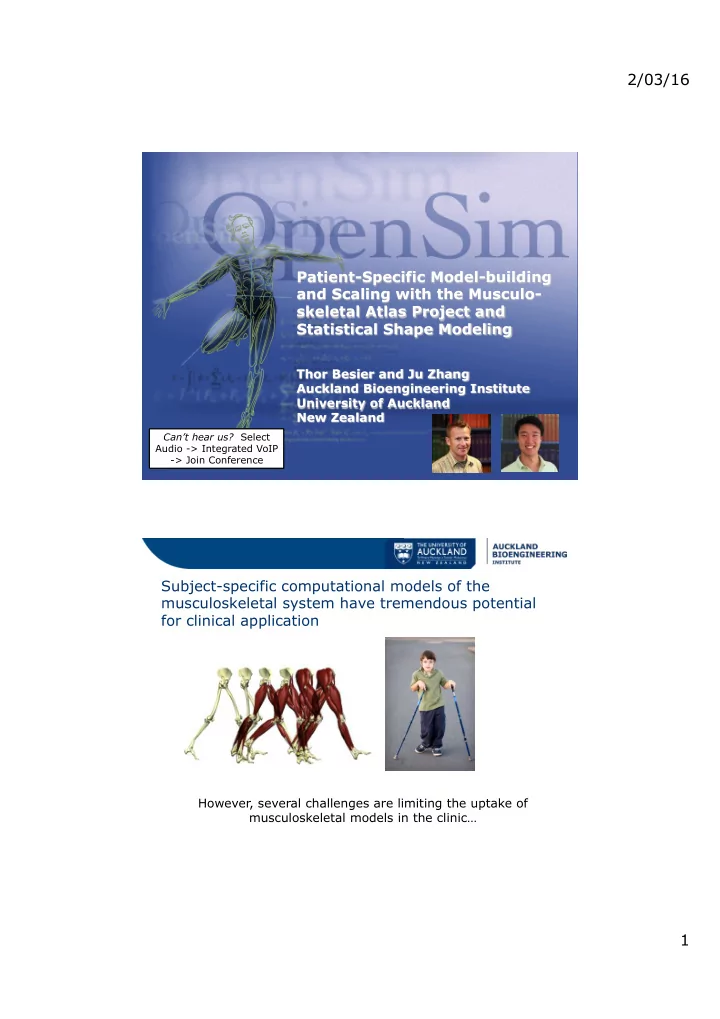
Patient-Specific Model-building and Scaling with the Musculo- skeletal Atlas Project and Statistical Shape Modeling

Thor Besier and Ju Zhang Auckland Bioengineering Institute University of Auckland New Zealand

Can’t hear us? Select Audio -> Integrated VoIP

  • > Join Conference

However, several challenges are limiting the uptake of musculoskeletal models in the clinic…

Subject-specific computational models of the musculoskeletal system have tremendous potential for clinical application

slide-2
SLIDE 2

2/03/16 2

Challenges to clinical implementation

Generating subject-specific models is time-consuming and costly, and requires a high level of expertise

What do we mean when we say subject-specific?

This talk will focus on building subject-specific bone geometry to best-match sparse motion capture and imaging data

OpenSim – rigid body modelling Continuum mechanics – finite element modelling

slide-3
SLIDE 3

2/03/16 3

An example problem

Motion capture data (mocap) MR images of the hip

+

We want to scale or generate an OpenSim model to best- match mocap and imaging data What are the hip contact pressures during walking for this subject?

Segment MRI of pelvis Fit mesh to point cloud Create finite element mesh and import into FEBio

Current approach to this problem

Experimental markers from motion capture (mocap data) Scale existing osim model using anatomical landmarks and/or functional joint centres Perform IK, ID, and CEINMS toolbox to estimate kinematics, kinetics and muscle forces Estimate hip contact forces using MuscleForceDirection plugin A s s i g n f

  • r

c e s a n d B C ’ s t

  • F

E m

  • d

e l Solve contact model in FEBio

slide-4
SLIDE 4

2/03/16 4

A different approach…

Experimental markers from motion capture (mocap data) Segment MRI of pelvis Register segmented point cloud to mocap data Population model of lower limb bones (n>100’s) Find set of bones that best-match mocap AND segmented point cloud

Overview

  • The MAP framework and the MAP Client
  • Introduction to shape modelling
  • Constrained scaling using shape modelling

– Example 1 – scaling the hip joint with mocap – Example 2 – scaling lower limb with mocap and imaging data of femur

  • Muscle and joint parameters
  • Limitations and points for discussion
  • Community engagement
slide-5
SLIDE 5

2/03/16 5

Our aim is to provide the biomechanics community with a tool to rapidly generate subject-specific musculoskeletal models for computational modelling

The Musculoskeletal Atlas Project

slide-6
SLIDE 6

2/03/16 6

Current Scaling Methods

  • Deform generic model to fit to landmarks
  • Linear (OpenSim)

– Reference geometry: Delp (1990)

  • Linear + Nonlinear e.g. Radial Basis Functions (Anybody)

– Reference geometry: Klein Horsman (2007)

[Fernandez et al. 2004] [Lund et al 2015]

Statistical shape models

  • Efficiently capture variation in shape across a population

(n>100’s)

= + + +

PC1 PC2 PC3 Mean Segmented population

  • f femur bones
slide-7
SLIDE 7

2/03/16 7

Demo 1 – scaling the hip joint using motion capture data Results and summary of example 1

  • Shape model constrains scaling to provide accurate

estimate of pelvis shape and hip joint centre

0 ¡ 2 ¡ 4 ¡ 6 ¡ 8 ¡ 10 ¡

L ¡ ¡R ¡ Predic*on ¡Error ¡(mm) ¡ Registra*on ¡to ¡CT ¡image ¡

  • Linscale. ¡

PC ¡Reg ¡

slide-8
SLIDE 8

2/03/16 8

Example 2 – scaling the lower limb with mocap and imaging data

Articulated Shape Model

Degrees of freedom

  • Pelvis Rigid: 6
  • Hip rotations: 3
  • Knee flexion & abduction: 2
  • Shape model scores: n

Results and summary of example 2

  • Shape model constrains scaling of entire lower limb to

ensure an anatomically feasible solution

Shape model

mm

Iso-scaling Shape model Iso-scaling Shape model Iso-scaling Shape model Iso-scaling

slide-9
SLIDE 9

2/03/16 9

Results and summary of example 2

  • Combination of marker and imaging data improves the estimation of

bone geometry

  • Resulting bone geometry can be exported to OpenSim and/or FE

packages

Error Metric ¡ Proximal Partial Surface ¡ Distal Partial Surface ¡ Surface (mm) ¡ 1.75 ±0.31 ¡ 4.95 ±3.09 ¡ X (deg.) ¡ 0.15 ±0.09 ¡ 0.20 ±0.16 ¡ Y (deg.) ¡ 0.07 ±0.04 ¡ 0.06 ±0.05 ¡ Z (deg.) ¡ 0.15 ±0.08 ¡ 0.21 ±0.16 ¡

What about the muscles?

  • Muscle attachment sites embedded onto bones, but via

points and wrapping surfaces need to be adjusted

slide-10
SLIDE 10

2/03/16 10

Points for discussion

  • Complex joints (custom mobilizers)
  • Scaling muscle-tendon parameters
  • Body segment parameters (mass, CoM, moments of inertia)
  • Where are the feet and other body parts?

How can you contribute?

  • Download the MAP Client and start developing

your own plug-ins

– Free and open source (GPL3 license) – Developed in Python – Cross platform

  • Collaborate with us to grow our model

repository (e.g. send us segmented data)

  • Develop plug-ins
  • New joint models

https://github.com/MusculoskeletalAtlasProject/mapclient

slide-11
SLIDE 11

2/03/16 11

Acknowledgements

  • We are grateful to the Victorian Institute of Forensic Medicine

(VIFM), and the Melbourne Femur Collection for providing the CT images for our shape models – John Clement – David Thomas

  • Auckland Bioengineering Institute

– Poul Nielsen – Duane Malcolm

  • This work was funded by the US FDA (HHSF22320 1310119C)

and NZ Ministry of Business Innovation & Employment (MBIE UOAX1407)