
SLIDE 1
1970s Soft Rock, Baroque Pop, and ‘Prog-Lite’: Or, what does middle-of-the- road popular music sound like?
Nick Braae Waikato Institute of Technology Hamilton, New Zealand Music and the Middlebrow 22-24 June 2017
1970s Soft Rock, Baroque Pop, and Nick Braae Waikato Institute of - - PowerPoint PPT Presentation
1970s Soft Rock, Baroque Pop, and Nick Braae Waikato Institute of Technology Prog-Lite: Hamilton, New Zealand Or, what does middle-of-the- road Music and the Middlebrow popular music sound like? 22-24 June 2017 Middle-of-the-Road
Nick Braae Waikato Institute of Technology Hamilton, New Zealand Music and the Middlebrow 22-24 June 2017
❖ Synonymous with or closely related to: ‘easy listening’ (Scott 2004), ‘prog-
lite’ (Holm-Hudson 2005), major label ‘pop’ (Stanley 2014), ‘corporate’ rock (Covach 2003), ‘smooth’ music and ‘yacht rock’ (Crumsho 2006)
❖ The ‘large listening space’ between between the ‘somewhat
intellectualised course of progressive rock’ and ‘pop’ (Moore 2012)
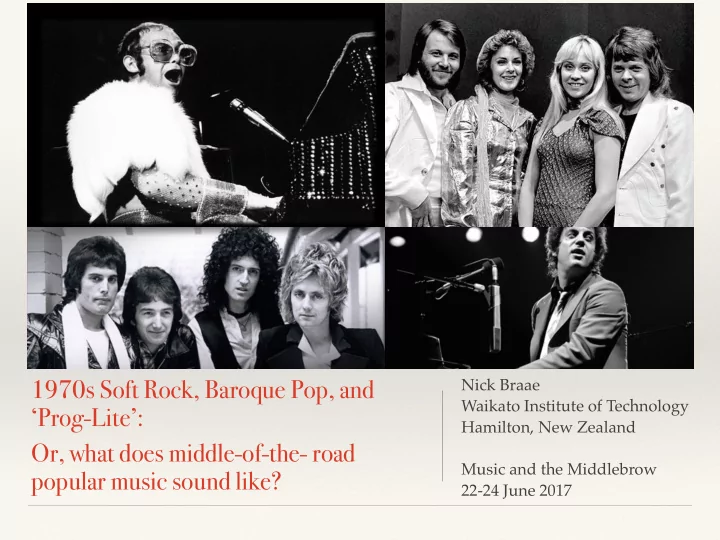
❖ 1970s artists: Queen, ABBA, Eric Carmen, Elton John, Billy Joel ❖ Classical training: Freddie Mercury (Grade 5/6 piano), Eric Carmen
(piano/violin), Elton John (Royal Academy of Music)
❖ What compositional strategies define their work in the 1970s? ❖ How do they land ‘in the middle’?
❖ Cadential trills: ‘The March of the Black Queen’, ‘Millionaire
Waltz’
❖ Descending thirds: ’S.O.S’ ❖ Rapid arpeggios: ‘In the Lap of the Gods’, ’Death on Two Legs’ ❖ Quotation: ‘Never Gonna Fall in Love Again’, ’All By Myself’,
and Rachmaninoff
❖ A lack of specificity in the borrowing; reference to a general
classical style, cf. specific idioms/composers (see Covach 1991)
❖ Balanced, arch melodies: ‘If I Only Had the Words’,
❖ Sequences: ‘Goodbye Yellow Brick Road’ [Elton John];
❖ Infiltration of sequential melodic elements into hard
❖ Influence of the Beatles ❖ Voice-leading patterns: ‘Mamma Mia’ ❖ Modal mixture: ‘All By Myself’ ❖ Extensive secondary dominants: ‘Mona Lisas and Mad
❖ Confluence of harmonic features: ‘Killer Queen’
❖ In progressive rock: multi-sectional songs, non-recapitulating sections, irregular
patterning of episodes
❖ Non-song-like forms in MOR pop ❖ ‘Funeral for a Friend’: a triple theme-and-variations? Or a passacaglia-derived
form?
❖ Three distinct sections: overture—march—Lloyd Webber pastiche—march (return) ❖ Departure-and-return narrative; see also, ‘Millionaire Waltz’, ‘Bohemian
Rhapsody’
❖ Or, ‘episodic song forms’: extended verse-chorus structures (‘Burn Down the
Mission’, ‘Levon’ or ‘Tiny Dancer’); addition of extra material to a verse-chorus/ AABA template (‘Bat Out of Hell’, ‘Scenes From An Italian Restaurant’, ‘Love of My Life’)
❖ General consensus: progressive rock elevated pop songs
❖ ‘Prog-lite’ - suggests a retreat from progressive rock ❖ Or, a partial elevation from the pop song? ❖ Middleground from below (cf. classical tradition;